
Math Worksheets by Topic
Choose addition, subtraction, multiplication, or division, then choose whole numbers, fractions, or decimals. Calculation practice and word problems have separate categories. Only available worksheet categories are listed.
Kindergarten · Count & compare picture groups
 Picture activity
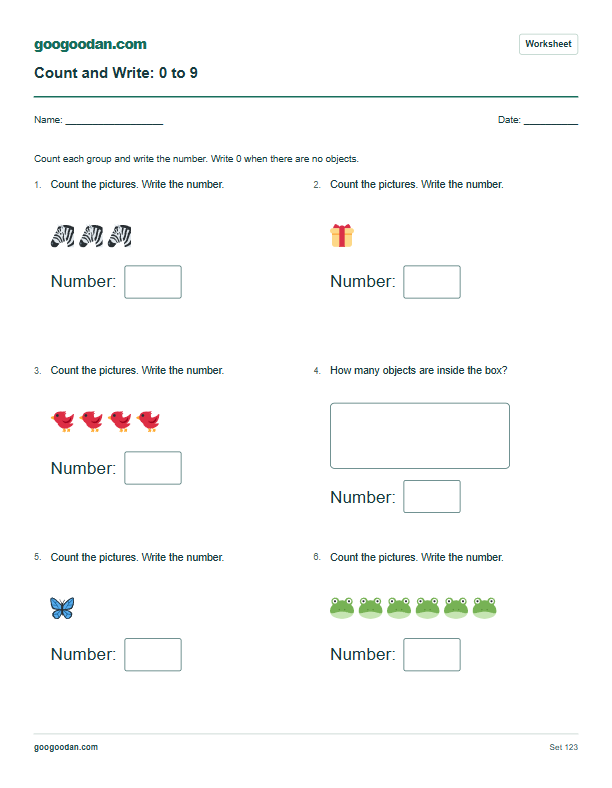
Count and Write Worksheets for Kindergarten
Count picture groups from 1 to 9 and write 0 for an empty group. Touch each object once and record the total.
6 problems · Answer key included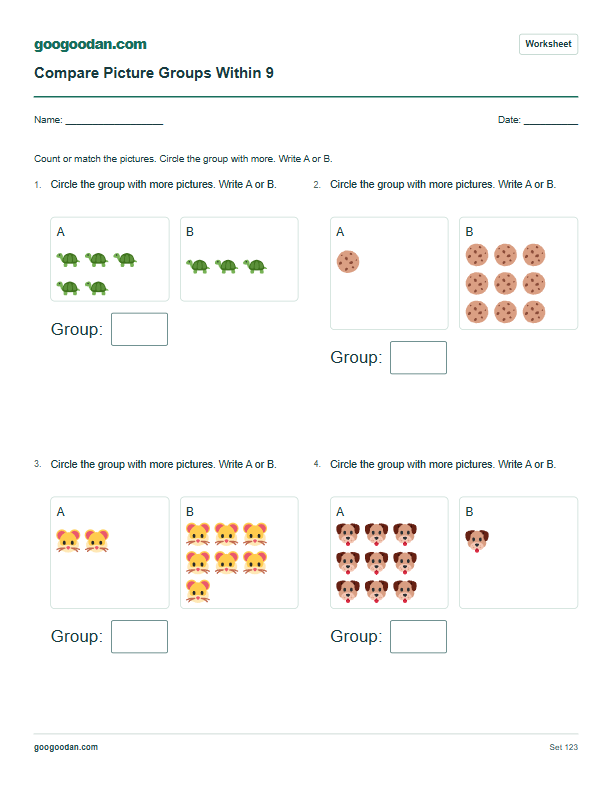 Picture activity
Compare Picture Groups Worksheets for Kindergarten
Match or count two groups and circle the group with more objects.
4 problems · Answer key included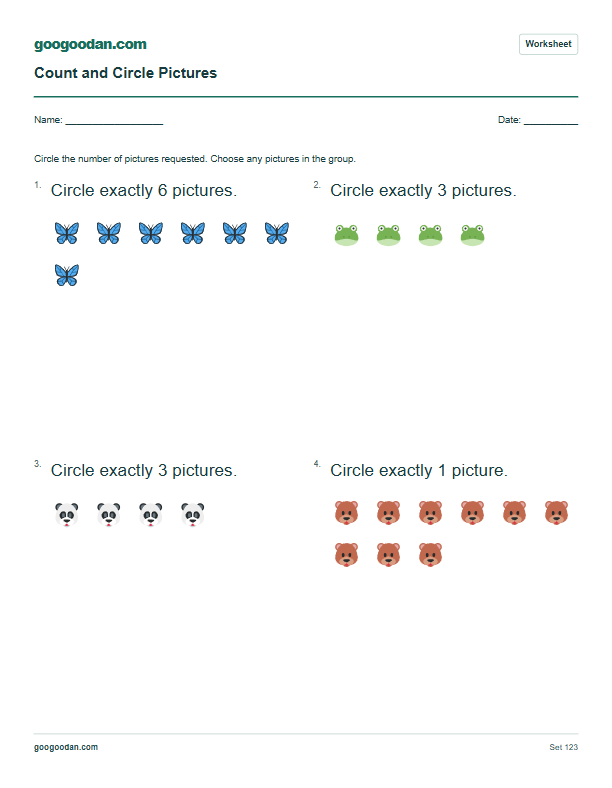 Picture activity
Count and Circle Worksheets for Kindergarten
Circle a requested number of pictures. Any selection with the right count is correct.
4 problems · Answer key included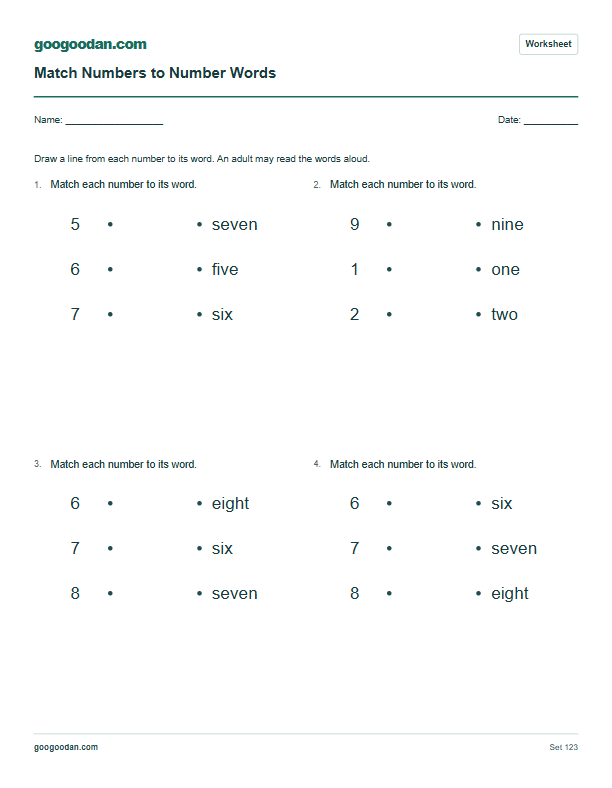 Matching activity
Number Word Matching Worksheets for Kindergarten
Draw lines from numerals 1–9 to their English number words. An adult can read the words aloud.
4 problems · Answer key included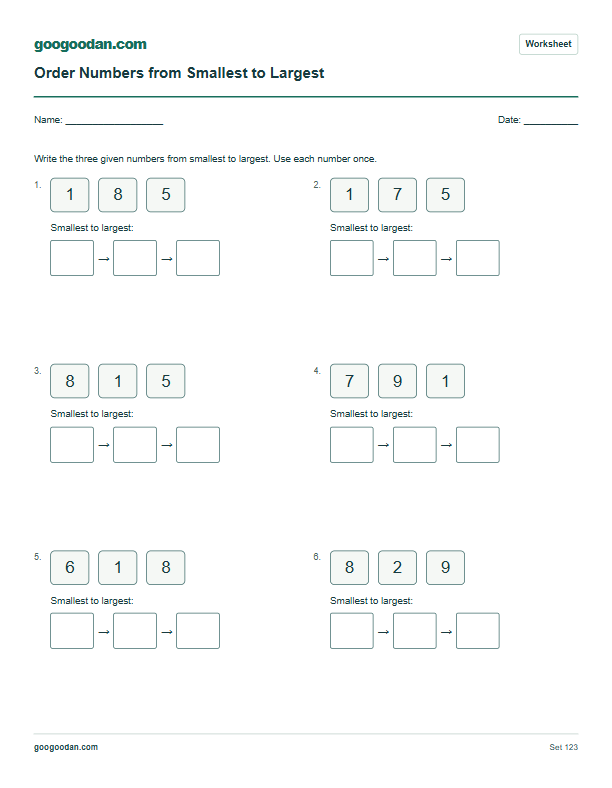 Number card activity
Ordering Numbers Worksheets for Kindergarten
Put three different numbers from 1–9 in order from smallest to largest. Use counters or number cards for support.
6 problems · Answer key included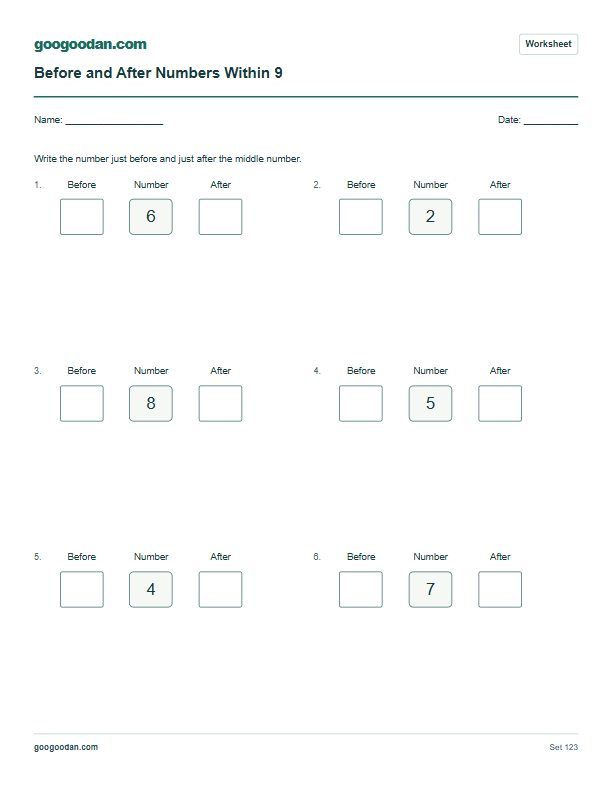 Number sequence activity
Before and After Numbers Worksheets for Kindergarten
Find the number just before and just after a given number. Count one step back and one step forward within 1–9.
6 problems · Answer key included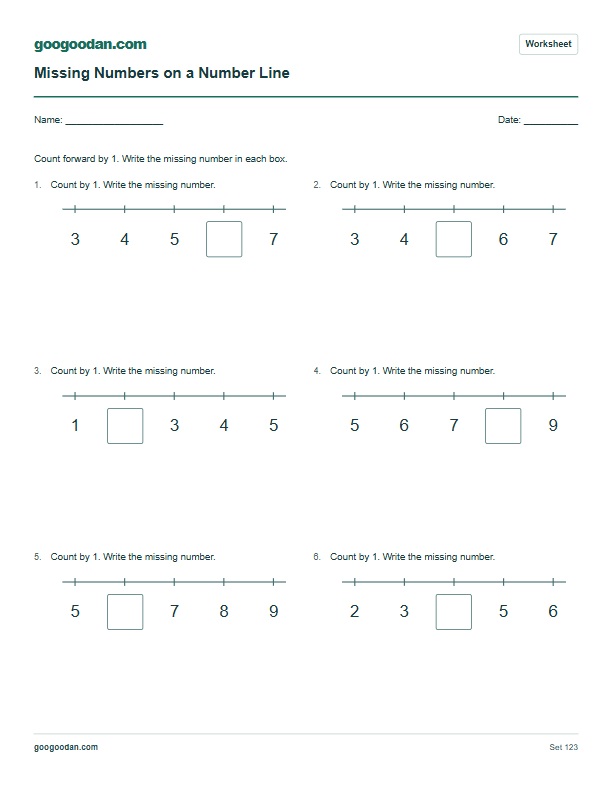 Number line activity
Missing Numbers on a Number Line Worksheets for Kindergarten
Count by ones along five evenly spaced marks and fill one missing number. These short number lines stay within 1–9.
6 problems · Answer key included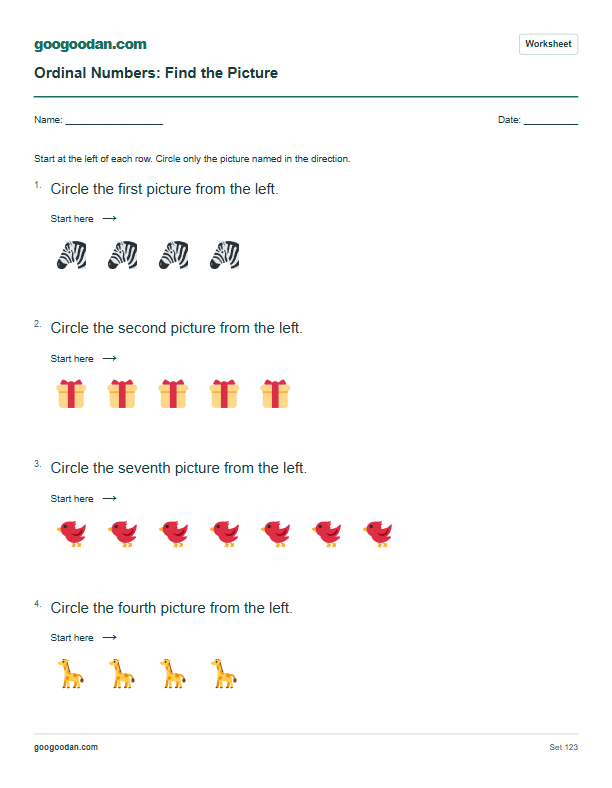 Picture position activity
Ordinal Number Worksheets for Kindergarten
Count from the left and circle one picture in the requested position. An adult can read the directions aloud.
4 problems · Answer key included
Kindergarten · Add & subtract within 5
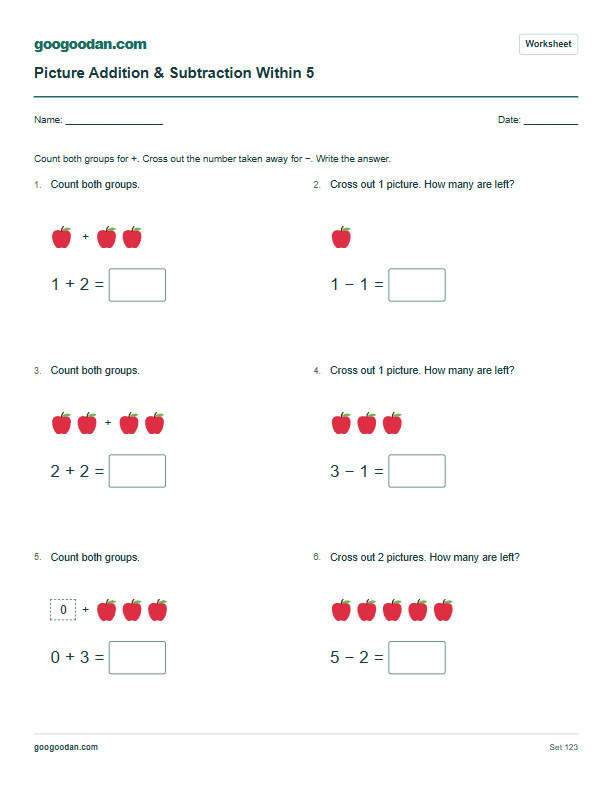 Picture activity
Kindergarten Addition and Subtraction Within 5
Count and combine pictures, or cross out the amount taken away.
6 problems · Answer key included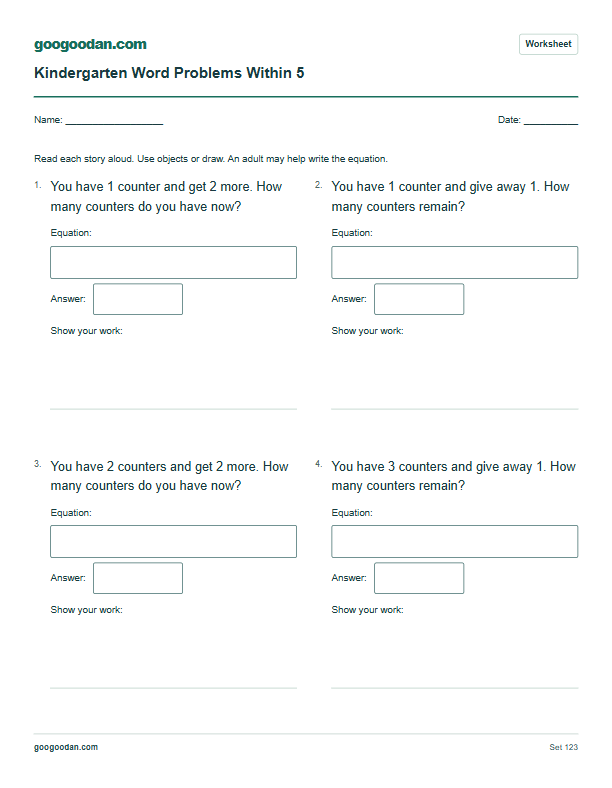 Word problems
Kindergarten Word Problems Within 5
Listen to a short story, act it out, and draw or write an answer within 5.
4 problems · Answer key included
Kindergarten · Act out stories within 10
After small-group stories within 5, use objects or drawings for joining and taking away within 10. An adult can read and record the equation while the child moves or draws counters.
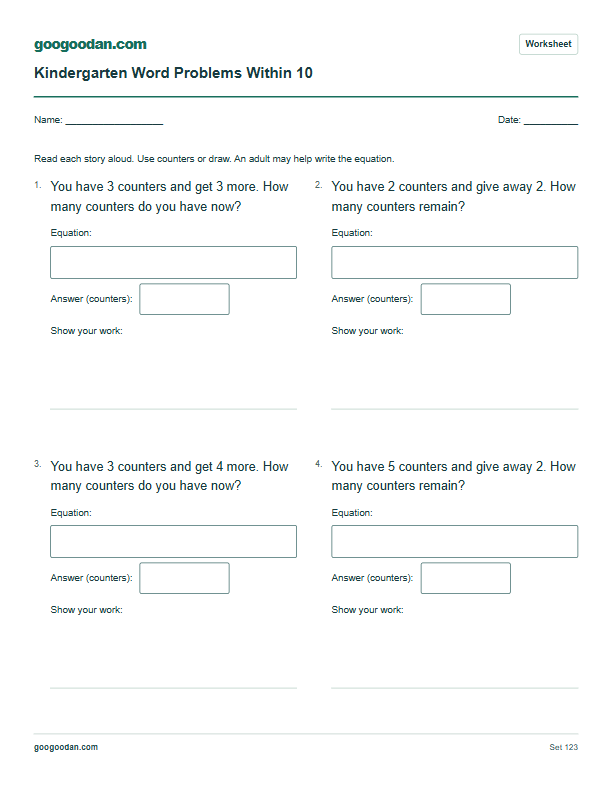 Word problems
Kindergarten Word Problems Within 10
Listen, move counters, and draw joining or taking-away stories with amounts up to 10.
4 problems · Answer key included
Kindergarten · Make 10 with pictures
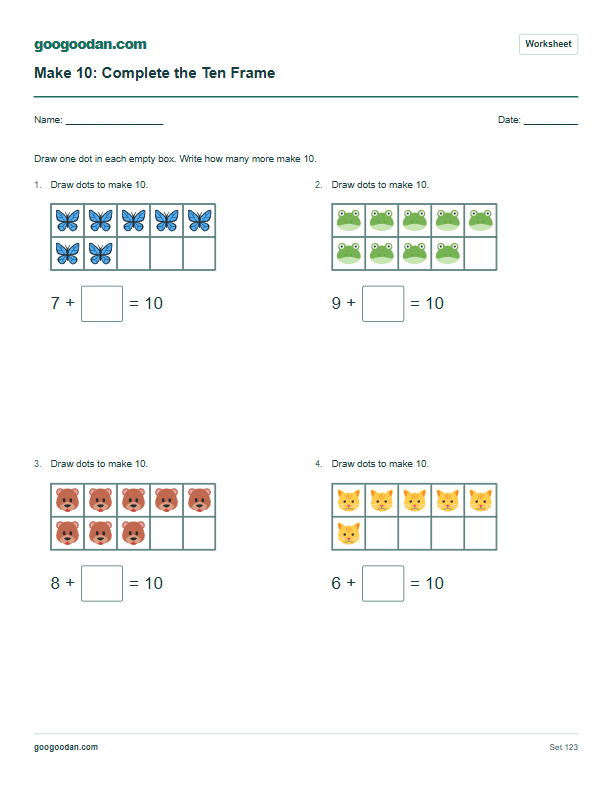 Draw and count activity
Making 10 with Ten Frames Worksheets
Draw a dot in each empty box, then write how many more make 10. Start with 5–9 pictures in a two-row frame.
4 problems · Answer key included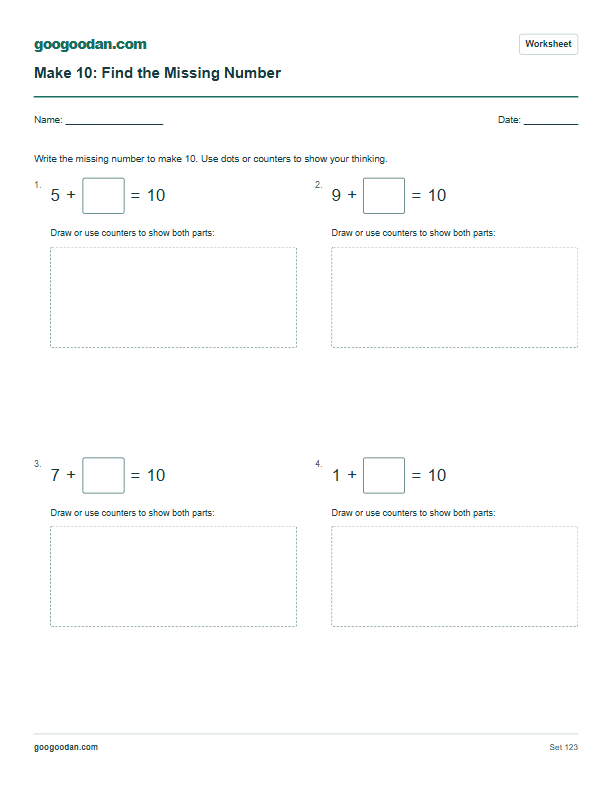 Missing number and drawing activity
Make 10 Missing Addend Worksheets
Find the missing part in an addition equation that totals 10. Use the drawing space or counters to explain your answer.
4 problems · Answer key included
Kindergarten · Compare lengths
 Compare and circle activity
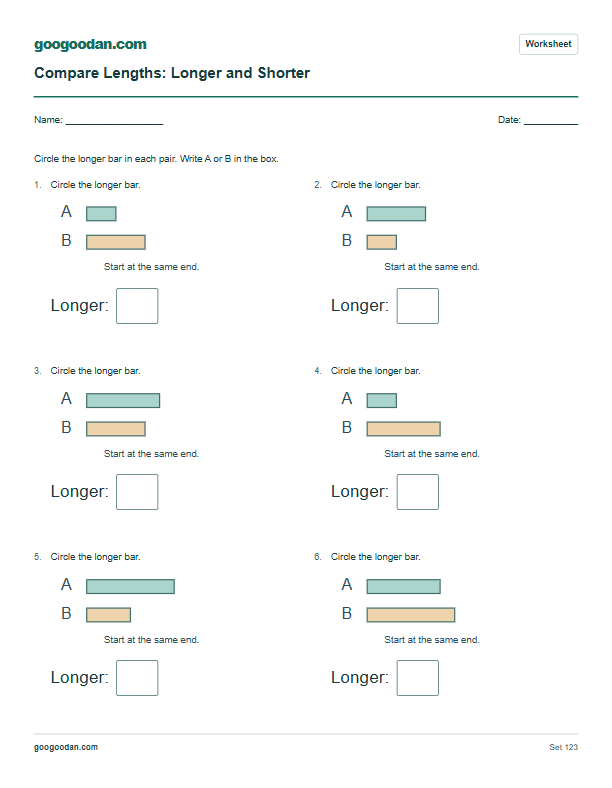
Longer and Shorter Worksheets for Kindergarten
Compare two bars that start at the same point. Circle the longer one and write A or B without using a ruler.
6 problems · Answer key included
Kindergarten · Sort & count shapes
 Find, circle, and count activity
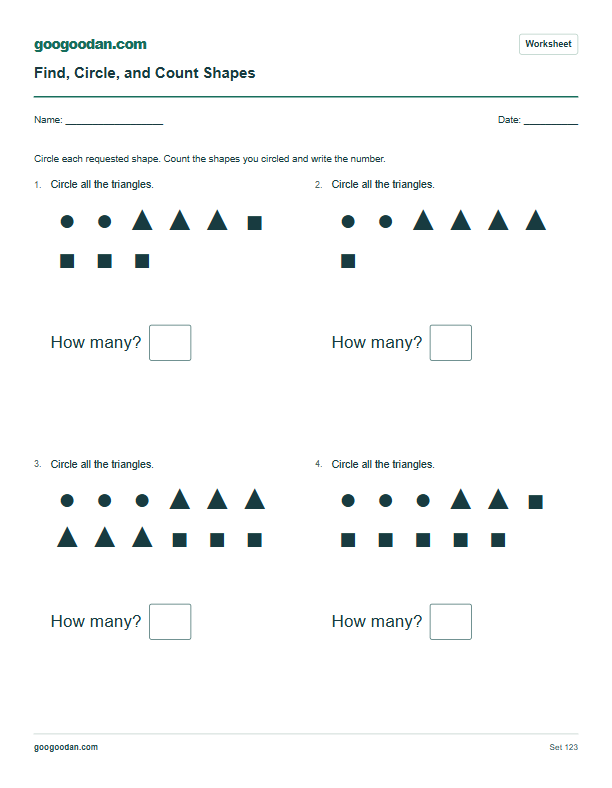
Sort and Count Shapes Worksheets for Kindergarten
Circle every shape of the requested kind, then count the circles, triangles, or squares you selected.
4 problems · Answer key included
Kindergarten · Name & describe flat shapes
 Trace and name shapes activity
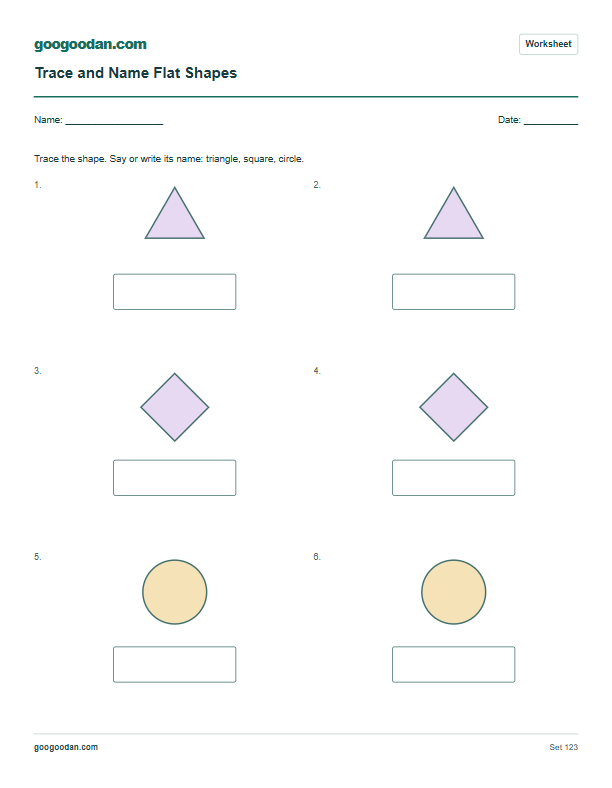
2D Shape Recognition Worksheets for Kindergarten
Trace and name a triangle, square, or circle. Notice that a square is still a square when it rests on a corner.
6 problems · Answer key included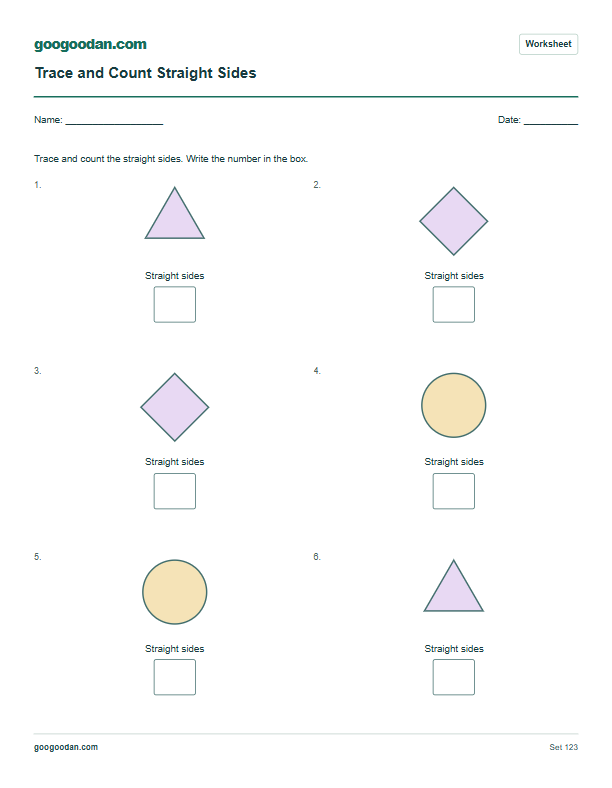 Trace and count sides activity
Counting Sides Worksheets for Kindergarten
Trace and count the straight sides of triangles, squares, and circles. A circle has a curved boundary and zero straight sides.
6 problems · Answer key included
Kindergarten · Repeating patterns · enrichment
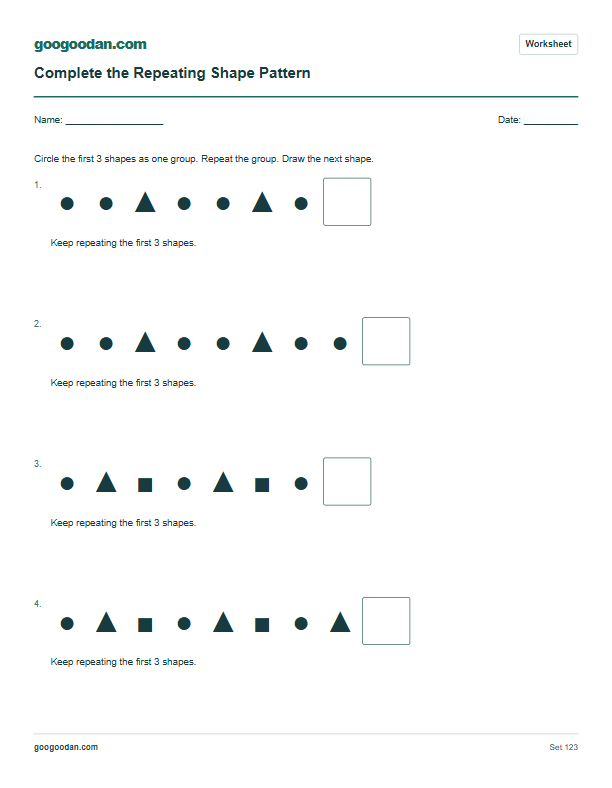 Pattern drawing enrichment
Repeating Shape Patterns Worksheets for Kindergarten
Find the repeating group of three shapes, then draw the next shape. Practice ABC and AAB patterns with a matching answer key.
4 problems · Answer key included
Kindergarten · Break apart numbers within 9
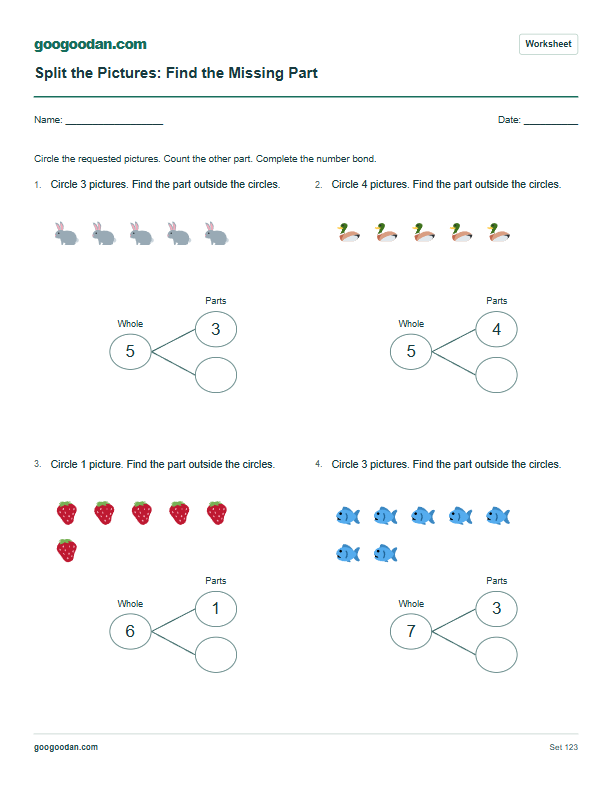 Circle and split picture groups
Missing Part Number Bonds Worksheets Within 9
Circle part of a group and complete the number bond. Choose two nonempty parts or one empty part (0). Empty-part practice also includes wholes of 1 or 10.
4 problems · Answer key included
Grade 1 · Addition & subtraction within 20
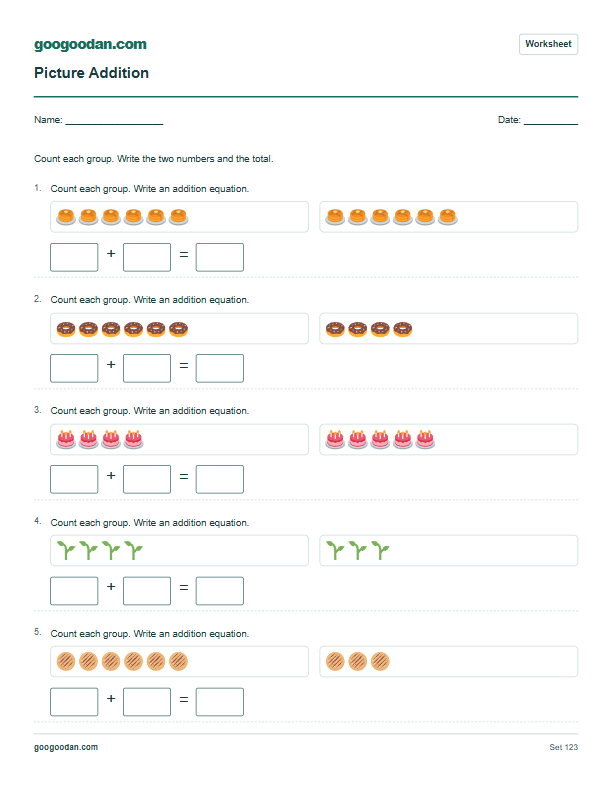 Picture activity
Picture Addition Worksheets
Count two groups of pictures and write the matching addition equation.
5 problems · Answer key included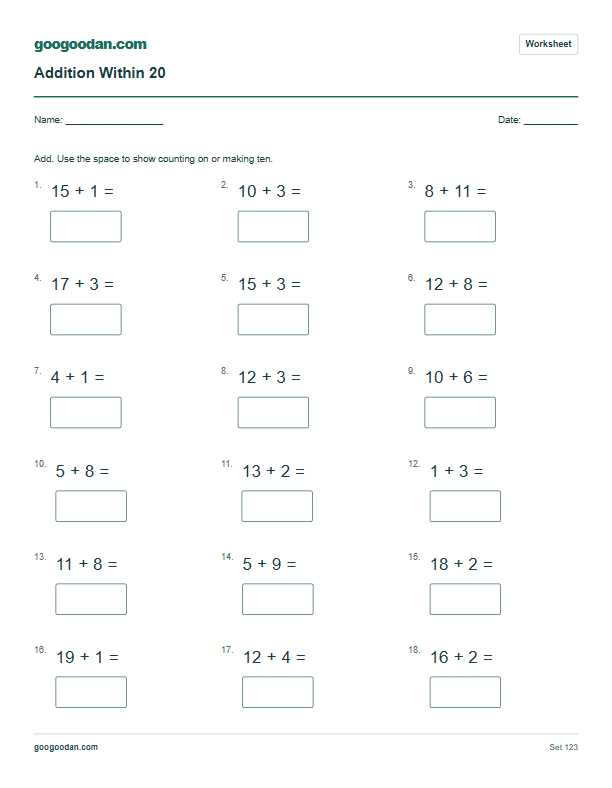 Calculation practice
Addition Within 20
Count on or make ten to add two numbers.
18 problems · Answer key included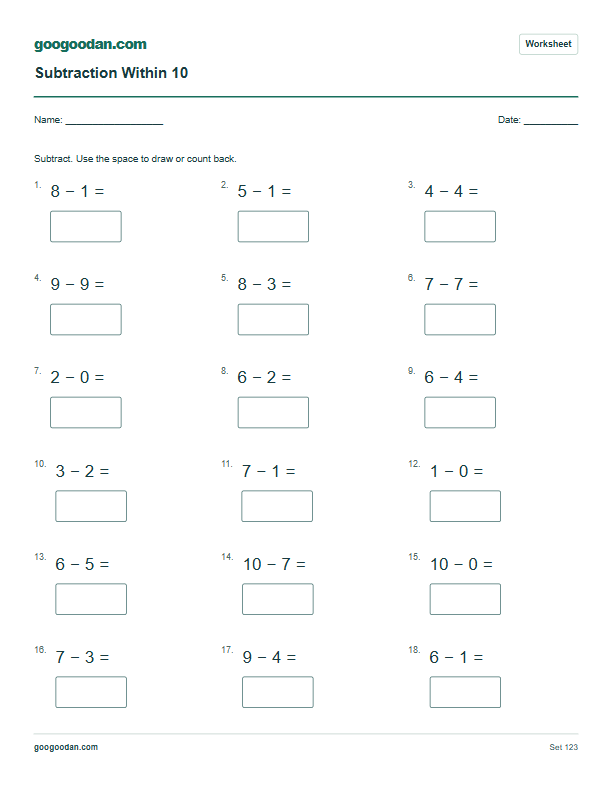 Calculation practice
Subtraction Within 10
Take away or count back, including subtracting zero and subtracting a number from itself.
18 problems · Answer key included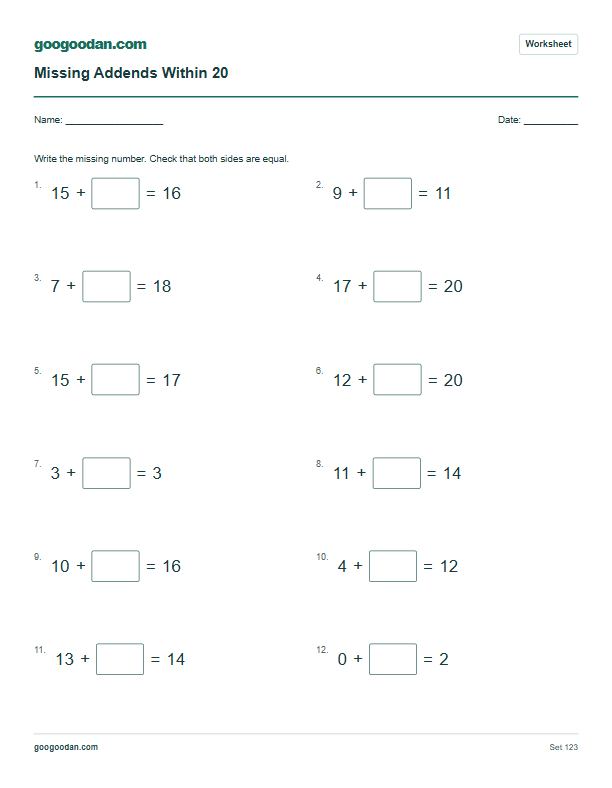 Missing-number practice
Missing Addend Worksheets Within 20
Find the missing part of an addition equation; use counting on or subtraction.
12 problems · Answer key included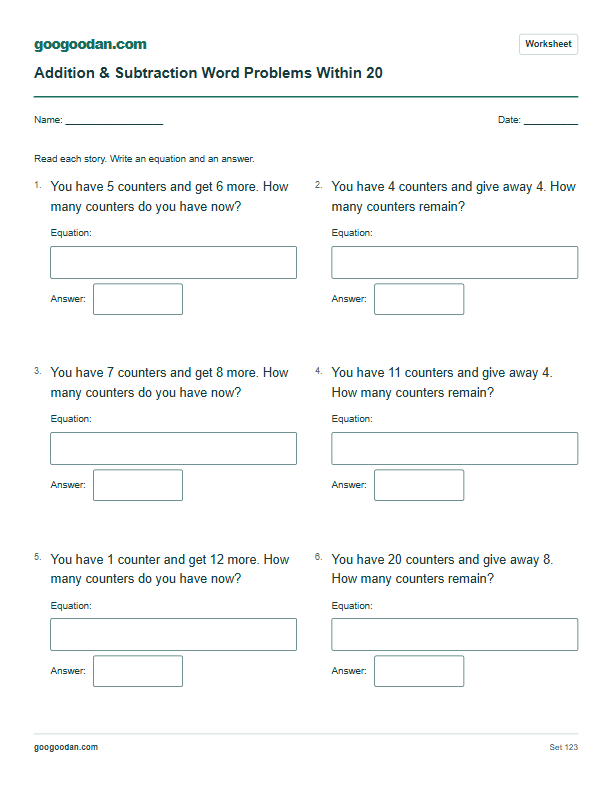 Word problems
Addition and Subtraction Word Problems Within 20
Read joining and taking-away stories, choose an equation, and answer in context.
6 problems · Answer key included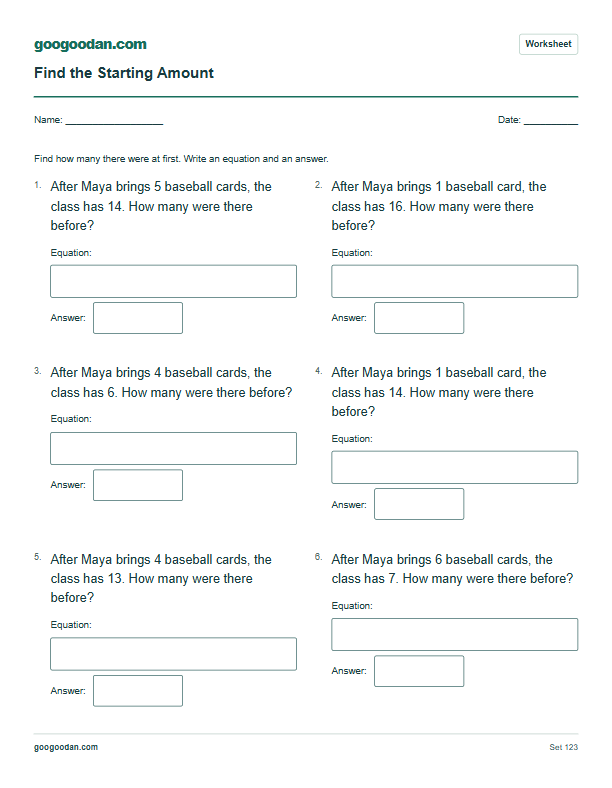 Word problems
Find the Starting Amount Word Problems
Work backward from a final total to find how many there were before.
6 problems · Answer key included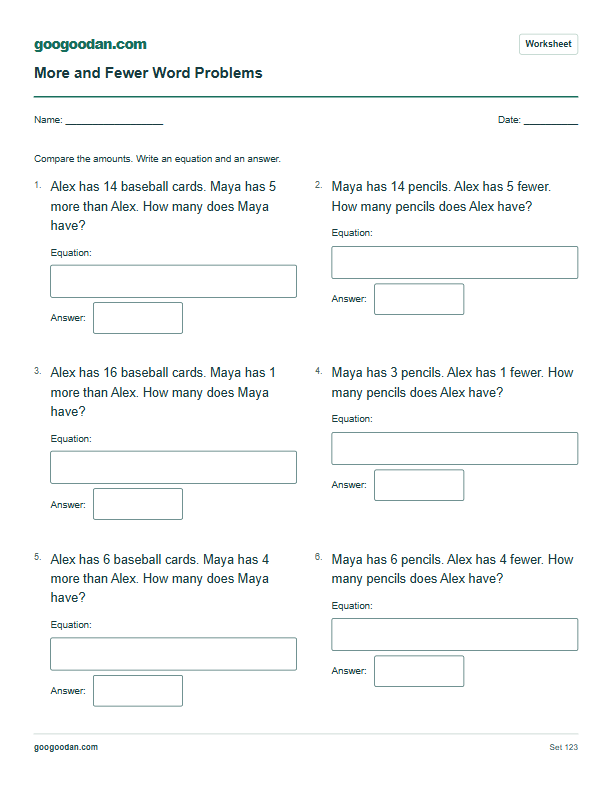 Word problems
More and Fewer Comparison Word Problems
Identify the known amount and compare two people’s collections.
6 problems · Answer key included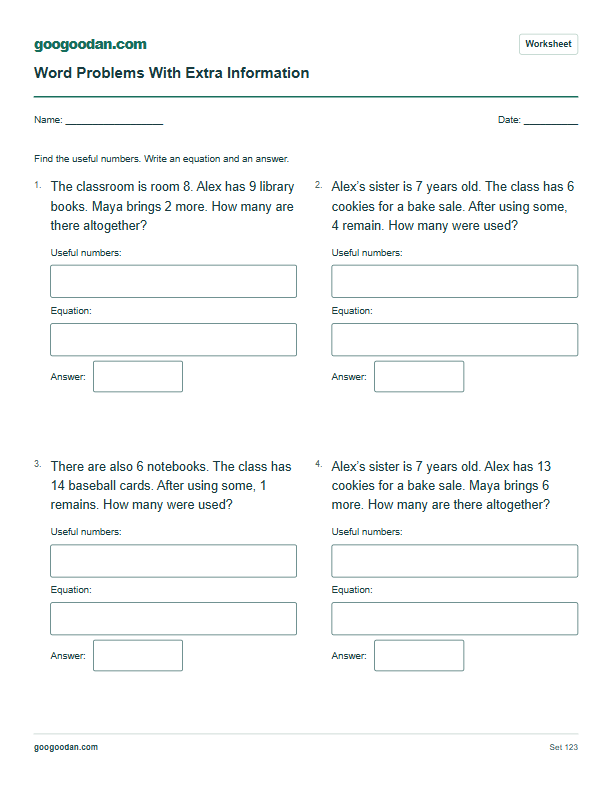 Word problems
Word Problems With Extra Information
Choose the useful quantities instead of calculating with every number.
4 problems · Answer key included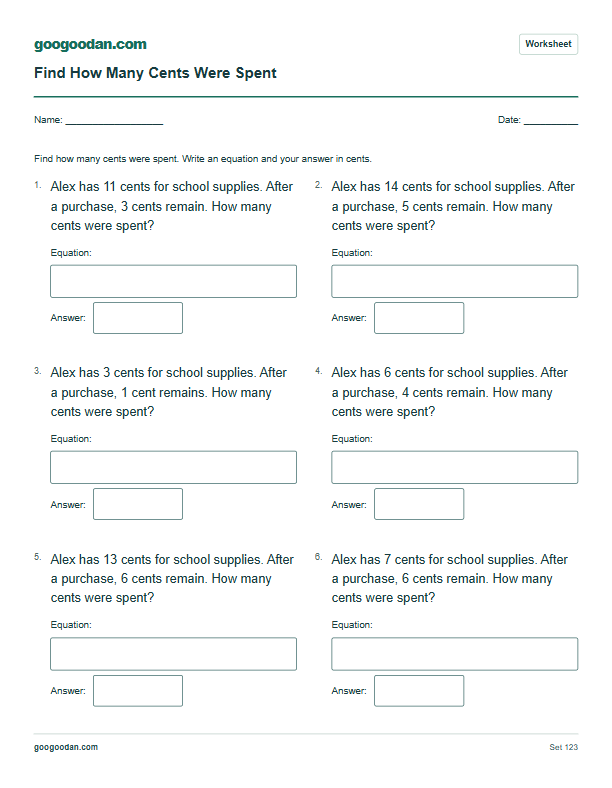 Word problems
Find the Missing Change Word Problems
Use the starting amount and what remains to find how many cents were spent.
6 problems · Answer key included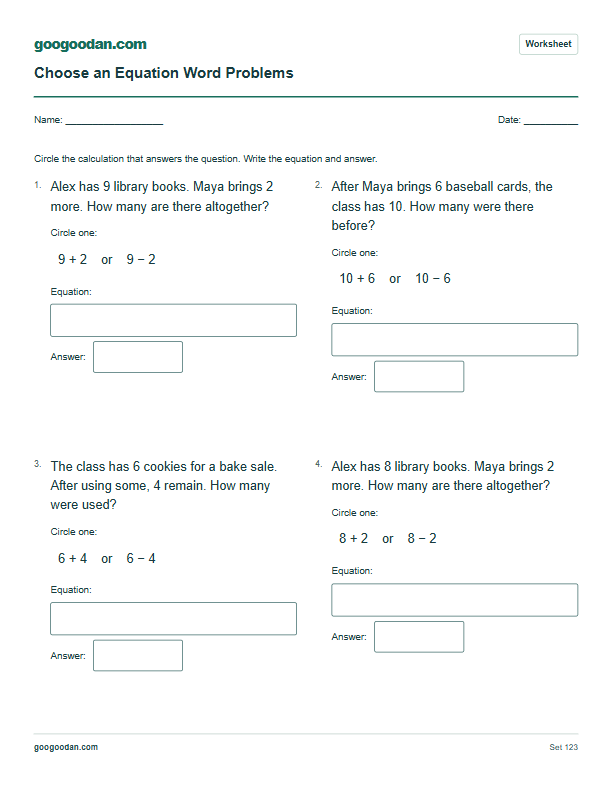 Word problems
Choose an Equation Word Problems
Decide whether addition or subtraction finds the missing quantity in the story.
4 problems · Answer key included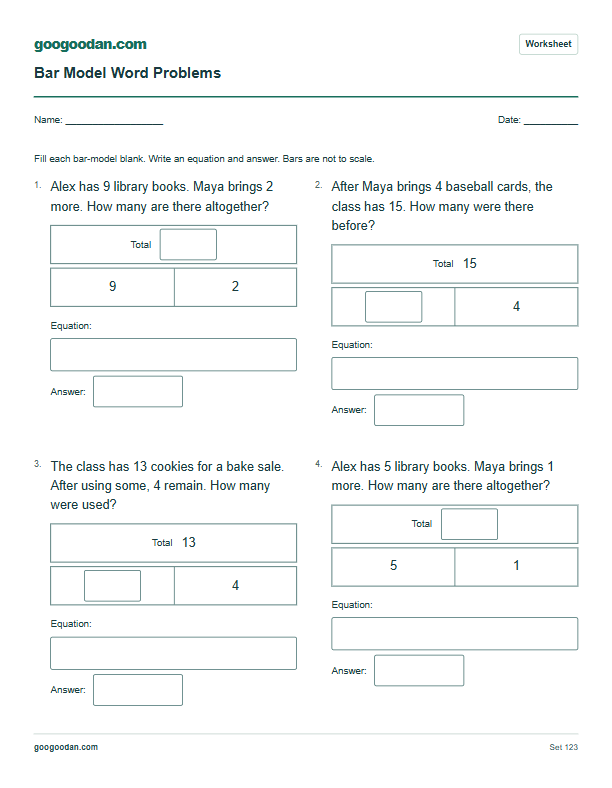 Word problems
Bar Model Word Problems
Use a whole-and-parts diagram to find the total, the starting amount, or the amount used.
4 problems · Answer key included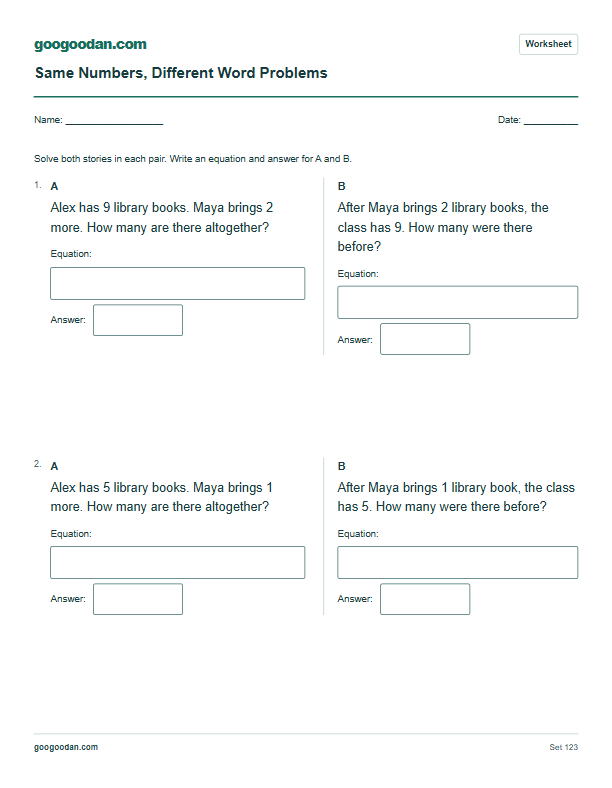 Word problems
Same Numbers, Different Questions Word Problems
Compare two stories with the same numbers: find the new total in one and the starting amount in the other.
2 pairs · 4 word problems · Answer key included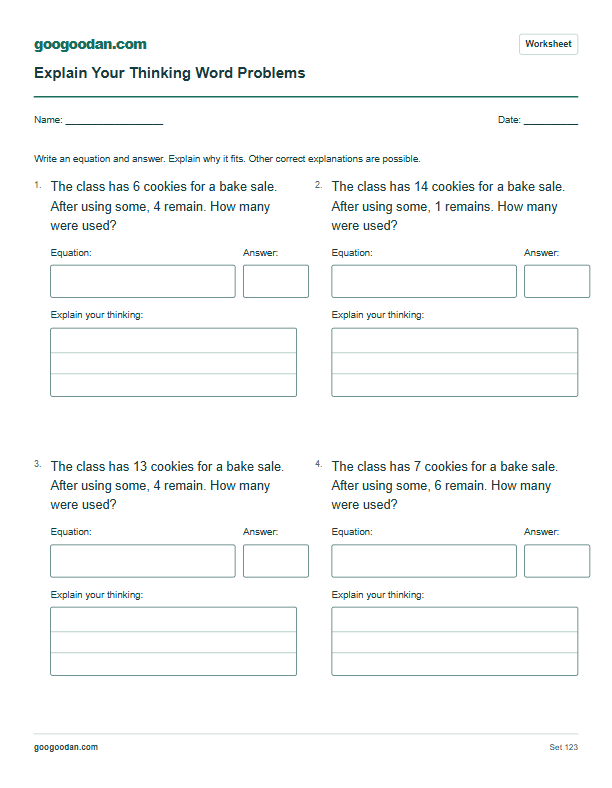 Word problems
Explain Your Thinking Word Problems
Explain why the equation fits a taking-away story.
4 problems · Answer key included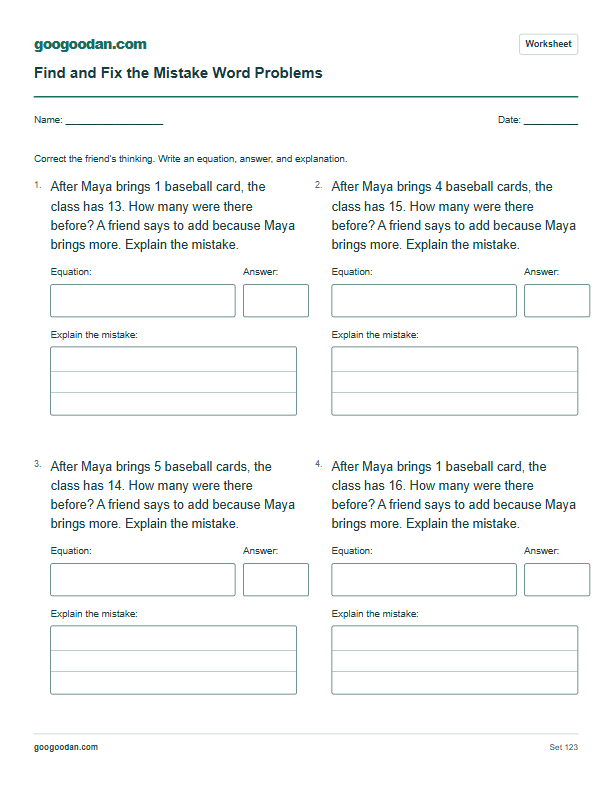 Word problems
Error Analysis Word Problems: Find and Fix the Mistake
Correct a friend who chooses addition just because more items arrive.
4 problems · Answer key included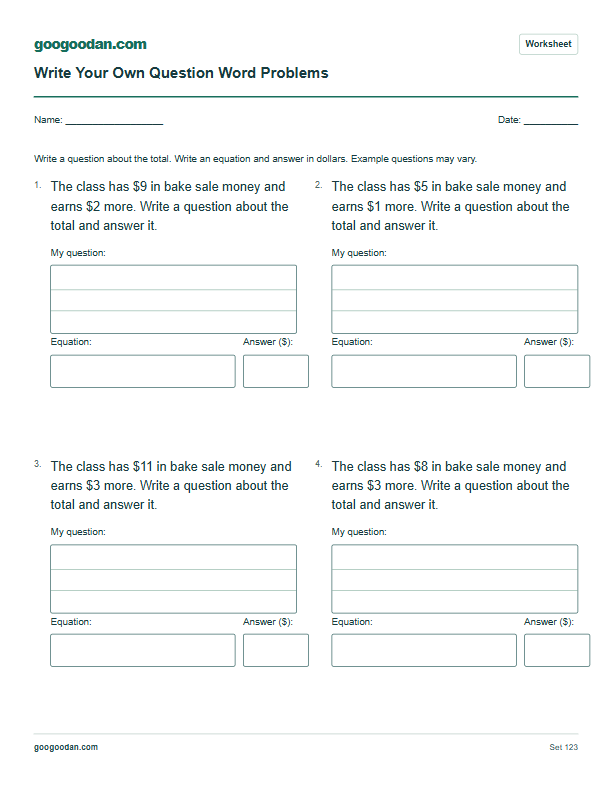 Word problems
Write Your Own Question Word Problems
Write a question about the total, then answer it with an addition equation using whole dollars.
4 problems · Answer key included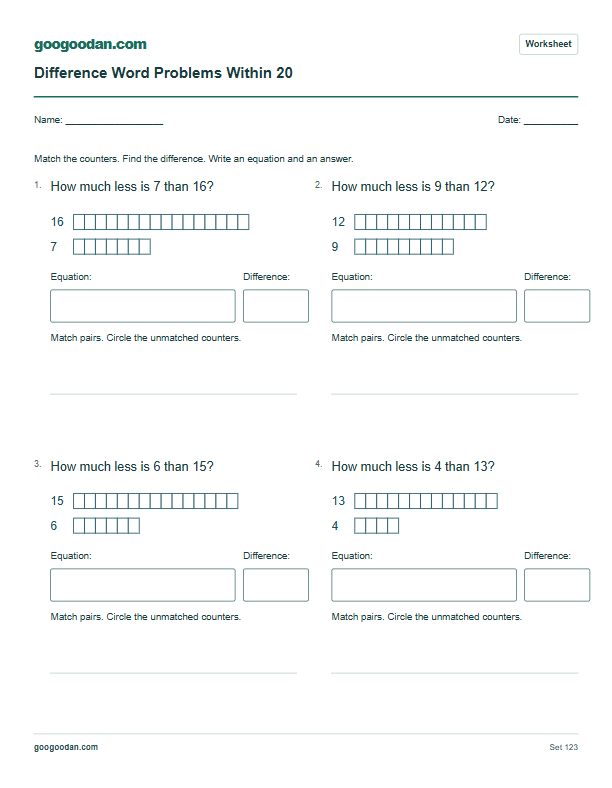 Word problems
Difference Word Problems Within 20
Match two rows of counters to find how much less one amount is than another.
4 problems · Answer key included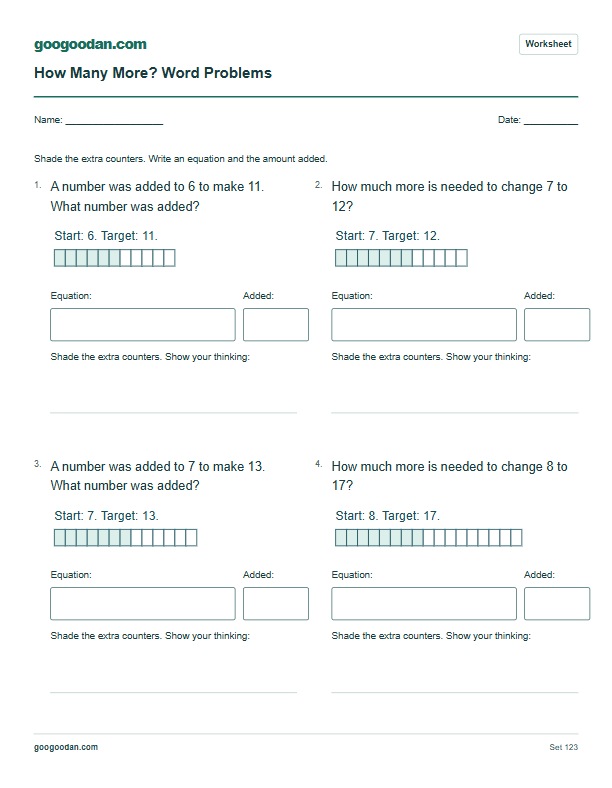 Word problems
How Many More? Word Problems Within 20
Find the amount to add to reach a target. Fill the empty spaces and check the missing part.
4 problems · Answer key included
Grade 2 · Place value, addition & subtraction
 Calculation practice
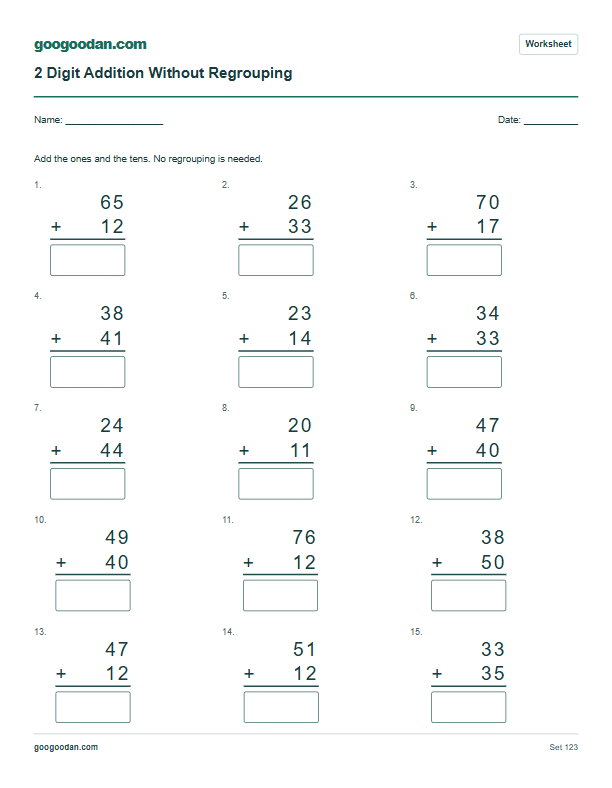
2 Digit Addition Without Regrouping
Add tens to tens and ones to ones without exchanging ten ones.
15 problems · Answer key included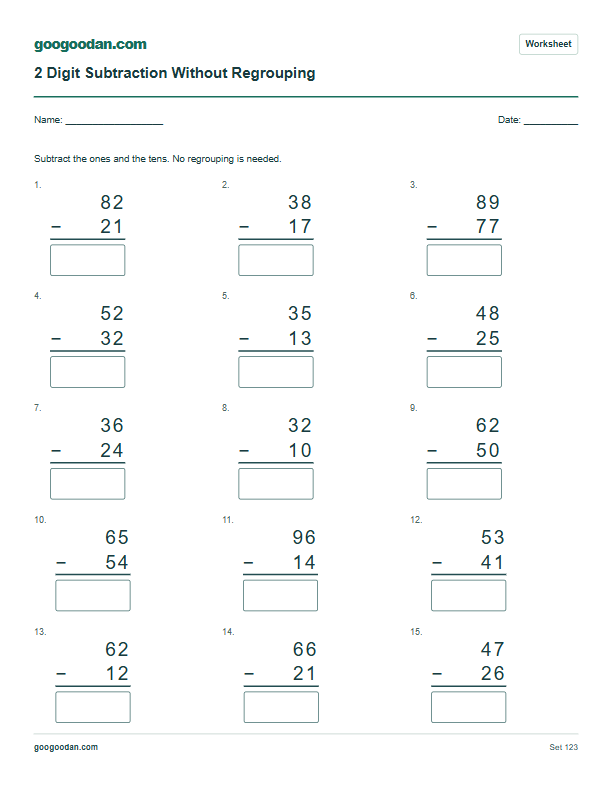 Calculation practice
2 Digit Subtraction Without Regrouping
Keep the place values aligned and subtract without exchanging a ten.
15 problems · Answer key included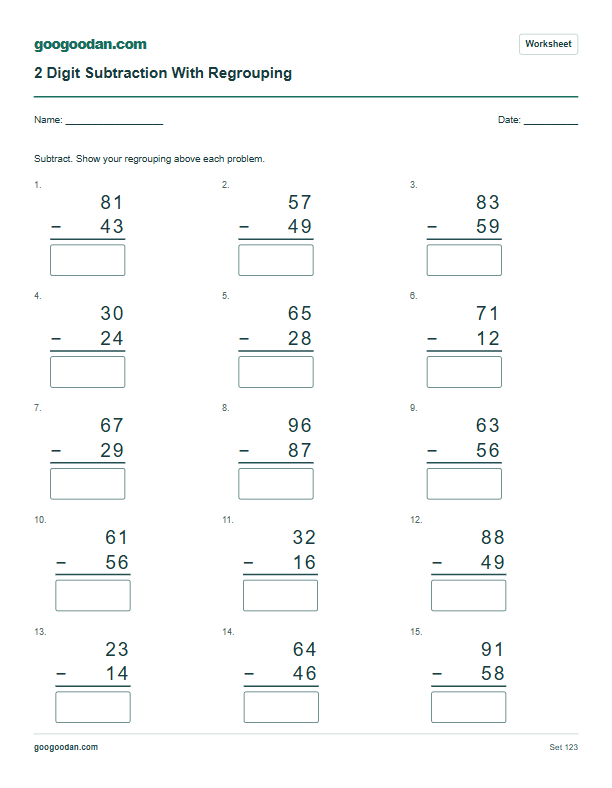 Calculation practice
2 Digit Subtraction With Regrouping
Exchange one ten for ten ones and subtract within 100.
15 problems · Answer key included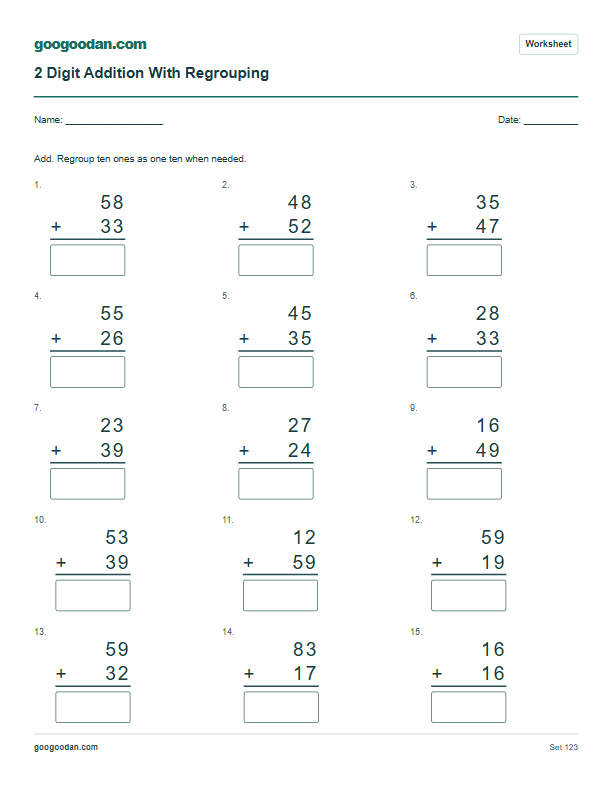 Calculation practice
2 Digit Addition With Regrouping
Exchange ten ones for a ten and keep the total within 100.
15 problems · Answer key included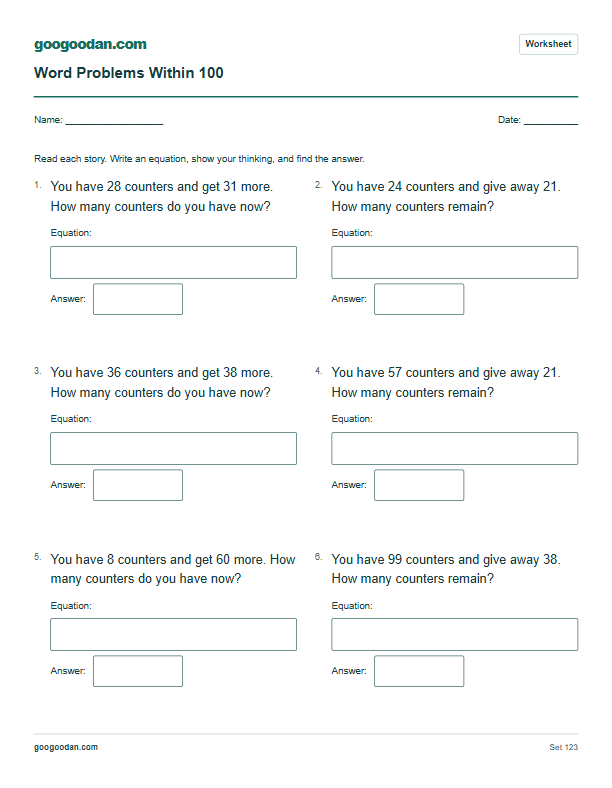 Word problems
Addition & Subtraction Word Problems Within 100
Choose an operation for a joining or taking-away story, then solve within 100.
6 problems · Answer key included
Grade 3 · Equal groups, multiplication & division
 Calculation practice
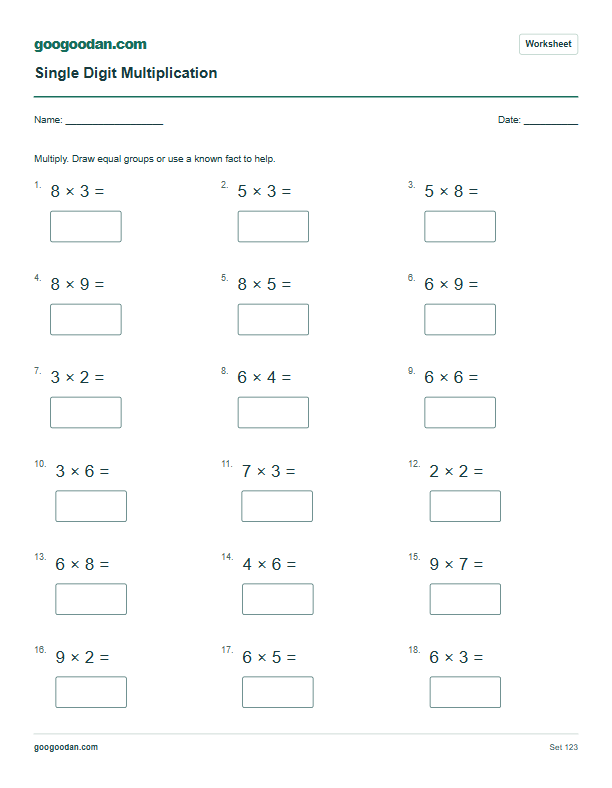
Single Digit Multiplication Worksheets
Use equal groups and arrays to practise multiplication facts with factors from 2 to 9.
18 problems · Answer key included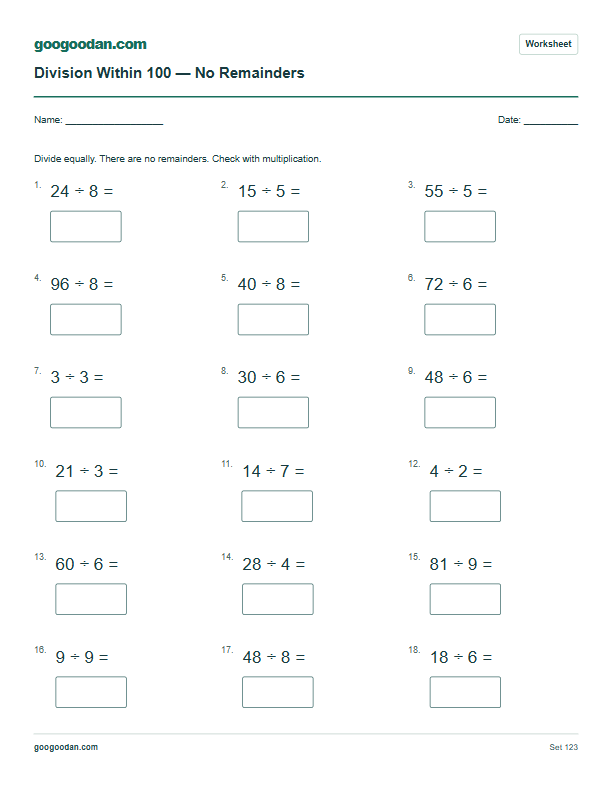 Calculation practice
Division Without Remainders Worksheets
Share equally or make equal groups, then check each quotient with multiplication.
18 problems · Answer key included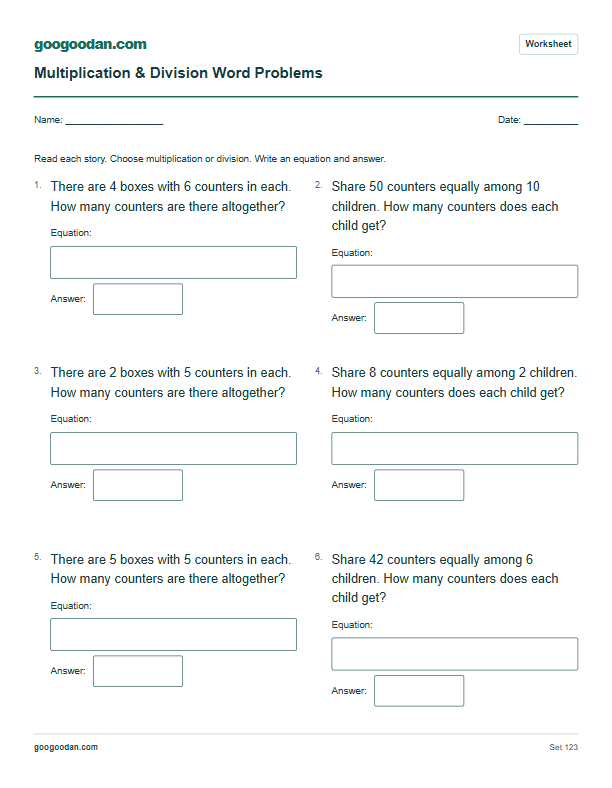 Word problems
3rd Grade Multiplication and Division Word Problems
Choose mixed facts, zero-and-one groups, or two- and three-digit group amounts. Explain what the answer counts.
6 mixed stories or 4 focused multiplication stories · Answer key included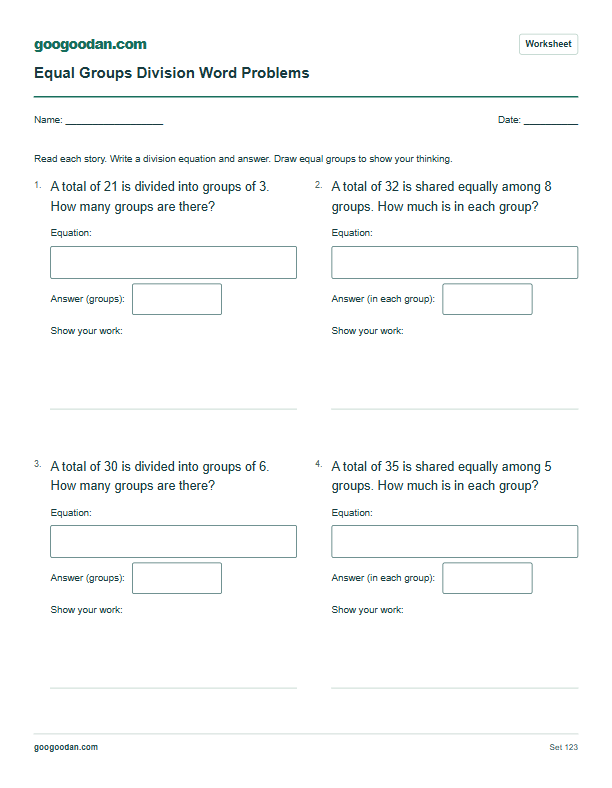 Word problems
Equal Groups Division Word Problems
Find group count or group size with division facts, or share larger totals to find two-digit amounts.
4 problems · Answer key included
Grade 3 · Addition & subtraction within 1,000
Practice accurate addition and subtraction within 1,000. Choose and explain an efficient place-value strategy, then check the result. The story worksheet is shared with Grade 2; use models as needed and work toward confident calculation. For missing amounts, choose the Within 1,000 option on the shared missing-part worksheet. Choose the Within 1,000 option on the difference worksheet to compare two known amounts. On the missing-part page, Crossing 100 starts with a two-digit amount and ends above 100. On the difference page, Crossing 100 compares a two-digit amount with an amount above 100.
 Calculation practice
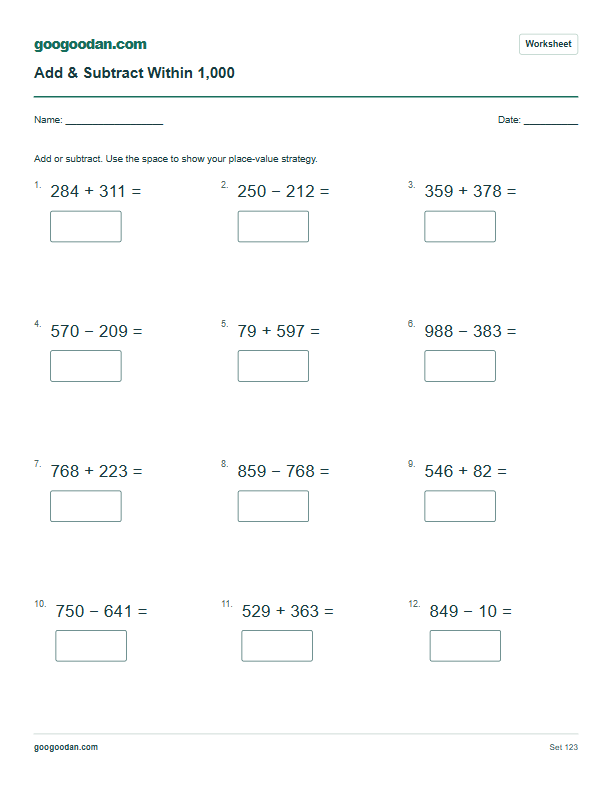
Addition & Subtraction Within 1,000
Use hundreds, tens, and ones to add or subtract, with room to show your strategy.
12 problems · Answer key included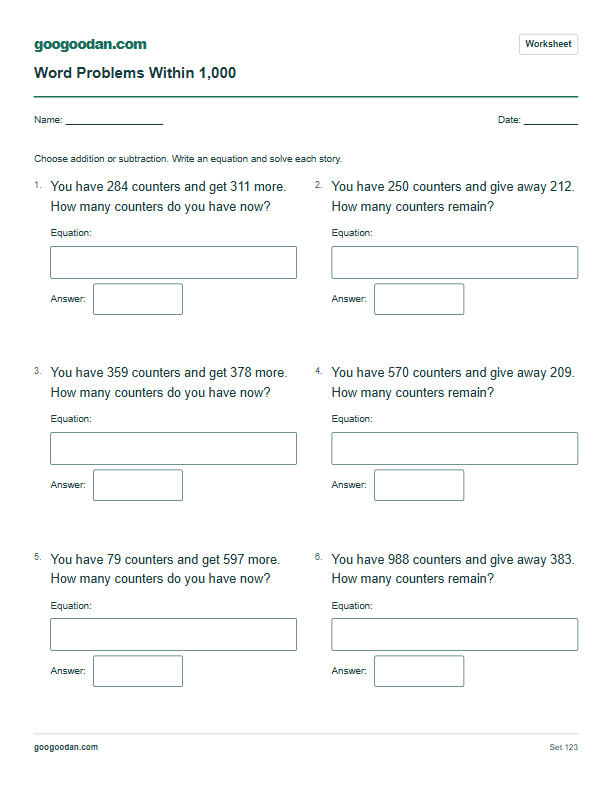 Word problems
Addition and Subtraction Word Problems Within 1,000
Explain a joining or taking-away situation and check the calculation with place value.
6 problems · Answer key included
Grade 4 · Add & subtract fractions with like denominators
 Calculation practice
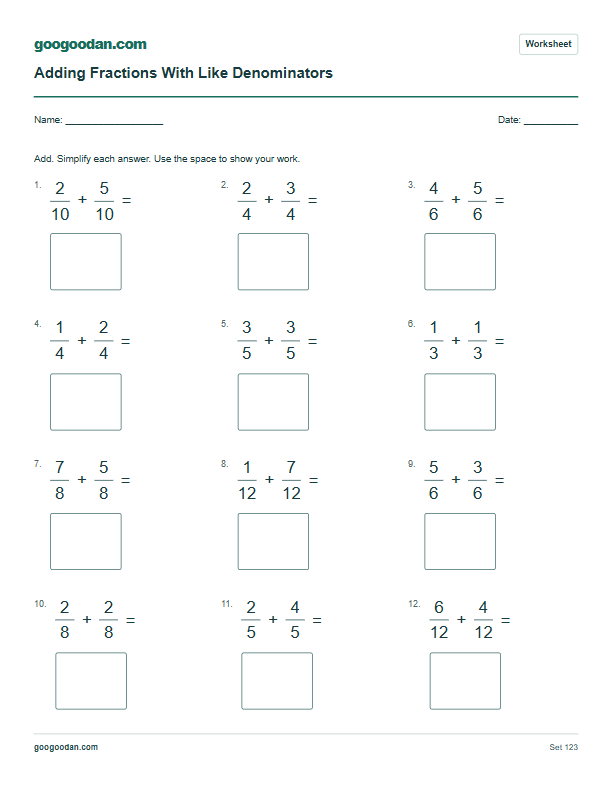
Adding Fractions With Like Denominators
Add equal-sized parts; simplify sums that may be greater than one.
12 problems · Answer key included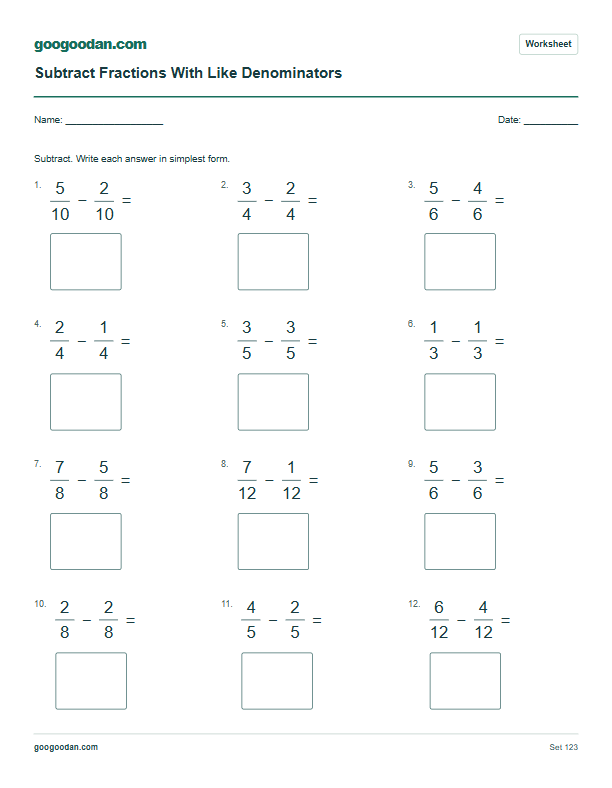 Calculation practice
Subtracting Fractions With Like Denominators
Take away equal-sized parts of the same whole and simplify the difference.
12 problems · Answer key included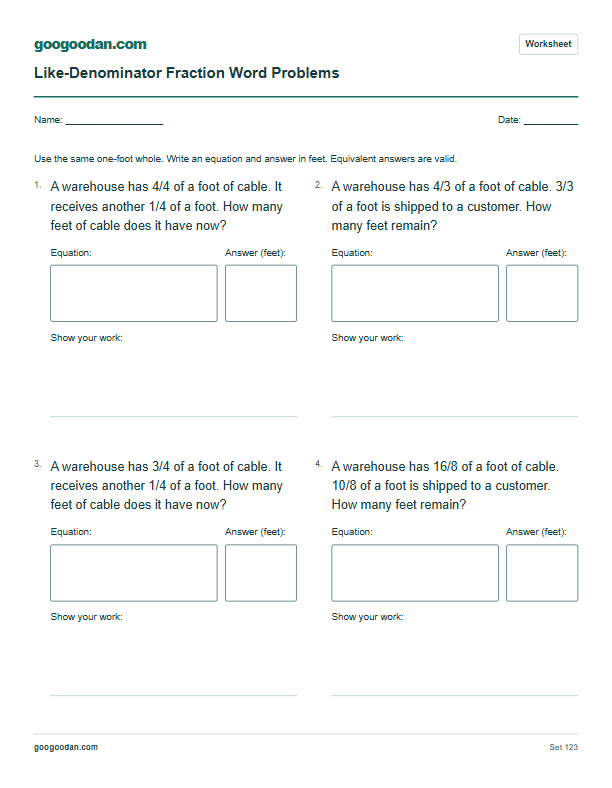 Word problems
Adding and Subtracting Fractions Word Problems With Like Denominators
Combine or remove fractional cable lengths measured using the same one-foot whole.
4 problems · Answer key included
Grade 4 · Multi-digit addition & subtraction
 Word problems
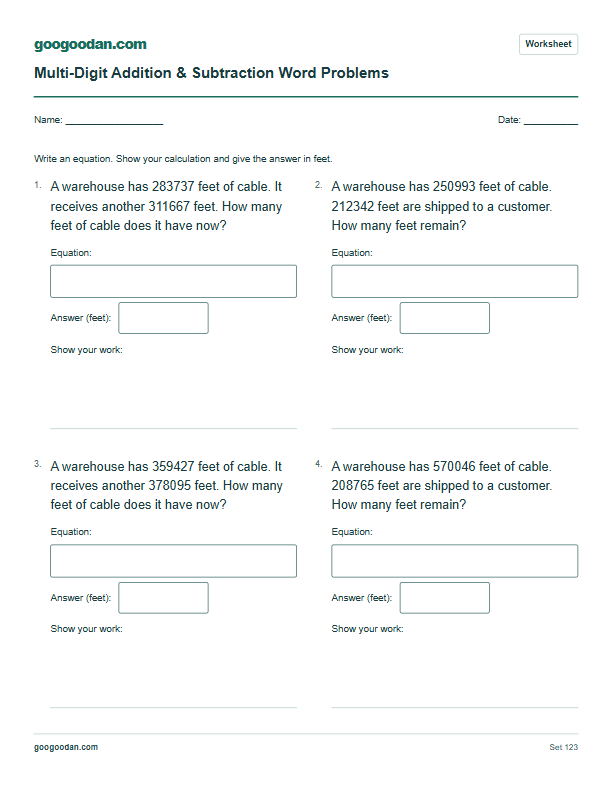
Multi-Digit Addition and Subtraction Word Problems
Add and subtract cable lengths within 1,000,000 and label the answer in feet.
4 problems · Answer key included
Grade 4 · Multiplication & rectangle area
Use equal groups and rectangle models to explain place-value multiplication. Choose a two- or three-digit group amounts activity on the shared multiplication and division worksheet before moving to larger products.
 Word problems
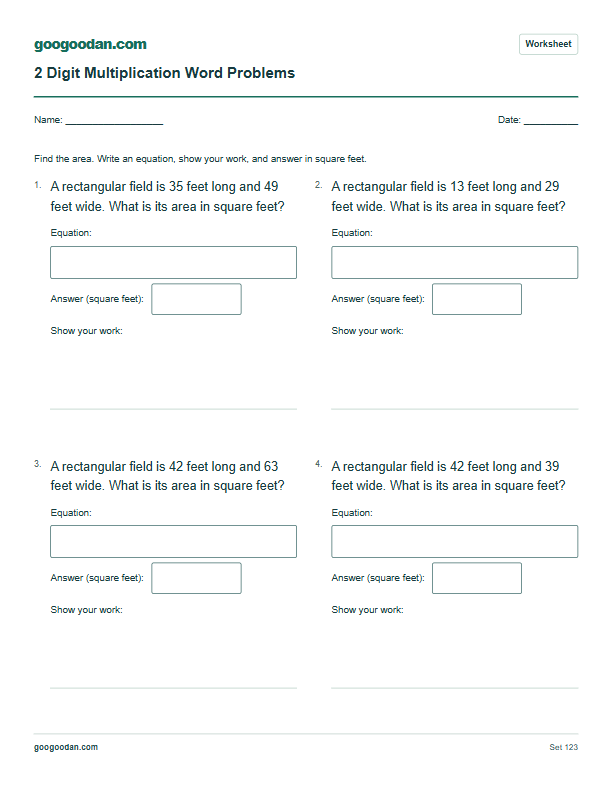
2 Digit Multiplication Word Problems: Rectangle Area
Multiply two two-digit side lengths to find a rectangular field’s area in square feet.
4 problems · Answer key included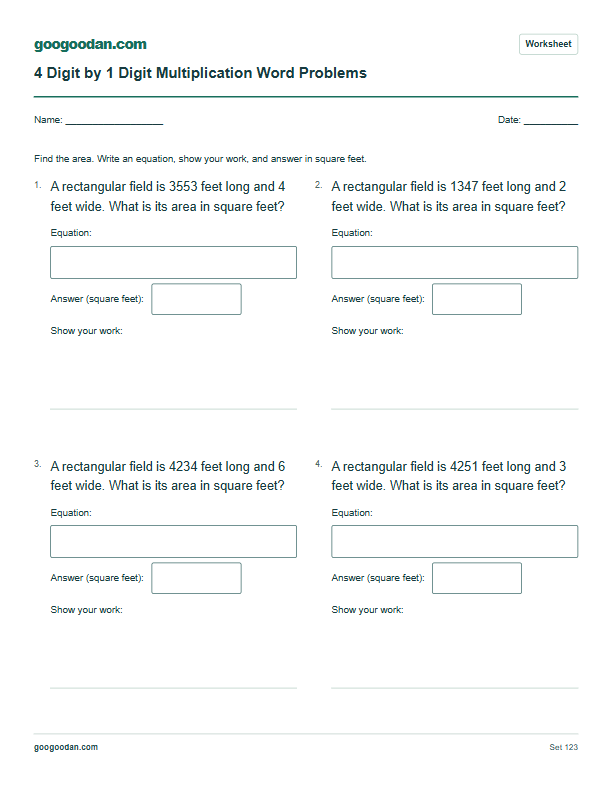 Word problems
4 Digit by 1 Digit Multiplication Word Problems
Use place-value partial products to find rectangle area from a four-digit length and a one-digit width.
4 problems · Answer key included
Grade 4 · Division & remainders
Use sharing with two-digit answers to explain exact division, then consider the meaning of remainders in division stories. Choose the larger-sharing activity on the shared equal-groups worksheet.
 Word problems
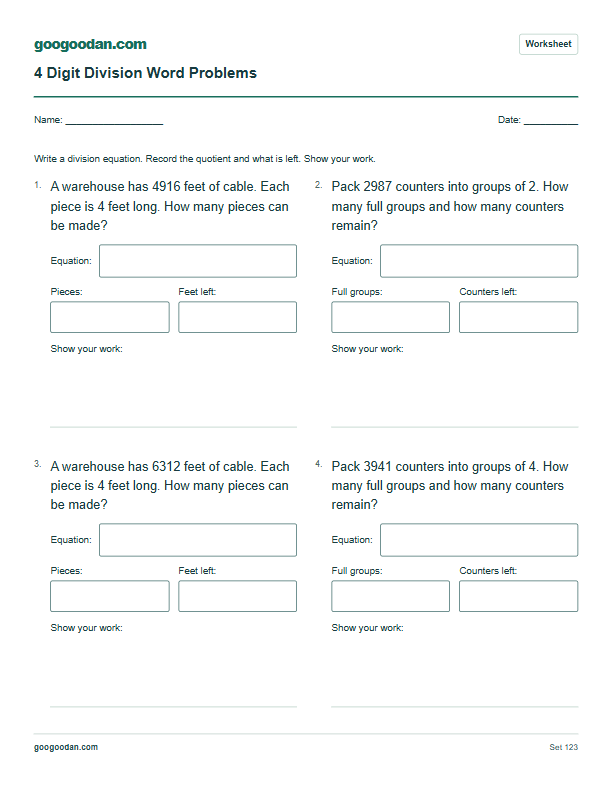
4 Digit Division Word Problems With and Without Remainders
Find complete groups or cable pieces, and record what is left separately from the quotient.
4 problems · Answer key included
Grade 5 · Add & subtract decimals to hundredths
 Word problems
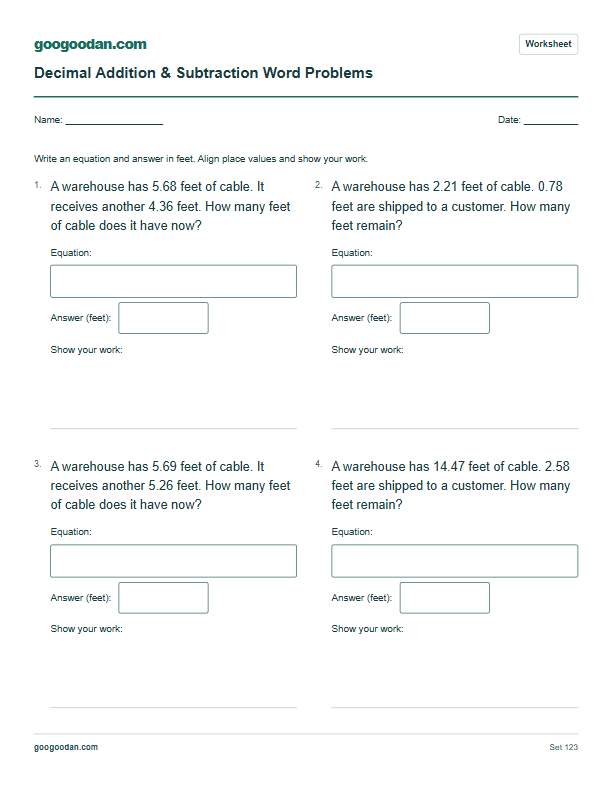
Adding and Subtracting Decimals Word Problems
Combine cable lengths or find what remains, using place value through hundredths.
4 problems · Answer key included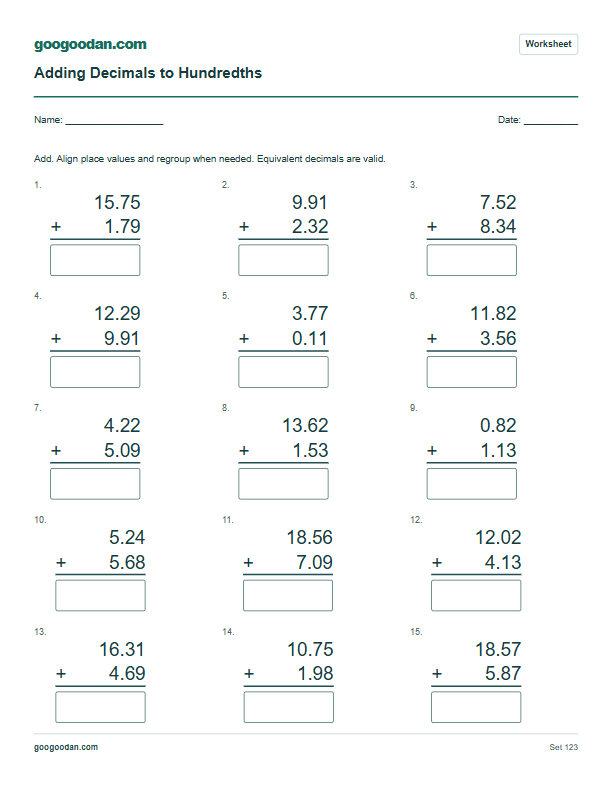 Calculation practice
Adding Decimals to Hundredths Worksheets
Align decimal points and exchange ten hundredths for one tenth.
15 problems · Answer key included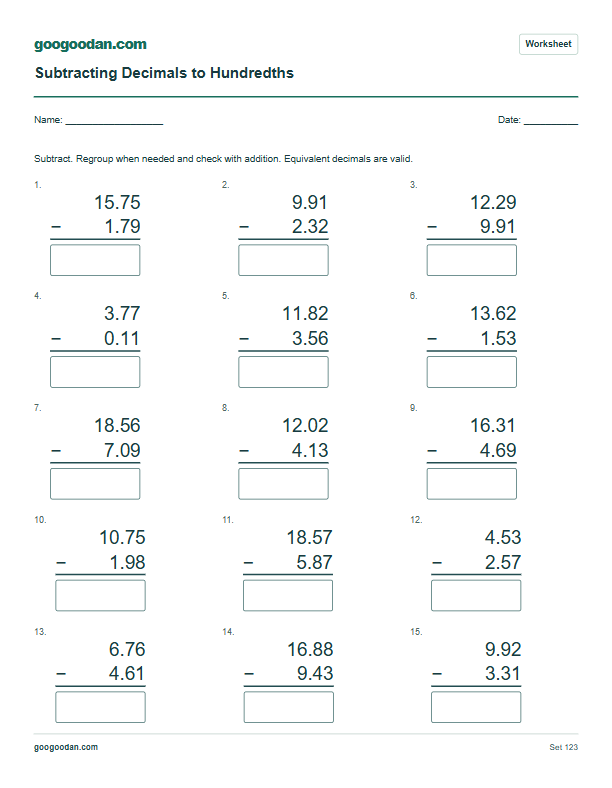 Calculation practice
Subtracting Decimals to Hundredths Worksheets
Align decimal points and rename tenths and hundredths before subtracting.
15 problems · Answer key included
Grade 5 · Multiply decimals: tenths by tenths
 Calculation practice
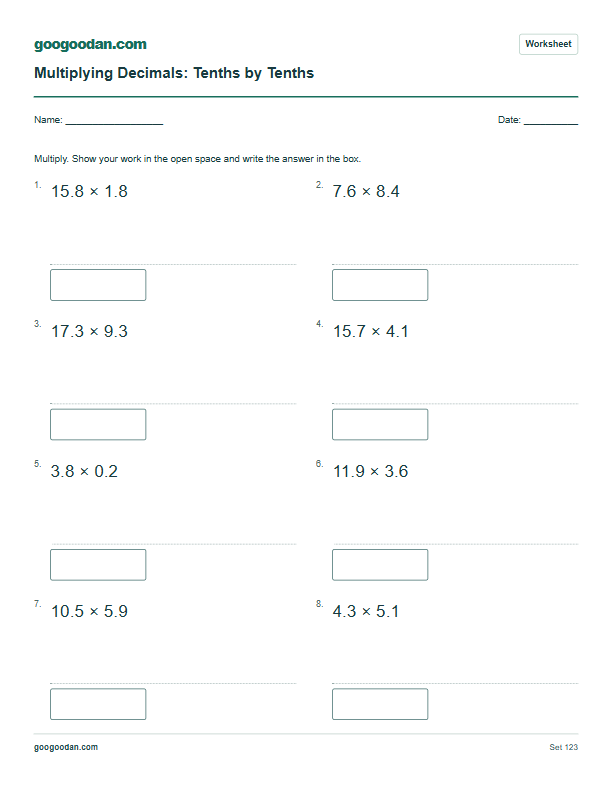
Multiplying Decimals Worksheets – Tenths by Tenths
Use tenths and hundredths to explain the product, then show your work.
8 problems · Answer key included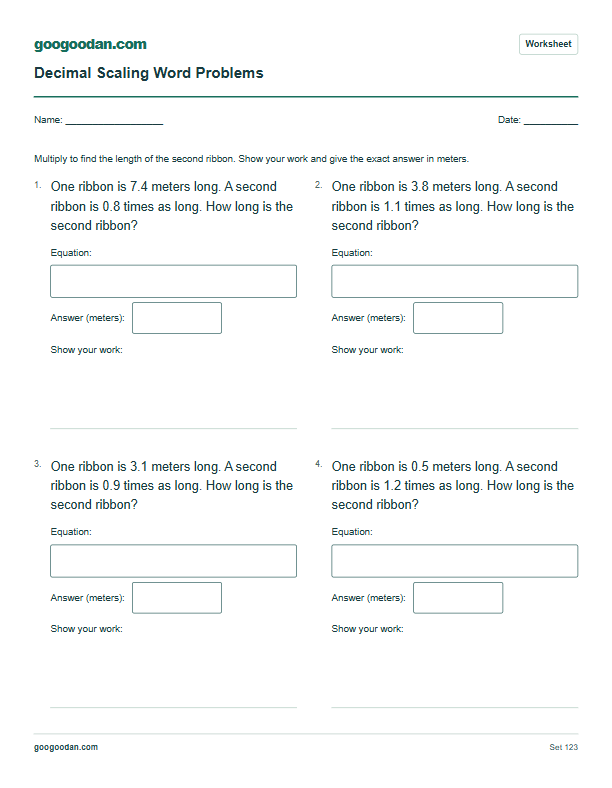 Word problems
Decimal Scaling Word Problems
Compare ribbon lengths using decimal multipliers below and above one. Explain the scale and keep exact answers.
4 problems · Answer key included
Grade 5 · Divide decimals: tenths by tenths
 Calculation practice
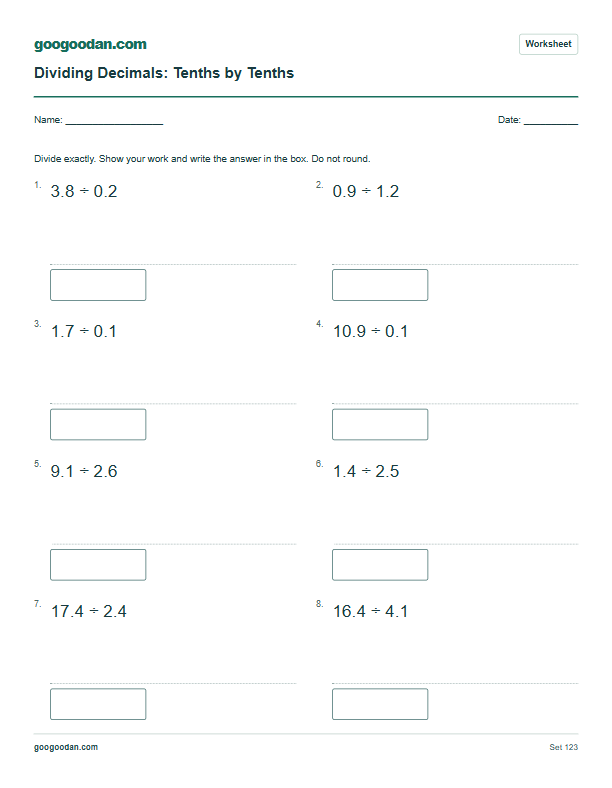
Dividing Decimals Worksheets – Tenths by Tenths
Scale both numbers together, divide exactly, and check with multiplication.
8 problems · Answer key included
Grade 4 · Multiply fractions by whole numbers
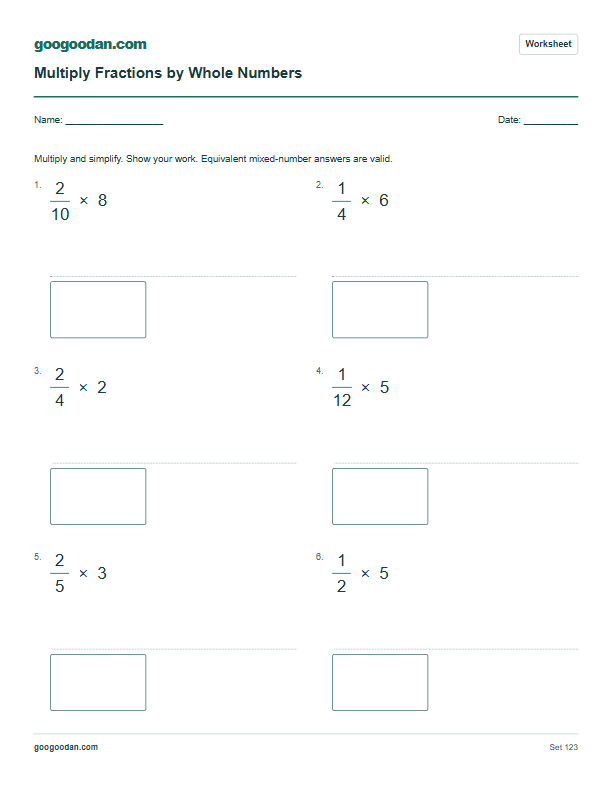 Calculation practice
Multiplying Fractions by Whole Numbers Worksheets
Count repeated groups of equal fraction parts and simplify the product.
6 problems · Answer key included
Grade 5 · Rectangle area with fractional sides
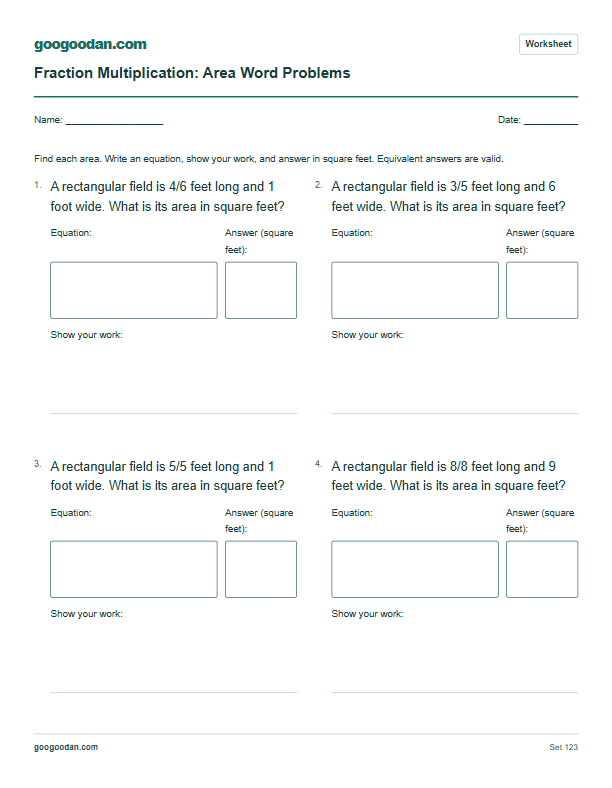 Word problems
Fraction Multiplication Word Problems: Rectangle Area
Multiply a fractional side length by a whole-number side to find area in square feet.
4 problems · Answer key included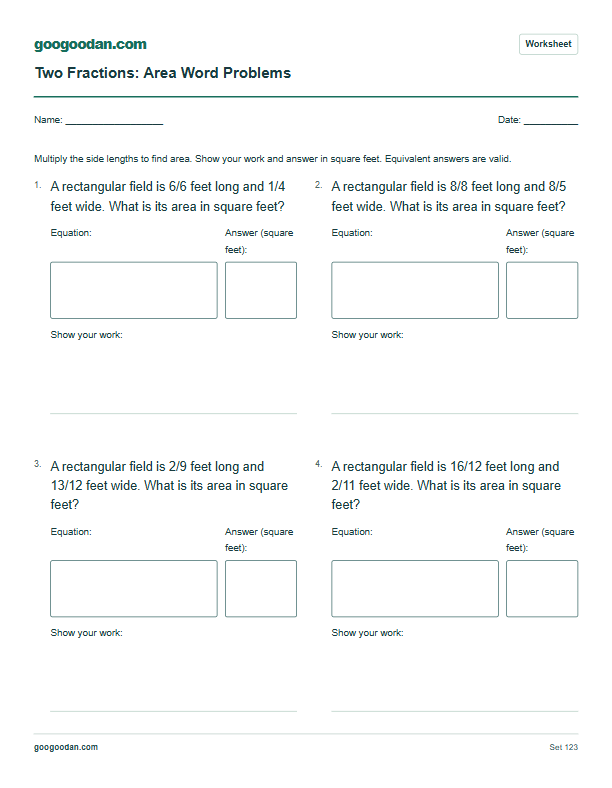 Word problems
Multiplying Two Fractions Word Problems: Area
Find rectangle area when both side lengths are written as fractions; include lengths greater than one foot.
4 problems · Answer key included
Grade 5 · Add & subtract fractions with unlike denominators
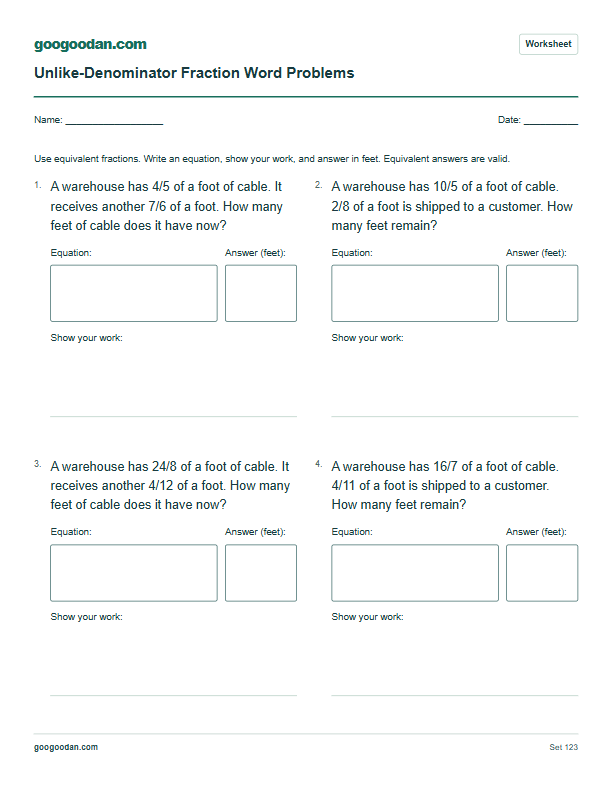 Word problems
Adding and Subtracting Fractions Word Problems With Unlike Denominators
Use equivalent fractions to combine or remove cable lengths measured against the same one-foot whole.
4 problems · Answer key included
Grade 5 · Divide whole numbers by unit fractions
 Word problems
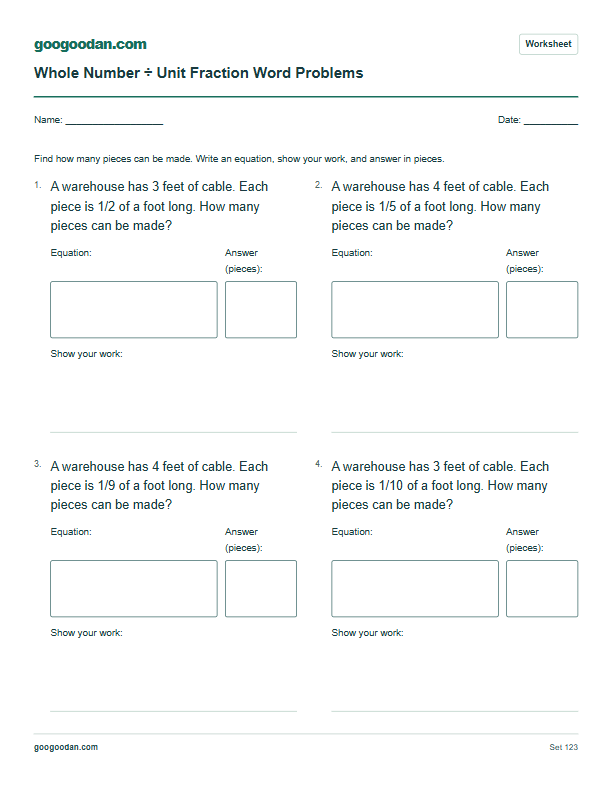
Dividing Whole Numbers by Unit Fractions Word Problems
Count fractional-foot cable pieces in a whole-number length, using equal groups and multiplication to check.
4 problems · Answer key included
Grade 5 · Divide with two-digit divisors
 Word problems
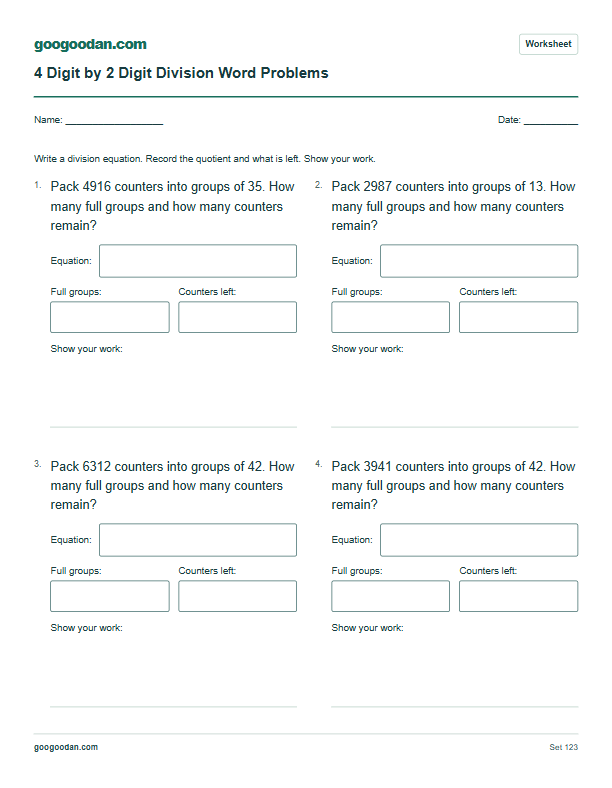
4 Digit by 2 Digit Division Word Problems
Use estimates and partial quotients to find complete groups with two-digit divisors, then interpret any remainder. Choose a smaller exact-group activity before four-digit totals.
4 problems · Answer key included
Grade 5 · Multiply three-digit by two-digit numbers
 Word problems
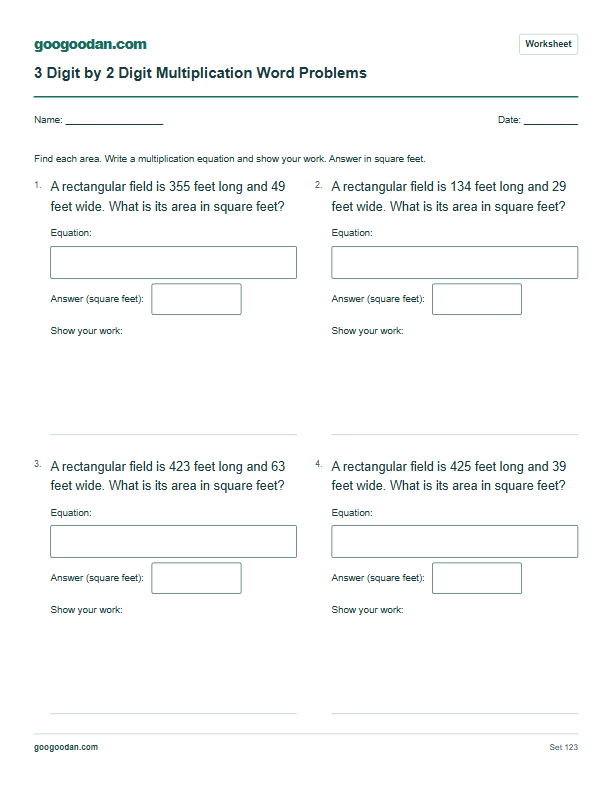
3 Digit by 2 Digit Multiplication Word Problems
Find rectangle area using a three-digit length and two-digit width; connect partial products to the written multiplication method.
4 problems · Answer key included
Grade 2 · Add four two-digit numbers
 Word problems
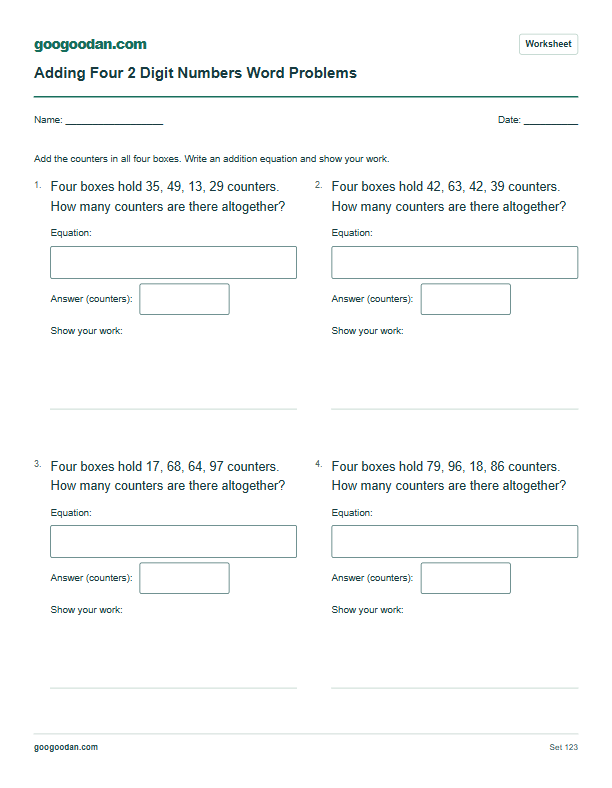
Adding Four 2 Digit Numbers Word Problems
Combine four boxes of counters. Pair friendly sums or add tens and ones, keeping every box in the total.
4 problems · Answer key included
Grade 3 · Multiply by multiples of 10
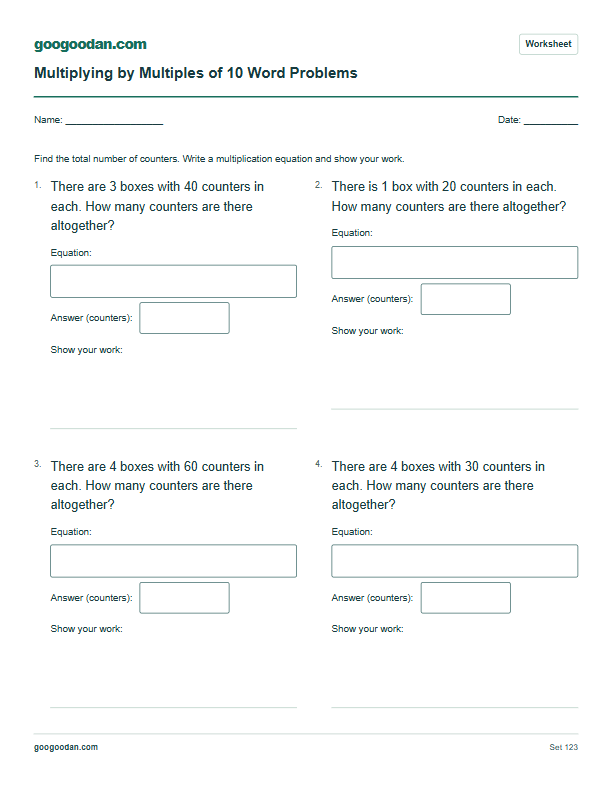 Word problems
Multiplying by Multiples of 10 Word Problems
Count equal boxes of 10–90 counters. Use a known multiplication fact to find the number of tens, then express the total in ones.
4 problems · Answer key included
Grade 1 · Add & subtract whole tens
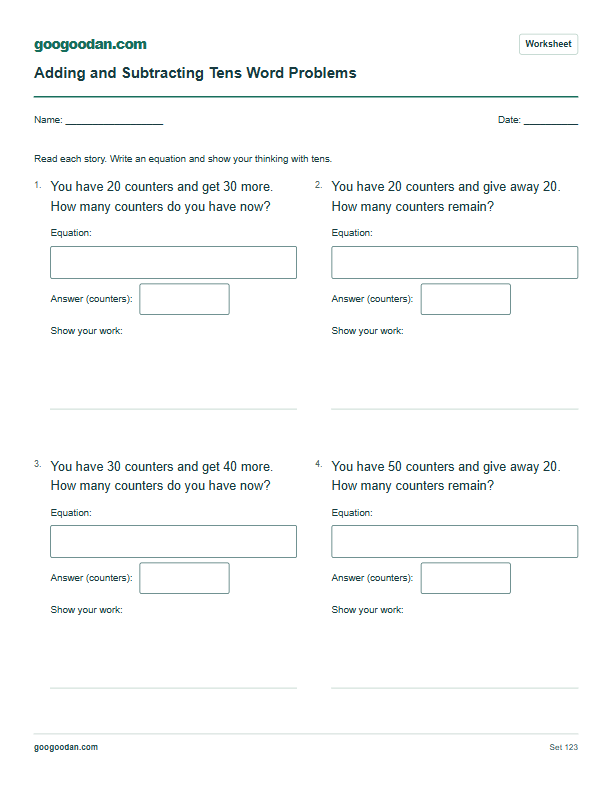 Word problems
Adding and Subtracting Tens Word Problems
Combine or remove whole tens of counters. Explain the place value, including stories where zero counters change or remain.
4 problems · Answer key included
Grade 5 · Write & interpret expressions with parentheses
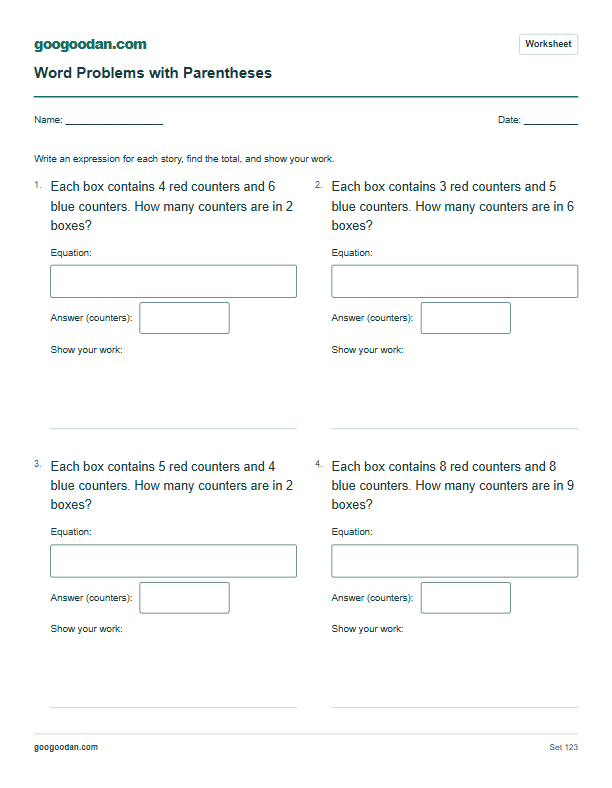 Word problems
Order of Operations Word Problems with Parentheses
Add two colors of counters in each box, then multiply by the number of boxes. Explain what the parentheses group together.
4 problems · Answer key included
Grade 4 · Find factors through equal arrays
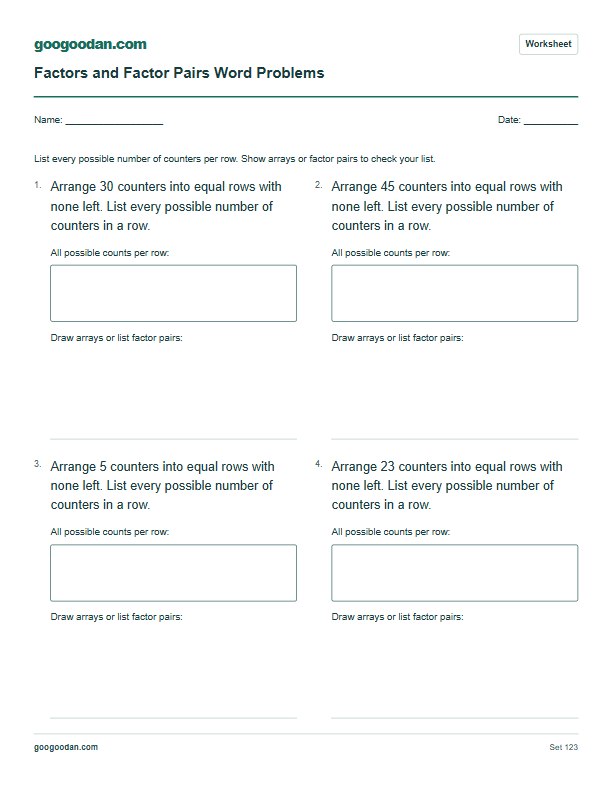 Word problems
Factors and Factor Pairs Word Problems
Arrange counters into equal rows with none left. Find every possible count per row and check that the factor list is complete.
4 problems · Answer key included
Grade 1 · Add ones to a two-digit number
 Word problems
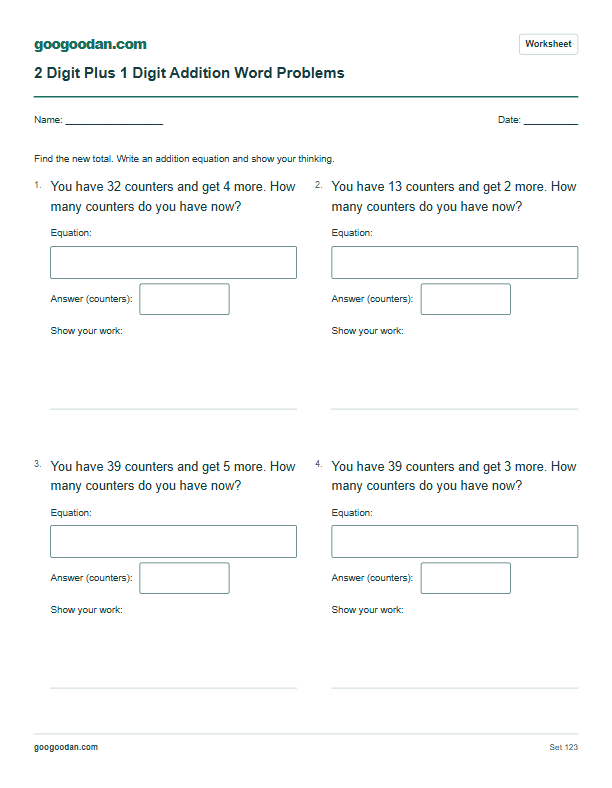
2 Digit Plus 1 Digit Addition Word Problems
Add 0–9 more counters to a two-digit collection. Count on, add the ones, or make the next ten; sums stay below 100.
4 problems · Answer key included
Grade 2 · Two-step addition & subtraction stories
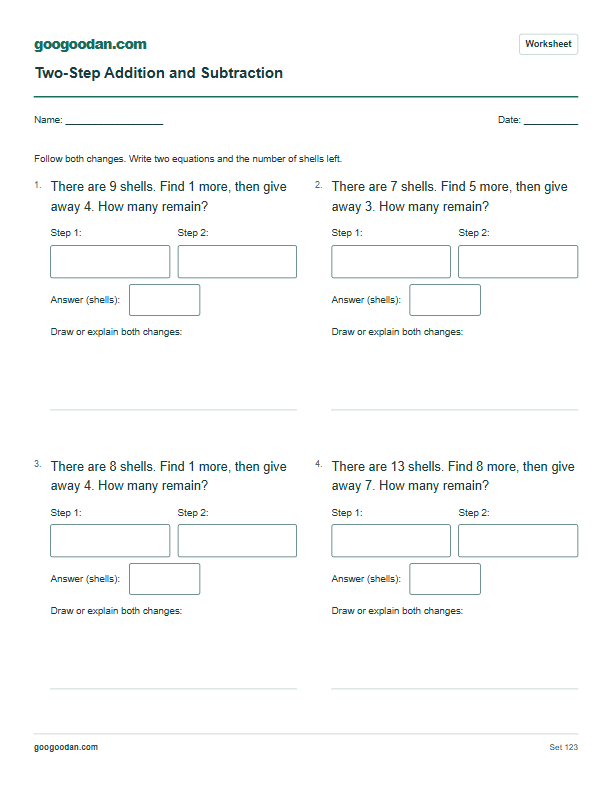
Follow a small collection through two changes: find more, then give some away. Explain the intermediate total before finding the final amount.
 Word problems
Two-Step Addition and Subtraction Word Problems
Find a new total, then subtract what is given away. Follow both changes with small numbers.
4 problems · Answer key included
Grade 3 · Two-step multiplication & subtraction stories
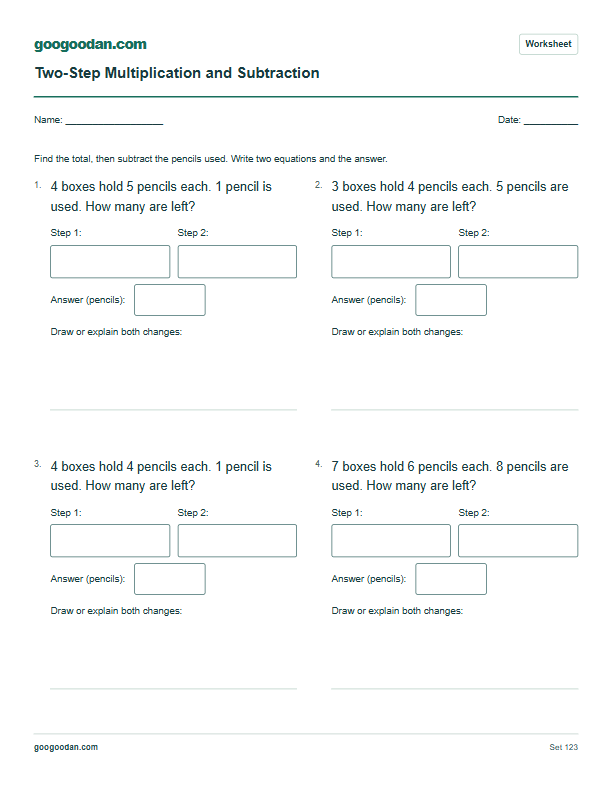
Combine equal groups, then remove an amount from the total. Connect each step to its meaning and check the remaining number.
 Word problems
Two-Step Multiplication and Subtraction Word Problems
Find the number of pencils in equal boxes, then subtract the pencils used. Explain both steps.
4 problems · Answer key included
Grade 2 · Length addition & subtraction stories
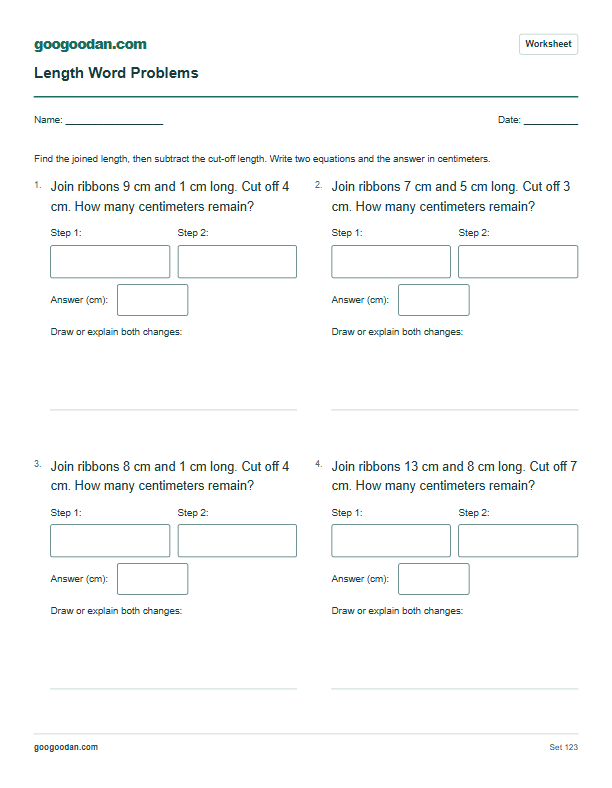
Use lengths in the same unit to model joining ribbons and cutting off a section. Find the remaining length in centimeters.
 Word problems
Length Word Problems in Centimeters
Join two ribbon lengths, then cut some off. Model both steps and label the remaining length in centimeters.
4 problems · Answer key included
Grade 3 · Liquid volume & mass word problems
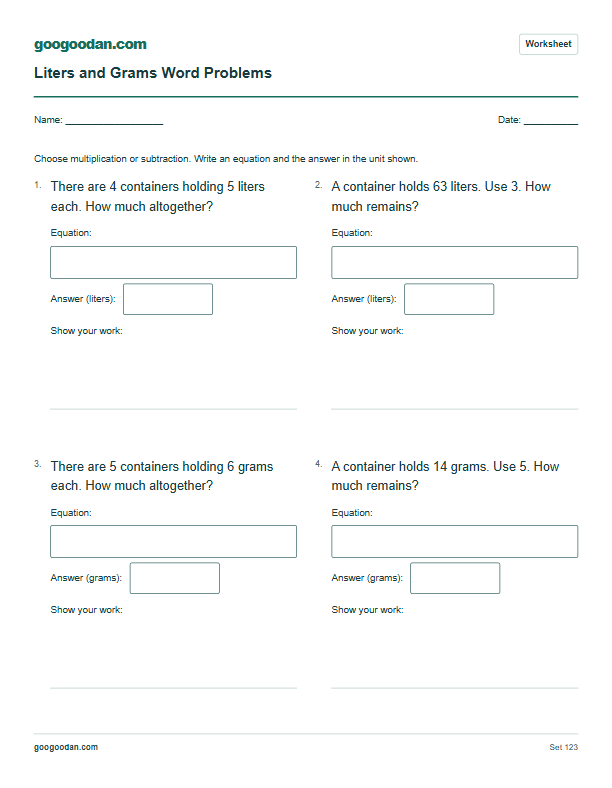
Multiply equal amounts or subtract an amount used. Each story stays in liters or grams; no conversion is needed.
 Word problems
Liters and Grams Word Problems
Find the total in equal containers or the amount left after use. Keep liters and grams in separate problems.
4 problems · Answer key included
Grade 4 · Interpret remainders: enough vans for everyone
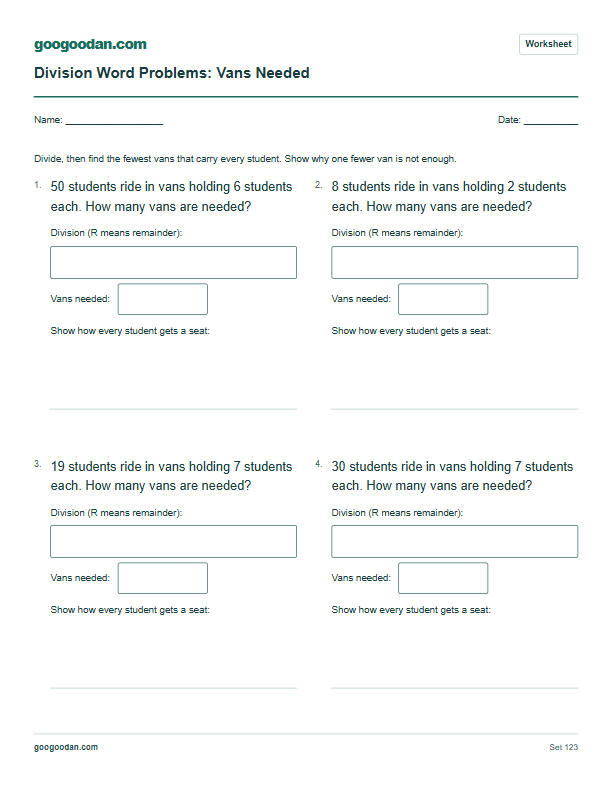
Use the quotient and remainder to find the minimum number of whole vehicles. Check that there are enough seats and one fewer van would not be enough.
 Word problems
Division Word Problems: Round Up the Remainder
Find the fewest vans that seat every student. Compare exact division with a remainder that needs one more van.
4 problems · Answer key included
Grade 5 · Fraction multiplication: scale amounts
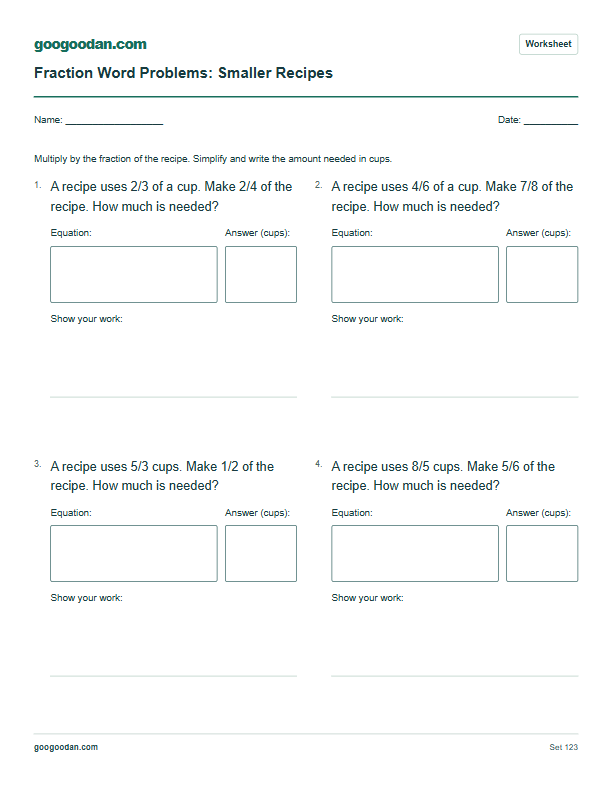
Compare smaller and larger amounts using fractional multipliers. Use equal-sized measuring parts to explain how the scale factor changes the original amount.
 Word problems
Fraction Multiplication Word Problems: Recipes
Make a fraction of a recipe. Scale amounts below and above one cup while keeping the cup unit.
4 problems · Answer key included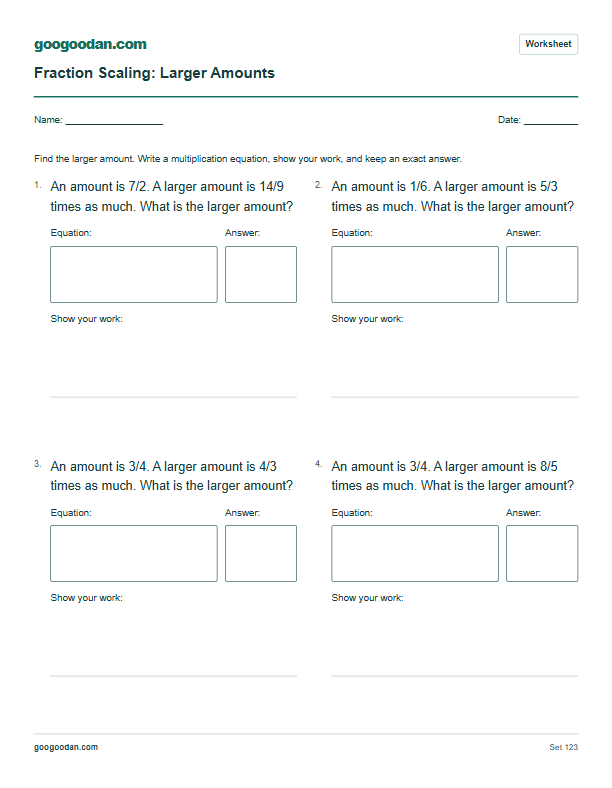 Word problems
Fraction Scaling Word Problems: Making Amounts Larger
Multiply by a fraction greater than one. Separate the original amount, extra amount, and new total.
4 problems · Answer key included
Grade 2 · Find missing amounts and differences within 100
Identify a missing part, an amount needed, or the difference between two known amounts. Use bar models and an addition check to explain the answer.
 Word problems
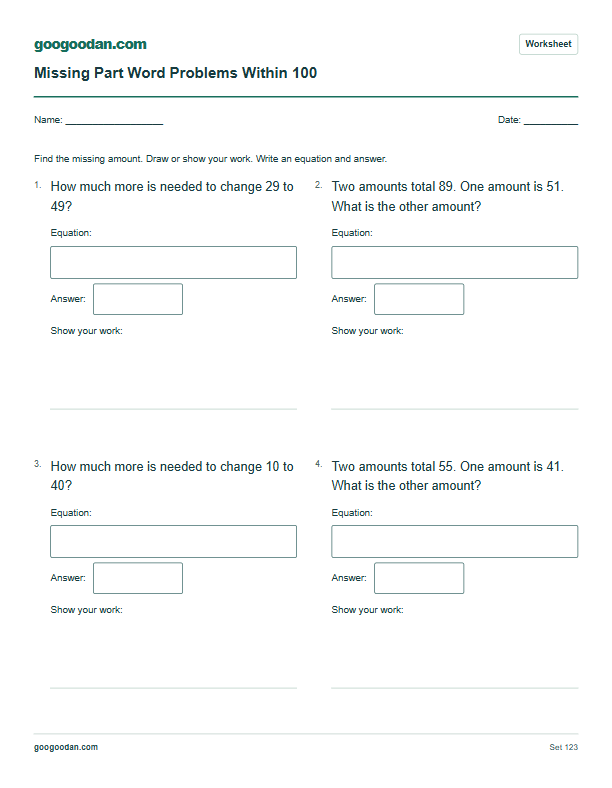
Missing Part Word Problems — Within 100 or 1,000
Find a missing part or an amount needed to reach a target. Choose practice within 100 or extend to 1,000.
4 problems · Answer key included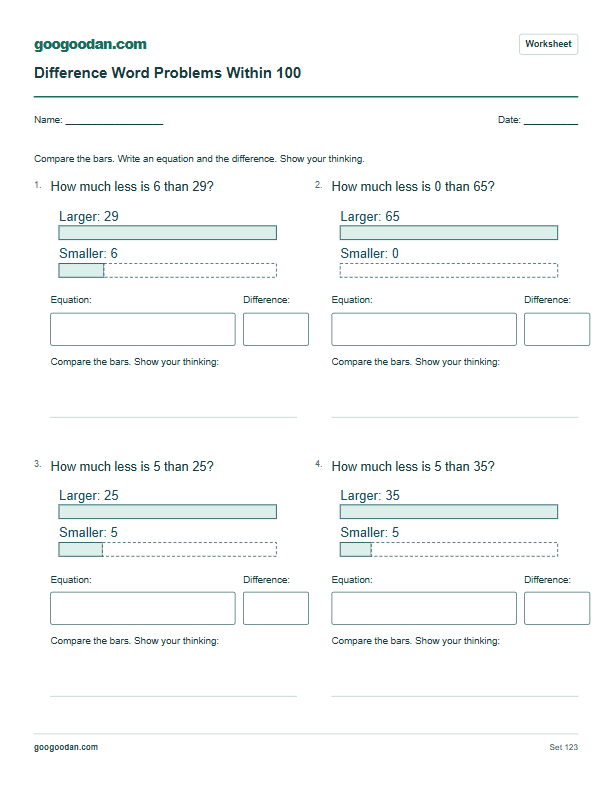 Word problems
Difference Word Problems — Within 100 or 1,000
Compare aligned bars and find the difference. Choose the default range within 100 or compare three-digit amounts within 1,000.
4 problems · Answer key included
Grade 4 · Find a missing fraction amount
Keep the same unit whole while finding the other part or the amount needed. Use equivalent fractions and an addition check.
 Word problems
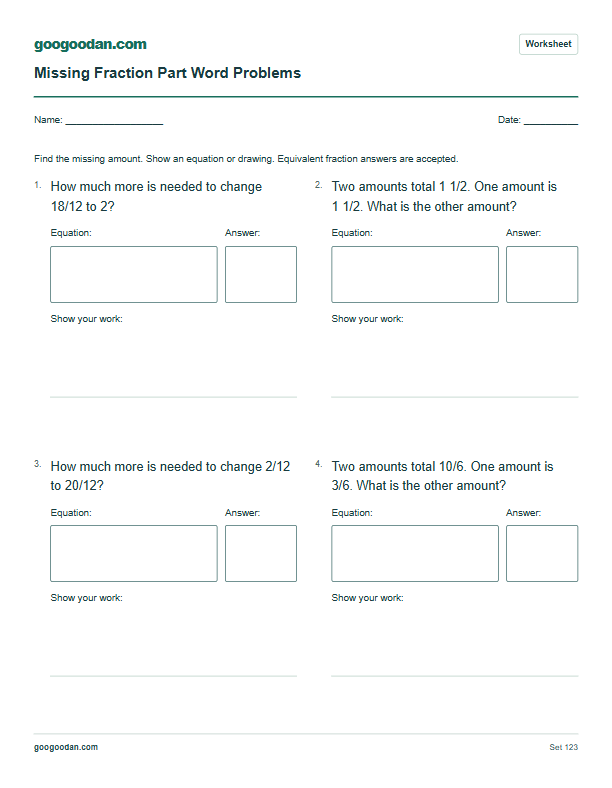
Missing Fraction Part Word Problems
Find a missing fraction amount, including mixed numbers, and check by adding the parts.
4 problems · Answer key included
Grade 5 · Find a missing fraction part with unlike denominators
Rename amounts using equal-sized fractional pieces. Find the other part and rebuild the total to check.
 Word problems
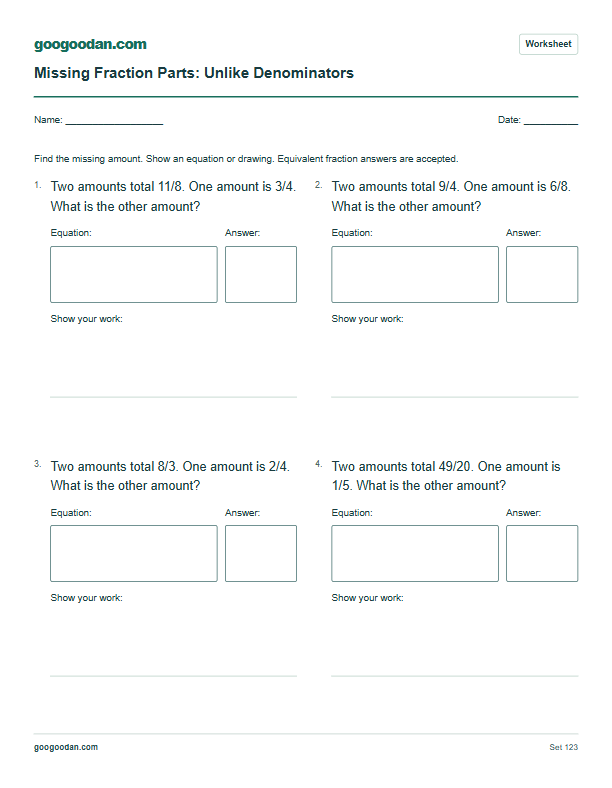
Missing Fraction Part Word Problems With Unlike Denominators
Use a common denominator to find the missing part, then add the parts to check the total.
4 problems · Answer key included
Grade 5 · Find a missing decimal amount
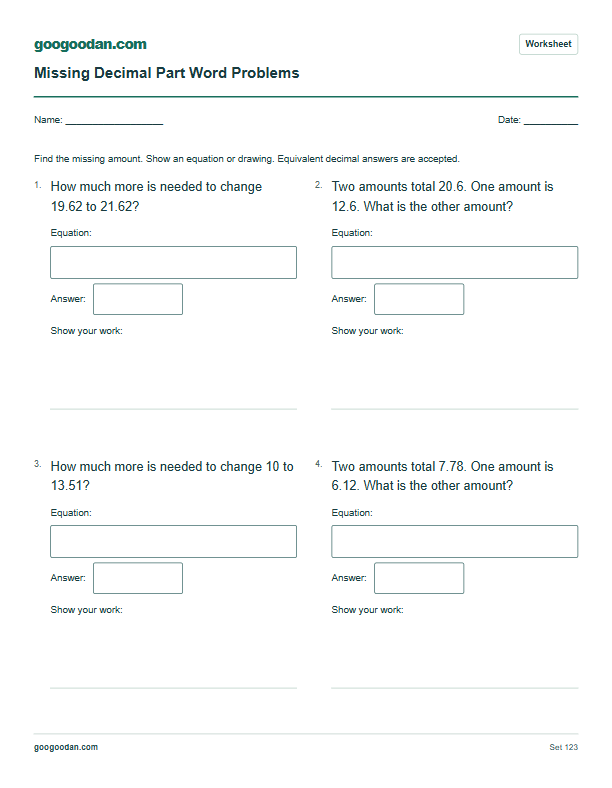
Find the other part or the increase needed to reach a total. Use place-value exchanges and an addition check.
 Word problems
Missing Decimal Part Word Problems
Find a missing decimal amount through hundredths. Align place values and check by adding the parts.
4 problems · Answer key included
Grade 5 · Measure full and partial groups
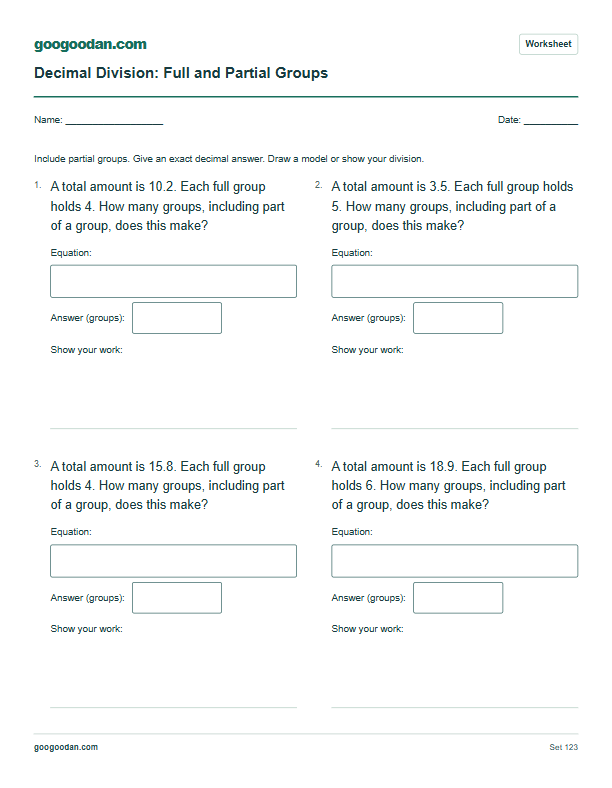
Divide a decimal amount by a whole-number group size. Include the fractional part of a group and check the total.
 Word problems
Dividing Decimals by Whole Numbers Word Problems
Measure how many full and partial groups fit in a decimal amount. Use exact decimal quotients and a multiplication check.
4 problems · Answer key included
Grade 5 · Measure groups with decimal sizes
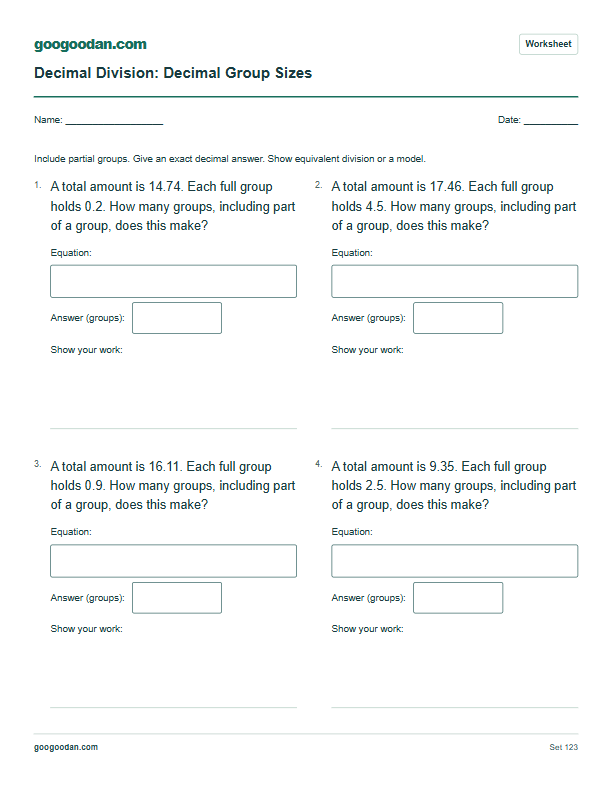
Use the same smaller unit for both quantities. Explain why a group size below one gives a larger numerical quotient.
 Word problems
Dividing by Decimals Word Problems
Compare decimal group sizes below and above one. Rename both quantities to divide and include partial groups.
4 problems · Answer key included
Grade 4 · Compare amounts with multiplication
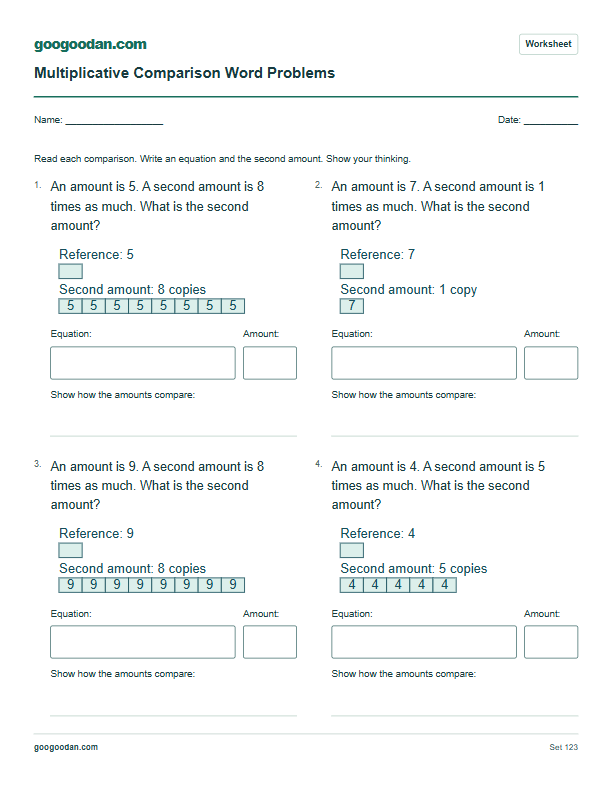
Distinguish times as much from more than. Find the compared amount from a reference amount and a whole-number multiplier.
 Word problems
Multiplicative Comparison Word Problems
Compare one- or two-digit reference amounts using equal bar units and whole-number multipliers.
4 problems · Answer key included
Grade 3 · Understand and compare fractions
Name shaded parts of a whole, read fractions on number lines from zero to one, and compare fractions with matching denominators. Use equal-sized parts and explain the meaning of the denominator.
 Calculation practice
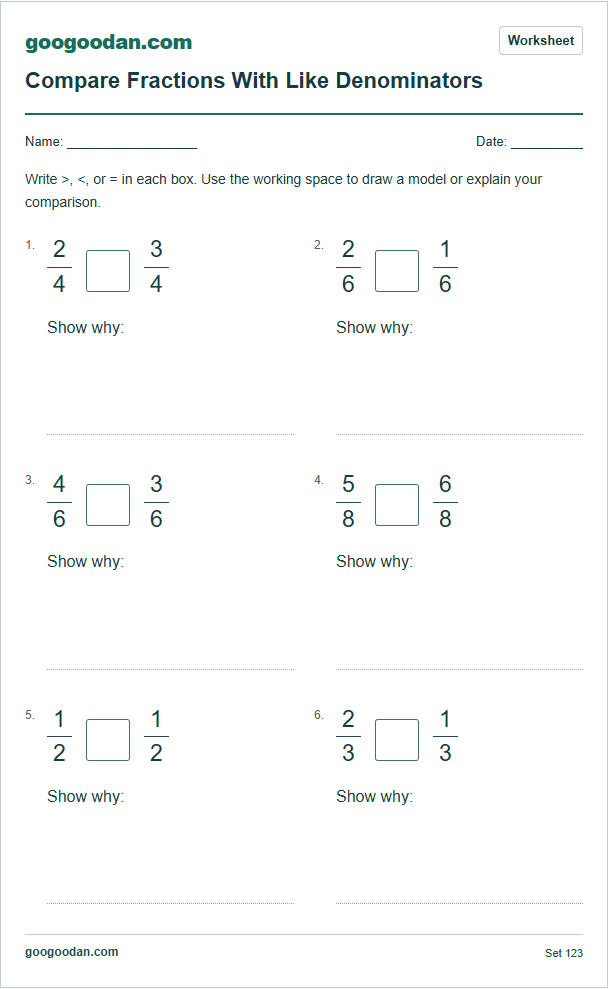
Comparing Fractions With the Same Denominator
Compare equal-sized parts using >, <, or = and explain your choice.
6 problems · Answer key included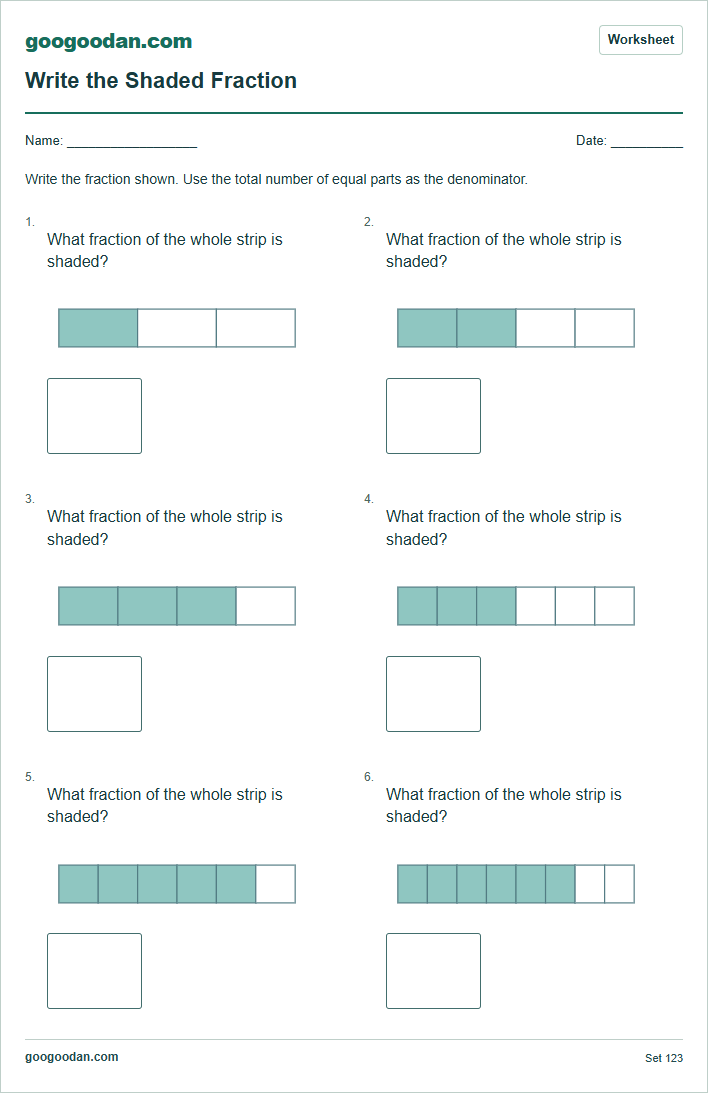 Picture activity
Write Fractions From Shaded Parts
Count all equal parts, then the shaded parts, to name the fraction shown.
6 problems · Answer key included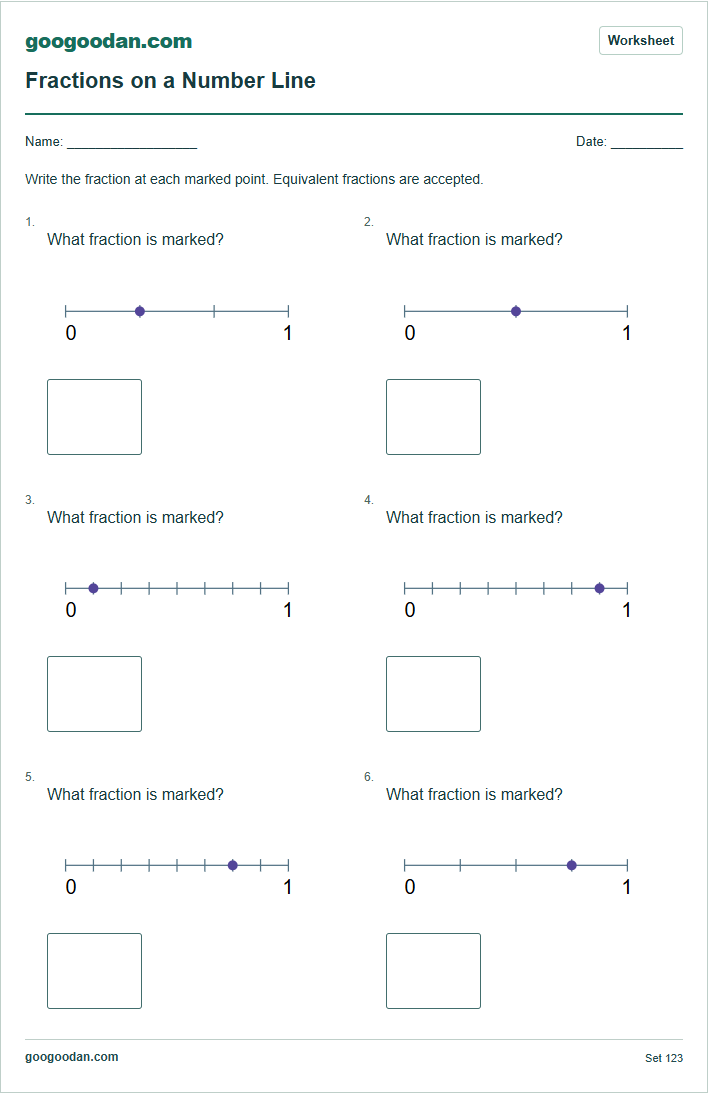 Picture activity
Fractions on a Number Line
Count equal intervals from zero to name the fraction at a marked point.
6 problems · Answer key included
Grade 5 · Decimal place value
Identify digits through thousandths, explain their values, and compare decimals by place value. These selected activities do not assess every part of decimal notation.
 Calculation practice
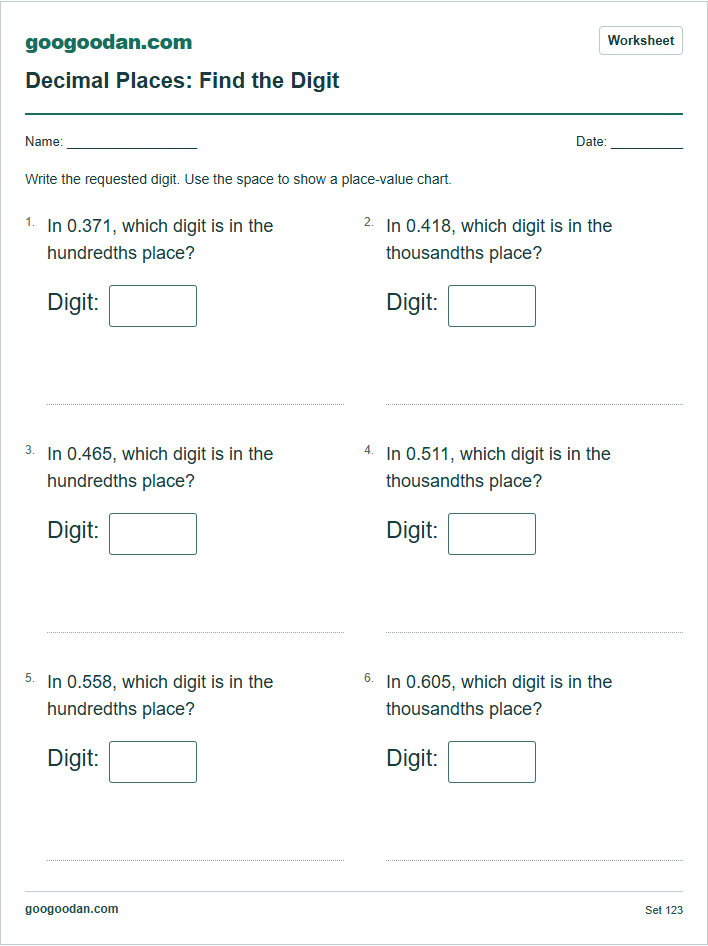
Decimal Place Value: Find the Digit
Identify the tenths, hundredths, or thousandths digit, including zero.
6 problems · Answer key included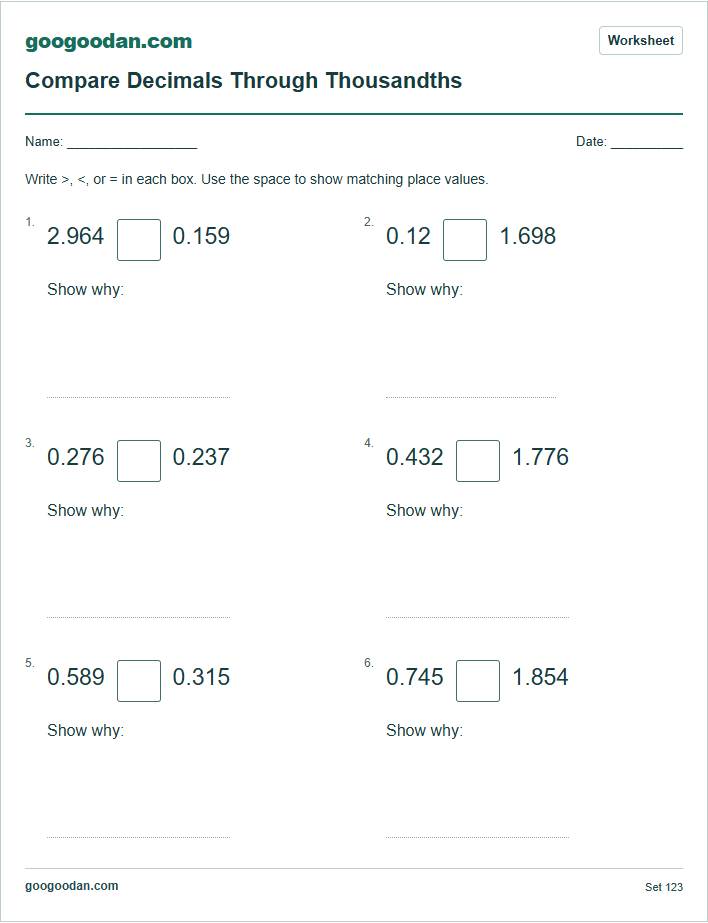 Calculation practice
Comparing Decimals Through Thousandths
Align decimal places and compare using >, <, or =.
6 problems · Answer key included
Grade 5 · Equivalent fractions for fraction operations
Preserve a fraction’s value by changing numerator and denominator together. Simplifying is supporting practice before operations, not a full assessment of unlike-denominator addition and subtraction.
 Calculation practice
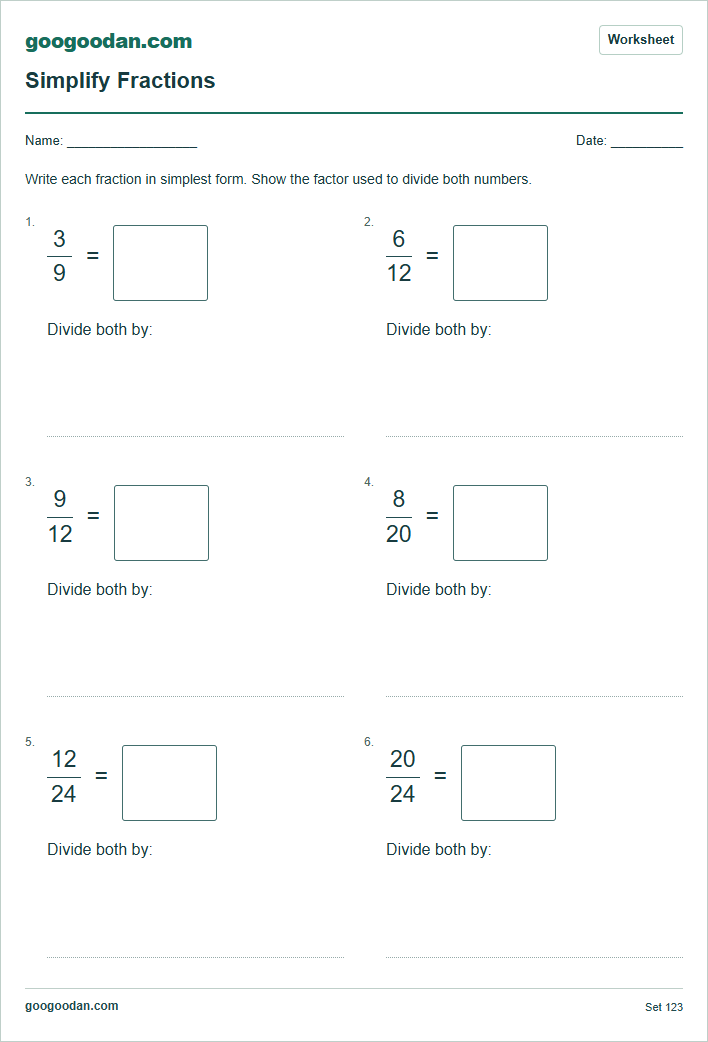
Simplifying Fractions
Divide both numbers by a common factor while keeping the fraction value unchanged.
6 problems · Answer key included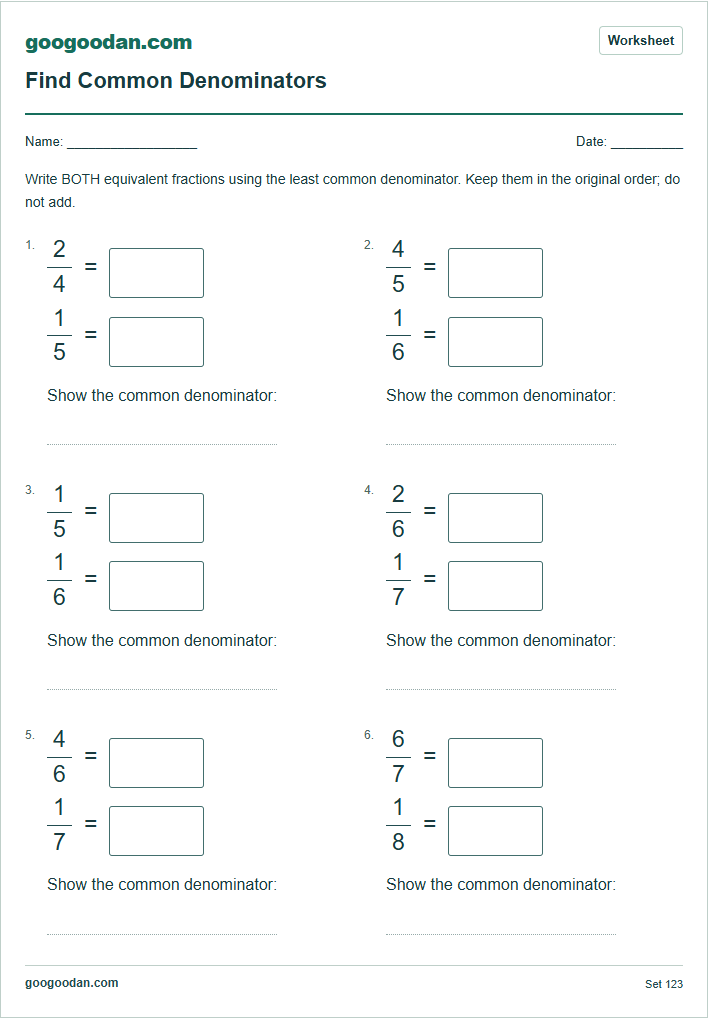 Calculation practice
Finding Common Denominators
Rewrite both fractions with the least common denominator without changing their values.
6 problems · Answer key included
Grade 2 · Compare three-digit numbers
Compare the meanings of hundreds, tens, and ones. Reading number names and writing expanded form are not included in this activity.
 Calculation practice
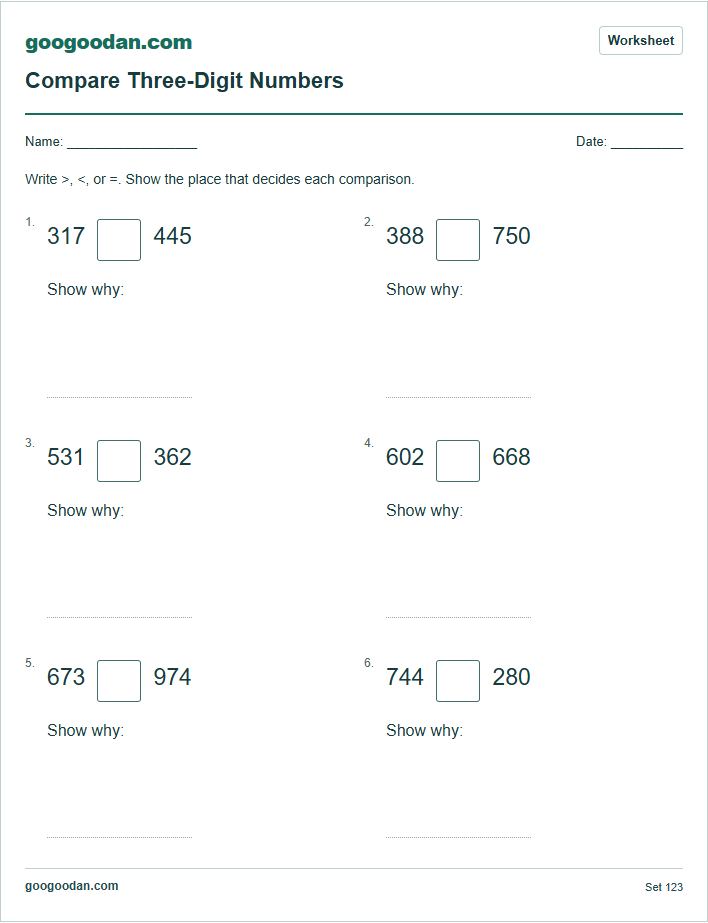
Comparing Three-Digit Numbers
Compare hundreds, tens, and ones using >, <, or =.
6 problems · Answer key included
Grade 2 · Hundreds, tens, and ones
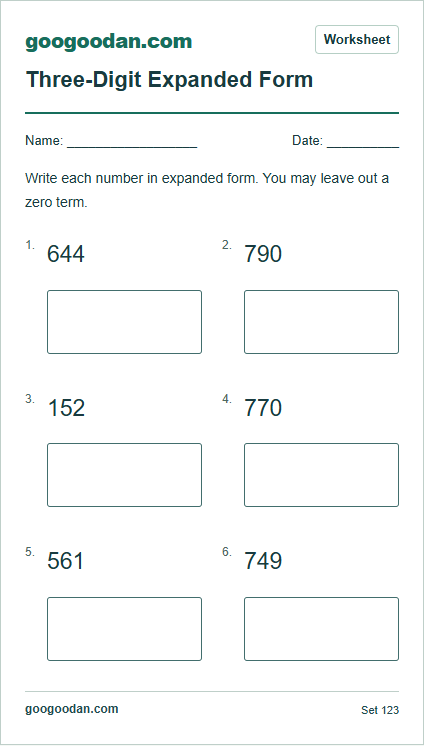 Calculation practice
Three-Digit Expanded Form
Write hundreds, tens, and ones as a sum.
6 problems · Answer key included
Grade 1 · Understand tens and ones
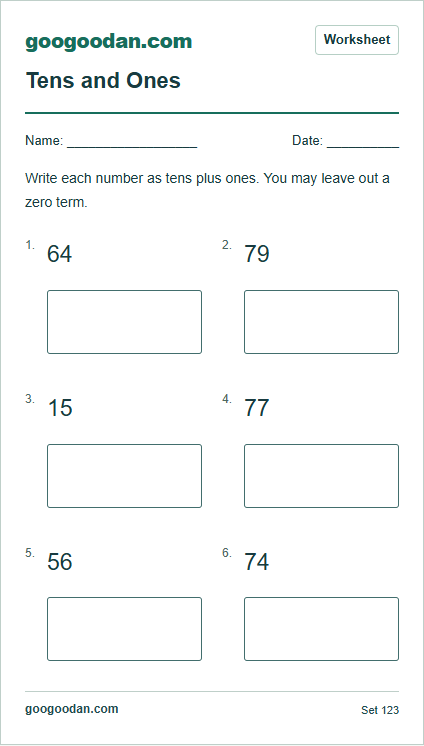 Calculation practice
Tens and Ones Expanded Form
Show the tens and ones in a two-digit number.
6 problems · Answer key included
Grade 1 · Tell time to the hour and half hour
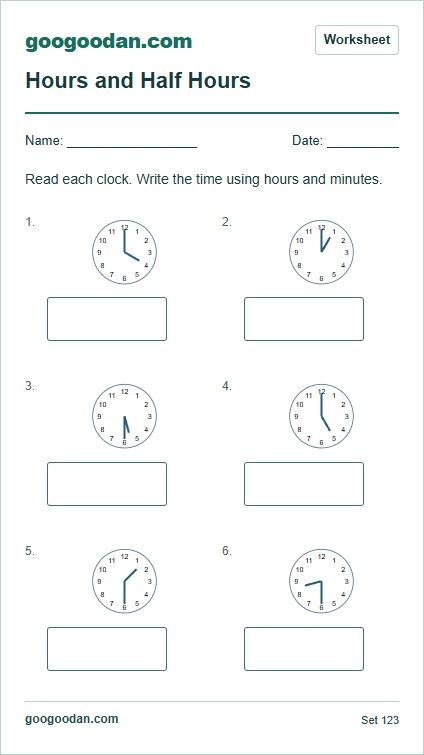 Picture activity
Telling Time: Hours and Half Hours
Read analog clocks and write the time to the hour or half hour.
6 problems · Answer key included
Grade 2 · Tell time to five minutes
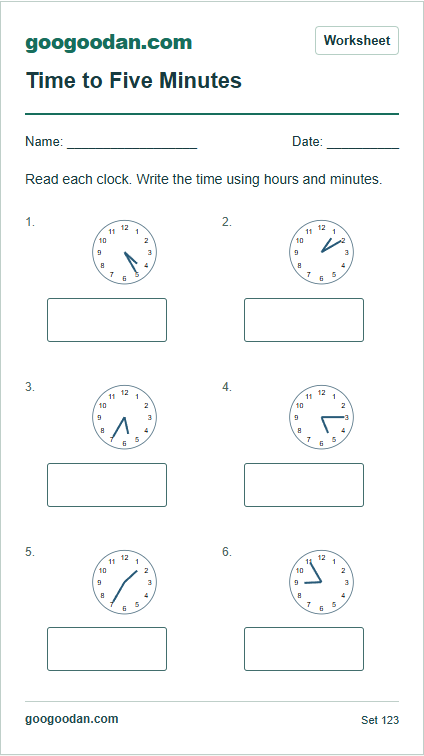 Picture activity
Telling Time to Five Minutes
Count minutes in fives and check the hour hand.
6 problems · Answer key included
Grade 3 · Understand rectangle perimeter
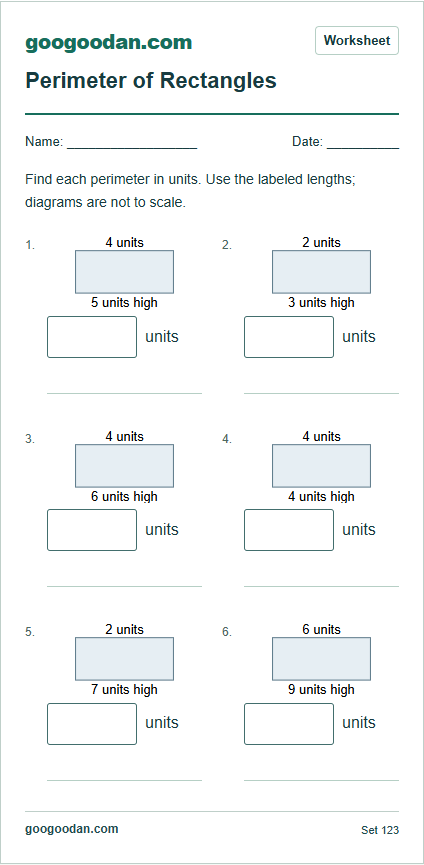 Picture activity
Rectangle Perimeter Worksheets
Use labeled side lengths to find the distance around a rectangle.
6 problems · Answer key included
Grade 3 · Understand area in square units
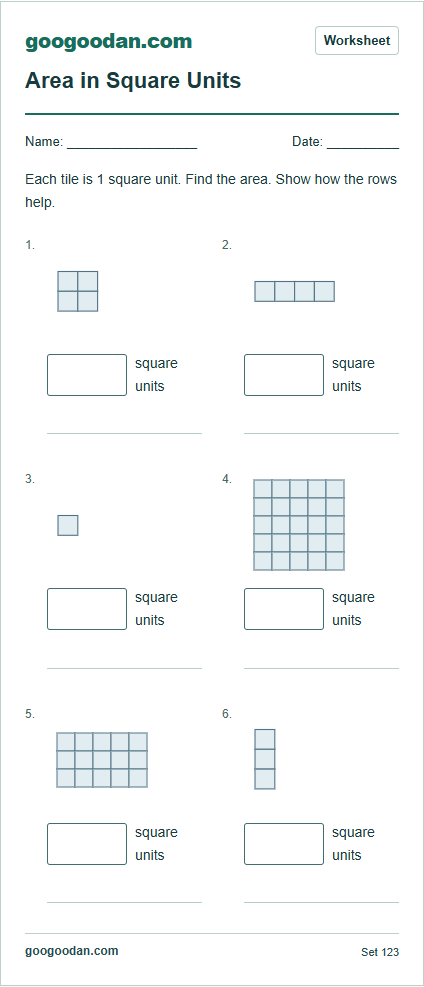 Picture activity
Counting Square Units: Area
Count equal square tiles and use rows to find area.
6 problems · Answer key included
Grade 5 · Understand volume with unit cubes
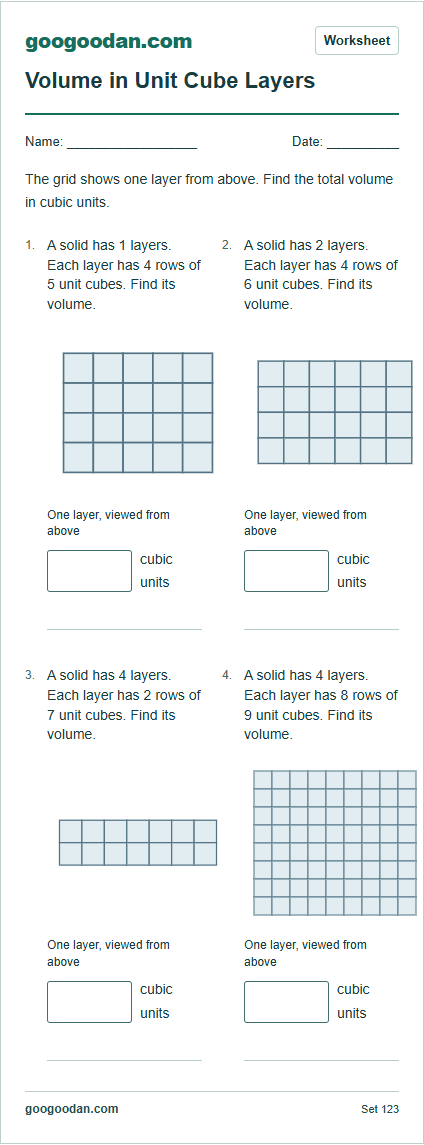 Picture activity
Volume with Layers of Unit Cubes
Count cubes in one layer and multiply by the number of layers.
4 problems · Answer key included
Grade 5 · Read points on the coordinate plane
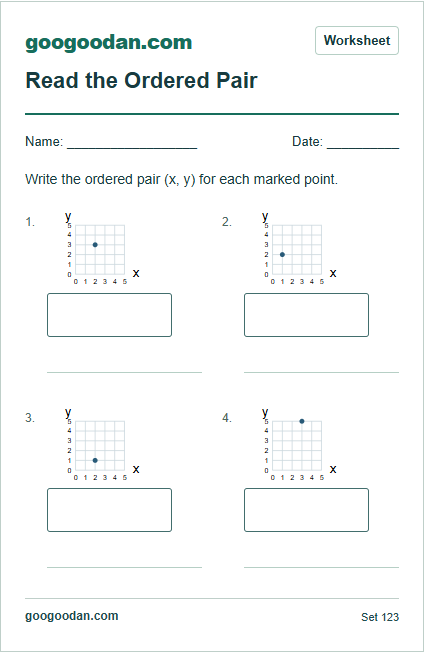 Picture activity
Reading Ordered Pairs
Read the horizontal and vertical position of a marked point.
4 problems · Answer key included
Grade 3 · Round to tens and hundreds
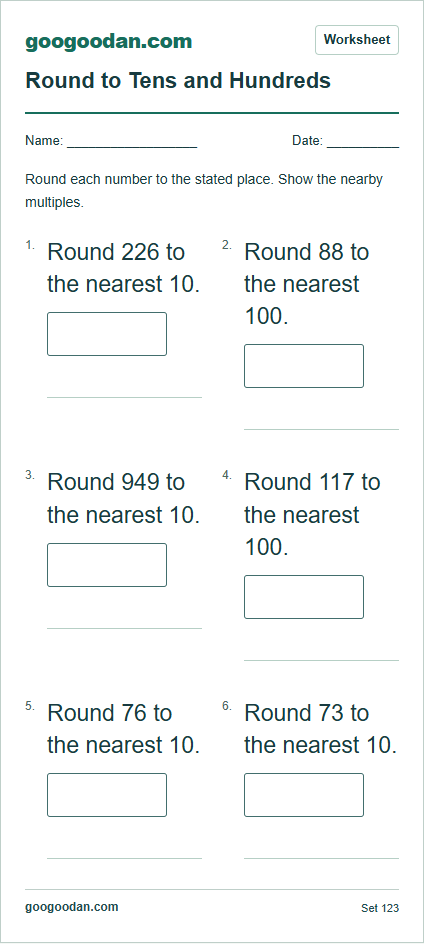 Calculation practice
Rounding to Tens and Hundreds
Compare nearby multiples and round to the requested place.
6 problems · Answer key included
Grade 4 · Compare large whole numbers
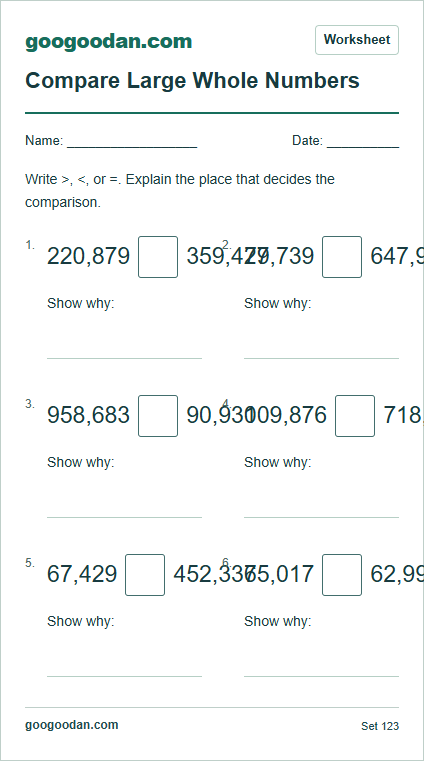 Calculation practice
Comparing Large Whole Numbers
Compare numbers below one million using place value.
6 problems · Answer key included
Grade 5 · Round decimals to whole numbers and tenths
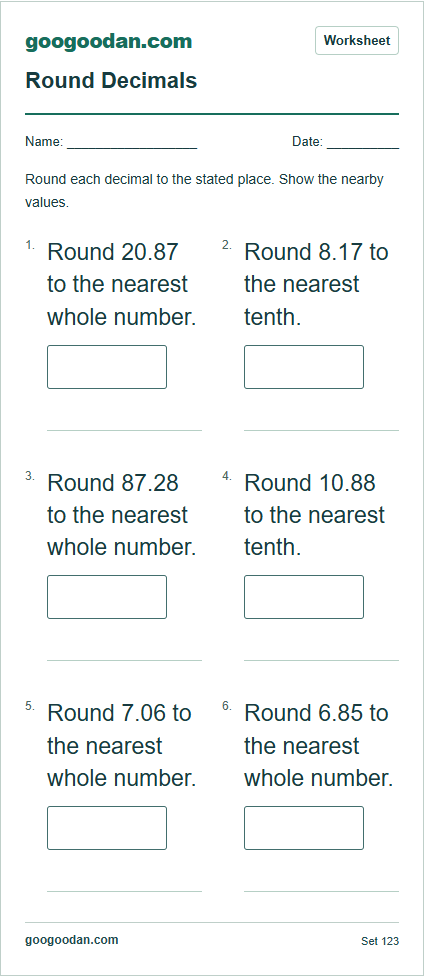 Calculation practice
Rounding Decimals
Round to a whole number or tenth using nearby values.
6 problems · Answer key included
Grade 1 · Compare two-digit numbers
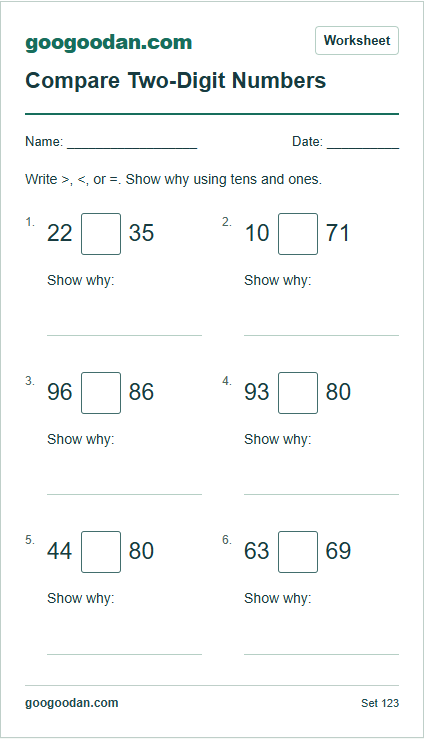 Calculation practice
Comparing Two-Digit Numbers
Compare tens first, then ones, using numbers from 10 to 99.
6 problems · Answer key included
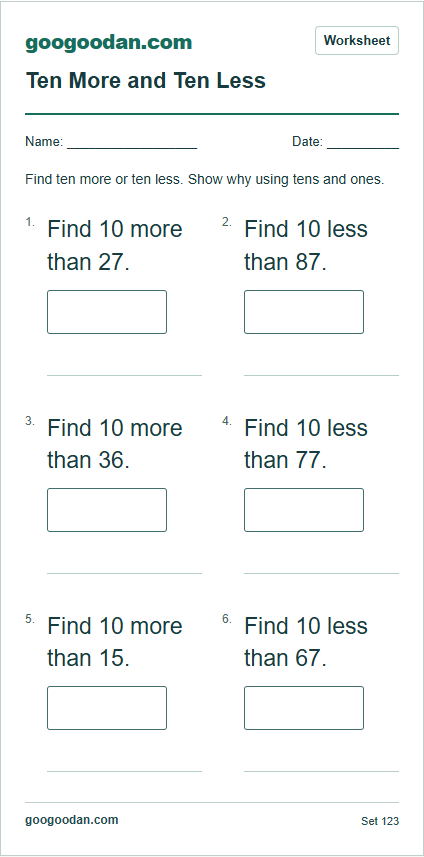
Grade 1 · Ten more and ten less
 Calculation practice
Ten More and Ten Less
Change one ten and keep the ones the same.
6 problems · Answer key included
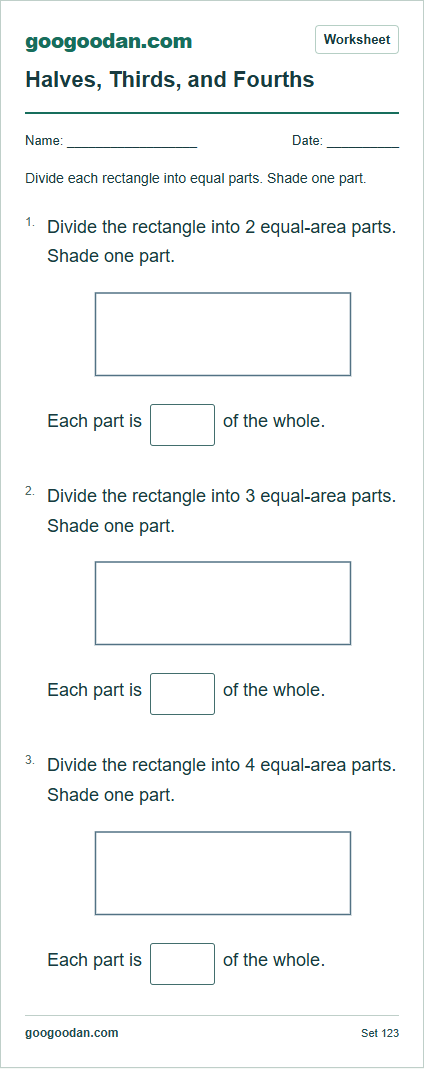
Grade 2 · Halves, thirds, and fourths
 Drawing activity
Halves, Thirds, and Fourths
Divide rectangles into equal parts and shade one part.
3 problems · Answer key included
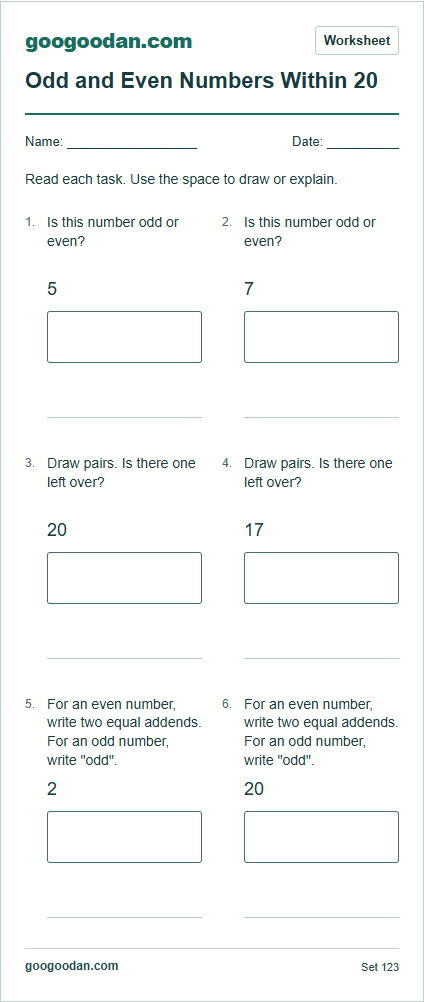
Grade 2 · Odd and even groups
 Drawing and number activity
Odd and Even Numbers Within 20
Classify numbers, draw pairs, and write equal addends.
6 problems · Answer key included
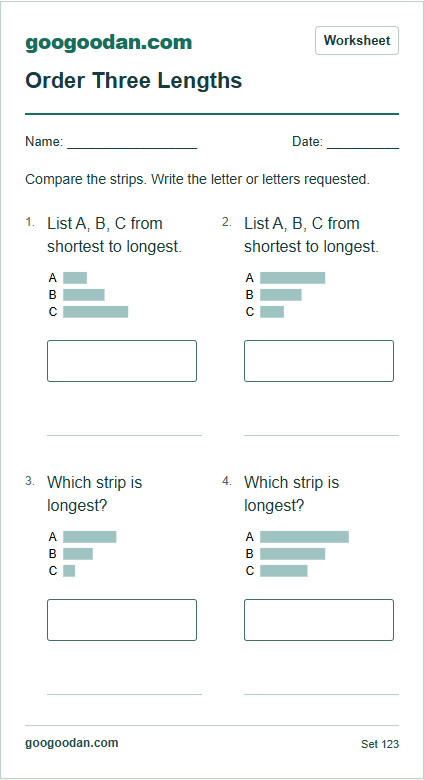
Grade 1 · Order three lengths
 Picture activity
Ordering Three Lengths
Order three aligned strips and find the longest.
4 problems · Answer key included
Grade 2 · Read and compare graph data
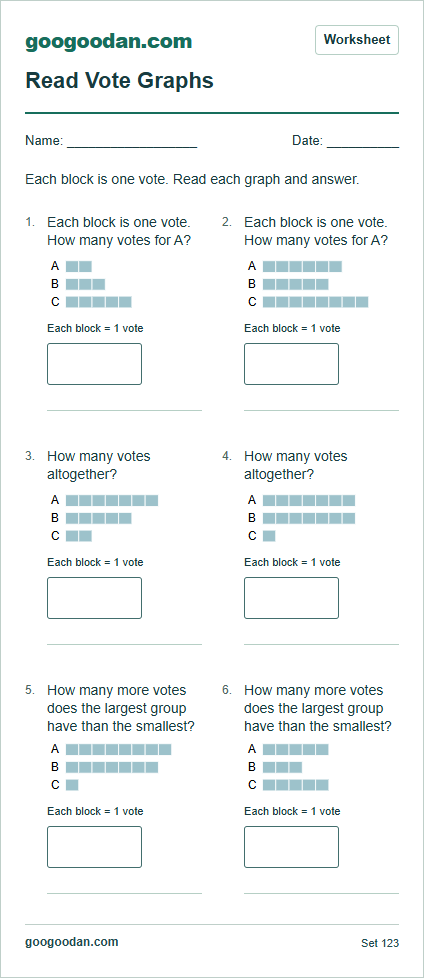 Picture activity
Reading Vote Graphs
Count votes, find totals, and compare groups in unit-block graphs.
6 problems · Answer key included
Grade 2 · Read measurement line plots
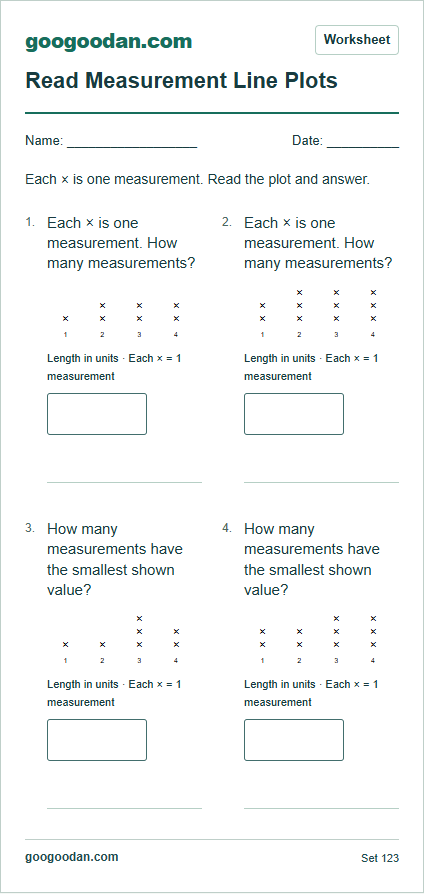 Picture activity
Reading Whole-Number Line Plots
Count measurements and read the frequency of a length.
4 problems · Answer key included
Grade 1 · Understand the equal sign
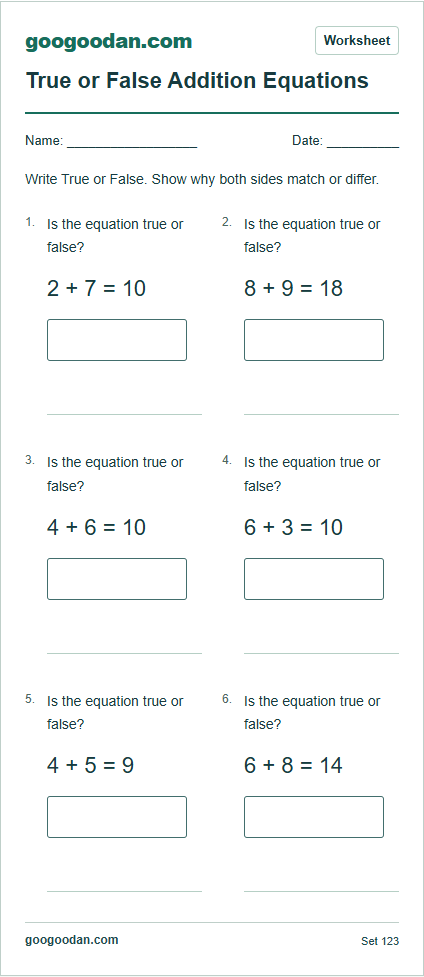 Calculation practice
True or False Addition Equations
Compare both sides of an addition equation and explain whether they match.
6 problems · Answer key included
Grade 3 · Missing factors and dividends
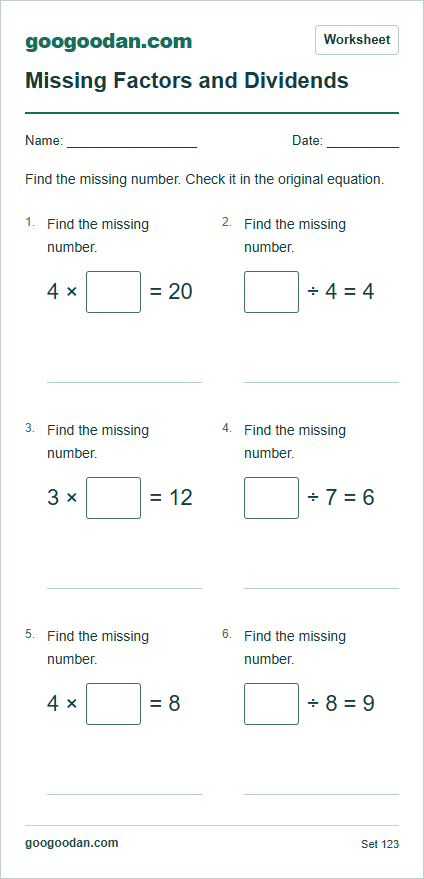 Calculation practice
Missing Factors and Dividends
Use related multiplication and division facts to find the missing number.
6 problems · Answer key included
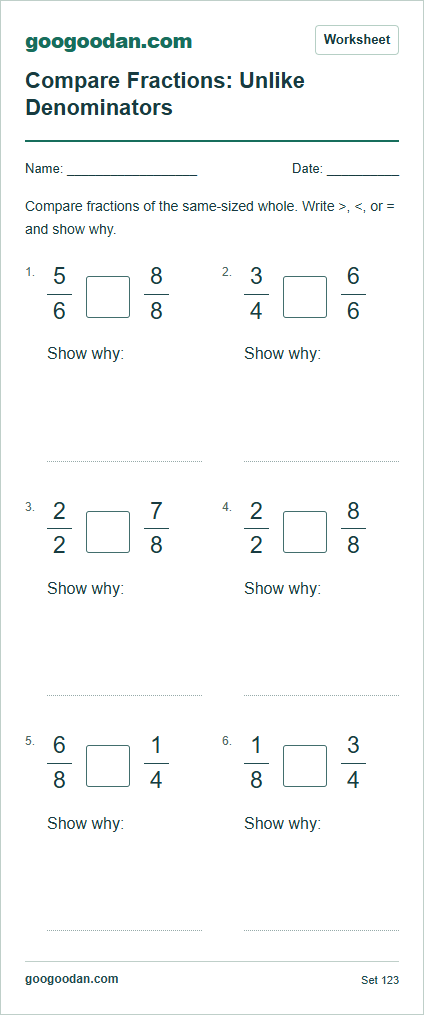
Grade 4 · Compare fractions with unlike denominators
 Calculation practice
Comparing Fractions with Unlike Denominators
Compare fractions using equivalent fractions or a common benchmark.
6 problems · Answer key included
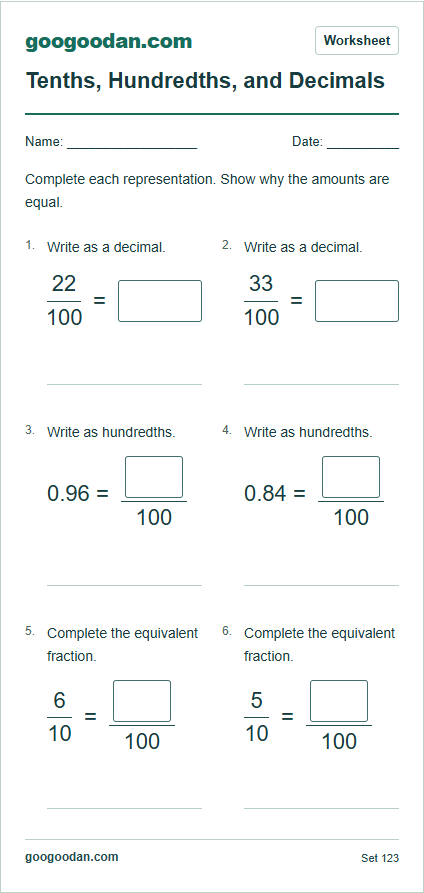
Grade 4 · Tenths, hundredths, and decimals
 Calculation practice
Tenths, Hundredths, and Decimals
Connect hundredths to decimals and rename tenths as hundredths.
6 problems · Answer key included
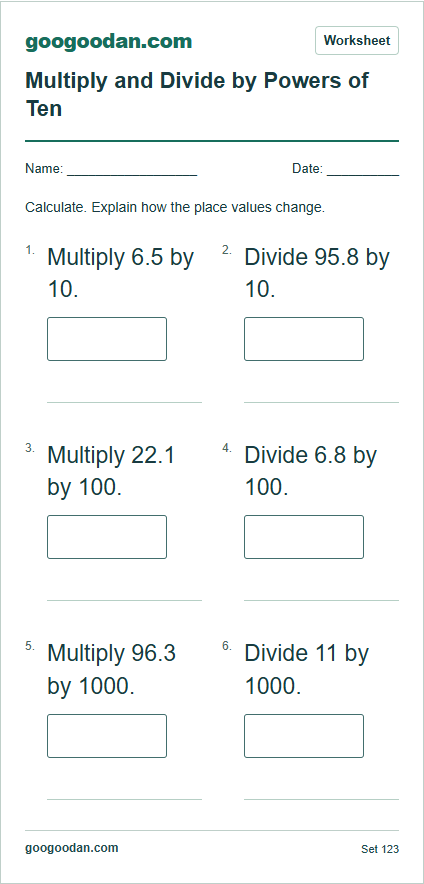
Grade 5 · Multiply and divide by powers of ten
 Calculation practice
Multiply and Divide by 10, 100, and 1,000
Explain place-value changes when multiplying and dividing by powers of ten.
6 problems · Answer key included
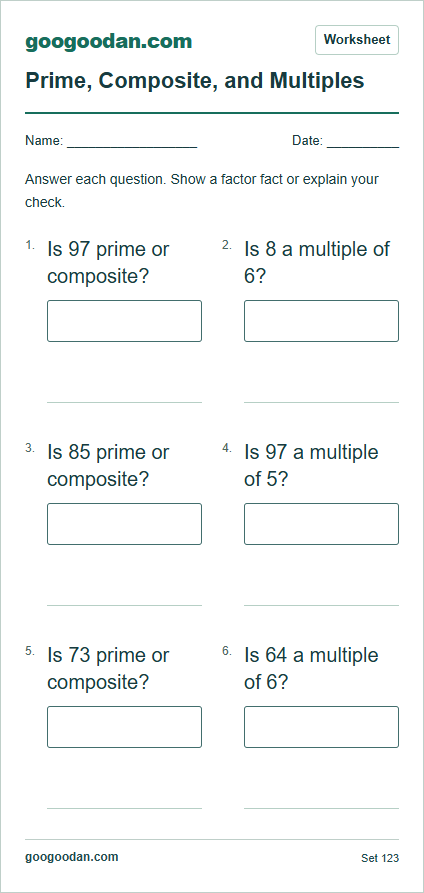
Grade 4 · Prime, composite, and multiples
 Calculation practice
Prime, Composite, and Multiples
Classify numbers and test multiples using factor facts.
6 problems · Answer key included
Grade 3 · Quadrilateral families
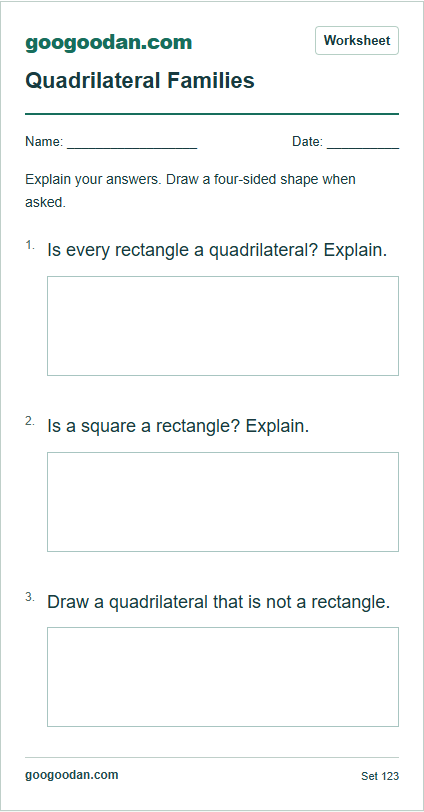 Drawing activity
Quadrilateral Families
Explain rectangle and square families, then draw a different quadrilateral.
3 problems · Answer key included
Grade 2 · 10 or 100 more or less
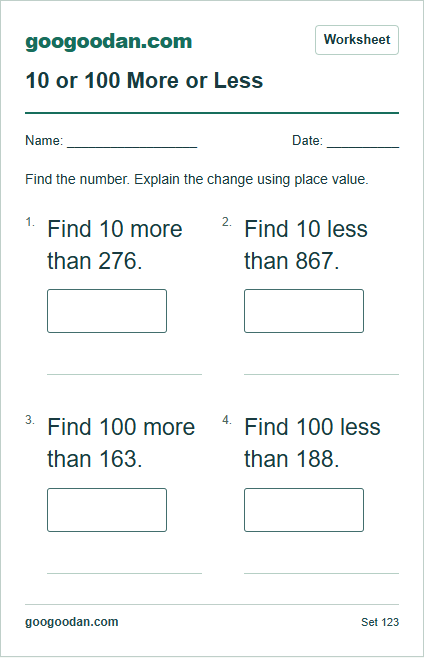 Calculation practice
10 or 100 More or Less
Add or remove one ten or one hundred using place value.
4 problems · Answer key included
Grade 2 · Count forward by 5, 10, and 100
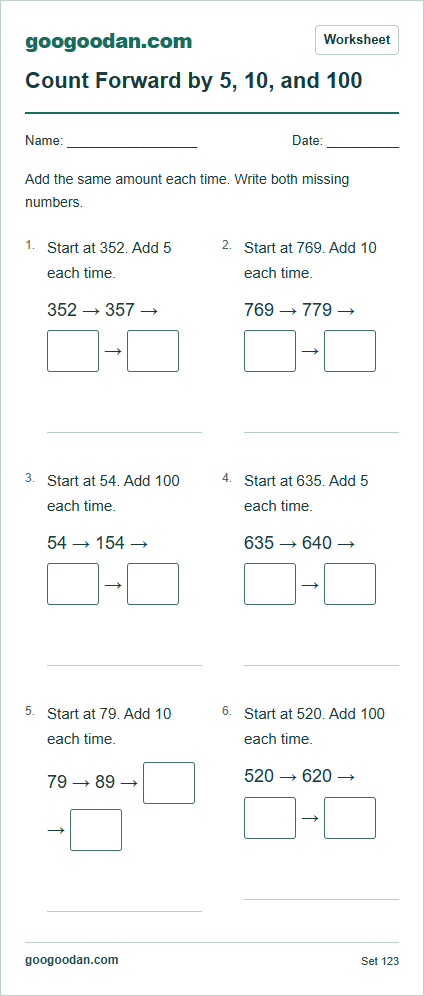 Calculation practice
Count Forward by 5, 10, and 100
Complete two missing numbers in each equal-jump sequence.
6 problems · Answer key included
Grade 3 · Elapsed time word problems
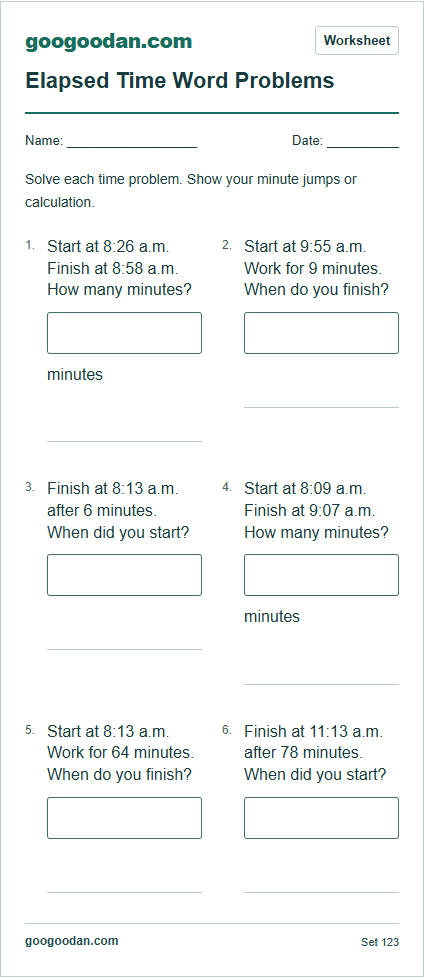 Word problems
Elapsed Time Word Problems
Find elapsed minutes, starting times, and finishing times.
6 problems · Answer key included
Grade 2 · Three-digit number names
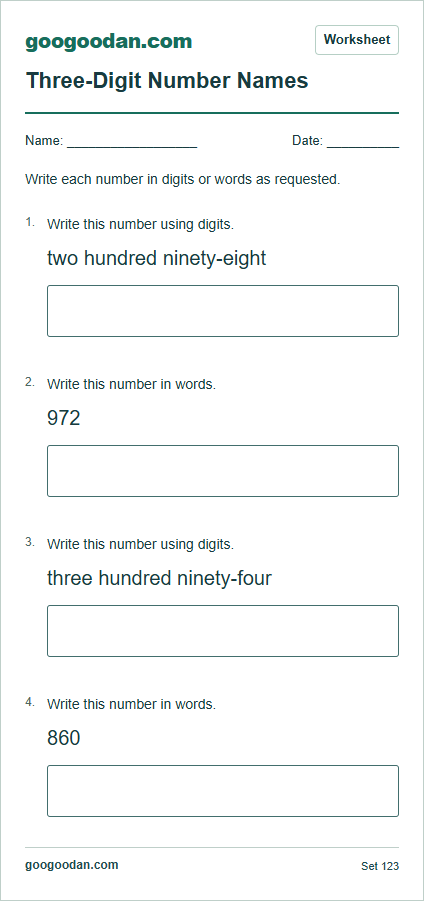 Writing activity
Three-Digit Number Names
Read and write three-digit numbers in digits and words.
4 problems · Answer key included
Grade 4 · Lines of symmetry
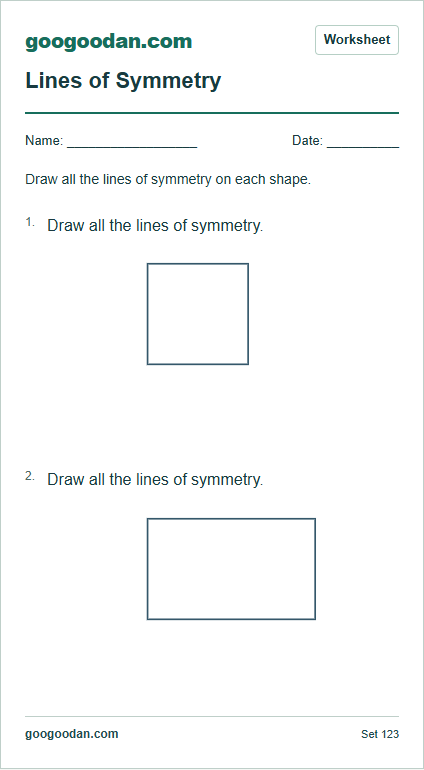 Drawing activity
Square and Rectangle Symmetry
Draw all symmetry lines on two original shapes.
2 problems · Answer key included
Grade 4 · Lines, rays, and segments
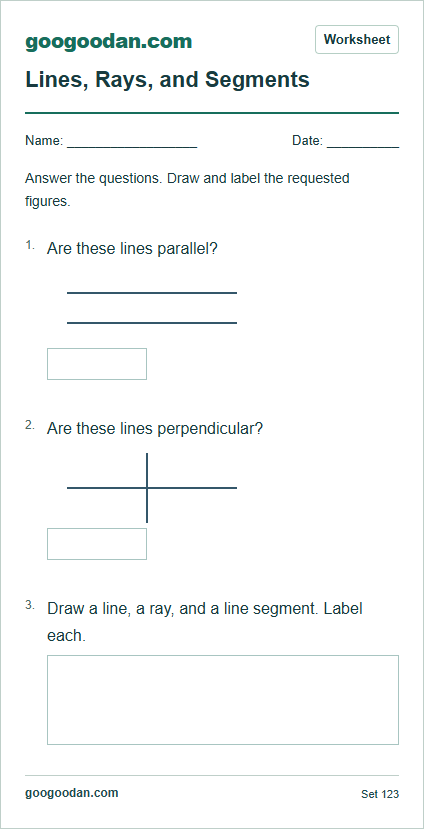 Drawing activity
Lines, Rays, and Segments
Identify parallel and perpendicular lines, then draw three types of figures.
3 problems · Answer key included
Grade 1 · Build and draw shapes
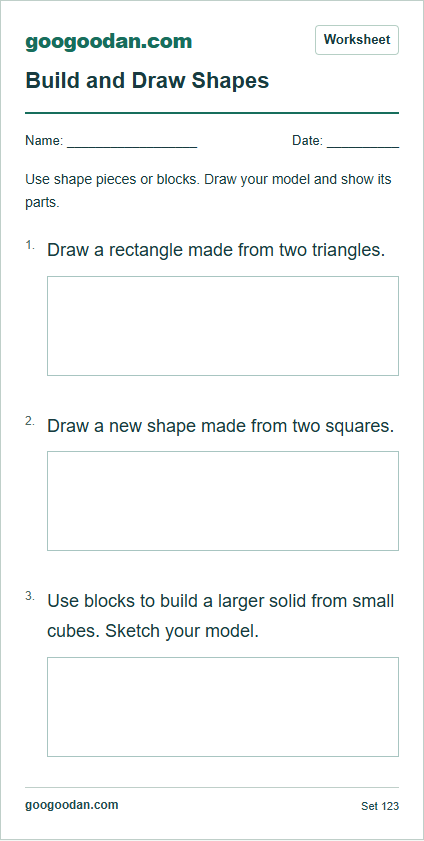 Drawing activity
Build and Draw Shapes
Join triangles, squares, and cubes, then sketch your models.
3 problems · Answer key included
Grade 4 · Measurement unit conversions
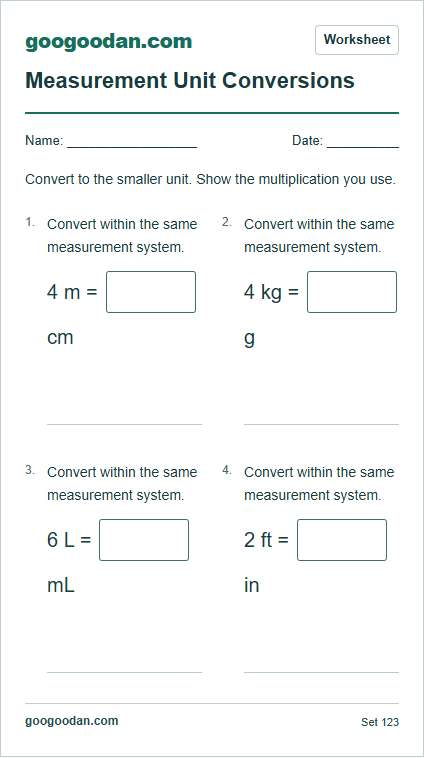 Calculation practice
Measurement Unit Conversions
Convert four larger units to smaller units within the same system.
4 problems · Answer key included
Grade 4 · Measure and draw angles
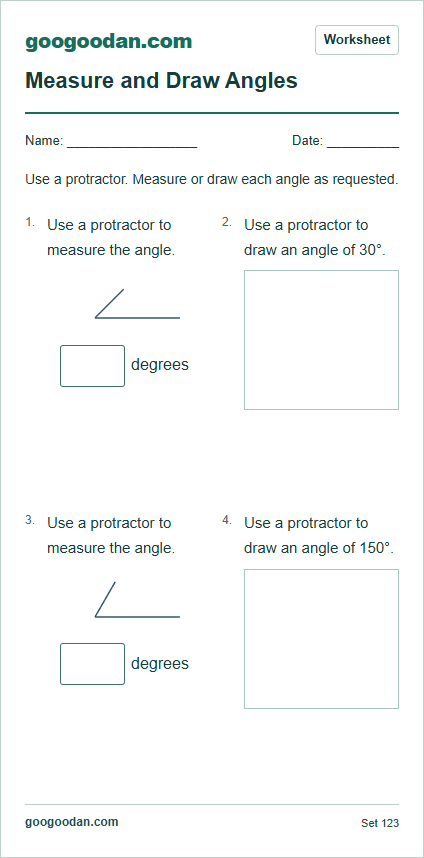 Drawing activity
Measure and Draw Angles
Use a protractor to measure two angles and draw two more.
4 problems · Answer key included
Grade 3 · Read fraction measurement plots
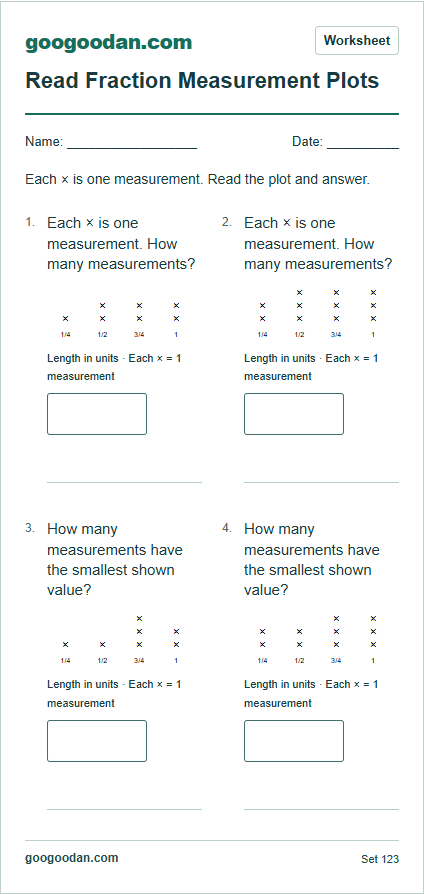 Picture activity
Read Fraction Measurement Plots
Count measurements and read quarter-unit labels on original plots.
4 problems · Answer key included
Grade 2 · Estimate and measure length
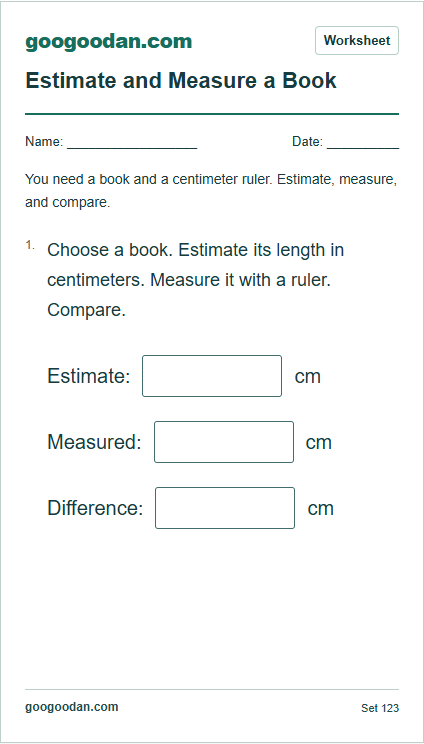 Hands-on activity
Estimate and Measure a Book
Estimate, measure, and compare one book edge in centimeters.
1 problems · Answer key included
Grade 2 · Sides, corners, and faces
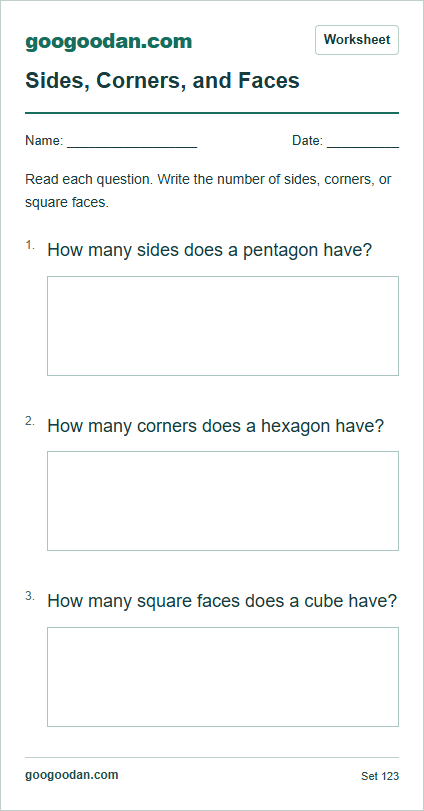 Shape practice
Sides, Corners, and Faces
Review pentagon sides, hexagon corners, and cube faces.
3 problems · Answer key included
Grade 4 · Compare decimals through hundredths
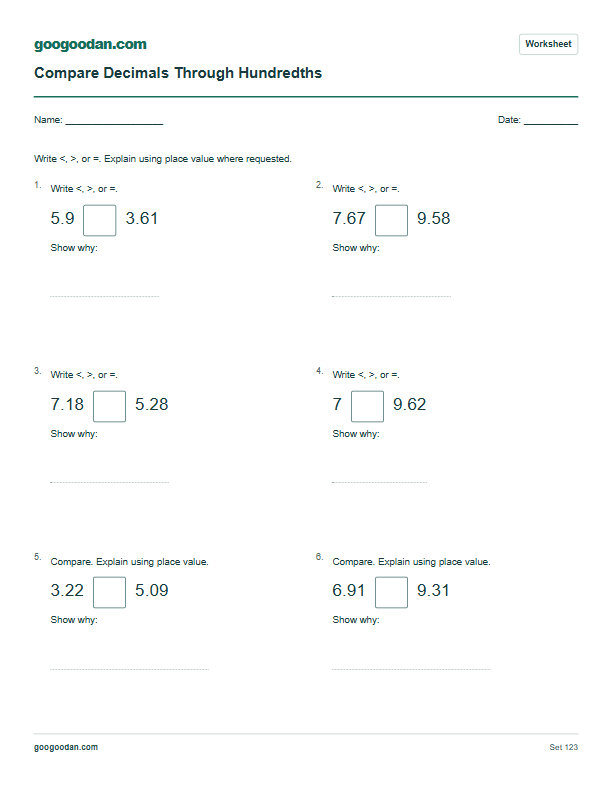 Number practice
Compare Decimals Through Hundredths
Compare matching places and explain your reasoning.
6 problems · Answer key included
Grade 5 · Convert to larger units
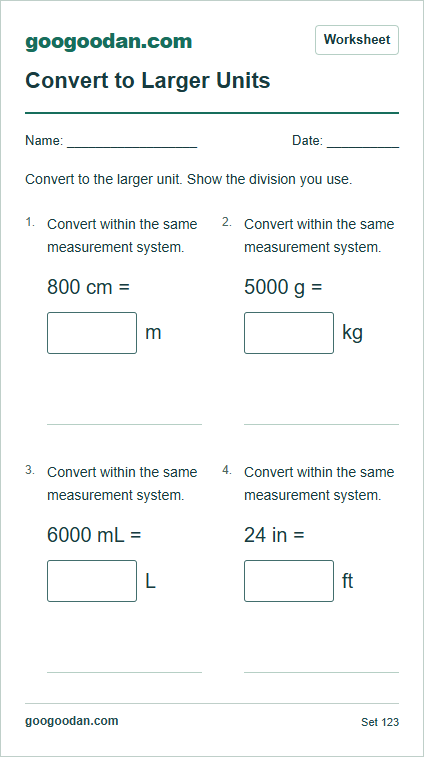 Measurement practice
Convert to Larger Units
Convert cm to m, g to kg, mL to L, and inches to feet.
4 problems · Answer key included