
Adding and Subtracting Decimals Word Problems Worksheets
Help a child turn a cable-length story into an equation. Add or subtract through hundredths, explain why decimal points line up, and check the remaining or combined length in feet.
What changes when the amounts have decimal parts?
Maya is checking cable lengths for a school display. One piece measures 6.78 feet, and another measures 2.46 feet. She knows she needs the combined length, so she chooses addition. Her first answer is 8.124: she has added 6 and 2, then written 78 plus 46 after the decimal point.
The operation is right, but the place values need attention. A hundredth of a foot is a fixed-size unit. One hundred hundredths make a whole foot, and ten hundredths make one tenth. The digits after the decimal point are not a separate whole number that can simply be attached to the answer.
Build the total from equal-sized units
6.78: 6 ones + 7 tenths + 8 hundredths.
2.46: 2 ones + 4 tenths + 6 hundredths.
6.78 + 2.46 = 9.24
- 8 hundredths + 6 hundredths = 14 hundredths. Keep 4 hundredths and exchange 10 hundredths for 1 tenth.
- 7 tenths + 4 tenths + the new tenth = 12 tenths. Keep 2 tenths and exchange 10 tenths for 1 whole.
- 6 wholes + 2 wholes + the new whole = 9 wholes.
The result is 9 wholes, 2 tenths, and 4 hundredths: 9.24 feet.
Line up decimal points because place values must match
Write each amount with ones beneath ones, tenths beneath tenths, and hundredths beneath hundredths. Lining up the decimal points is a useful way to do this, but the reason is the matching units. Adding 8 hundredths to 4 tenths would combine different-sized units without first renaming them.
If a number has fewer written decimal places, adding a zero at the end does not change its value: 2.4 = 2.40. That zero records zero hundredths; it does not make the number ten times larger. On this worksheet, the given lengths already have two decimal places. The answer key may leave off a final zero, so an answer of 7.5 is equivalent to 7.50.
Subtracting across a zero
Later, the warehouse has 8.03 feet of cable and ships 2.78 feet to a customer. Maya tries taking the smaller digit from the larger digit in each column. That shortcut loses which length is being removed. Keep the starting amount at the top and rename its units instead.
8.03 − 2.78 = 5.25
- Start with 8 wholes, 0 tenths, and 3 hundredths.
- Exchange 1 whole for 10 tenths. There are now 7 wholes, 10 tenths, and 3 hundredths.
- Exchange 1 tenth for 10 hundredths. There are now 7 wholes, 9 tenths, and 13 hundredths. The value is still 8.03.
- Subtract like units: 13 − 8 = 5 hundredths; 9 − 7 = 2 tenths; 7 − 2 = 5 wholes.
Check: 5.25 + 2.78 = 8.03. The remaining length and the shipped length reconstruct the starting length.
Crossed-out digits and small regrouping marks record these exchanges. If the child cannot explain a mark, return to wholes, tenths, and hundredths. “Borrow from the next digit” is not enough when that digit is zero; the child needs to know which larger unit can be exchanged.
Choose the relationship before calculating
A delivery adds cable to the stored amount. A shipment takes cable away from it. Have the child identify the starting amount, the change, and the unknown length, then write an equation. These are one-step addition and subtraction stories; they do not require a price calculation, an area calculation, or rounding.
Keep feet in the answer. For example, 5.25 feet means five and twenty-five hundredths of a foot, not five feet and twenty-five inches. The decimal part refers to a fraction of the same unit as the whole-number part.
Use an estimate to catch a misplaced decimal point
In the addition example, 6.78 is close to 7 and 2.46 is close to 2.5, so a total near 9.5 is reasonable. An answer of 92.4 would be far too large. An estimate does not replace the exact answer, but it gives the child a way to question a misplaced decimal point before checking the key.
Each printable has four distinct cable-length stories. Given lengths are positive and no more than 20 feet each; addition totals do not exceed 30 feet, and subtraction answers are never negative. Some answers can be whole numbers or zero. Use the work area for aligned calculations or a place-value drawing, and accept equivalent forms such as 4, 4.0, and 4.00 when the value is correct.
Make a practice set
Choose what to print. Selecting both shows the answer key on screen and prints the questions followed by the answers.
After the practice
Ask the child to explain one regrouping mark and check one subtraction with addition. If the calculation is correct but the written decimal differs from the key, compare place values before marking it wrong. Use a fresh set once the child can explain both the operation and the units.
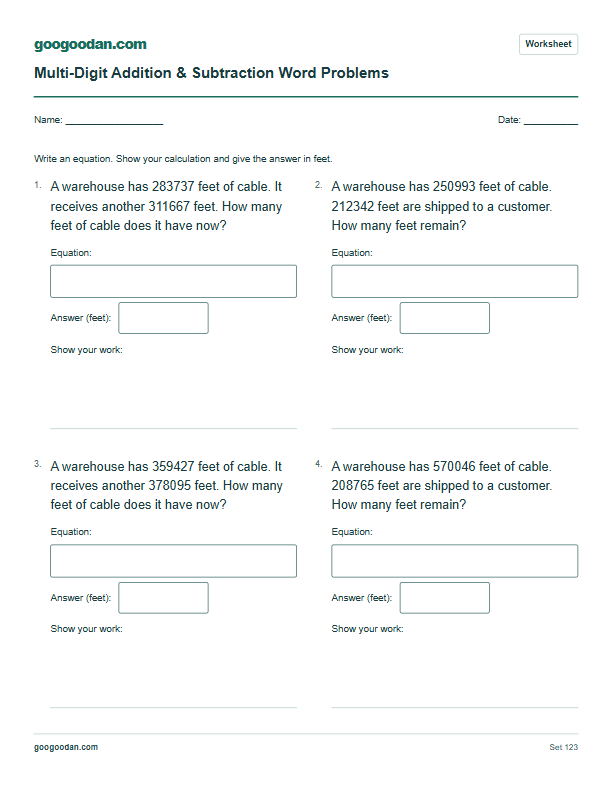 Word problems
Multi-Digit Addition and Subtraction Word Problems
Add and subtract cable lengths within 1,000,000 and label the answer in feet.
4 problems · Answer key included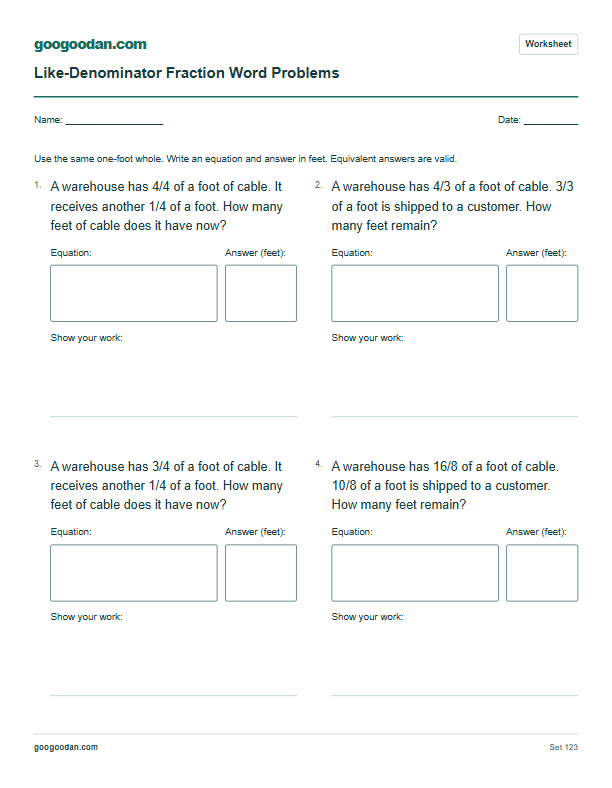 Word problems
Adding and Subtracting Fractions Word Problems With Like Denominators
Combine or remove fractional cable lengths measured using the same one-foot whole.
4 problems · Answer key included
More about addition · Grade 5 worksheets
Grade 5 selected skill connection: 5.NBT.B.7 (addition and subtraction through hundredths in length contexts). See the Common Core grade guidance. This worksheet does not cover every requirement in the standard.