
4th Grade Multi-Digit Addition and Subtraction Word Problems
Read the change in a warehouse’s cable supply, choose an equation, and calculate with place value. The four one-step stories use whole-number lengths within 1,000,000. A large number changes the calculation work, but not the meaning of receiving or shipping cable.
A bigger number still describes a quantity
Maya is helping read a warehouse inventory report. There are 248,650 feet of cable, and another 175,480 feet arrive. She starts lining up digits before deciding what the question asks. Pause to identify the two lengths: the cable already stored and the cable received. Both will be in the warehouse, so the question asks for their combined length.
Stored: 248,650 feet. Received: 175,480 feet.
248,650 + 175,480 = 424,130
The warehouse now has 424,130 feet of cable.
Keep place values aligned when regrouping
Write ones below ones, tens below tens, and continue to the left. In this example, the tens column contains five tens and eight tens. Thirteen tens is one hundred and three tens: write three in the tens place and carry one hundred into the next column. Each exchange keeps the same total value.
The comma groups digits for reading. It does not name a new place or take up a place-value column. An estimate of about 250,000 + 175,000 = 425,000 is close to the exact sum and helps reveal a missing zero or an omitted carry. An estimate supports a check; it is not the exact answer requested.
Shipping removes part of the original length
A second warehouse has 500,000 feet of cable and ships 176,450 feet to a customer. Maya writes an addition equation because the story contains two large numbers. Ask her where the shipped cable is now. It has left the warehouse, so the remaining length must be found by subtraction.
500,000 − 176,450 = 323,550
Check: 323,550 + 176,450 = 500,000.
Zeros do not prevent subtraction. One hundred thousand can be exchanged down through the place-value columns until there are enough tens to remove five tens. The regrouped starting amount can be written as four hundred-thousands, nine ten-thousands, nine thousands, nine hundreds, ten tens, and zero ones. Those parts still total 500,000.
Check the story and the calculation separately
First check whether the equation matches receiving or shipping. Then check the arithmetic with an estimate or inverse operation. Finally read the answer with its unit. The result counts feet of cable, not rolls, dollars, or square feet. No conversion is needed because both lengths already use feet.
Each worksheet has four one-step stories with room for written calculations. Quantities and answers stay within 1,000,000, but a set may include shorter numbers or zero. These are not multi-step inventory problems. The answer key provides the equation and final length; children can compare those with their own written method.
Make a practice set
Choose what to print. Selecting both shows the answer key on screen and prints the questions followed by the answers.
After the practice
Ask the child to explain what each number in one equation represents. If choosing the operation is difficult, use the within-1,000 stories first. If the operation is correct, focus feedback on the specific place-value exchange that needs attention.
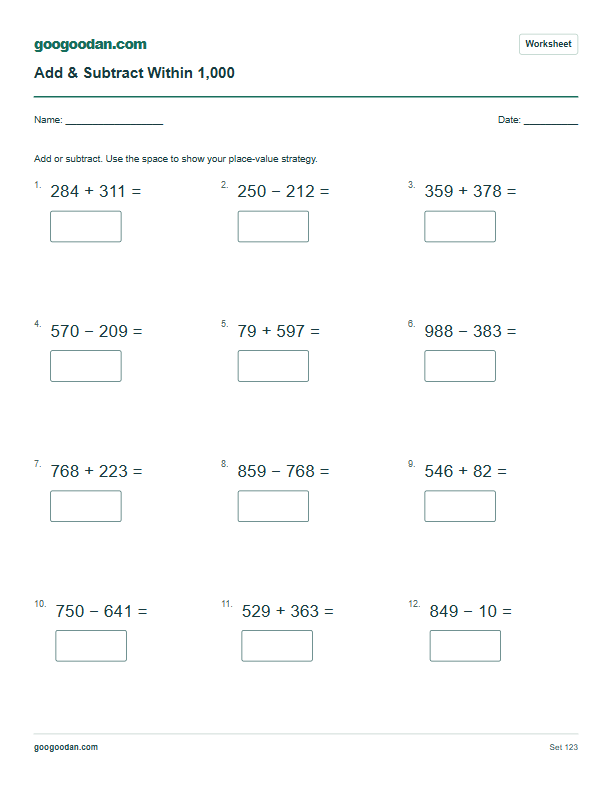 Calculation practice
Addition & Subtraction Within 1,000
Use hundreds, tens, and ones to add or subtract, with room to show your strategy.
12 problems · Answer key included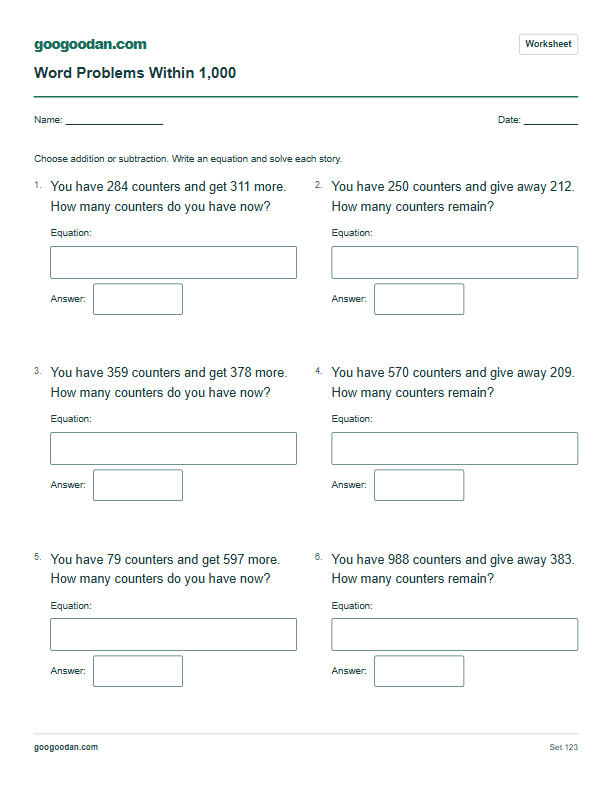 Word problems
Addition and Subtraction Word Problems Within 1,000
Explain a joining or taking-away situation and check the calculation with place value.
6 problems · Answer key included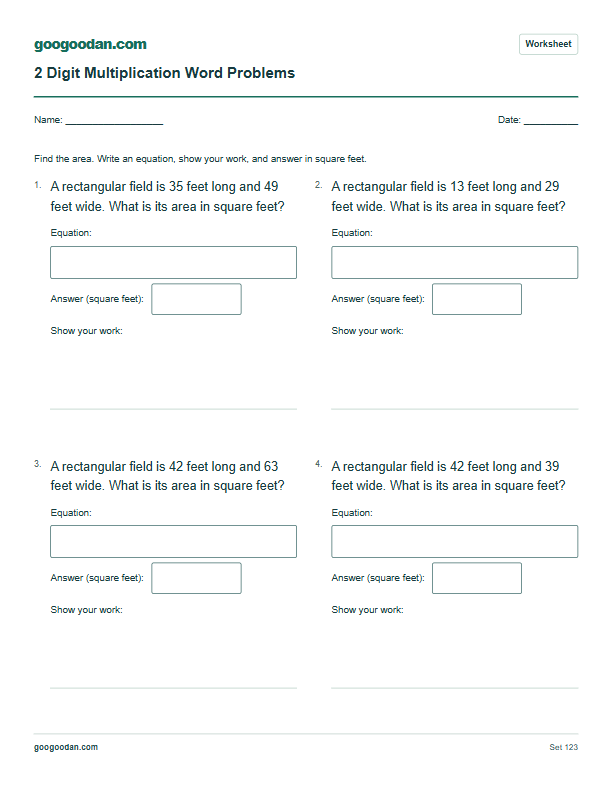 Word problems
2 Digit Multiplication Word Problems: Rectangle Area
Multiply two two-digit side lengths to find a rectangular field’s area in square feet.
4 problems · Answer key included
More about addition · Grade 4 worksheets
Grade 4 selected skill connection: 4.NBT.B.4 (one-step addition and subtraction contexts). See the Common Core grade guidance. This worksheet does not cover every requirement in the standard.