
Addition and Subtraction Worksheets Within 1,000
Use hundreds, tens, and ones to make larger calculations understandable. This mixed set keeps quantities and answers within 1,000 and leaves space for a drawing, a split-number strategy, or a written calculation.
A larger number still has parts you can work with
Jordan sees 368 + 257 and worries that the numbers are too large to hold in mind. Instead of treating each number as one difficult block, separate the second number into two hundreds, five tens, and seven ones. Each part can be added in a manageable step.
368 + 200 = 568
568 + 50 = 618
618 + 7 = 625
All three steps together add 257, so 368 + 257 = 625.
Understand the exchanges in a written method
A written addition method reaches the same result by combining equal place values. Eight ones plus seven ones make fifteen ones: one ten and five ones. Six tens plus five tens plus the exchanged ten make twelve tens: one hundred and two tens. Three hundreds plus two hundreds plus the exchanged hundred make six hundreds.
The result is six hundreds, two tens, and five ones. Naming the units helps a child understand why a small written 1 can represent ten in one column and one hundred in another. Its position gives it its value.
Use the same structure for subtraction
For 602 − 278, a child cannot remove eight ones from two ones without regrouping. There are no tens available, so first exchange one hundred for ten tens. Then exchange one of those tens for ten ones. Six hundred two becomes five hundreds, nine tens, and twelve ones; its total value stays 602.
602 = 500 + 90 + 12
602 − 278 = 324
324 + 278 = 602
Choose a strategy and check the result
Some questions are easier with mental steps. Subtracting 199, for example, can be done by subtracting 200 and adding one back. Other questions may suit a written method. Ask the child to explain one choice rather than requiring the same method on every line.
These twelve horizontal questions allow room for working. The set can include zero and one-, two-, or three-digit numbers, and a quantity can reach 1,000. “Within 1,000” is an upper limit; this is not a set in which every number has exactly three digits. Use addition to check subtraction and compare the result with a rough estimate.
Make a practice set
Choose what to print. Selecting both shows the answer key on screen and prints the questions followed by the answers.
After the practice
Look at the working as well as the answer. If exchanges are unclear, model one calculation with hundreds, tens, and ones. When calculation is secure, use the word-problem set to connect those same operations to a situation.
 Calculation practice
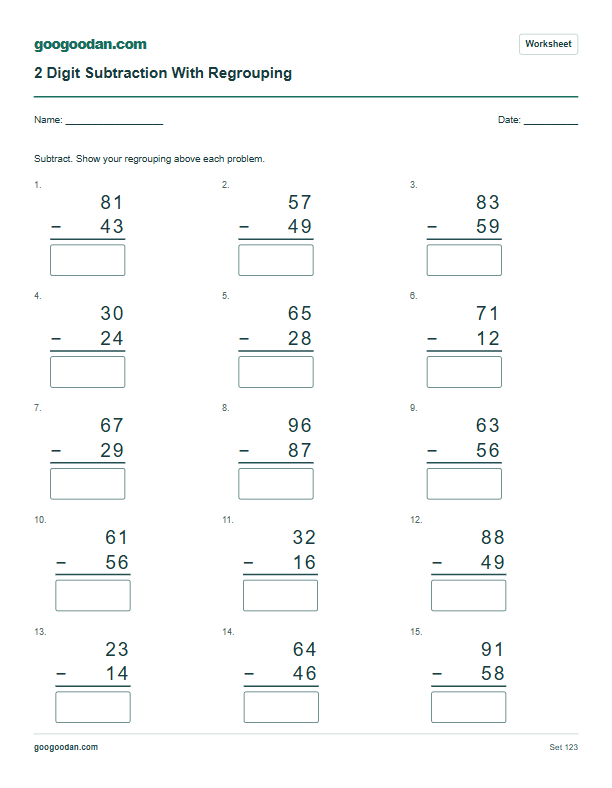
2 Digit Subtraction With Regrouping
Exchange one ten for ten ones and subtract within 100.
15 problems · Answer key included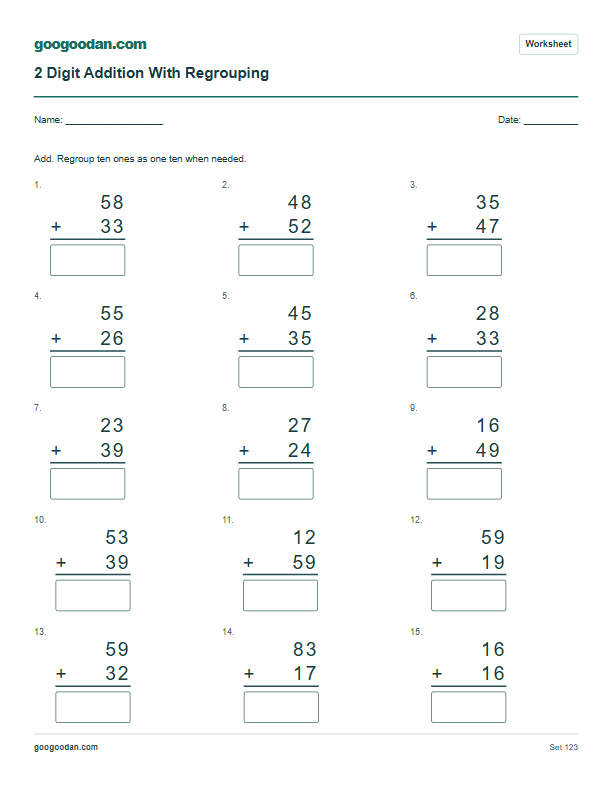 Calculation practice
2 Digit Addition With Regrouping
Exchange ten ones for a ten and keep the total within 100.
15 problems · Answer key included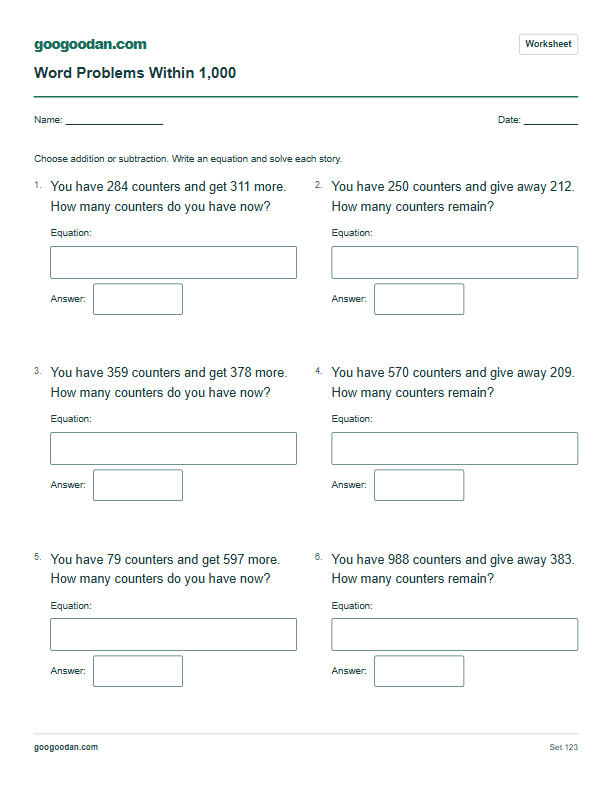 Word problems
Addition and Subtraction Word Problems Within 1,000
Explain a joining or taking-away situation and check the calculation with place value.
6 problems · Answer key included
More about addition · Grade 3 worksheets
Grade 3 selected skill connection: 3.NBT.A.2 (addition and subtraction practice). See the Common Core grade guidance. This worksheet does not cover every requirement in the standard.