
Addition and Subtraction Word Problems Within 1,000
Larger quantities should not hide a simple relationship. Decide whether the story combines counters or takes some away, write an equation, and use place value to calculate. Each of these six stories has one step.
Understand the collection before calculating
During a classroom math project, Elena has 468 counters and receives another 257. She knows the number of counters will increase, but adding every single counter would take too long. An equation records the relationship first; place value then makes the calculation manageable.
Already there: 468 counters.
Added: 257 counters.
468 + 257 = 725
Add 200 to get 668, add 50 to get 718, and add 7 to get 725.
Separate choosing the operation from doing it
Before calculating, ask the child to name the starting collection, the change, and the quantity requested. A sketch can use two labeled boxes rather than hundreds of individual dots. The equation should say how the quantities relate, even if the child has not yet worked out the answer.
If the child chooses addition correctly but writes 615, the difficulty may be exchanging ones or tens. Rebuild the calculation with place-value parts. If the child subtracts accurately, the arithmetic may be fine while the interpretation needs attention. Those two errors call for different help.
Taking away uses part of the starting collection
In a second situation, Elena has 703 counters and gives away 268. The question asks how many remain. Both the counters given away and those remaining came from the original 703, so they must fit back together to make that starting amount.
703 − 268 = 435
435 + 268 = 703
A place-value method rewrites 703 as six hundreds, nine tens, and thirteen ones before subtracting.
The zero in the tens place needs care. Exchange one hundred for ten tens, then one of those tens for ten ones. This preserves the value while making enough ones available. A child may instead subtract in parts or count up; the written work should still account for the full 268.
See why 703 can be regrouped without changing its value
Use base-ten blocks, or draw squares for hundreds, rods for tens, and dots for ones. Start with 7 hundreds and 3 ones. Trade one hundred for 10 tens: 6 hundreds, 10 tens, and 3 ones still make 703. Next trade one of those tens for 10 ones. The drawing below shows 6 hundreds, 9 tens, and 13 ones.
6 × 100 = 600
9 × 10 = 90
13 × 1 = 13
600 + 90 + 13 = 703
Remove 2 hundreds, 6 tens, and 8 ones. That leaves 4 hundreds, 3 tens, and 5 ones: 435.
The regrouping changes the number of blocks in each column, not the total amount. Ask the child to point to the hundred that became ten tens, then the ten that became ten ones. If they write 6 hundreds, 10 tens, and 13 ones, they have added ten extra ones without removing a ten. Count the value of that drawing together before subtracting.
Use the same stories with different learning goals
Grade 2: let the child build or sketch a model and describe each trade. Record an equation alongside the drawing. There is no need to rush through the exchanges. For 468 + 257, combine 4 hundreds, 6 tens, 8 ones with 2 hundreds, 5 tens, 7 ones. The 15 ones become 1 ten and 5 ones; the resulting 12 tens become 1 hundred and 2 tens. The total is 725.
Grade 3: ask the child to choose an accurate, efficient strategy and explain why it works. Compare adding in parts with regrouping, and check subtraction using addition. Use the model again whenever a written step is unclear. These one-step stories support calculation and explanation; they do not assess every requirement of either grade.
Use a check that fits the story
For addition, a rough estimate can reveal a missing hundred. For subtraction, put the remaining amount and the removed amount back together. Finally, read a sentence such as “435 counters remain” so the numerical answer keeps its meaning.
These are one-step joining and taking-away stories. The numbers can include zero or smaller quantities, and all stay within 1,000. The set does not introduce two-step stories or claim to cover every word-problem structure in Grades 2 and 3.
Make a practice set
Choose what to print. Selecting both shows the answer key on screen and prints the questions followed by the answers.
After the practice
Compare a child’s equation with the story before checking the written calculation. Use the mixed calculation set when place-value work needs attention, or a smaller-number story set when identifying the relationship is the harder part.
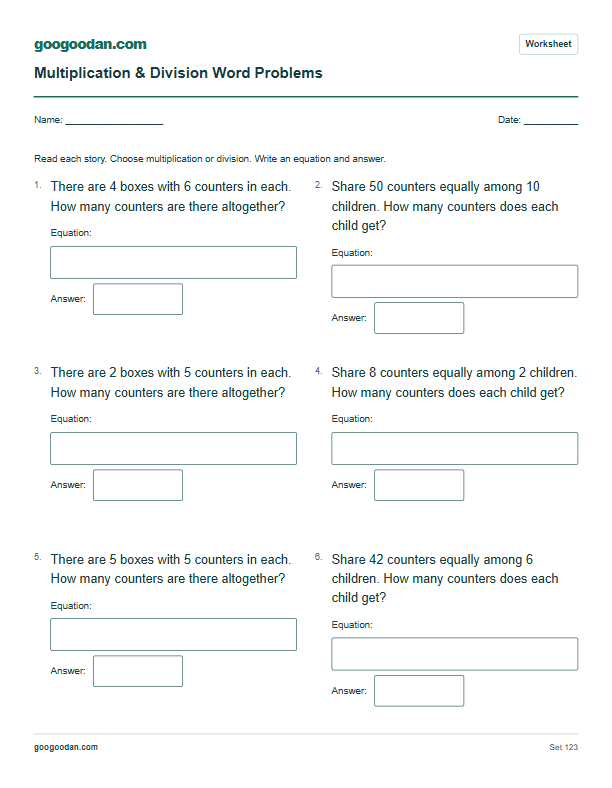 Word problems
3rd Grade Multiplication and Division Word Problems
Choose mixed facts, zero-and-one groups, or two- and three-digit group amounts. Explain what the answer counts.
6 mixed stories or 4 focused multiplication stories · Answer key included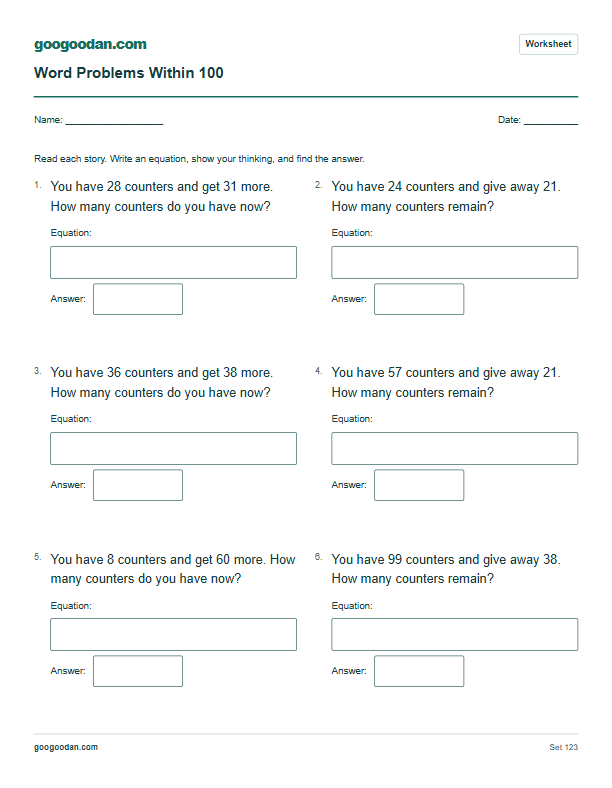 Word problems
Addition & Subtraction Word Problems Within 100
Choose an operation for a joining or taking-away story, then solve within 100.
6 problems · Answer key included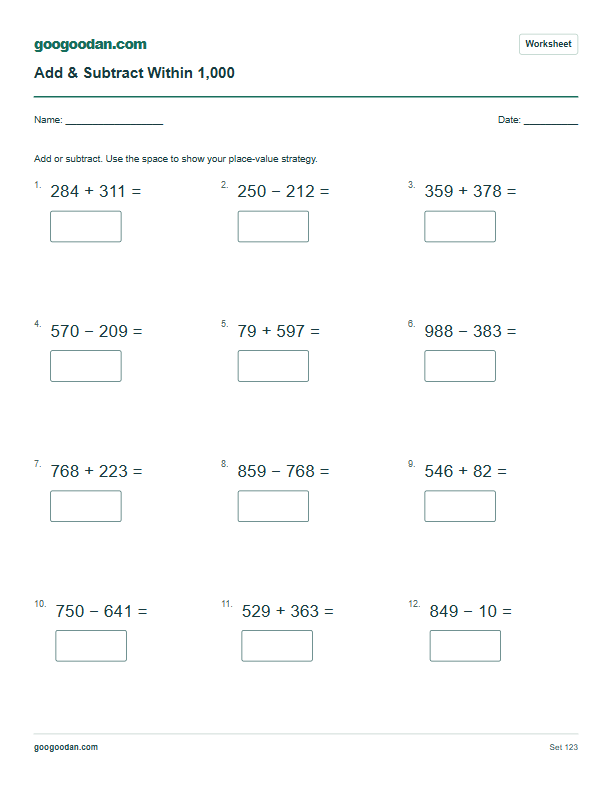 Calculation practice
Addition & Subtraction Within 1,000
Use hundreds, tens, and ones to add or subtract, with room to show your strategy.
12 problems · Answer key included
More about addition · Grade 2 worksheets · Grade 3 worksheets
Grade 2 selected skill connection: Selected 2.NBT.B.7 and 2.NBT.B.9: use models or drawings to explain addition and subtraction within 1,000. See the Common Core grade guidance. This worksheet does not cover every requirement in the standard.
Grade 3 selected skill connection: 3.NBT.A.2 (place-value practice in one-step contexts). See the Common Core grade guidance. This worksheet does not cover every requirement in the standard.