
3rd Grade Multiplication and Division Word Problems
Teach your student to identify the groups, group size, and total before calculating.
Teaching notes for parents and teachers
How to teach it
Draw equal groups and label what the story gives. Use the available activity choices to match the number range to the student's current skills.
Example to work through together
Use the model below as you explain the example. Have your student point to the quantities as you discuss them.
Known: 4 boxes and 6 counters in each box.
Unknown: counters altogether.
4 × 6 = 24
There are 24 counters altogether.
Ask your student
Which quantity is missing from this story?
If your student needs help
If the student adds the two numbers, ask whether each group contains the stated amount.
Choosing and using the worksheet
To practice the inverse relationship, use equal sharing with two-digit answers. That activity gives the total and the number of groups. Here both the group size and group count are known. The change in the unknown quantity explains the change in operation.
The default activity mixes six multiplication and division fact stories. Zero and one uses four small-group multiplication stories. Two-digit group amounts uses four multiplication stories with larger group sizes; it does not contain division, zero groups, or missing factors. At most one question on a sheet uses a single group, which keeps its original amount. A sheet does not guarantee a one-group question or a particular regrouping pattern.
Choose Three-digit group amounts or open the three-digit activity to use the same group-total relationship with larger numbers. Each group contains 100 through 999 items, and there are one through nine groups. The unknown is still the total. Knowing more multiplication facts helps, but naming the place-value units is what keeps the larger calculation meaningful.
Each sheet has four distinct original group-total questions. At most one uses a single group. This activity does not guarantee a particular regrouping pattern or a one-group question, and it does not include zero groups, two-digit multipliers, division, or missing factors. For those learning goals, choose the matching activity rather than assuming a larger number changes the meaning of the question.
Make a practice set
Select the worksheet, answer key, or both. When both are selected, the answer key prints after the questions. Keep it separate if you want your student to work independently.
After your student finishes
Ask the child to explain why the operation fits before checking the arithmetic. If a story is difficult, label a simple group drawing with the known quantities and leave a question mark for the unknown. Return to fact practice only if choosing the operation is already secure.
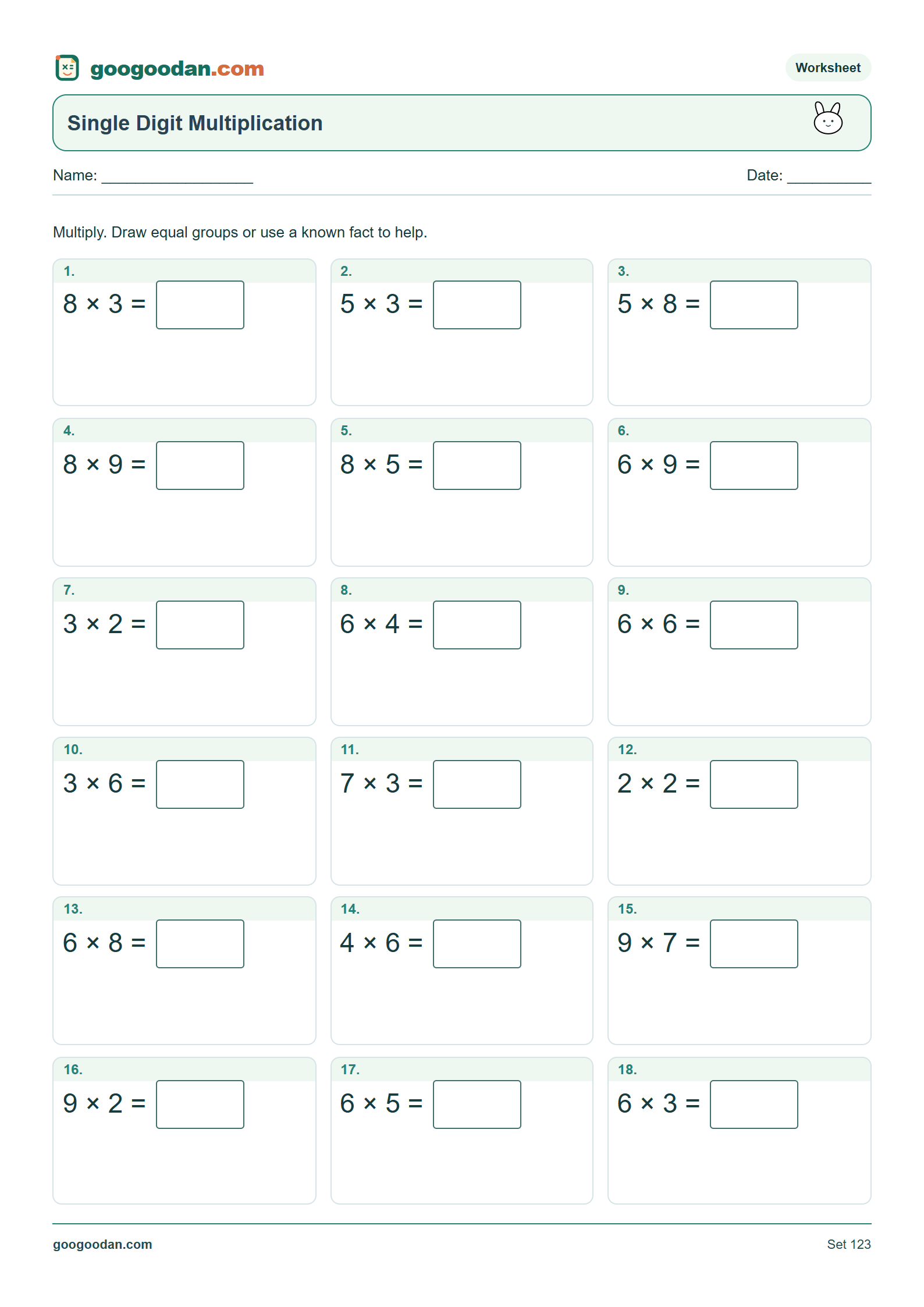 Calculation practice
Single Digit Multiplication Worksheets
Use equal groups and arrays to practice multiplication facts with factors from 2 to 9.
18 problems · Answer key included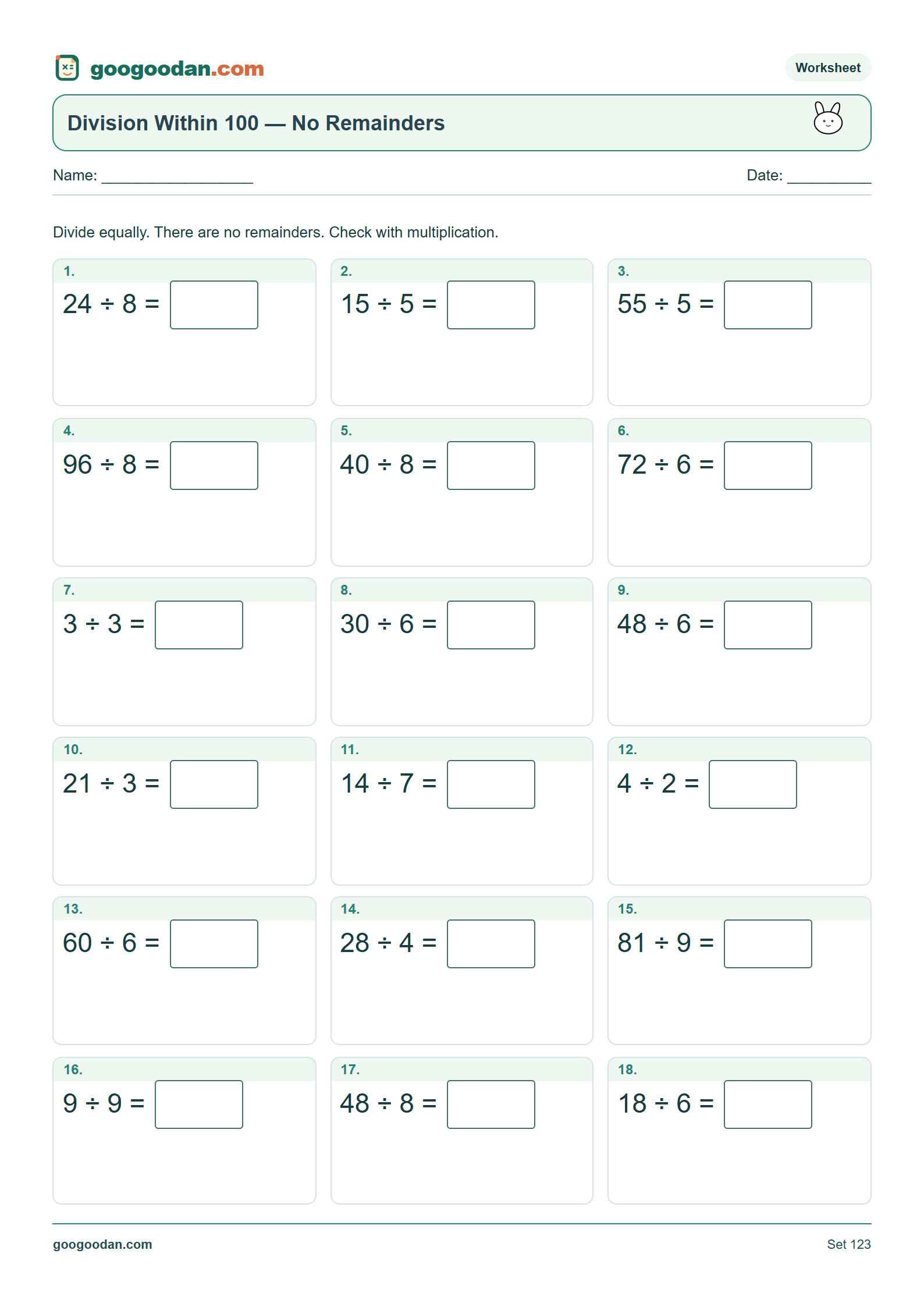 Calculation practice
Division Without Remainders Worksheets
Share equally or make equal groups, then check each quotient with multiplication.
18 problems · Answer key included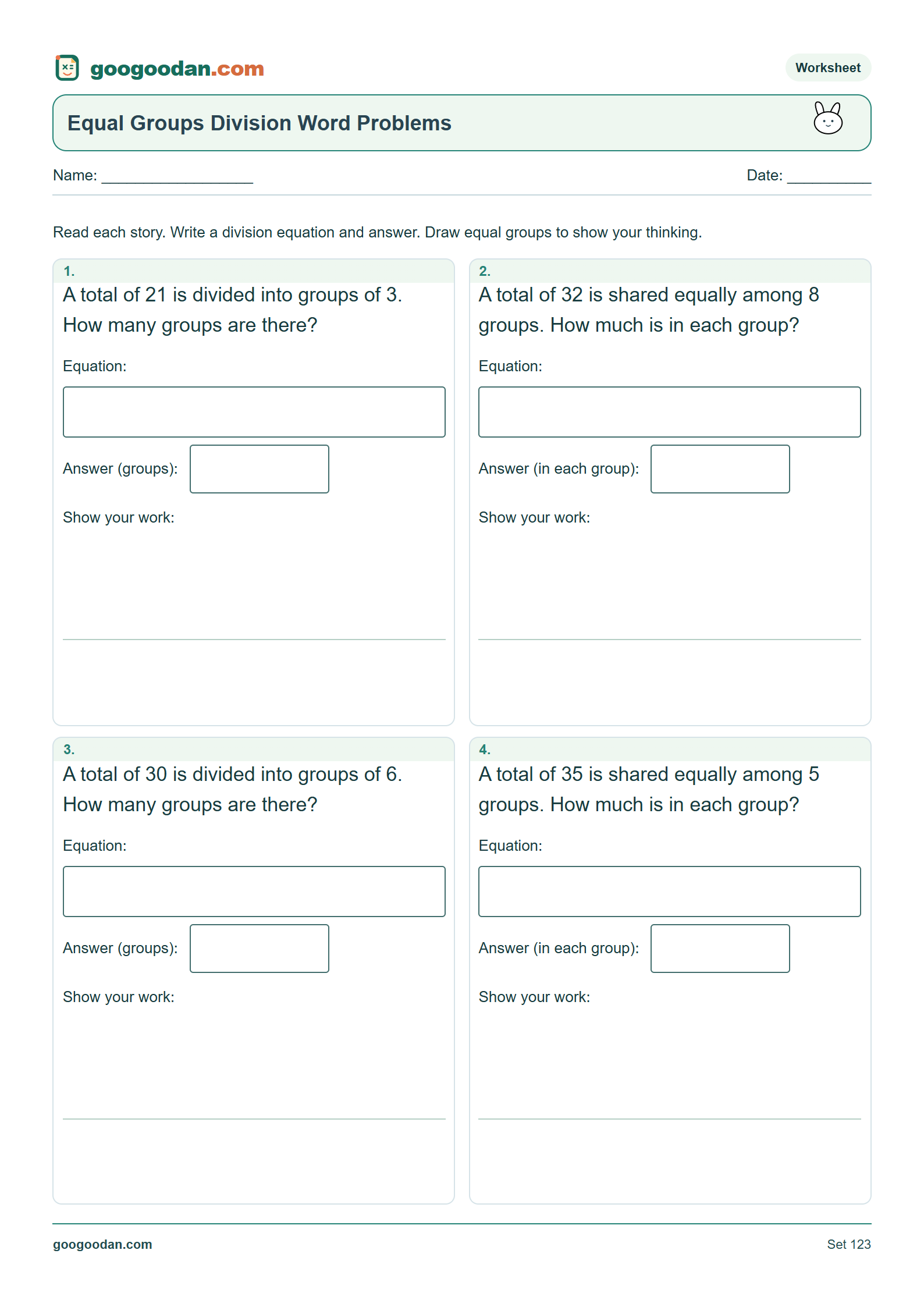 Word problems
Equal Groups Division Word Problems
Find group count or group size with division facts, or share larger totals to find two-digit amounts.
4 problems · Answer key included
More about multiplication · Grade 3 worksheets · Grade 4 worksheets
Grade 3 selected skill connection: Default mixed-facts activity: 3.OA.A.3 (equal groups and equal sharing). See the Common Core standards for this grade. This worksheet does not cover every requirement in the standard.
Grade 4 selected skill connection: Supporting 4.NBT.B.5 through two- and three-digit group options: multiply group amounts by 1–9 using place-value strategies. Selected group-total stories only. See the Common Core standards for this grade. This worksheet does not cover every requirement in the standard.