
Single Digit Multiplication Worksheets
Multiplication counts equal groups. Connect the factors to a picture, then practise facts with both factors from 2 through 9. The worksheet has room to sketch a strategy instead of guessing a fact.
Four groups of six are more than four plus six
Liam is packing four snack bags for a picnic. Each bag needs six crackers. He writes 4 + 6 = 10 and starts counting out ten crackers, but the bags are not full. The two numbers describe different things: four is the number of bags, and six is the number in each bag.
Each outlined group represents one bag. Count six crackers in each of the four bags.
6 + 6 + 6 + 6 = 24
4 × 6 = 24
The multiplication sign connects a number of equal groups with the amount in each group. Four groups of six contain twenty-four objects altogether. Adding 4 and 6 combines two numbers once; it does not count six objects four times.
Move from separate groups to an array
Arrange the crackers into four rows with six in every row. The total stays 24. This row-and-column arrangement is called an array. It helps a child see the equal groups and keeps objects from being counted twice.
Turn the array a quarter turn and it shows six rows of four. That is why 4 × 6 and 6 × 4 have the same product. The picnic story still has four bags with six in each; rotating the array changes how we group the objects, not their total.
Use a fact the child already knows
If 4 × 6 is hard to recall, start with 2 × 6 = 12. Two groups of six make twelve, and two more groups of six make another twelve. Doubling twelve gives 24. For 7 × 6, split seven groups into five groups and two groups: 30 + 12 = 42.
Build accuracy before rushing
Use a small group of problems at first. Let the child explain a strategy for one uncertain fact, then try that fact again later without the picture. Faster recall is useful, but a time limit is not part of this printable set.
Both factors in these worksheets are whole numbers from 2 to 9, so products range from 4 to 81. This set does not include the zero and one facts or a complete times-table chart. The answer key gives each product in the same order as the questions.
Make a practice set
Choose what to print. Selecting both shows the answer key on screen and prints the questions followed by the answers.
After the practice
Choose one product and ask the child to name its equal groups. Then use the same numbers in a division question: if 4 × 6 = 24, how many are in each of four equal groups of 24 objects? Use the related division set to make that connection.
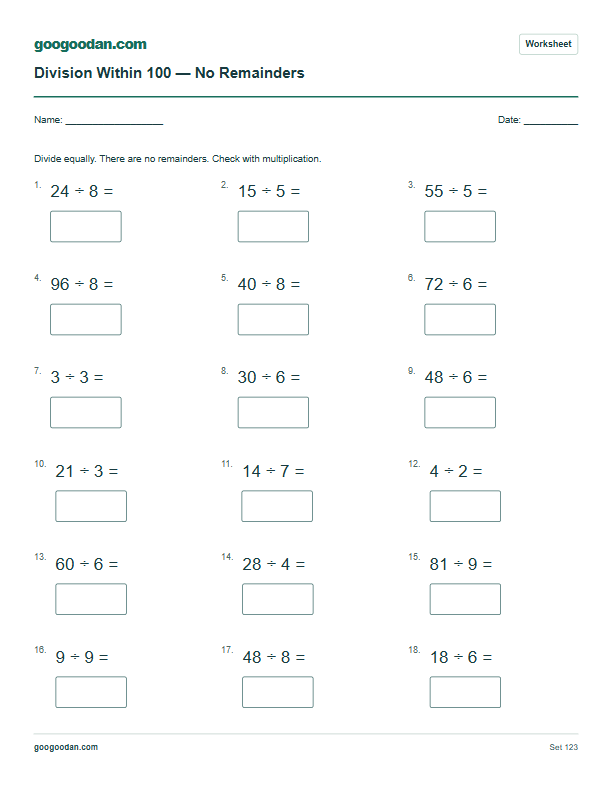 Calculation practice
Division Without Remainders Worksheets
Share equally or make equal groups, then check each quotient with multiplication.
18 problems · Answer key included
More about multiplication · Grade 3 worksheets
Grade 3 selected skill connection: 3.OA.C.7 (selected fact practice). See the Common Core grade guidance. This worksheet does not cover every requirement in the standard.