
Division Worksheets Within 100 Without Remainders
Division can tell how many belong in each group or how many groups can be made. These whole-number problems divide evenly, with totals no greater than 100 and one-digit divisors from 2 through 9.
Same counters, two different questions
Zoe has 18 counters and three small plates. She wants every plate to have the same number. She deals one counter onto each plate, then goes around again until none are left. Each plate ends with six counters.
Three plates, six counters on each, eighteen altogether.
18 ÷ 3 = 6
3 × 6 = 18
In this question, 18 is the total and 3 is the number of equal groups. The quotient, 6, is the number in each group. Counting all the counters again gives the total, not the answer to “How many on each plate?”
What if each group must contain six?
Keep the same 18 counters, but change the question: make groups of six and count how many groups are possible. Zoe can make three groups, so 18 ÷ 6 = 3. The same picture helps answer both questions, but the unknown is different.
Ask the child to finish one sentence before calculating: “I know the number of groups, and I need the number in each,” or “I know the number in each, and I need the number of groups.” The worksheet uses equations; these short stories help explain what an equation can mean.
Use a multiplication fact to check
For 42 ÷ 6, ask “Six times what equals forty-two?” The missing factor is 7, so 42 ÷ 6 = 7. Check by multiplying the divisor, 6, by the quotient, 7. A result of 42 confirms that the groups use the entire total.
For a less familiar fact such as 96 ÷ 8, split the total: 80 ÷ 8 = 10 and 16 ÷ 8 = 2. Together, that makes 12 groups of eight. This set may include quotients up to 12; it is not limited to the facts with quotients up to 9.
What does “without remainders” mean?
All objects fit into equal groups, with none left over. In 7 ÷ 7, there is one group of seven, so the quotient is 1. These worksheets do not include dividing by zero, zero totals, or problems with leftover objects. They are fact practice, not a long-division layout.
Make a practice set
Choose what to print. Selecting both shows the answer key on screen and prints the questions followed by the answers.
After the practice
Ask the child to multiply each uncertain quotient by its divisor. If that does not return the dividend, build the equal groups again. Follow a few division questions with related multiplication facts so both operations refer to the same total and groups.
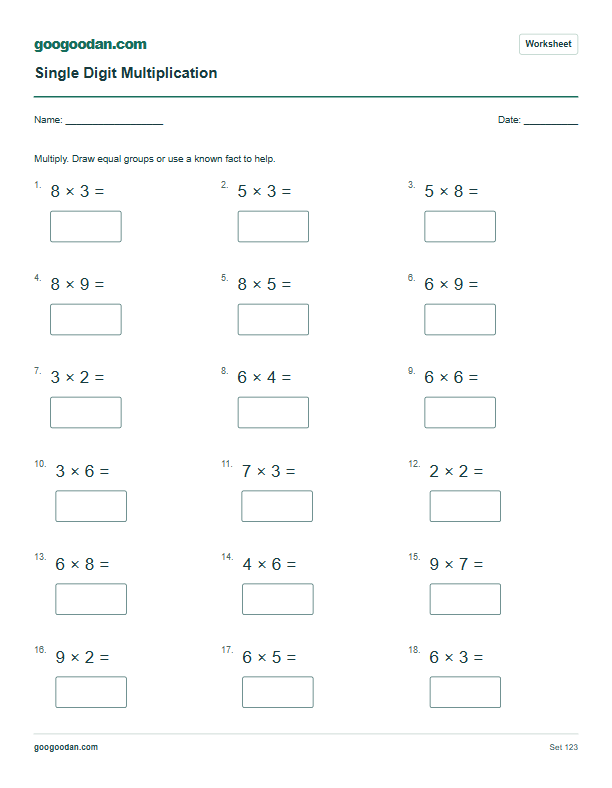 Calculation practice
Single Digit Multiplication Worksheets
Use equal groups and arrays to practise multiplication facts with factors from 2 to 9.
18 problems · Answer key included
More about division · Grade 3 worksheets
Grade 3 selected skill connection: 3.OA.C.7 (selected fact practice). See the Common Core grade guidance. This worksheet does not cover every requirement in the standard.