
3rd Grade Multiplication and Division Word Problems
Choose six multiplication and division stories, or four equal-group stories that explore zero and one. Name the number of groups, the amount in each group, and the total before choosing a calculation. Choose two- or three-digit group amounts for place-value multiplication practice.
The missing quantity decides the operation
Owen is organizing counters for a game. He has four boxes, and each box contains six counters. He can see the number of boxes and the number in each, but he needs the total before starting the game.
Known: 4 boxes and 6 counters in each box.
Unknown: counters altogether.
4 × 6 = 24
There are 24 counters altogether.
Later Owen shares the same 24 counters equally among four children. This time the total and the number of equal shares are known. The amount each child receives is missing: 24 ÷ 4 = 6. Each child receives six counters.
Write the three quantities before the equation
For an equal-group situation, name the number of groups, the amount in each group, and the total. Put a question mark by the missing quantity. If both the number of groups and group size are known, multiply to find the total. If the total and number of groups are known, divide to find the size of a share.
Drawing one box for each group helps distinguish the number of boxes from the counters inside. For division, draw the empty groups first and distribute the total among them. Every group must have the same amount.
Separate the groups from the amount in each
Try this smaller example with Owen: one group contains four counters, and there are three equal groups. Before multiplying, ask him to point to a whole group, then count only the counters inside it.
4 + 4 + 4 = 12
3 × 4 = 12
The repeated addition has three addends because there are three groups. Every addend is four because each group contains four counters. Writing 3 + 4 would add the two labels instead of counting what is in all the groups.
Using the groups-first convention, 3 × 4 describes three groups of four. The reversed calculation, 4 × 3, also gives 12 because changing the order of the factors does not change their product. If we use that same groups-first convention for a drawing, however, 4 × 3 would show four groups of three. The total is the same; the grouping is different.
Check what the answer counts
A number alone can hide a misunderstanding. In 24 ÷ 4 = 6, six is the number of counters per child in this story. If the question instead asked how many groups of four can be made, six would count groups. Both calculations can be correct, but the answer must address the question being asked.
Use the related operation as a check
After finding six counters per child, multiply 4 × 6. The total returns to 24, so all counters have been used. For a multiplication result, divide the total by the number of groups to recover the amount in each group.
The default mixed set includes multiplication factors and division facts from the existing grade-three bank, with values up to ten in the fact pairs. It contains no remainders and no multi-step stories. A worked equation appears in the answer key; a child may use drawings, repeated addition, or a known fact to arrive at the same result.
What happens with zero or one?
The optional Zero and one activity uses four multiplication stories. Each has a picture of the groups, a place for an equation, and space to explain the total. Select it below or open the zero-and-one activity. The usual six mixed multiplication and division stories remain available.
Empty groups are still groups
0 × 5 = 0
There are five outlined groups, but none contains an item. Counting the outlines gives five groups; it does not give five items. The total asked for is the number of items, which is zero. The small 0 in each box labels an empty group. It is not an item to count.
The original equation is 0 × 5 = 0. Using a groups-first reading, 5 × 0 = 0 also describes five groups of zero. Ask the child to name what each factor means rather than treating a reversed product as a wrong answer. For a repeated-addition check, 0 + 0 + 0 + 0 + 0 is still zero.
One group keeps its contents
3 × 1 = 3
Only one group is present, and it holds three items. Nothing is copied into an extra group, so the total remains three. The equation 3 × 1 = 3 shows one copy of three. This differs from adding one: 3 + 1 would describe an additional item, which the picture does not show.
A single item in every group is another way that one appears. With four groups containing one item each, the total is four. Here one names the size of each group; in the picture above, one names the number of groups. Point to the groups and then the items inside them to keep those roles separate.
Check without dividing by zero
For the five empty groups, 0 ÷ 5 = 0 checks the number of items in each group. Do not use 0 ÷ 0 to recover the number of groups: division by zero is undefined, and a zero total alone cannot tell you how many empty groups there were. For one group of three, 3 ÷ 1 = 3 recovers the group size.
Every optional sheet includes one ordinary group total, one empty-group story, one single-group story, and one story with a single item per group. Group sizes are zero through nine and the number of groups is one through five. There is at least one group in every picture. This activity does not include zero groups or division questions. Return to the default activity to practice choosing between multiplication and division.
Find the total in larger groups
The Two-digit group amounts activity uses four multiplication stories. Each group holds 10 through 99 items and there are one through nine groups. We know both the number of groups and the amount in each; the total is unknown. Choose this activity when the child understands equal groups and is ready to multiply tens and ones.
Every group includes both tens and ones
There are five equal groups, and each contains 61 items. The labels inside the bars tell the size of a group; they do not mean there is only one item in each bar. Write 61 × 5. Break one group into 60 + 1, then multiply both parts by five: 60 × 5 = 300 and 1 × 5 = 5. The total is 300 + 5 = 305.
The tens calculation is six tens multiplied by five, making thirty tens. Thirty tens have a value of 300, not 30. Asking “Thirty of which unit?” helps the child connect a familiar fact to place value. If the child gives 35, ask them to check whether five groups of about 60 could total only 35.
Connect the drawing to the equation
In 61 × 5, 61 names the amount in a group and five counts the groups. The reversed equation 5 × 61 has the same product and is also a correct calculation. Ask the child to name the roles of both numbers. When an exercise specifically asks for groups-first order, write 5 × 61 while keeping the same five groups in the picture.
Regroup the partial products when needed
Now each group has 24 items and there are seven groups. Split 24 into 20 + 4. Seven copies of 20 make 140, and seven copies of four make 28. Combine them: 140 + 28 = 168. The ones product is 28 ones, which can be exchanged for two tens and eight ones. Together with fourteen tens from the tens product, that gives sixteen tens and eight ones, or 168.
An answer of 144 would suggest multiplying only the tens and adding the original four ones once. Have the child point to the four ones in each of the seven groups. The groups contain seven sets of four ones, not just one. Repeated addition, 24 + 24 + 24 + 24 + 24 + 24 + 24, can confirm the total.
Check the total by sharing it back
For the first story, 305 ÷ 5 = 61 recovers the amount in each group. For the second, 168 ÷ 7 = 24 does the same. These checks should return the original group size. Dividing by the group size instead finds the number of groups, so name what the quotient represents before accepting a check.
To practice the inverse relationship, use equal sharing with two-digit answers. That activity gives the total and the number of groups. Here both the group size and group count are known. The change in the unknown quantity explains the change in operation.
Choose the activity for the learning goal
The default activity mixes six multiplication and division fact stories. Zero and one uses four small-group multiplication stories. Two-digit group amounts uses four multiplication stories with larger group sizes; it does not contain division, zero groups, or missing factors. At most one question on a sheet uses a single group, which keeps its original amount. A sheet does not guarantee a one-group question or a particular regrouping pattern.
For comparison language such as “six times as much,” use two-digit multiplicative comparisons. Multiplication is used in both settings, but a comparison identifies a reference amount while this activity describes actual equal groups.
Extend equal groups to hundreds
Choose Three-digit group amounts or open the three-digit activity to use the same group-total relationship with larger numbers. Each group contains 100 through 999 items, and there are one through nine groups. The unknown is still the total. Knowing more multiplication facts helps, but naming the place-value units is what keeps the larger calculation meaningful.
Multiply hundreds, tens, and ones
Each of the five groups contains 611 items. Split 611 into 600 + 10 + 1. Five copies of 600 make 3,000, five copies of ten make 50, and five copies of one make five. Combine all three partial products: 3,000 + 50 + 5 = 3,055.
Six hundreds multiplied by five is thirty hundreds, or three thousands. One ten multiplied by five is five tens. Keeping those unit names beside the products makes it harder to confuse 600 × 5 with 6 × 5. Ask the child to explain why the same multiplication fact appears in both calculations but the values differ by a factor of one hundred.
Keep the zero place visible
The total 3,055 has three thousands, zero hundreds, five tens, and five ones. The zero marks the empty hundreds place; it cannot simply be removed from the written number. If the child writes 355, ask whether five groups of about 600 could total only a few hundred. The estimate 600 × 5 = 3,000 gives a useful size check before reviewing the exact partial products.
Combine partial products that need regrouping
For seven groups of 247, split each group into 200 + 40 + 7. The partial products are 1,400, 280, and 49. Add them: 1,400 + 280 = 1,680, then 1,680 + 49 = 1,729. All seven groups contribute hundreds, tens, and ones; no place is used only once.
You can also explain the regrouping by units. Seven times seven ones makes 49 ones: four tens and nine ones. Seven times four tens makes 28 tens. Combining the extra four tens gives 32 tens: three hundreds and two tens. Seven times two hundreds makes 14 hundreds; adding the three hundreds gives 17 hundreds, or one thousand and seven hundreds. The result is one thousand, seven hundreds, two tens, and nine ones.
Check the model as well as the arithmetic
The seven equal sections each represent 247. They are not seven single items, and the unknown is not the number of groups. A child who adds 247 + 7 has added seven items once instead of using seven equal groups. Re-read what each number names and point to the repeated sections before calculating again.
Check 1,729 ÷ 7 = 247, which recovers the amount in each original group. Repeated addition also works. An estimate of 250 × 7 = 1,750 is slightly above the exact total because every group has been rounded up by three. Seven extra threes account for the difference of 21.
What this range includes
Each sheet has four distinct original group-total questions. At most one uses a single group. This activity does not guarantee a particular regrouping pattern or a one-group question, and it does not include zero groups, two-digit multipliers, division, or missing factors. For those learning goals, choose the matching activity rather than assuming a larger number changes the meaning of the question.
If hundreds make the calculation difficult to explain, return to two-digit group amounts and practice naming tens and ones. The drawing and reasoning stay the same as the range changes.
Make a practice set
Choose what to print. Selecting both shows the answer key on screen and prints the questions followed by the answers.
After the practice
Ask the child to explain why the operation fits before checking the arithmetic. If a story is difficult, label a simple group drawing with the known quantities and leave a question mark for the unknown. Return to fact practice only if choosing the operation is already secure.
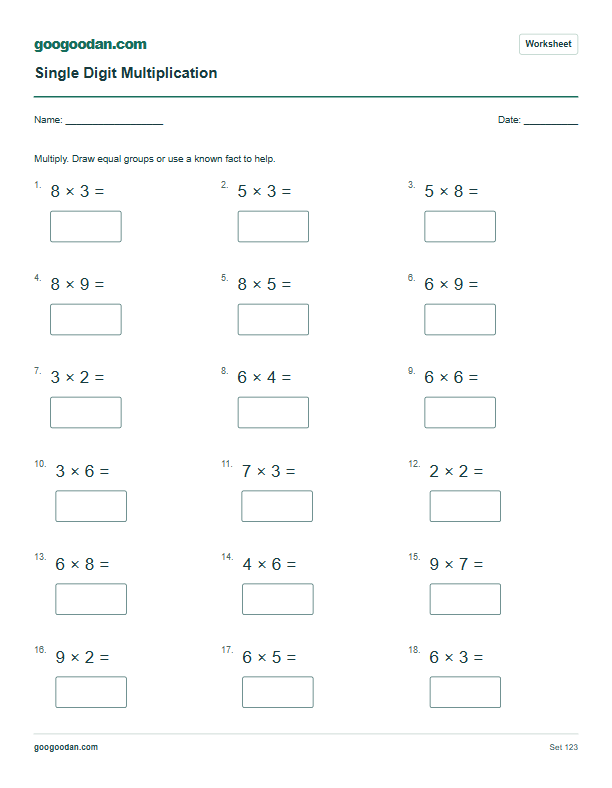 Calculation practice
Single Digit Multiplication Worksheets
Use equal groups and arrays to practise multiplication facts with factors from 2 to 9.
18 problems · Answer key included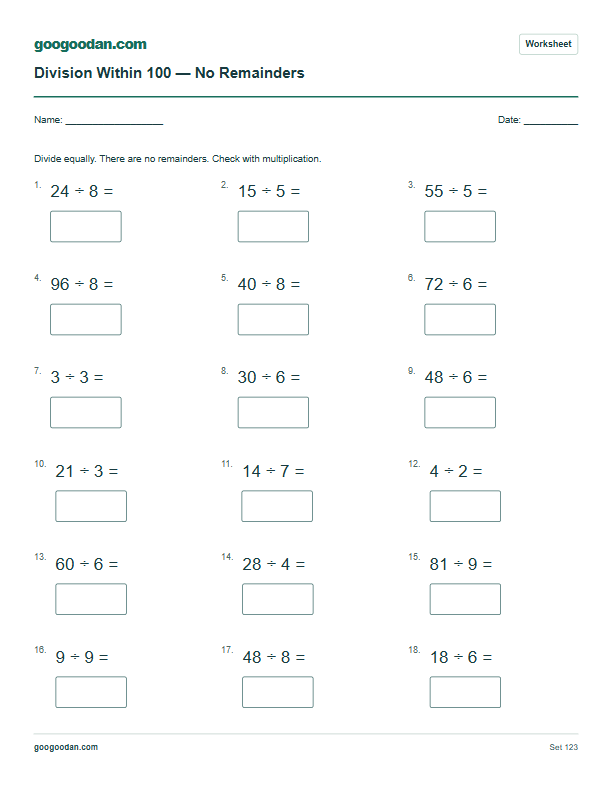 Calculation practice
Division Without Remainders Worksheets
Share equally or make equal groups, then check each quotient with multiplication.
18 problems · Answer key included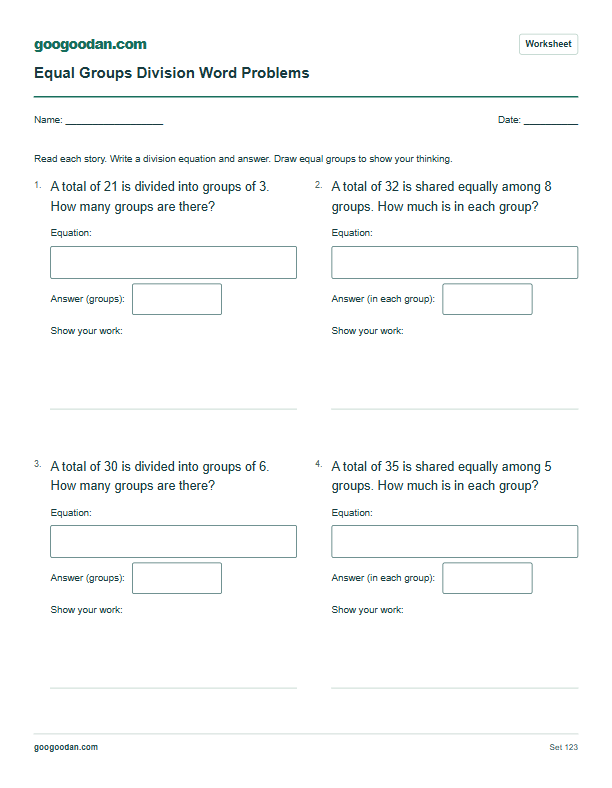 Word problems
Equal Groups Division Word Problems
Find group count or group size with division facts, or share larger totals to find two-digit amounts.
4 problems · Answer key included
More about multiplication · Grade 3 worksheets · Grade 4 worksheets
Grade 3 selected skill connection: Default mixed-facts activity: 3.OA.A.3 (equal groups and equal sharing). See the Common Core grade guidance. This worksheet does not cover every requirement in the standard.
Grade 4 selected skill connection: Supporting 4.NBT.B.5 through two- and three-digit group options: multiply group amounts by 1–9 using place-value strategies. Selected group-total stories only. See the Common Core grade guidance. This worksheet does not cover every requirement in the standard.