
Multiplicative Comparison Word Problems
Compare a reference amount with a second amount that is a whole-number multiple of it. Use equal units for smaller multipliers, or split a two-digit multiplier into tens and ones. Choose the range that matches the child's multiplication goal.
What does “times as much” mean?
Start with an amount of five. A second amount is nine times as much. Before calculating, ask the child to identify the reference amount and the multiplier. Five tells us the size of one unit. Nine tells us how many copies of that unit make the second amount. We know both of those quantities; the second amount is what we need to find.
Read the two bars together
The short bar represents five. Each segment in the long bar has exactly the same length as that reference bar, so each also represents five. There are nine segments. Count by fives across them: 5, 10, 15, 20, 25, 30, 35, 40, 45. The second amount is 45, not nine. Nine counts the copies; 45 measures the amount those copies represent.
Write 5 × 9 = 45. The equation 9 × 5 = 45 has the same product and is also a correct calculation. Ask the child to point to the reference and explain the multiplier so that the meaning stays clear whichever factor order they choose.
Why not add five and nine?
“Nine more than five” means add nine once: 5 + 9 = 14. “Nine times as much as five” means take nine copies of five: 5 × 9 = 45. Both questions contain five and nine, but they describe different relationships. Do not choose an operation just because a sentence contains the word more or a large number.
If the child answers 14, draw a single bar of five and a separate added length of nine. Compare that picture with the nine equal segments above. Ask which drawing matches the words “nine times as much.” Let the child explain what changed before trying the calculation again.
One times as much can be the same amount
One copy of seven still represents seven. The two bars have equal lengths because 7 × 1 = 7. Multiplication does not always make an amount larger. In these questions the second amount is equal to the reference when the multiplier is one, and larger when the multiplier is greater than one. That is why the question calls it the second amount, rather than always calling it the larger amount.
Use division to check the relationship
After finding 45, check 45 ÷ 9 = 5. Dividing the second amount into nine equal parts recovers the reference amount. You can also check 45 ÷ 5 = 9: that tells how many reference-sized copies fit in the second amount. These equations check the same multiplication, but their answers describe different quantities.
For the one-copy example, 7 ÷ 1 = 7 recovers the reference, and 7 ÷ 7 = 1 recovers the multiplier. Ask the child to finish the sentence “My answer represents…” before moving on. Naming the quantity helps reveal a misunderstanding that a correct number alone can hide.
What to expect on the worksheet
The default activity has four short comparison questions with a reference amount and a whole-number multiplier from one through nine. One question uses a multiplier of one; three use a multiplier greater than one. The compared amount is always the unknown. Zero, fractional multipliers, unknown references, and unknown multipliers are not included in this set.
Each question includes matching bar units, an equation box, an amount box, and space to explain the relationship. The bars share a scale within a question; do not compare their lengths across different questions. The answer key gives a multiplication equation and the second amount. A correct reversed multiplication equation or division check can also show understanding.
For stories about equal-group totals and sharing, use multiplication and division word problems. Once whole-number comparisons are secure, older students can explore fraction scaling-up word problems.
Compare a two-digit amount
In the Two-digit reference option, the reference amount is from 10 through 99 and the multiplier is from one through nine. The picture still shows copies of one reference unit. A longer written number does not change what the comparison means. Identify the amount in one unit before deciding how to calculate.
Split the value, then multiply both parts
The short bar represents 21. Every segment in the second bar also represents 21, and there are six segments. We need six copies of the whole amount, not 21 plus six. Write 21 × 6. Break 21 into 20 + 1: six copies of 20 make 120 and six copies of one make six. Combine the partial products: 120 + 6 = 126.
This is the distributive property: (20 + 1) × 6 = (20 × 6) + (1 × 6). The parentheses keep the reference amount together. Ask the child to point to all six segments when explaining each partial product. An answer of 26 would mean that only the ones were multiplied and the tens were used just once.
Explain the place values
Twenty is two tens. Two tens multiplied by six give twelve tens, which have a value of 120. The extra six ones give a total of one hundred, two tens, and six ones. If the child says that two times six is twelve, agree with the fact and ask, “Twelve of which unit?” Naming the unit connects a familiar multiplication fact to the value of the two-digit number.
Use a second picture to check the reasoning
This time one segment is 81 and there are two copies. Split each 81 into 80 + 1. Two copies of 80 make 160; two copies of one make two. Together they make 162. The calculation 81 + 81 reaches the same answer and can help the child check the multiplication. By contrast, 81 + 2 answers a different question: two more than 81.
Check the first picture in reverse: 126 ÷ 6 = 21 recovers the reference amount. For the second, 162 ÷ 2 = 81 does the same. You can also divide the second amount by the reference to recover the number of copies. Ask which quantity each quotient describes instead of treating every division statement as interchangeable.
Choose the range that matches the goal
Use one-digit references while the child is learning what “times as much” means. Choose two-digit references when that relationship is clear and you want to practice tens, ones, and partial products. The One-digit reference and Two-digit reference activities each have four questions: one with a multiplier of one and three with larger multipliers. A multiplier of one keeps the amount unchanged, including a two-digit amount.
The Two-digit reference activity uses whole-number comparisons. It does not include zero, fractional multipliers, missing references, or missing multipliers. Some calculations need regrouping and others do not; a sheet does not guarantee a fixed mix of those cases. The bars share a scale within each problem, not across separate problems.
For an example that shows exchanging ones and tens while multiplying, see the place-value multiplication guide. Its printable questions use a different number range; the worked example is a bridge to that later practice.
Build a two-digit multiplier from tens and ones
Choose Two-digit multiplier when the child understands what times as much means and is ready to multiply two two-digit numbers. The reference amount and multiplier are both known. The unknown is the second amount. Instead of drawing dozens of separate bars, the model groups every ten copies into one labeled box.
For example, an amount is 21 and a second amount is 62 times as much. Sixty-two copies are six groups of ten copies and two single copies. A box labeled 10 stands for ten copies of 21, and a box labeled 1 stands for one copy of 21. These boxes are labeled counters, not bars drawn to scale: the labels tell how many copies they represent. They do not show the product.
Multiply each part of the multiplier
Split 62 into 60 + 2. Multiply the same reference amount by both parts: 21 × 60 = 1,260 and 21 × 2 = 42. Then combine the partial products: 1,260 + 42 = 1,302. This is the distributive property, 21 × (60 + 2) = (21 × 60) + (21 × 2).
The zero in 60 matters. Calculating 21 × 6 gives 126, which counts six copies rather than sixty copies. Multiplying by 60 makes the value ten times as large: 1,260. Ask the child to name the unit in the first partial product: six tens of copies, or sixty copies altogether.
Use a smaller second example
For 29 × 14, split 14 into 10 + 4. Ten copies of 29 make 290. Four copies make 116. The two partial products total 406.
This example also shows regrouping inside a partial product: 29 × 4 = 116. The tens-and-ones split of the multiplier does not mean every partial product will be a two-digit number. Keep the full value of each product before adding.
Check the size and the relationship
Estimate before accepting an answer. Since 21 is close to 20 and 62 is close to 60, the product should be near 1,200. The exact answer 1,302 is reasonable; 168 or 172 is not. For 29 × 14, 30 × 14 = 420, so 406 is a sensible result.
Check the relationship in reverse when division is familiar: 1,302 ÷ 62 = 21 and 406 ÷ 14 = 29. The quotient should recover the reference amount. The check confirms both the calculation and the meaning of times as much.
What the printable asks
The Two-digit multiplier activity has four short quantity-comparison problems with different pairs of factors. Both factors are from 10 through 99. The picture groups the multiplier into tens and ones without revealing either partial product or the final amount. A sheet contains no more than one multiplier ending in zero, so at least three questions have a nonzero ones partial product. If the multiplier ends in zero, there are no single copies to add: the ones partial product is zero. The answer key shows the full equation and the second amount.
Use the equation box for the complete multiplication statement. In the working area, record the tens partial product, the ones partial product, and their sum. Choose Two-digit reference for a smaller multiplier from one through nine, or One-digit reference when the child is still learning the comparison language.
Make a practice set
Choose what to print. Selecting both shows the answer key on screen and prints the questions followed by the answers.
After the practice
Ask the child what the reference amount represents and what the multiplier counts. For a two-digit multiplier, check the tens and ones partial products and their sum. When division is familiar, use it to check that the second amount gives back the reference amount.
 Word problems
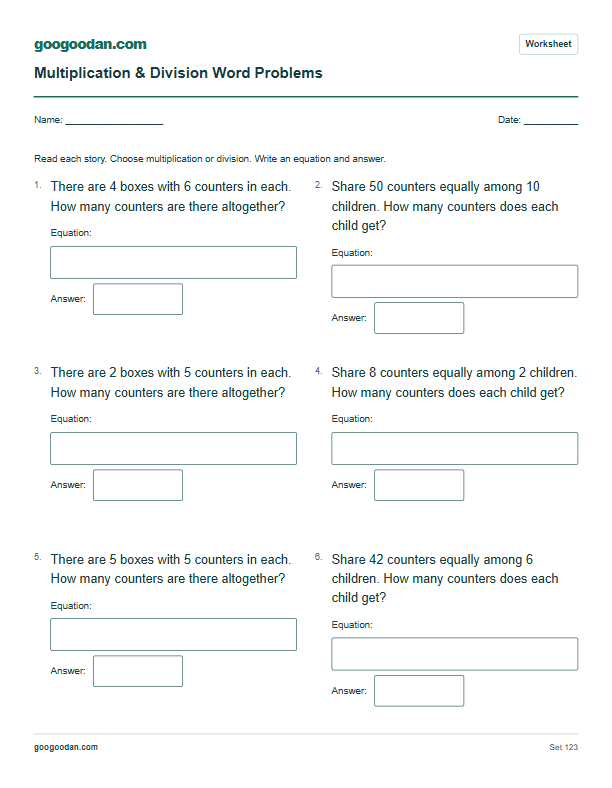
3rd Grade Multiplication and Division Word Problems
Choose mixed facts, zero-and-one groups, or two- and three-digit group amounts. Explain what the answer counts.
6 mixed stories or 4 focused multiplication stories · Answer key included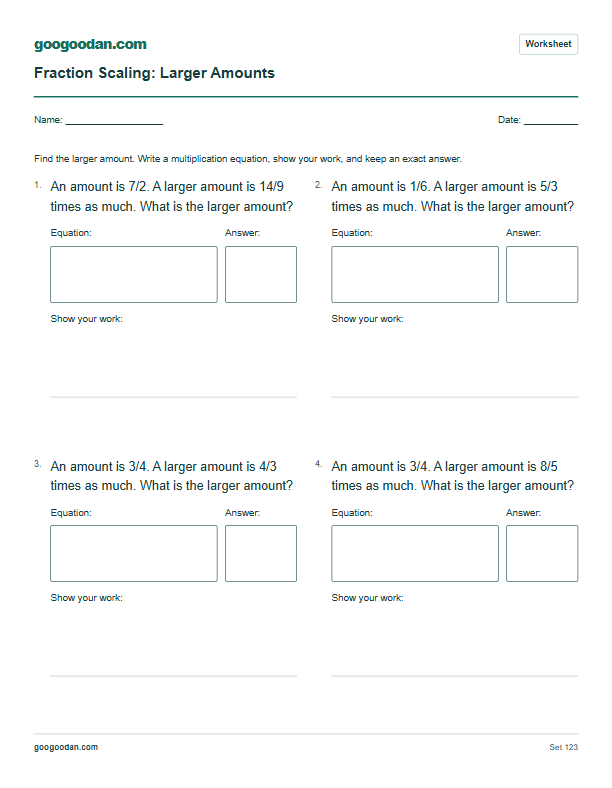 Word problems
Fraction Scaling Word Problems: Making Amounts Larger
Multiply by a fraction greater than one. Separate the original amount, extra amount, and new total.
4 problems · Answer key included
More about multiplication · Grade 4 worksheets
Grade 4 selected skill connection: 4.OA.A.1; 4.OA.A.2 (selected compared-amount-unknown cases). The two-digit reference and two-digit multiplier options support place-value multiplication in 4.NBT.B.5; the latter uses selected 10–99 by 10–99 products. See the Common Core grade guidance. This worksheet does not cover every requirement in the standard.