
4 Digit by 1 Digit Multiplication Word Problems
A four-digit factor can be split into thousands, hundreds, tens, and ones. Use those parts to calculate the area of a rectangular field, then connect the partial products to a shorter written multiplication method.
First see the exchanges with a smaller number
Before working with the field, Lena packs six trays with 17 counters in each tray. She knows 17 is one ten and seven ones. For all six trays, she needs six tens and 42 ones. Every part of 17 must be multiplied by six.
17 × 6 = (10 × 6) + (7 × 6) = 60 + 42
Count ten loose ones into a new ten. Do that four times: 40 of the 42 loose ones become four tens, with two ones left. Add those four tens to the original six tens. Now Lena has ten tens and two ones. Exchange the ten tens for one hundred. The number of counters has not changed; only the units used to describe them have changed.
60 + 42 = 100 + 2 = 102
In a compact written calculation, 7 × 6 gives 42 ones. Write two in the ones place and record four tens to combine with the tens product. Then 1 ten × 6 plus those 4 tens makes 10 tens, or 1 hundred and 0 tens. This is why the answer is 102, not a list of separate multiplication facts.
The next example uses exactly the same place-value idea with thousands, hundreds, tens, and ones. Its answer measures area in square feet; the counters above were only a smaller warm-up to make the exchanges visible. The printable below still contains four-digit by one-digit area problems.
Split the long side into place-value parts
A rectangular strip of land is 4,307 feet long and 6 feet wide. Lena knows she needs to multiply, but the zero in 4,307 makes her hesitate. Start with the quantity the answer should describe: the number of one-foot-by-one-foot squares that cover the strip.
Length: 4,307 feet. Width: 6 feet.
4,307 × 6 = 25,842
The area is 25,842 square feet.
Think of the length as 4,000 + 300 + 0 + 7. Each part has the same width of six feet. Multiplying all four parts and adding their areas covers the original rectangle once, with no gaps or overlaps.
| Length part | Multiply by 6 | Square feet |
|---|---|---|
| 4,000 | 4,000 × 6 | 24,000 |
| 300 | 300 × 6 | 1,800 |
| 0 tens | 0 × 6 | 0 |
| 7 | 7 × 6 | 42 |
24,000 + 1,800 + 0 + 42 = 25,842
A zero place still has a job
The zero says there are no tens in the original length. It keeps the seven in the ones place and the three in the hundreds place. Ignoring that position would turn 4,307 into a different number. In the expanded calculation, the zero-tens partial product contributes nothing, while all the other place values stay intact.
Connect the parts to compact multiplication
Multiply the ones first: seven times six is forty-two. Write two ones and regroup four tens. Next, zero tens times six gives zero tens, but the four regrouped tens are still there, so write four in the tens place.
Three hundreds times six is eighteen hundreds. Write eight hundreds and regroup one thousand. Finally, four thousands times six plus the regrouped thousand is twenty-five thousands. The digits now represent 25,842, the same total as the partial products.
Check the size before checking every digit
Because 4,307 is between 4,000 and 5,000, multiplying by six gives an answer between 24,000 and 30,000. This rules out 2,584 without redoing the whole calculation. Dividing the final area by the known width provides another check when the child is ready for that calculation.
Area uses square feet, not feet. The two given lengths describe the edges; their product describes the surface. Adding the sides or finding the distance around the rectangle would answer a different question.
What this printable practices
Each set contains four rectangle-area stories. Lengths range from 1,000 to 9,999 feet, and widths range from one to nine feet. A width of one is allowed: multiplying by one leaves the numerical value unchanged, while the answer still names square feet. Zero-width rectangles and missing-side questions are not included.
Children have space to write an equation and show partial products or a compact method. The answer key supplies the equation and final area. Use their written work to locate an error in a multiplication fact, a place value, or a regrouped amount instead of asking them to repeat every step without feedback.
Make a practice set
Choose what to print. Selecting both shows the answer key on screen and prints the questions followed by the answers.
After the practice
Compare the child’s partial products with their compact multiplication for one story. Ask them to name each carried amount by place value. The two-digit area set provides a next comparison: both factors are split there, while only the longer factor needs splitting here.
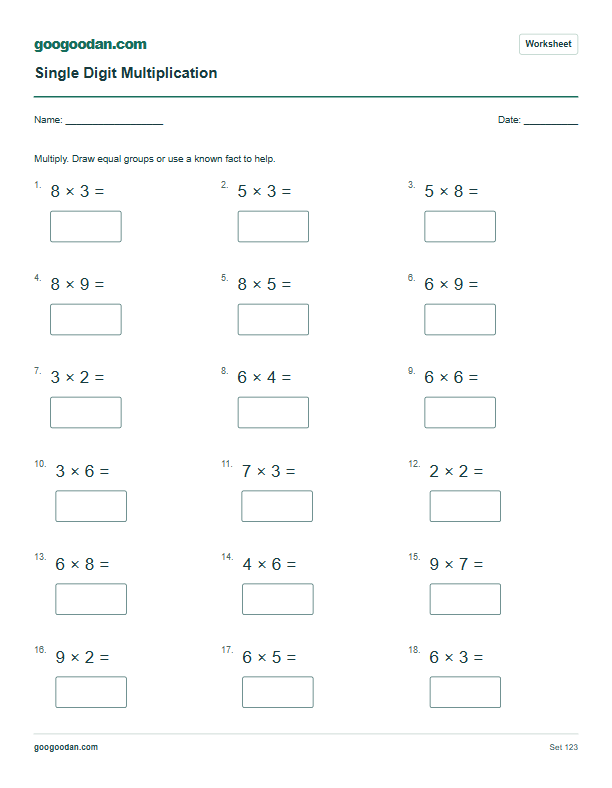 Calculation practice
Single Digit Multiplication Worksheets
Use equal groups and arrays to practise multiplication facts with factors from 2 to 9.
18 problems · Answer key included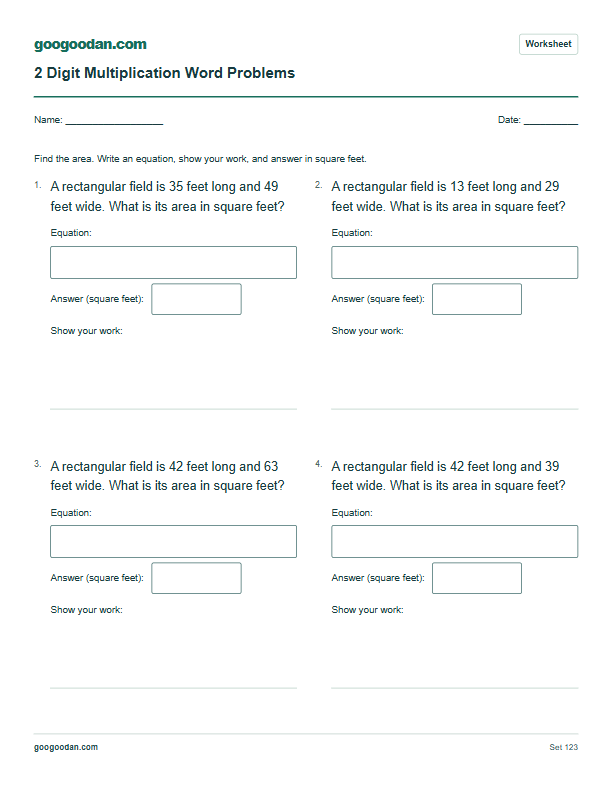 Word problems
2 Digit Multiplication Word Problems: Rectangle Area
Multiply two two-digit side lengths to find a rectangular field’s area in square feet.
4 problems · Answer key included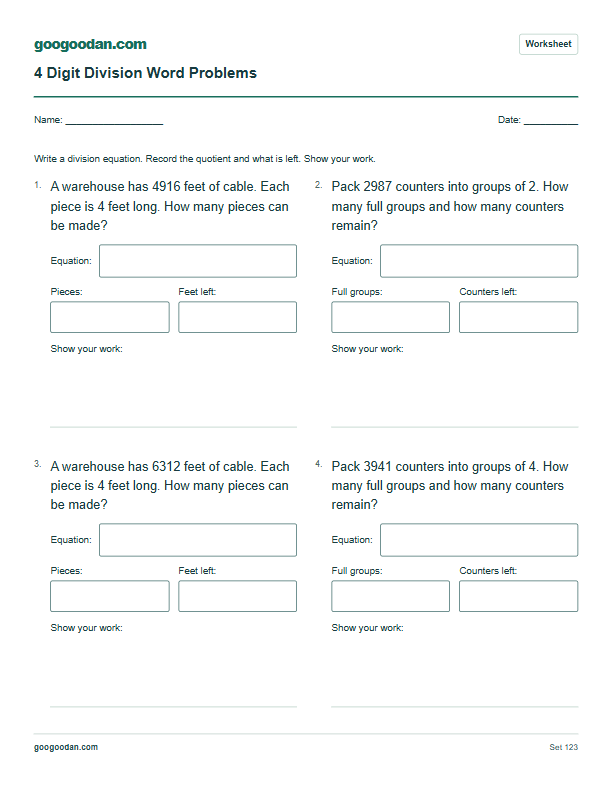 Word problems
4 Digit Division Word Problems With and Without Remainders
Find complete groups or cable pieces, and record what is left separately from the quotient.
4 problems · Answer key included
More about multiplication · Grade 4 worksheets
Grade 4 selected skill connection: 4.NBT.B.5; 4.MD.A.3 (four-digit by one-digit multiplication in rectangle-area contexts). See the Common Core grade guidance. This worksheet does not cover every requirement in the standard.