
4 Digit Division Word Problems With and Without Remainders
A division answer can describe complete groups and something left over. Read what the groups contain before interpreting the remainder. The default four-problem sets use four-digit totals and one-digit divisors; they may include exact division, remainders, or both. Choose Smaller totals: remainders for two- or three-digit totals with a positive amount left over in every question.
See the leftover amount before using larger numbers
Emma first tries a smaller packing problem: she has 32 counters and makes groups of nine. She completes three groups, using 27 counters. The remaining five counters stay beside the groups because they are not enough to make another group of nine.
32 ÷ 9 = 3 R 5
3 × 9 + 5 = 32
The 3 counts full groups. The 5 counts individual counters left over. Ask Emma to point to a full group and then to a single leftover counter. Adding 3 + 5 would mix groups with individual counters. Saying “four full groups” would require 36 counters, but she only has 32.
A different question can need one more container
Now ask how many boxes are needed to hold all 32 counters if each box can hold up to nine. A partly filled box is allowed in this question. Put the five remaining counters together in a fourth box. They do not each need a separate box.
Three boxes hold at most 27 counters, which is not enough. Four boxes hold at most 36, so four is the fewest boxes needed. The fourth box is partly filled; there are still only three full groups. The division calculation has not changed. The final question has changed which quantity Emma must report.
For these printable problems, report the complete groups and the leftover amount separately. The round-up division word problems provide a separate practice set about vehicles needed to carry everyone. First understand the smaller picture, then use the same distinction with the four-digit numbers below.
The quotient and remainder count different things
Emma is packing 1,237 counters into groups of six. She writes 1,237 ÷ 6 = 206 R 1, then says there are 207 full groups. Ask what the extra one represents. It is one counter, not a full group of six. Two hundred six groups use 1,236 counters; the remaining counter cannot complete another group.
Total: 1,237 counters. Group size: 6 counters.
1,237 ÷ 6 = 206 R 1
206 × 6 + 1 = 1,237
Quotient: 206 full groups. Remainder: 1 counter.
Keep a zero in the quotient when its place is needed
In a written division method, start with twelve hundreds. Six fits twice, so the first quotient digit represents two hundreds. After subtracting, bring down the three tens. Six does not fit into three even once, so write zero in the tens place of the quotient. Then bring down the seven ones to make thirty-seven ones.
Six fits into thirty-seven six times, leaving one. The quotient is 206, not 26. The zero records that there are no groups of ten in this place-value step; omitting it changes the value of the answer.
Use the four-step routine with meaning
- Divide: find how many times the divisor fits into the current amount.
- Multiply: multiply that quotient digit by the divisor.
- Subtract: find the amount still unaccounted for at that step.
- Bring down: bring down the next dividend digit if one remains, then repeat.
Once every digit has been used, the final remainder must be smaller than the divisor. A remainder of seven when dividing by six means another full group can still be made. Continue the calculation rather than accepting the first quotient written.
Recognize an exact division story
A warehouse has 1,248 feet of cable. Each piece is six feet long. The calculation 1,248 ÷ 6 = 208 shows that 208 pieces can be made, with zero feet left. Here the quotient counts pieces and any remainder would count feet, not pieces.
The worksheet uses this cable context when the source calculation divides exactly. When there is a remainder, it uses counters packed into full groups. The labels beside the answer boxes follow the actual story. Write zero in the leftover box for exact division.
Check before interpreting
Multiply the quotient by the divisor and add the remainder. The result must equal the dividend. Then check that the remainder is at least zero and less than the divisor. Finally read both parts with their units: “206 full groups and one counter left.”
These stories ask for complete groups or exact cable pieces. A different question, such as how many containers are needed to hold every counter, may require rounding up. That is not the question in this set. For these same 1,237 counters, 207 containers could hold everything if each holds up to six and a partly filled container is allowed. There would still be only 206 full groups; the last container would hold one counter.
Each printable has four problems with dividends from 1,000 to 9,999 and divisors from two to nine. A generated set may contain either kind of story or both; it does not guarantee a fixed balance. The answer key supplies the equation, quotient, and remainder. The work area is for the child’s calculation, not an automatically generated step-by-step solution.
Use smaller totals to explain a remainder
Choose Smaller totals: remainders to practice finding complete groups and the individual counters left over. Each sheet has four different questions with totals from 10 to 999 and group sizes from two to nine. Every question in this option has at least one full group and a positive remainder.
Start with the 32 ÷ 9 picture in the guide: three full groups use 27 counters, and five individual counters remain. The same idea works for a larger total. We can count full groups in batches instead of drawing every counter.
Make 35 groups in two steps
There are 247 counters to pack in groups of seven. Thirty groups use 7 × 30 = 210 counters. Subtract those counters from the total: 247 − 210 = 37. The 37 is what remains at this stage, but it is not yet the final remainder because more full groups of seven can still be made.
Five more groups use 7 × 5 = 35 counters. Now 37 − 35 = 2 counters remain. Add the full groups from both steps: 30 + 5 = 35. The numbers 30 and 5 are partial quotients: each counts the full groups made at that step. The 210 and 35 count the counters used in those steps.
247 ÷ 7 = 35 R 2
247 = 210 + 35 + 2
247 = (7 × 30) + (7 × 5) + 2
The diagram has 35 numbered cells, one for each full group. The first three rows are batches of ten groups, not three groups. The two loose dots are counters, not groups or fractional groups. Say the answer with both units: 35 full groups and 2 counters left.
Check the total and the size of the remainder
Rebuild the total by multiplying the quotient by the group size, then adding what is left: 35 × 7 + 2 = 245 + 2 = 247. In symbols, quotient × divisor + remainder = dividend. The remainder must also satisfy 0 ≤ remainder < divisor. Here 0 ≤ 2 < 7, so there are too few counters left to make another group of seven.
Do not add the two leftover counters to the 35 groups: the quantities have different units. Do not automatically change 35 to 36 either. This question asks for full groups and leftovers separately. A different question about containers needed to hold every counter can require a partly filled extra container, as the 32-counter example explains.
Move between the two practice options
This smaller-total option always leaves something over. The default four-digit activity can include exact division with zero left, division with a positive remainder, or both. For either option, write the equation, keep the quotient and leftover amount separate, and use the work space for your calculation. The answer key gives the final equation and values; the examples in this guide explain the steps.
Make a practice set
Choose what to print. Selecting both shows the answer key on screen and prints the questions followed by the answers.
After the practice
Choose one problem and ask what the quotient counts and what the remainder counts. Check the multiplication-and-addition identity together. If place-value division is secure, compare the wording with an equal-sharing story to discuss the meaning of each answer.
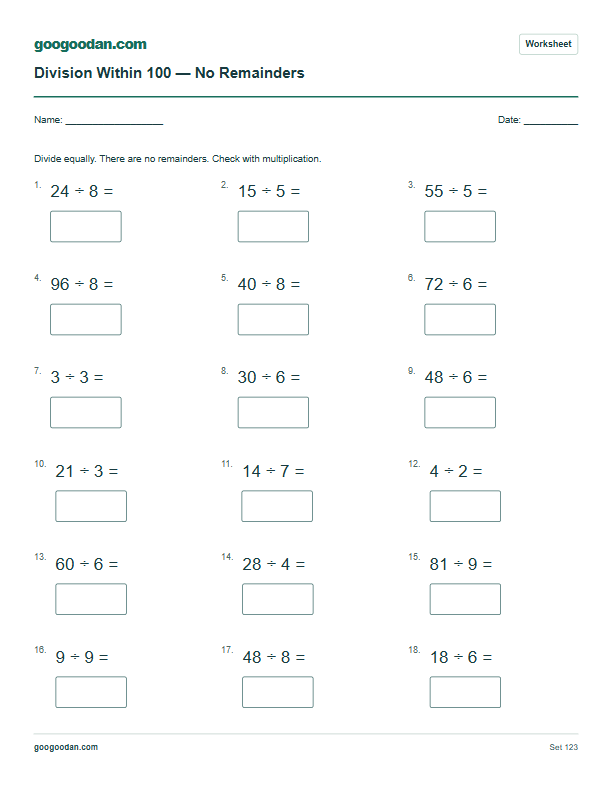 Calculation practice
Division Without Remainders Worksheets
Share equally or make equal groups, then check each quotient with multiplication.
18 problems · Answer key included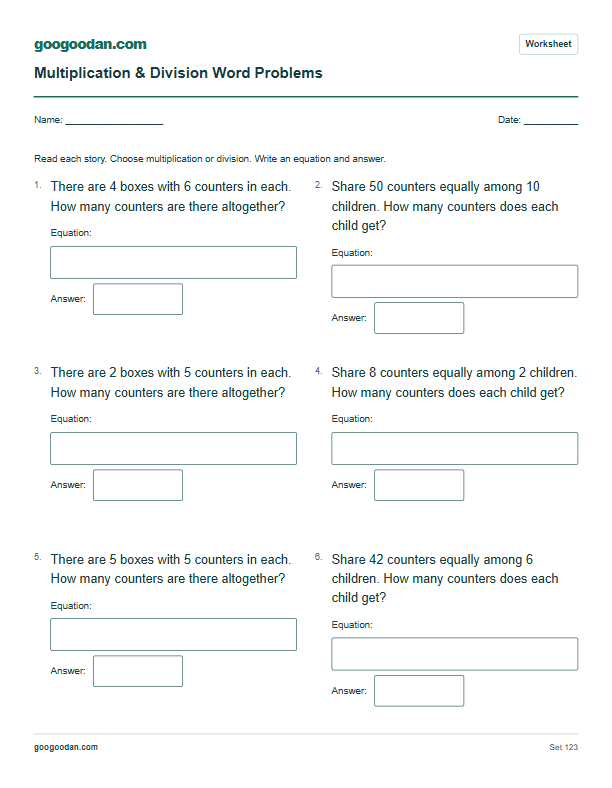 Word problems
3rd Grade Multiplication and Division Word Problems
Choose mixed facts, zero-and-one groups, or two- and three-digit group amounts. Explain what the answer counts.
6 mixed stories or 4 focused multiplication stories · Answer key included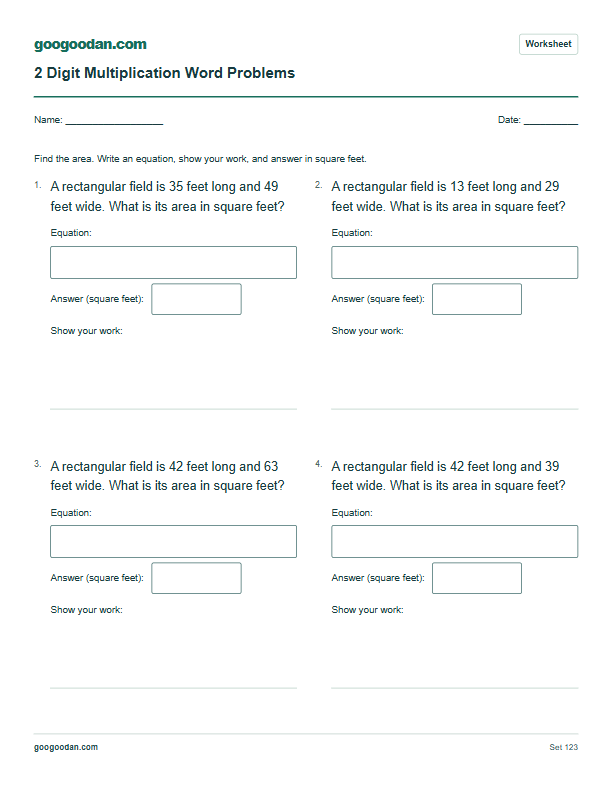 Word problems
2 Digit Multiplication Word Problems: Rectangle Area
Multiply two two-digit side lengths to find a rectangular field’s area in square feet.
4 problems · Answer key included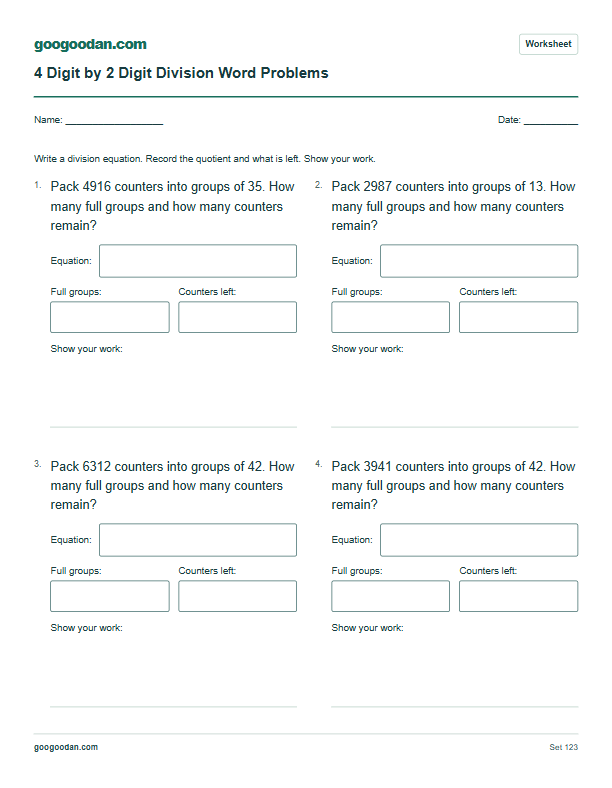 Word problems
4 Digit by 2 Digit Division Word Problems
Use estimates and partial quotients to find complete groups with two-digit divisors, then interpret any remainder. Choose a smaller exact-group activity before four-digit totals.
4 problems · Answer key included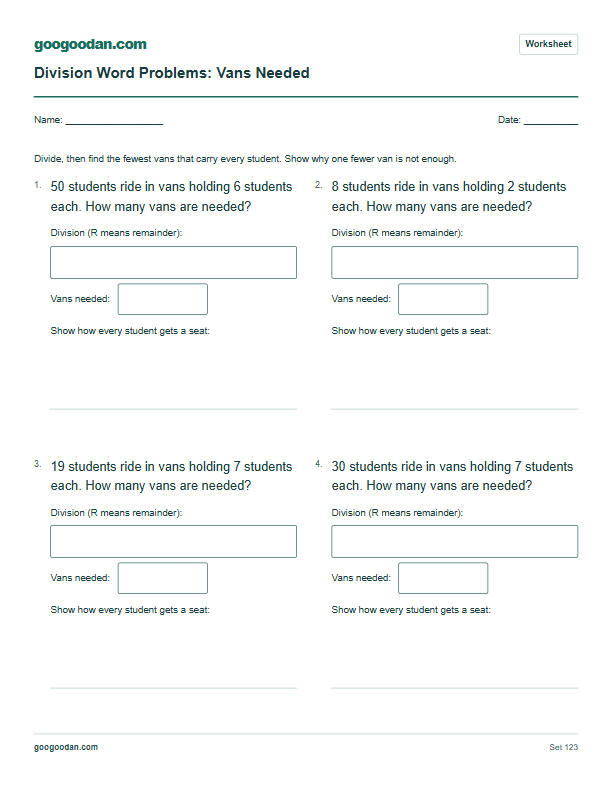 Word problems
Division Word Problems: Round Up the Remainder
Find the fewest vans that seat every student. Compare exact division with a remainder that needs one more van.
4 problems · Answer key included
More about division · Grade 4 worksheets
Grade 4 selected skill connection: 4.NBT.B.6 (up to four-digit dividends and one-digit divisors in grouping contexts; smaller-remainders uses two- and three-digit totals with positive remainders). See the Common Core grade guidance. This worksheet does not cover every requirement in the standard.