
2 Digit Multiplication Word Problems: Rectangle Area
Use two side lengths to find how much surface a rectangular field covers. Each of the four stories uses two-digit whole numbers. Connect the multiplication to rows of square units before calculating.
Why do the two side lengths multiply?
Noah reads about a rectangular field that is 24 feet long and 36 feet wide. He adds 24 and 36 and answers 60 feet. His arithmetic is correct, but it does not measure the surface of the field. The question asks how many one-foot-by-one-foot squares would cover it.
Length: 24 feet. Width: 36 feet.
Area = length × width
24 × 36 = 864
The field covers 864 square feet.
Imagine 24 unit squares in each row and 36 rows. Multiplication counts all the squares without drawing each one. A foot measures length; a square foot measures surface area. Naming the unit helps the child decide whether the answer describes the quantity requested.
Break the rectangle into four easier pieces
Split 24 into 20 and 4, and split 36 into 30 and 6. The four regions cover the original field exactly once. Calculate each region, then combine their areas.
Have Noah point to the tall narrow region and the short wide region. Each has an area of 120 square feet, although their side lengths and shapes differ. The picture shows why both 120s must be included. The smaller bottom-right region is 4 × 6, and the large top-left region is 20 × 30.
| Side lengths | 20 feet | 4 feet |
|---|---|---|
| 30 feet | 20 × 30 = 600 | 4 × 30 = 120 |
| 6 feet | 20 × 6 = 120 | 4 × 6 = 24 |
600 + 120 + 120 + 24 = 864
The two regions with area 120 are different pieces, so both belong in the total. Counting just the 600 and 24 regions misses the two other parts. Have the child point to each product in the table before adding.
Connect partial products to a written method
A shorter written method can calculate 24 × 6 = 144 and 24 × 30 = 720, then add 144 + 720 = 864. The three in 36 stands for thirty, so the second partial product is 720, not 72. Both this method and the four-part model account for the whole rectangle.
Estimate, then check the unit
Since 24 is between 20 and 25, the area lies between 20 × 36 = 720 and 25 × 36 = 900 square feet. The exact result of 864 fits. An answer of 86 is too small even before every step is checked. Swapping the factors is another useful check: 36 × 24 covers the same rectangle.
These worksheets use rectangular fields with side lengths from 10 through 99 feet. They ask for area with both sides given. They do not include irregular shapes, missing side lengths, or perimeter questions. The answer key gives an equation and square-foot total; the work area lets children show a method that explains their calculation.
Make a practice set
Choose what to print. Selecting both shows the answer key on screen and prints the questions followed by the answers.
After the practice
Ask the child to sketch a rectangle and label its two dimensions before solving one story. Discuss why the answer uses square feet. Compare the four-part model with the child’s written multiplication without requiring one single method.
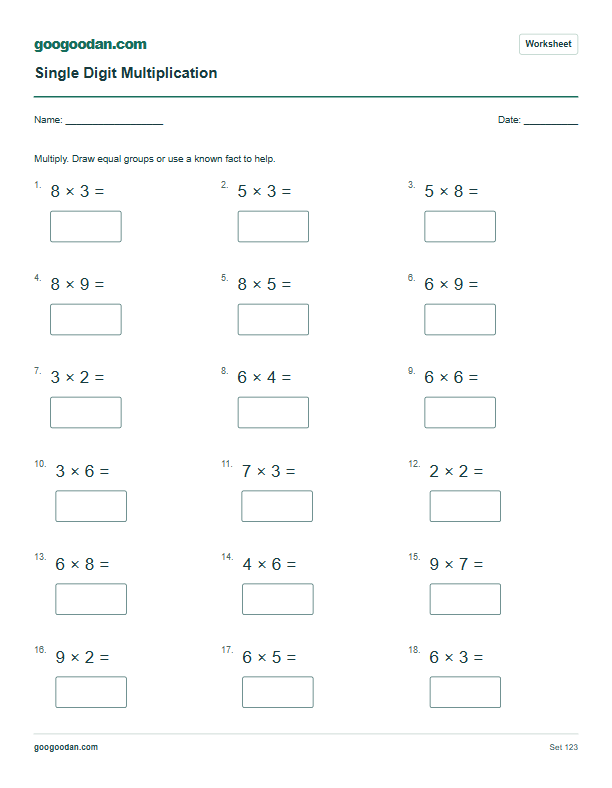 Calculation practice
Single Digit Multiplication Worksheets
Use equal groups and arrays to practise multiplication facts with factors from 2 to 9.
18 problems · Answer key included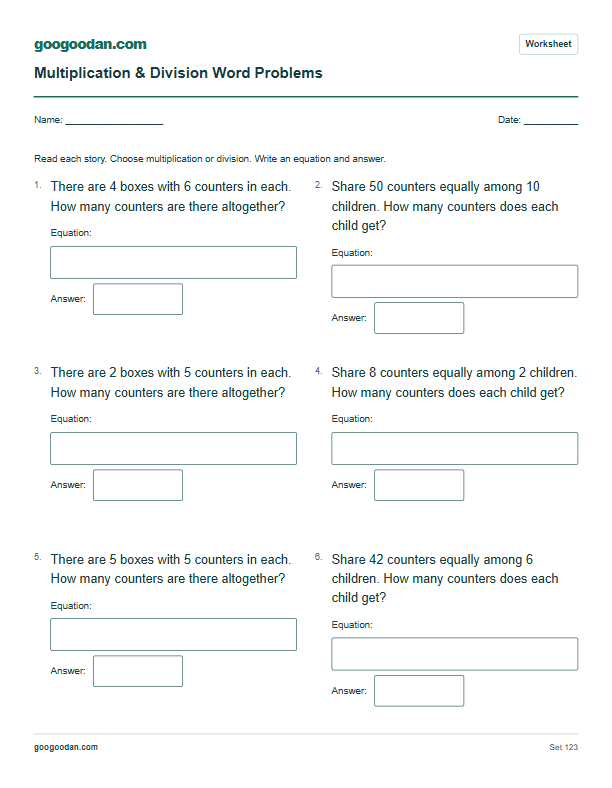 Word problems
3rd Grade Multiplication and Division Word Problems
Choose mixed facts, zero-and-one groups, or two- and three-digit group amounts. Explain what the answer counts.
6 mixed stories or 4 focused multiplication stories · Answer key included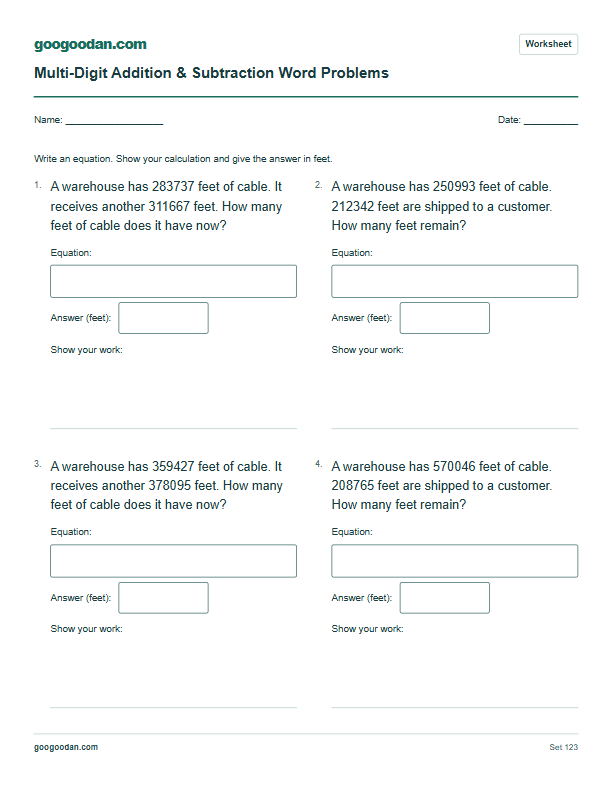 Word problems
Multi-Digit Addition and Subtraction Word Problems
Add and subtract cable lengths within 1,000,000 and label the answer in feet.
4 problems · Answer key included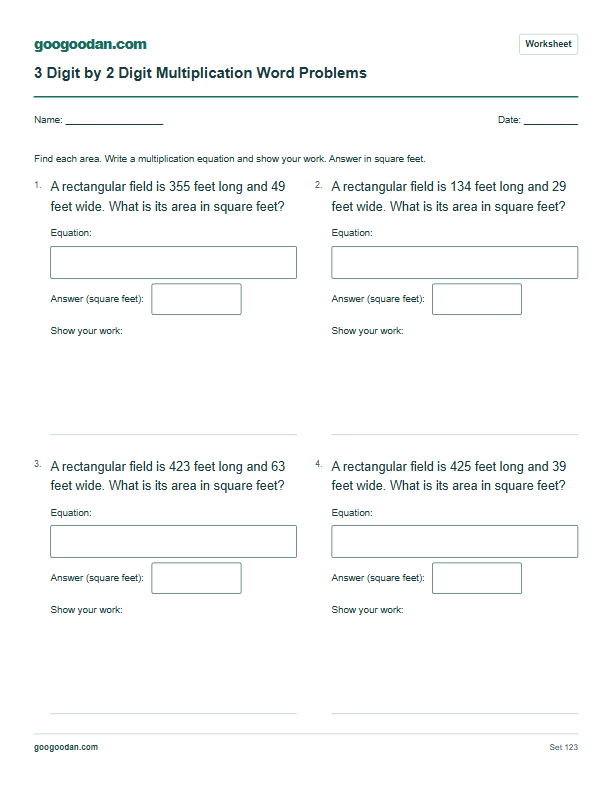 Word problems
3 Digit by 2 Digit Multiplication Word Problems
Find rectangle area using a three-digit length and two-digit width; connect partial products to the written multiplication method.
4 problems · Answer key included
More about multiplication · Grade 4 worksheets
Grade 4 selected skill connection: 4.NBT.B.5; 4.MD.A.3 (two-digit multiplication and rectangle area only). See the Common Core grade guidance. This worksheet does not cover every requirement in the standard.