
3 Digit by 2 Digit Multiplication Word Problems
Connect rectangle area to multi-digit multiplication. Explain the value of each partial product, keep regrouping organized, and label the answer in square feet.
Every digit in the width changes the product
Sofia is finding the area of a field that is 126 feet long and 24 feet wide. She calculates 126 × 4 = 504 and 126 × 2 = 252, then adds them to get 756. Both small multiplications are correct, but the second digit in 24 means twenty, not two.
Split the width into 20 feet and 4 feet. A 126-foot-by-20-foot section and a 126-foot-by-4-foot section cover the whole field without overlap. Their areas are 2,520 and 504 square feet. Combining them gives 3,024 square feet.
126 × 24 = 126 × (20 + 4)
= 2,520 + 504 = 3,024 square feet
| Width | 100 feet | 20 feet | 6 feet | Row total |
|---|---|---|---|---|
| 20 feet | 2,000 | 400 | 120 | 2,520 |
| 4 feet | 400 | 80 | 24 | 504 |
All six smaller areas belong in the total. Multiplying only the hundreds by the tens, or forgetting one row, leaves part of the field uncounted.
Connect the model to the written algorithm
In a vertical calculation, multiply by the ones digit first. The first partial product is 126 × 4 = 504. Then multiply by the tens digit's value: 126 × 20 = 2,520. Align the two partial products by ones, tens, hundreds, and thousands before adding.
The zero in 2,520 records zero ones because this partial product is a multiple of ten. Some written methods shift the second row one place left instead of writing that zero. Either notation is valid if the place values stay aligned. Writing 252 directly under 504 with both last digits in the ones column incorrectly treats twenty as two.
Explain each regrouping
When multiplying 126 by four, 4 × 6 makes 24 ones. Write four ones and regroup two tens. Next, four groups of two tens make eight tens; add the two regrouped tens to get ten tens. Write zero tens and regroup one hundred. Four hundreds plus that regrouped hundred make five hundreds, giving 504.
Regrouped amounts belong to the current multiplication row. Once that row is complete, start the next row's regrouping afresh. Reusing a carried amount from the ones row in the tens row counts it twice. Let the child point to the place-value column each small regrouping mark belongs to.
A zero digit still holds a place
For 304 × 20, the zero tens digit in 304 means there are no tens in the original length; it does not remove the tens column. Think of 304 × 2 = 608, then twenty is ten times two, so 304 × 20 = 6,080.
When the width is a multiple of ten, its ones digit is zero. The ones partial product is zero, and the tens partial product gives the whole answer. A child may omit writing the all-zero row if they can explain why it contributes nothing. They must still account for the tens value.
Estimate before accepting the final answer
For the original 126-by-24 field, compare with 125 × 24 = 3,000. The extra one-foot strip is 24 square feet, so the exact result should be 3,024. Even a rough estimate such as 120 × 20 = 2,400 shows why 756 is too small.
Use another decomposition to check: 126 × 25 − 126 = 3,150 − 126 = 3,024. This is optional; it is helpful when the child understands that twenty-four groups is one fewer than twenty-five. Checking by a different grouping can uncover an error repeated in the same algorithm.
Keep the area meaning visible
The two given measurements are side lengths in feet. Their product counts one-foot-by-one-foot squares, so the answer uses square feet. Adding the lengths does not find the covered surface. The problems do not ask for perimeter or a missing side.
Each sheet contains four original rectangle-area stories with lengths from 100 to 999 feet and widths from 10 to 99 feet. Zero digits and multiples of ten can occur, but a set does not guarantee a particular digit pattern. Use the working space for the two partial products, regrouping marks, and their sum. The key supplies the equation and final area; the child still explains the calculation.
Make a practice set
Choose what to print. Selecting both shows the answer key on screen and prints the questions followed by the answers.
After the practice
Ask the child what the second partial product represents and why its place value differs from the first. Compare the exact answer with an estimate, then check the square-foot unit.
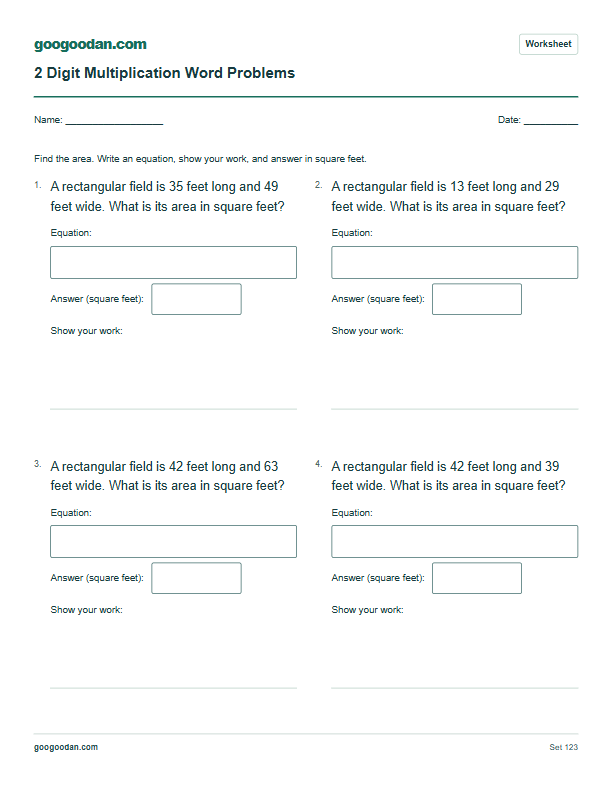 Word problems
2 Digit Multiplication Word Problems: Rectangle Area
Multiply two two-digit side lengths to find a rectangular field’s area in square feet.
4 problems · Answer key included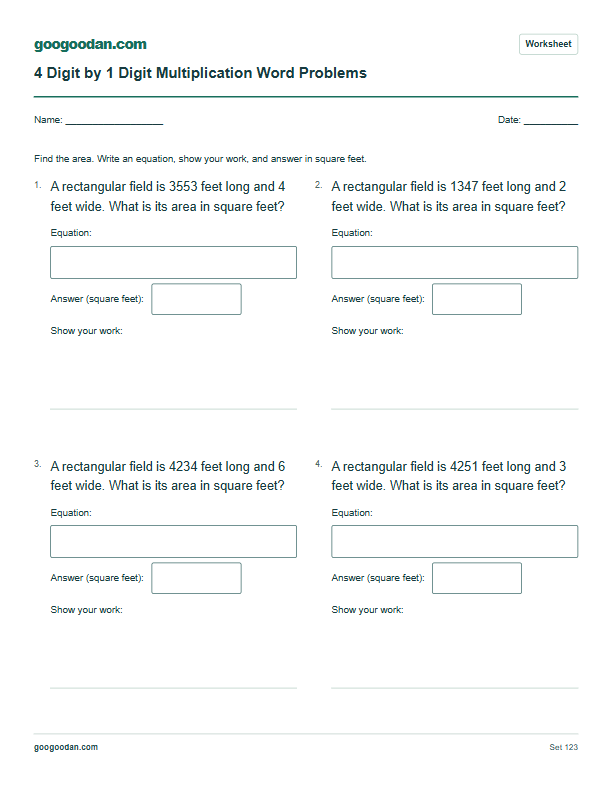 Word problems
4 Digit by 1 Digit Multiplication Word Problems
Use place-value partial products to find rectangle area from a four-digit length and a one-digit width.
4 problems · Answer key included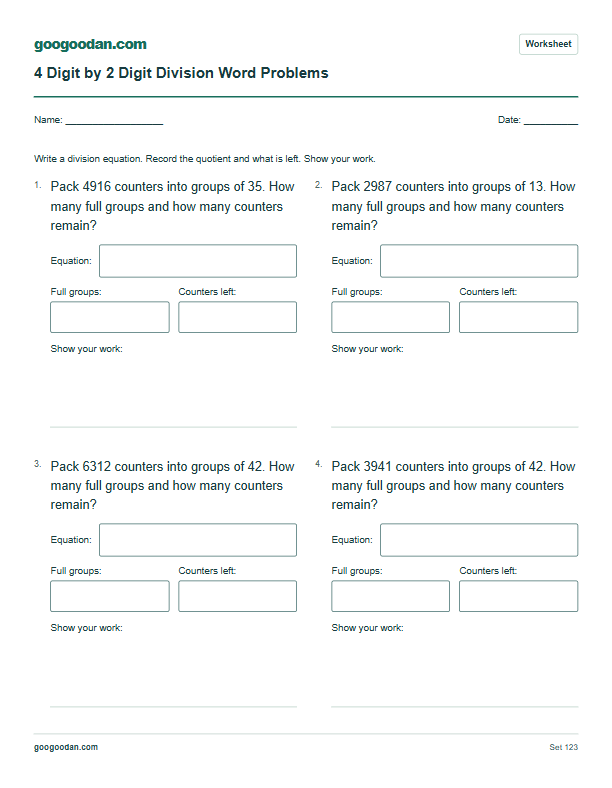 Word problems
4 Digit by 2 Digit Division Word Problems
Use estimates and partial quotients to find complete groups with two-digit divisors, then interpret any remainder. Choose a smaller exact-group activity before four-digit totals.
4 problems · Answer key included
More about multiplication · Grade 5 worksheets
Grade 5 selected skill connection: 5.NBT.B.5 (three-digit by two-digit multiplication in rectangle-area contexts). See the Common Core grade guidance. This worksheet does not cover every requirement in the standard.