
4 Digit by 2 Digit Division Word Problems With Remainders
Use friendly multiples to divide a four-digit total into groups with a two-digit size. Estimate, adjust, and check the quotient while keeping the meaning of any remainder clear. Need a smaller starting point? Choose Exact groups: 1–9 groups to find how many two-digit groups fit into a smaller total before tackling four-digit totals. To find the amount in each group instead, choose Equal sharing: two-digit groups. In that option the number of groups is given, and every total divides exactly. To practice full groups and leftovers with two- or three-digit totals, choose Smaller totals: remainders.
Start smaller: how many equal groups fit?
Before using several partial quotients, try a total that makes fewer than ten groups. In this activity the total and the size of one group are known. The number of groups is the missing quantity. This is different from knowing how many children share something and finding how much each child gets.
Imagine 819 counters packed in groups of 91. Ask the child to identify the two known amounts before calculating: 819 counters altogether and 91 counters in each group. The question is how many groups can be made, not how many counters are in a group.
Use a nearby multiple, then undo one group
Ten groups would use 91 × 10 = 910 counters. That is too many, so subtract one whole group: 910 − 91 = 819. Nine groups fit exactly. The division equation is 819 ÷ 91 = 9. This works because removing one group of 91 reduces the group count from ten to nine.
Check in the opposite direction: 9 × 91 = 819. All counters have been accounted for, so nothing is left. The 9 counts groups; the 91 counts counters in each group. If a child writes 91 as the answer, point to the question and ask which quantity was already given.
The practice sheet shows an unbroken total bar and a separate bar for one group, drawn to the same scale. It deliberately leaves the total bar unpartitioned. Let the child mark where each group would end and count the sections, or use multiplication to find the count. The solved example above shows those sections only after explaining the question.
Build a useful multiple in two chunks
Now consider 488 items packed in groups of 61. Four groups would use 61 × 4 = 244 items. Another four groups use another 244, and 244 + 244 = 488. There are eight groups altogether.
Keep the units clear while combining the chunks: 244 + 244 counts items, while 4 + 4 counts groups. Adding the item totals gives 488; adding the group counts gives the quotient, 8. This is the same idea as partial quotients in the larger example, with simpler totals.
A common mistake is to stop at four groups because 244 is a correct multiple. Ask whether any of the 488 items are still waiting to be grouped. The remaining 244 make four more groups. Check 61 × 8 = 488 before writing the final answer.
Choose Exact groups: 1–9 groups for four questions with group sizes from 10 to 99. Every division in this option is exact, and the answer counts groups. A set contains at most one single-group question. Switch back to the four-digit activity to practice larger quotients and interpreting remainders.
Build the quotient from useful multiples
Aiden is packing 1,237 counters into groups of 24. He knows how to divide by a one-digit number, but he is unsure how to choose a quotient when the group size has two digits. Start with a multiple he can explain: 24 × 10 = 240. Five groups of ten make 50 groups, and 24 × 50 = 1,200.
Those fifty groups use most of the counters. There are 37 left, enough for one more full group of 24. The last 13 counters cannot make another group. Aiden has found 51 full groups and 13 counters left over.
1,237 ÷ 24 = 51 R 13
| Step | Full groups | Counters used | Counters left |
|---|---|---|---|
| First chunk | 50 | 24 × 50 = 1,200 | 37 |
| Next chunk | 1 | 24 × 1 = 24 | 13 |
Add the partial quotients: 50 + 1 = 51 groups.
Check the total: 24 × 51 + 13 = 1,237 counters.
An estimate is a starting point, not the answer
Round 24 to a nearby friendly number or compare known multiples to choose a reasonable chunk. Then multiply by the actual divisor, 24, before subtracting. A guessed 60 groups would need 24 × 60 = 1,440 counters, more than the 1,237 available, so that chunk is too large.
Fifty groups is convenient, but it is not the only correct start. Forty groups use 960 counters and leave 277. Ten more groups use 240 and leave 37. One more group leaves 13. The partial quotients 40 + 10 + 1 still total 51. Smaller chunks are valid when the child is learning; efficiency can grow with confidence.
Try a smaller example and test the guess
Aiden tries 244 counters in groups of 31. He rounds 31 to 30 to get a starting estimate. Eight groups of 30 would use 240 counters, so eight looks possible. But the real groups contain 31 counters each, not 30.
31 × 8 = 248 > 244
There are four fewer counters than eight complete groups would need. The estimate is too high. Aiden reduces the guess by one group. He does not change the original group size to 30 or treat the shortage as an acceptable remainder.
31 × 7 = 217
244 − 217 = 27
244 ÷ 31 = 7 R 27
The 27 remaining counters are fewer than the 31 needed for another full group. Check both conditions: 31 × 7 + 27 = 244, and 0 ≤ 27 < 31. This confirms the seven complete groups and 27 counters left over.
This example needs only one adjustment. Other estimates can need more than one. If a guess uses too many counters, lower it; if the remaining counters can still fill a group, raise it. Always check against the actual divisor. The default printable uses four-digit totals; the smaller example makes the adjustment visible first.
Keep the remaining amount organized
After each chunk, subtract only the counters used in that step from the current remainder. Do not subtract every new chunk from the original 1,237. Keep a running record of two things: groups made and counters still available. These quantities have different units.
When the remaining count is smaller than 24, stop making full groups. A remainder of 37 would mean another group is still possible. A negative remainder means a chunk used more counters than were available. For any divisor in this worksheet, the final remainder must be at least zero and smaller than that divisor.
Connect partial quotients with written long division
The written long-division method organizes the same multiplication and subtraction by place value. Divide, multiply, subtract, and bring down the next digit when one remains. With a two-digit divisor, estimates may need adjusting; check each quotient digit with multiplication before continuing.
Watch for zeros in the quotient. For 2,413 ÷ 24, one hundred groups use 2,400 counters, leaving 13. The quotient is 100 R 13, not 1 R 13. The two zeros preserve the hundreds value. Use 24 × 100 + 13 = 2,413 to show why the place matters rather than treating zeros as optional placeholders.
Read the answer in the story's units
In the counter story, 51 describes full groups and 13 describes individual counters. The remainder is not thirteen additional groups. These questions ask how many complete groups can be formed; they do not ask how many containers would be needed to hold every counter. Do not round the count up automatically.
When the source division is exact, the worksheet uses a cable story instead. A warehouse with 1,248 feet of cable can make 52 pieces that are each 24 feet long. The quotient counts pieces, and zero feet are left. The answer boxes change their labels to match the actual story.
Finish with two checks
First, multiply the quotient by the divisor and add the remainder. This must rebuild the original total. Second, compare the remainder with the group size. Both conditions are necessary: an equation such as 24 × 50 + 37 = 1,237 has the correct total but has not made all possible full groups.
Each default sheet has four original word problems with dividends from 1,000 to 9,999 and divisors from 10 to 99. A set can have exact divisions, remainder divisions, or both. Record the equation, quotient, and leftover amount separately, and use the space below for partial quotients or long division. The key gives final values, not a generated step-by-step solution for every problem.
Share a total among a known number of groups
Choose Equal sharing: two-digit groups to find how much belongs in each group. The total and the number of equal groups are given. The missing quantity is the amount in one group. Keep that distinction clear: in the other activities on this page, the amount in one group is given and the question asks how many groups can be made.
Identify what is known before dividing
A total of 920 is shared equally among 92 groups. The 92 already tells us how many groups there are. Ask the child to finish this sentence: “Each of the 92 groups gets the same amount, and I need to find that amount.”
Think of multiplication with a missing factor: 92 × ? = 920. Since 92 × 10 = 920, each group gets 10. Write 920 ÷ 92 = 10, and say “10 in each group.” Multiplying by ten changes the value of 92 to 920 because every one of the 92 groups receives ten.
Check by rebuilding the whole amount: 92 groups with 10 in each use 920 altogether. Nothing is left. A quotient of 1 would account for only 92, so the zero in 10 is part of the answer’s place value, not a digit to leave out.
Build each share in manageable parts
Now share 7,029 equally among 99 groups. Giving one to each group uses 99. Giving ten to each uses 990. Seven of those ten-per-group rounds give 70 to every group and use 99 × 70 = 6,930 altogether.
Subtract what has been shared: 7,029 − 6,930 = 99. Those 99 remaining can be shared as one more in each of the 99 groups. Add the amounts received by a single group: 70 + 1 = 71. The equation is 7,029 ÷ 99 = 71.
The numbers 70 and 1 are partial quotients: each tells how much one group receives during a step. The numbers 6,930 and 99 tell how much has been shared across all the groups. Add the partial quotients to find the answer; use the larger amounts to track the total that has been distributed.
Check the answer and its meaning
Multiply the number of groups by the amount in each: 99 × 71 = (99 × 70) + (99 × 1) = 6,930 + 99 = 7,029. This returns the original total, with nothing left. The answer means 71 in each group. It does not mean 71 groups, because the problem already specified 99 groups.
Different partial quotients can work. The important rule is to give the same amount to every group at each step, subtract the amount used from the current remaining total, and combine all the amounts received by one group. Encourage a child who uses smaller correct steps to explain them before looking for a more efficient choice.
What this activity provides
Each sheet has four different exact-sharing questions. The number of groups is a two-digit whole number, and the amount in each group is also a two-digit whole number. Totals can have three or four digits. The total and group count are given; the amount in each group is always the unknown.
Write a division equation, record the amount per group, and use the working space for partial quotients or long division. The answer key gives final values; the worked examples above show how to explain the reasoning. Use Exact groups: 1–9 groups when the goal is finding the number of groups, or the default four-digit activity when the child is ready to interpret remainders as well.
Smaller totals: make full groups and keep track of what is left
Start with 80 counters and put 68 in each group. Ask the child to point out the total, 80, and the size of one group, 68. The question asks how many complete groups can be made and how many individual counters remain.
Why stop after one group?
One group uses 68 counters, so subtract: 80 − 68 = 12. The 12 left are fewer than the 68 needed for another group. Two complete groups would need 68 × 2 = 136 counters, more than the 80 available. Write 80 ÷ 68 = 1 R 12: the quotient, 1, counts full groups; the remainder, 12, counts individual counters.
Notice a common mistake, then check
If the child calls the 12 left over “12 groups,” point back to the group of 68 and ask whether another such group can be filled. Do not round the quotient up to 2. This question counts complete groups; a question asking for enough containers to hold every item would ask something different.
Check both the total and the leftover size: 68 × 1 + 12 = 80, and 0 < 12 < 68. Rebuilding the total accounts for every counter. Comparing 12 with 68 confirms that no further full group can be made.
Practice with smaller totals
Choose Smaller totals: remainders for four questions with totals from 10 to 999 and group sizes from 10 to 99. Every question makes at least one complete group and has a positive remainder smaller than the group size. Write an equation, label the full groups and the items left, and show your work.
The four-digit activity is still available for larger totals. Choose Exact groups: 1–9 groups for grouping with nothing left, or Equal sharing: two-digit groups to find the amount in each of a given number of groups.
Make a practice set
Choose what to print. Selecting both shows the answer key on screen and prints the questions followed by the answers.
After the practice
Ask the child what the quotient measures: the number of groups or the amount in each group. Use multiplication to rebuild the total. For a problem with a remainder, include what is left and check that it is smaller than the divisor.
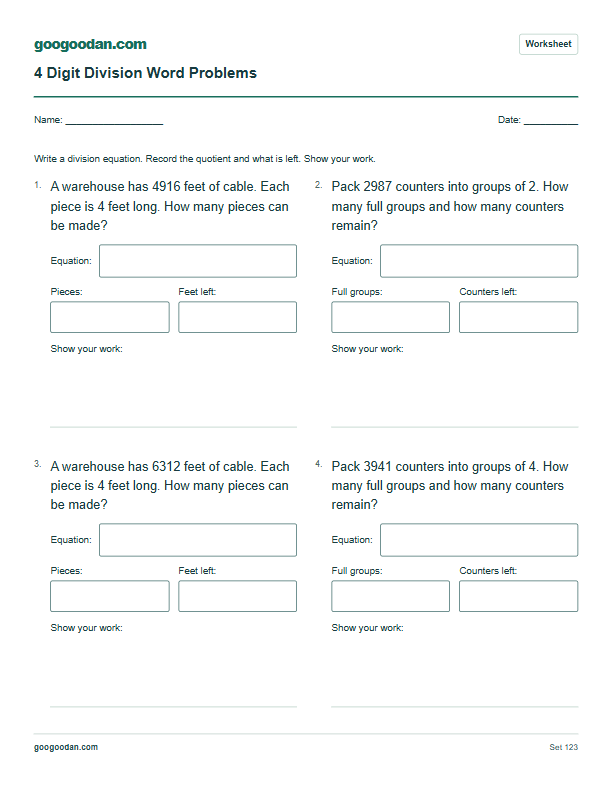 Word problems
4 Digit Division Word Problems With and Without Remainders
Find complete groups or cable pieces, and record what is left separately from the quotient.
4 problems · Answer key included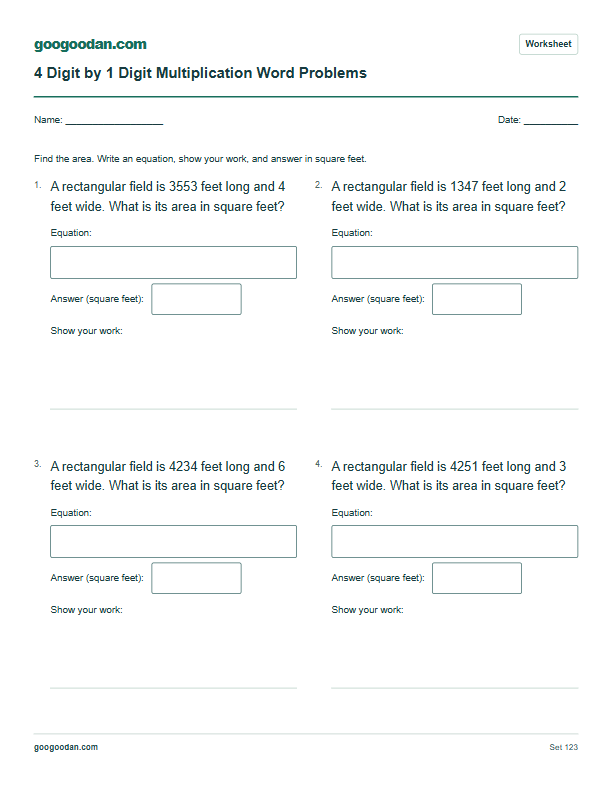 Word problems
4 Digit by 1 Digit Multiplication Word Problems
Use place-value partial products to find rectangle area from a four-digit length and a one-digit width.
4 problems · Answer key included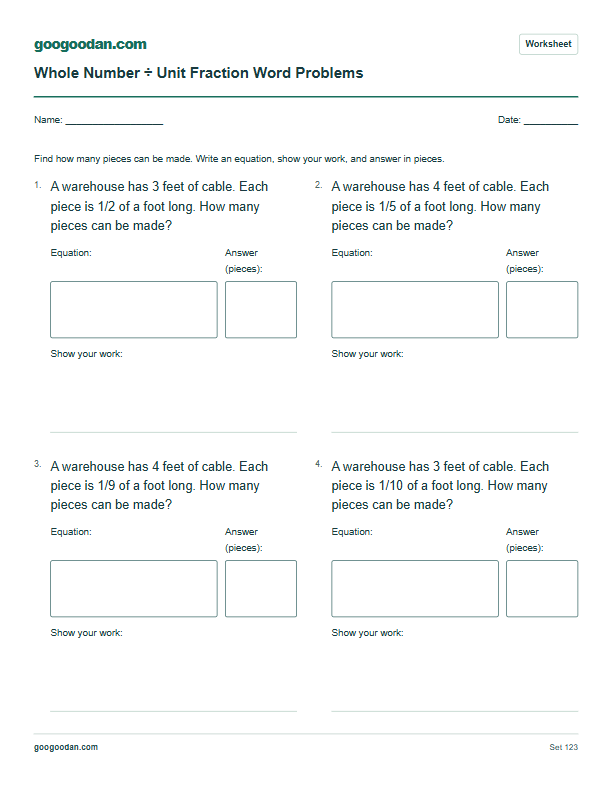 Word problems
Dividing Whole Numbers by Unit Fractions Word Problems
Count fractional-foot cable pieces in a whole-number length, using equal groups and multiplication to check.
4 problems · Answer key included
More about division · Grade 5 worksheets
Grade 5 selected skill connection: 5.NBT.B.6: up to four-digit dividends and two-digit divisors; exact-small-groups finds 1–9 groups, and exact-two-digit-sharing finds amounts of 10–99 in each of 10–99 groups. See the Common Core grade guidance. This worksheet does not cover every requirement in the standard.