
4 Digit by 2 Digit Division Word Problems With Remainders
Teach division with two-digit divisors using estimates and labeled groups.
Teaching notes for parents and teachers
How to teach it
Begin with a convenient multiple of the divisor and adjust it. Choose an activity that matches whether you want students to find group size, group count, or a remainder.
Example to work through together
Use the model below as you explain the example. Have your student point to the quantities as you discuss them.
1,237 ÷ 24 = 51 R 13
| Step | Full groups | Counters used | Counters left |
|---|---|---|---|
| First chunk | 50 | 24 × 50 = 1,200 | 37 |
| Next chunk | 1 | 24 × 1 = 24 | 13 |
Add the partial quotients: 50 + 1 = 51 groups.
Check the total: 24 × 51 + 13 = 1,237 counters.
Ask your student
What does the quotient count in this activity?
If your student needs help
If the estimate is too large, compare its product with the dividend and revise it together.
Share a total among a known number of groups
Choose Equal sharing: two-digit groups to find how much belongs in each group. The total and the number of equal groups are given. The missing quantity is the amount in one group. Keep that distinction clear: in the other activities on this page, the amount in one group is given and the question asks how many groups can be made.
Identify what is known before dividing
A total of 920 is shared equally among 92 groups. The 92 already tells us how many groups there are. Ask the child to finish this sentence: “Each of the 92 groups gets the same amount, and I need to find that amount.”
Think of multiplication with a missing factor: 92 × ? = 920. Since 92 × 10 = 920, each group gets 10. Write 920 ÷ 92 = 10, and say “10 in each group.” Multiplying by ten changes the value of 92 to 920 because every one of the 92 groups receives ten.
Check by rebuilding the whole amount: 92 groups with 10 in each use 920 altogether. Nothing is left. A quotient of 1 would account for only 92, so the zero in 10 is part of the answer’s place value, not a digit to leave out.
Build each share in manageable parts
Now share 7,029 equally among 99 groups. Giving one to each group uses 99. Giving ten to each uses 990. Seven of those ten-per-group rounds give 70 to every group and use 99 × 70 = 6,930 altogether.
Subtract what has been shared: 7,029 − 6,930 = 99. Those 99 remaining can be shared as one more in each of the 99 groups. Add the amounts received by a single group: 70 + 1 = 71. The equation is 7,029 ÷ 99 = 71.
The numbers 70 and 1 are partial quotients: each tells how much one group receives during a step. The numbers 6,930 and 99 tell how much has been shared across all the groups. Add the partial quotients to find the answer; use the larger amounts to track the total that has been distributed.
Check the answer and its meaning
Multiply the number of groups by the amount in each: 99 × 71 = (99 × 70) + (99 × 1) = 6,930 + 99 = 7,029. This returns the original total, with nothing left. The answer means 71 in each group. It does not mean 71 groups, because the problem already specified 99 groups.
Different partial quotients can work. The important rule is to give the same amount to every group at each step, subtract the amount used from the current remaining total, and combine all the amounts received by one group. Encourage a child who uses smaller correct steps to explain them before looking for a more efficient choice.
What this activity provides
Each sheet has four different exact-sharing questions. The number of groups is a two-digit whole number, and the amount in each group is also a two-digit whole number. Totals can have three or four digits. The total and group count are given; the amount in each group is always the unknown.
Write a division equation, record the amount per group, and use the working space for partial quotients or long division. The answer key gives final values; the worked examples above show how to explain the reasoning. Use Exact groups: 1–9 groups when the goal is finding the number of groups, or the default four-digit activity when the child is ready to interpret remainders as well.
Smaller totals: make full groups and keep track of what is left
Start with 80 counters and put 68 in each group. Ask the child to point out the total, 80, and the size of one group, 68. The question asks how many complete groups can be made and how many individual counters remain.
Why stop after one group?
One group uses 68 counters, so subtract: 80 − 68 = 12. The 12 left are fewer than the 68 needed for another group. Two complete groups would need 68 × 2 = 136 counters, more than the 80 available. Write 80 ÷ 68 = 1 R 12: the quotient, 1, counts full groups; the remainder, 12, counts individual counters.
Notice a common mistake, then check
If the child calls the 12 left over “12 groups,” point back to the group of 68 and ask whether another such group can be filled. Do not round the quotient up to 2. This question counts complete groups; a question asking for enough containers to hold every item would ask something different.
Check both the total and the leftover size: 68 × 1 + 12 = 80, and 0 < 12 < 68. Rebuilding the total accounts for every counter. Comparing 12 with 68 confirms that no further full group can be made.
Practice with smaller totals
Choose Smaller totals: remainders for four questions with totals from 10 to 999 and group sizes from 10 to 99. Every question makes at least one complete group and has a positive remainder smaller than the group size. Write an equation, label the full groups and the items left, and show your work.
The four-digit activity is still available for larger totals. Choose Exact groups: 1–9 groups for grouping with nothing left, or Equal sharing: two-digit groups to find the amount in each of a given number of groups.
Make a practice set
Select the worksheet, answer key, or both. When both are selected, the answer key prints after the questions. Keep it separate if you want your student to work independently.
After your student finishes
Ask the child what the quotient measures: the number of groups or the amount in each group. Use multiplication to rebuild the total. For a problem with a remainder, include what is left and check that it is smaller than the divisor.
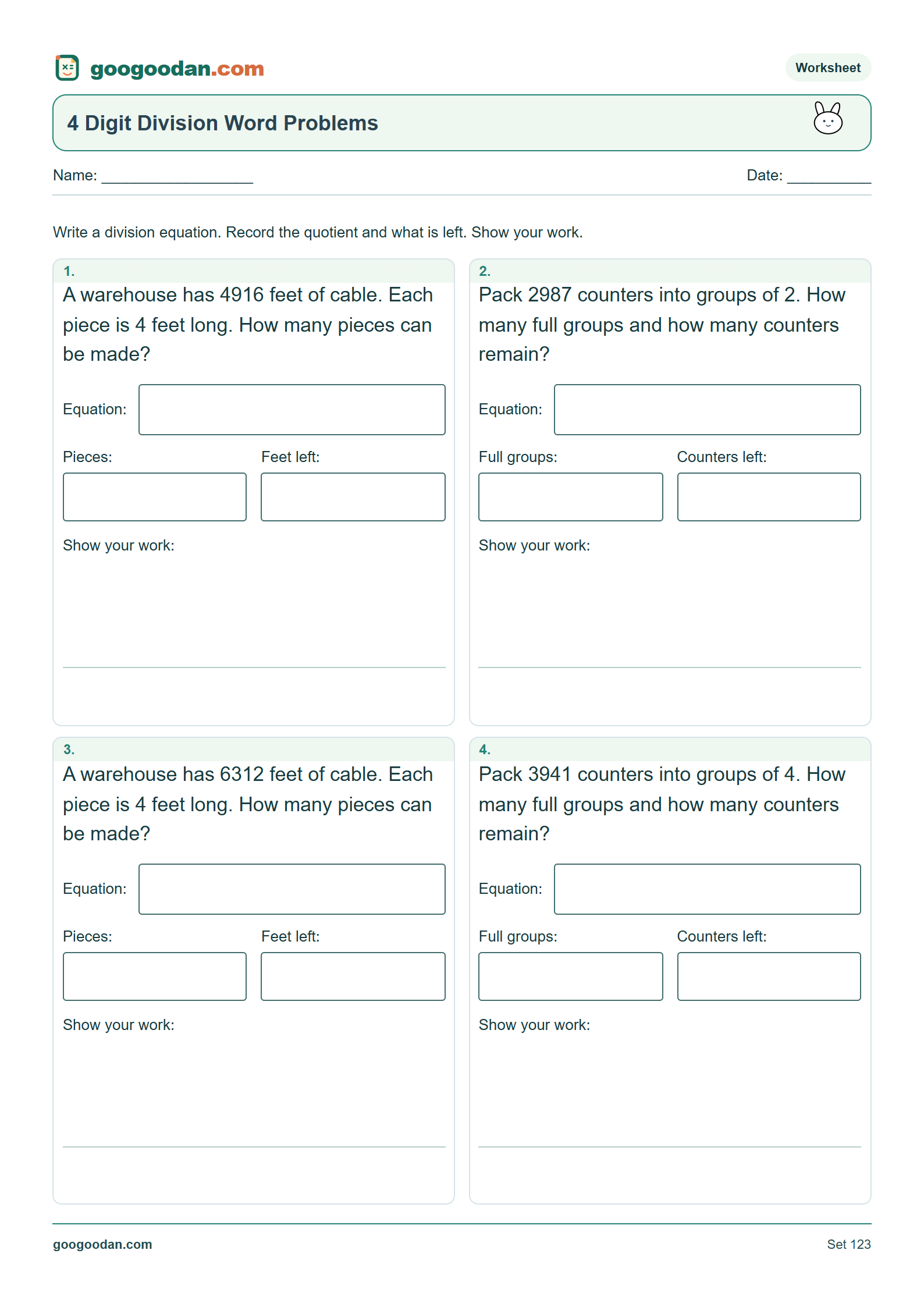 Word problems
4 Digit Division Word Problems With and Without Remainders
Find complete groups or cable pieces, and record what is left separately from the quotient.
4 problems · Answer key included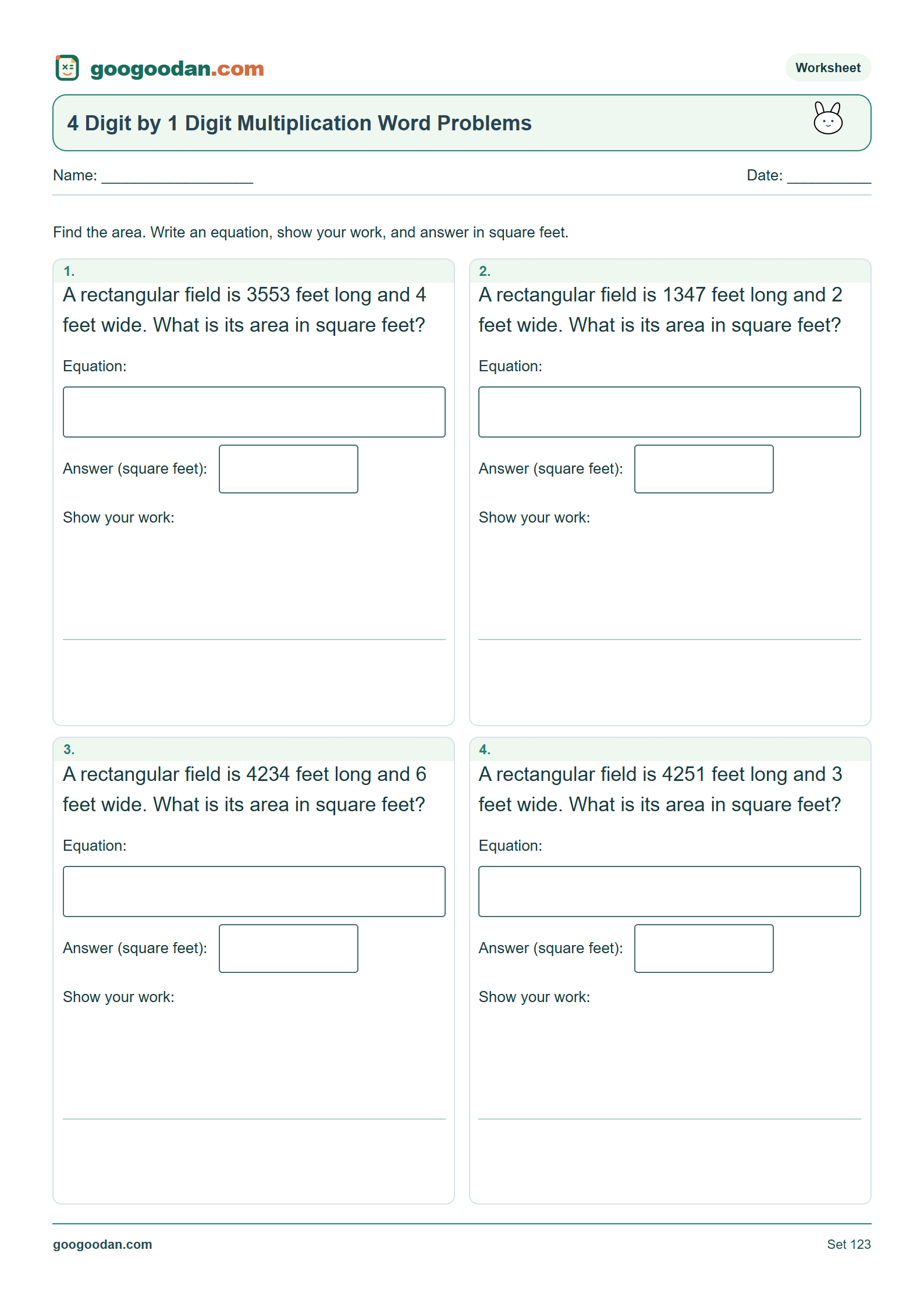 Word problems
4 Digit by 1 Digit Multiplication Word Problems
Use place-value partial products to find rectangle area from a four-digit length and a one-digit width.
4 problems · Answer key included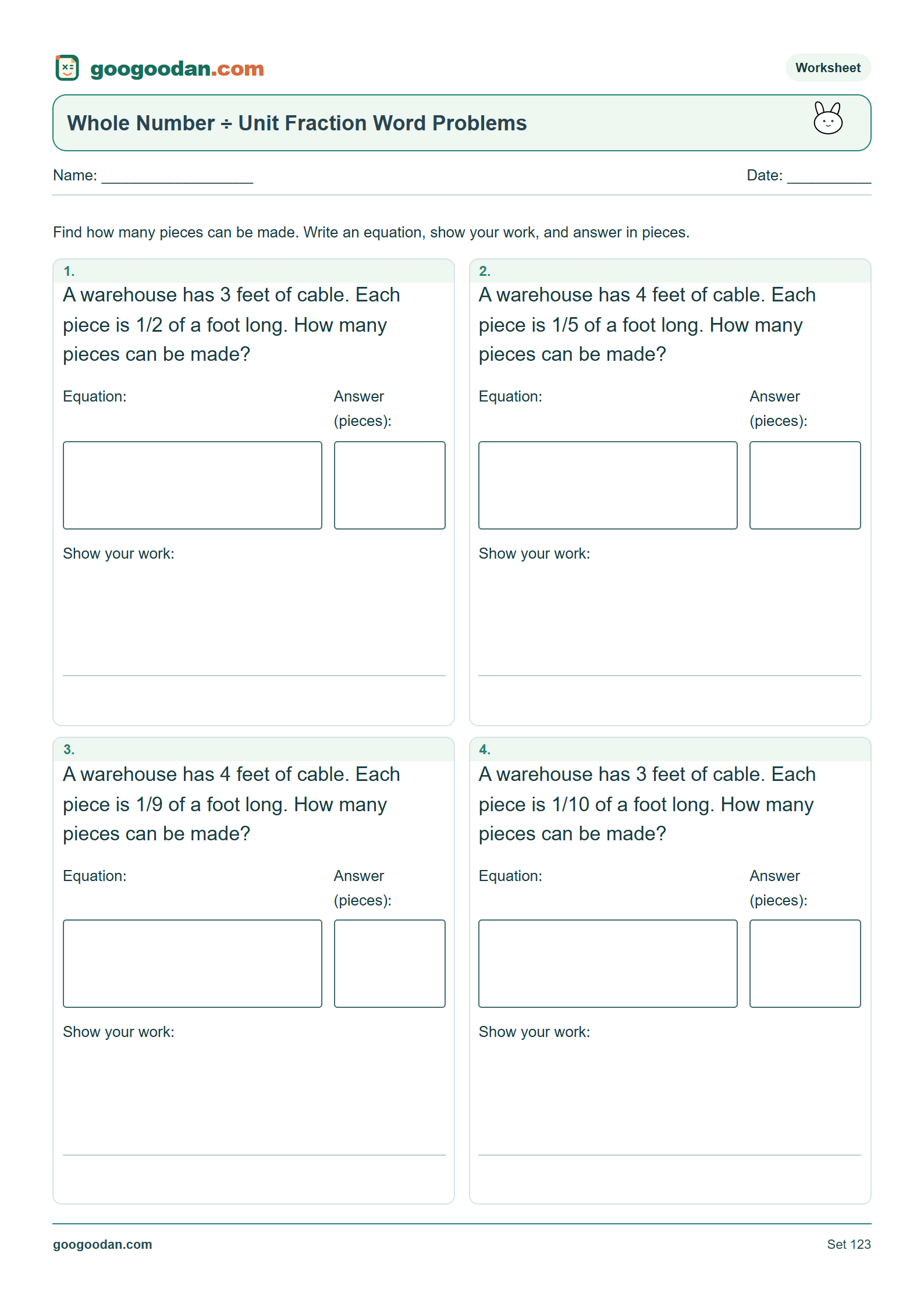 Word problems
Dividing Whole Numbers by Unit Fractions Word Problems
Count fractional-foot cable pieces in a whole-number length, using equal groups and multiplication to check.
4 problems · Answer key included
More about division · Grade 5 worksheets
Grade 5 selected skill connection: 5.NBT.B.6: up to four-digit dividends and two-digit divisors; exact-small-groups finds 1–9 groups, and exact-two-digit-sharing finds amounts of 10–99 in each of 10–99 groups. See the Common Core standards for this grade. This worksheet does not cover every requirement in the standard.