
Dividing Whole Numbers by Unit Fractions Word Problems
How many fractional-foot pieces fit into a whole-number cable length? Use equal groups to understand the quotient, then check that the pieces rebuild the original length.
Division can count small groups inside a larger amount
Leo needs to cut a three-foot cable into pieces that are each half a foot long. He sees the division sign and expects an answer smaller than three. Before calculating, ask him to mark the one-foot intervals and split each interval in half. He can now point to six pieces.
The total length is the amount being divided. The length of one piece is the group size. The question asks how many of those equal-size groups fit in the total. It does not ask for the length of a piece; that measurement has already been given.
3 ÷ 1/2 = 6 pieces
Count the pieces, not just the three whole feet. Each foot contains two half-foot pieces, so three feet contains three groups of two: six pieces.
Why dividing by one half doubles the count
One whole foot contains two half-foot lengths. Three whole feet therefore contains 3 × 2 half-foot lengths. This explains why 3 ÷ 1/2 = 6 without treating the rule as a trick. The cable has not become longer. The number increases because the counted unit is smaller than one foot.
A unit fraction has numerator one. If each piece is 1/5 of a foot long, five pieces fit in each foot. Four feet contains 4 × 5 = 20 pieces. More generally, dividing a whole-number length by 1/d counts d equal pieces per foot, giving whole number × d.
Connect the picture to the reciprocal rule
Once the grouping makes sense, write the equivalent multiplication. For 4 ÷ 1/5, the reciprocal of 1/5 is 5, so 4 × 5 = 20. Only the divisor is replaced by its reciprocal; the four-foot total stays four.
This is different from 4 × 1/5, which finds four fifths of a foot. That multiplication combines four small lengths, whereas the original division counts how many fifth-foot lengths fit inside four whole feet. Have the child say which quantity the answer represents before choosing a rule.
The order of the quantities matters
Read the story as total length ÷ length of one piece. Reversing the order changes the question. For example, 1/2 ÷ 3 can describe sharing half a foot equally among three people, where each share is 1/6 foot. It does not answer how many half-foot pieces fit into three feet.
These printed problems use only the first relationship: a whole-number total divided by a unit-fraction piece length. Keeping that scope clear helps children connect the equation to the story instead of selecting whichever order gives a familiar-looking result.
Check by rebuilding the original cable
Multiply the number of pieces by the length of one piece. Six pieces at 1/2 foot each cover 6 × 1/2 = 3 feet, which rebuilds the three-foot total. For twenty pieces at 1/5 foot each, 20 × 1/5 = 4 feet. This check tests the answer and the interpretation of its unit.
The answer box is labeled pieces. Writing six feet would describe a length rather than the requested count. All the lengths here divide exactly, so there are no leftover lengths or partial pieces to report.
Choose a manageable drawing
For a small problem, draw the full cable, label each whole foot, and divide every foot into equal pieces. For 12 feet cut into twelfths, drawing 144 tiny sections can hide the idea. Draw one foot split into twelve pieces, then explain that the same group appears twelve times: 12 × 12 = 144 pieces.
A diagram is useful when it shows why the calculation works. It does not need to contain a tiny mark for every piece once equal groups are understood. Ask the child to label the total, the piece size, and what one repeated group represents.
What the worksheet includes
The four questions reuse the original cable-cutting context with totals from 1 to 12 feet and piece lengths from 1/2 to 1/12 of a foot. Answers are whole counts from 2 to 144. Write an equation, use the working space for a diagram or explanation, and check by multiplication.
This is an idealized mathematics model with no material lost during cutting. It does not include division of a unit fraction by a whole number, non-unit-fraction divisors, remainders, or multi-step cutting instructions. Those relationships need their own matching contexts.
Make a practice set
Choose what to print. Selecting both shows the answer key on screen and prints the questions followed by the answers.
After the practice
Ask the child what each number measures. Have them explain how many pieces fit in one foot, then repeat that group for the total length. Check the final count by multiplying it by the length of one piece.
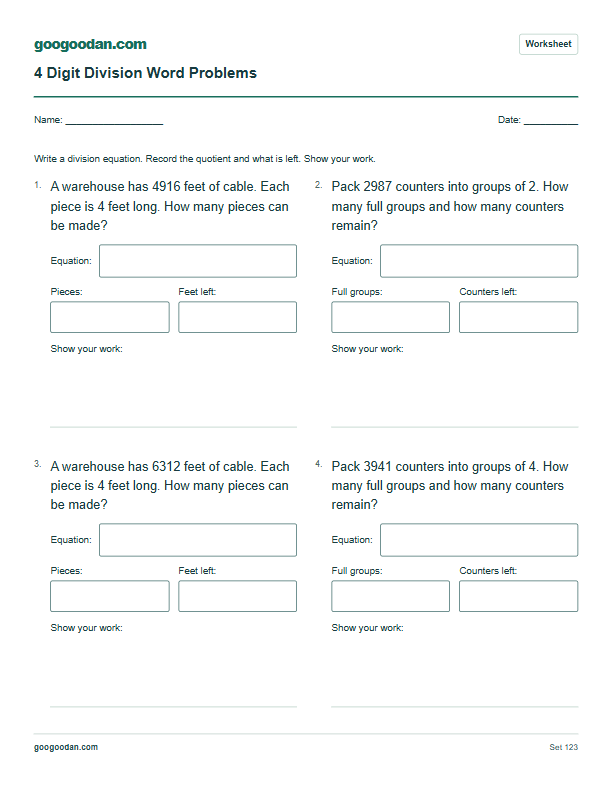 Word problems
4 Digit Division Word Problems With and Without Remainders
Find complete groups or cable pieces, and record what is left separately from the quotient.
4 problems · Answer key included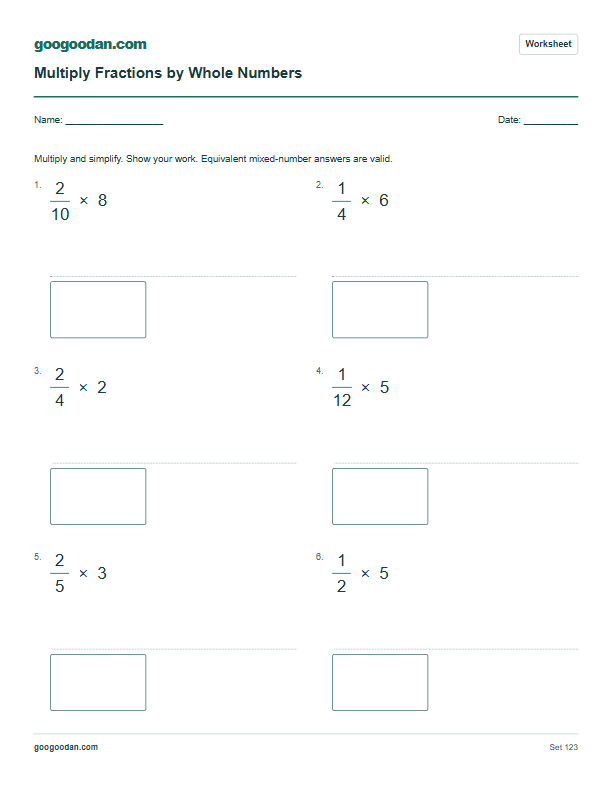 Calculation practice
Multiplying Fractions by Whole Numbers Worksheets
Count repeated groups of equal fraction parts and simplify the product.
6 problems · Answer key included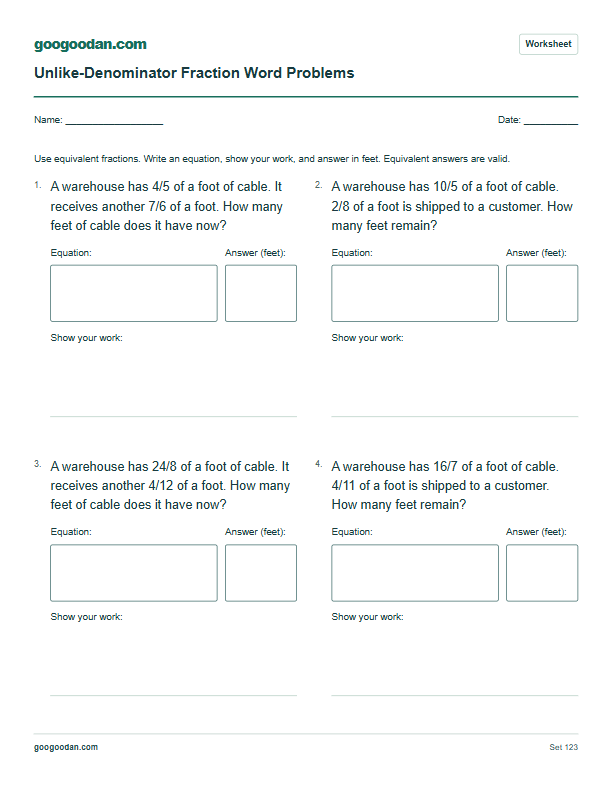 Word problems
Adding and Subtracting Fractions Word Problems With Unlike Denominators
Use equivalent fractions to combine or remove cable lengths measured against the same one-foot whole.
4 problems · Answer key included
More about division · Grade 5 worksheets
Grade 5 selected skill connection: 5.NF.B.7.b; 5.NF.B.7.c (whole number divided by unit fraction in exact measurement-grouping stories). See the Common Core grade guidance. This worksheet does not cover every requirement in the standard.