
Multiplying Fractions Worksheets: By Whole Numbers
Repeat equal-sized fraction parts, then simplify the product. Use the fraction-strip example and print six problems with room for a model or calculation.
Multiply the number of parts, not their size
Lia is finding 3/4 × 3. She multiplies both the numerator and denominator by three and gets 9/12. That fraction equals the original 3/4, so her result has not increased even though she wanted three copies of the amount. Return to equal-sized fraction pieces before asking her to memorize another rule.
Show three groups of three fourths. Each strip below represents a whole of the same size. Every whole has four equal parts, and three parts in each strip are shaded.
Count the shaded fourths: 3 + 3 + 3 = 9 fourths. Each piece is still one fourth of a whole. The product is 3/4 × 3 = 9/4 = 2 1/4, not 9/12. Eight fourths make two wholes, with one fourth left.
Connect equal groups to repeated addition
Three copies of 3/4 can be written as 3/4 + 3/4 + 3/4. Combining the pieces changes how many fourths you have, but does not cut each piece into smaller parts. Multiply the numerator by the whole-number factor and keep the denominator: (3 × 3)/4 = 9/4.
The worksheet writes the fraction first. You can also write 3 × 3/4 to describe three groups of three fourths. Multiplication gives the same product in either order. When drawing, use the whole number to decide how many equal groups to make and the fraction to show how much belongs in each group.
Start with unit fractions when needed
If 3/4 feels hard to track, start with 1/4 × 3. Three copies of one fourth make 3/4. Then put three one-fourth pieces into each of those three groups. There are now nine pieces, each still one fourth. This connects a fraction such as 3/4 to three copies of its unit fraction, 1/4.
Keep the whole the same size in every group. Three fourths of a long strip and three fourths of a shorter strip are different amounts. In these numerical exercises, all fraction parts refer to the same-sized whole.
A product may be below one, equal to one, or above one
For 1/8 × 3, the total is 3/8, still less than a whole. For 2/5 × 5, ten fifths make 2 wholes. Use the denominator to count how many pieces complete a whole; a numerator larger than the denominator is not automatically an error.
To check 3/8 × 4 = 12/8, notice that each group has less than half a whole. Four groups must total less than two wholes. The simplified answer 3/2, or 1 1/2, fits that check. An answer greater than four would not make sense because every original group is smaller than one.
Simplify after finding the product
For 2/6 × 4, first find 8/6. Divide numerator and denominator by their common factor of two to get 4/3. You may also simplify 2/6 to 1/3 first, then multiply by four. Both paths describe the same amount.
The answer key uses a fraction in simplest form or a whole number. An equivalent mixed number is also correct: 4/3 and 1 1/3 have the same value. If a child writes 8/6, the multiplication is correct, but the instruction to simplify still needs attention. Discuss that final step separately from understanding the product.
Use the work area to explain one example
Draw equal-sized bars, write repeated addition, or show the numerator multiplication in the open space. Put the final simplified value in the answer box. Ask the child to name the fraction unit out loud: “eight sixths,” for example, instead of naming only the digits.
Each page has six problems. The fraction is positive and less than one; the whole-number factor is from one through nine. Denominators are 2, 3, 4, 5, 6, 8, 10, and 12. Some original fractions can be simplified before multiplying. Products may be proper fractions, improper fractions, or whole numbers. This set does not include zero factors, mixed-number factors, multiplying two fractions, or denominator 100.
Make a practice set
Choose what to print. Selecting both shows the answer key on screen and prints the questions followed by the answers.
After the practice
Check that the size of each fraction part stayed the same. Accept equivalent mixed numbers, and distinguish a correct product from a product that still needs simplifying.
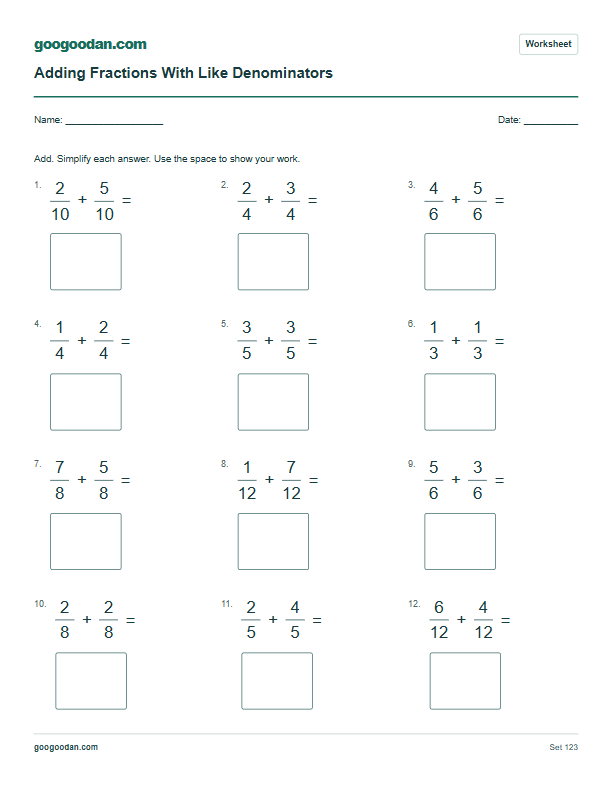 Calculation practice
Adding Fractions With Like Denominators
Add equal-sized parts; simplify sums that may be greater than one.
12 problems · Answer key included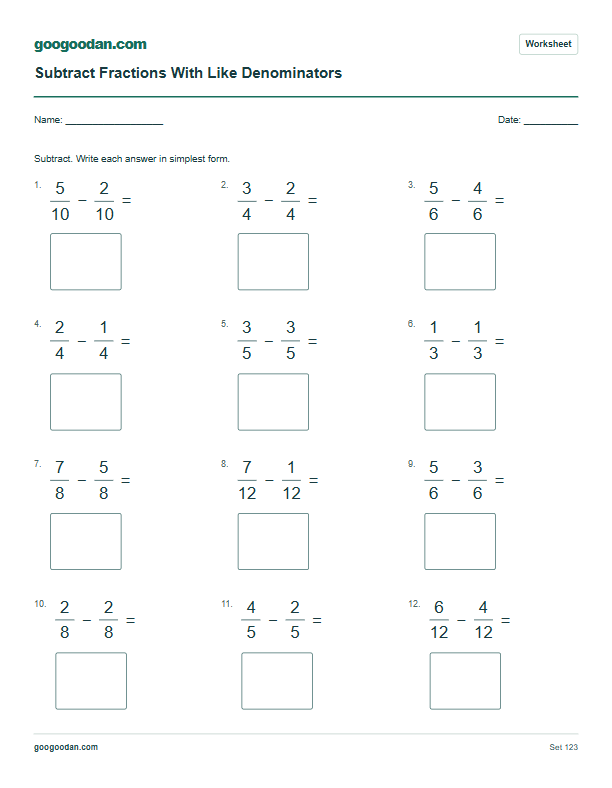 Calculation practice
Subtracting Fractions With Like Denominators
Take away equal-sized parts of the same whole and simplify the difference.
12 problems · Answer key included
More about multiplication · Grade 4 worksheets
Grade 4 selected skill connection: 4.NF.B.4.a–b (selected proper-fraction times whole-number practice). See the Common Core grade guidance. This worksheet does not cover every requirement in the standard.