
Adding and Subtracting Fractions Word Problems With Unlike Denominators
Give unlike fraction parts a common name before adding or subtracting. These cable-length stories keep one foot as the shared whole and connect the action in each story to an equation.
Rename the parts before combining them
Elena reads that a warehouse has 1/2 of a foot of cable and receives another 1/3 of a foot. She writes 2/5 because she adds the two numerators and the two denominators. Ask her to compare a half-foot piece with a third-foot piece. They are not the same size, so counting them as if they were fifths loses the meaning of the measurements.
Use a one-foot reference length for both fractions. Divide it into six equal parts. Half of the whole covers three sixths; one third covers two sixths. Elena can now count five pieces of the same size.
1/2 + 1/3 = 3/6 + 2/6 = 5/6 foot
The bars use the same whole and the same-sized sixths. Splitting one half into three sixths, or one third into two sixths, changes the way the length is named, not the amount of cable.
Why equivalent fractions keep the value
To rename 1/2 as sixths, multiply both its numerator and denominator by three. Each half is split into three smaller pieces, so three of the six pieces still cover the same half-foot length. Renaming 1/3 as 2/6 uses a factor of two for the same reason. Multiplying only the denominator would shrink the represented length.
A common denominator is a shared partition of the one-foot whole. It does not have to be the smallest possible one. Twelfths also work: 1/2 + 1/3 = 6/12 + 4/12 = 10/12 = 5/6. Using the least common denominator usually keeps the numbers smaller, but a correct larger common denominator is valid.
Subtract a length using the same idea
A warehouse has 5/6 of a foot of cable and ships 1/4 of a foot. Twelfths name both lengths: 5/6 = 10/12 and 1/4 = 3/12. Removing three twelfth-foot pieces from ten leaves seven, so 5/6 − 1/4 = 7/12 foot.
The story decides whether to add or subtract. Receiving another length increases the total; shipping some away reduces what remains. First identify the action, then make equivalent fractions. Do not add simply because a common denominator was found, and do not subtract the denominators. They name the part size throughout the calculation.
Improper fractions still measure the same unit
The printed problems can begin with more than one foot. For example, 9/4 feet plus 6/5 feet becomes 45/20 + 24/20 = 69/20 feet. That is also 3 9/20 feet. The one-foot reference has not changed; the fractions simply count parts across several one-foot lengths.
You may convert improper fractions to mixed numbers, or keep them as fractions until the final step. The key uses the simplified original answer, including whole-number answers when appropriate. Accept an equivalent mixed number or fraction. If the child chooses a mixed-number subtraction method, help them regroup a whole into fractional parts when needed; the improper-fraction method avoids that separate regrouping step.
Zero can be a complete answer
Different written denominators do not guarantee different values. If the warehouse has 2/3 of a foot and ships 4/6 of a foot, it ships the entire length. The remaining amount is zero feet. A blank response means the answer has not been recorded; writing zero explains that no cable remains.
Likewise, a fraction such as 6/4 need not be simplified before starting. It is the same length as 3/2. Children can simplify inputs first or simplify their final answer, provided each step preserves the value.
Use a benchmark to catch an unreasonable result
In the first example, one half plus one third must exceed one half but stay below one whole. The proposed 2/5 is already below one half, so it cannot be the sum. For subtraction, the remainder cannot be larger than the starting length or negative in these stories. Estimate before comparing with the answer key.
Read each story, choose an operation, write equivalent fractions in the working space, and record the simplified result in feet. These four one-step problems use positive lengths at most three feet each, with different written denominators from 2 to 12. Sums are at most six feet; differences are nonnegative. A set may contain different counts of addition and subtraction questions. Mixed-number inputs, area, and multi-step stories are not included.
Estimate a recipe total before finding it exactly
Mateo measures 2/3 of a cup of an ingredient and then adds 2/4 of a cup more of the same ingredient. He predicts less than one cup because both measurements are fractions. Ask him to compare each amount with half a cup: 2/4 equals one half, and 2/3 is greater than one half. Together they must exceed one cup.
A recipe uses 2/3 cup. Add 2/4 cup more. How much altogether?
2/3 + 2/4 = 8/12 + 6/12 = 14/12 = 7/6
Green shows the original 8/12 cup. Orange shows the added 6/12 cup. Each full bar is one cup, so the fourteen colored parts fill one whole cup and two twelfths of the next.
The exact total is 7/6 cups, or 1 1/6 cups. That agrees with the prediction: more than one cup but less than two. Mateo can simplify 2/4 to 1/2 first and use sixths instead: 4/6 + 3/6 = 7/6. Twelfths and sixths describe the same final amount.
If he adds the numerators and denominators to get 4/7, the answer is already too small: 4/7 is less than the original 2/3 cup, even though more ingredient was added. A benchmark check catches the error before he repeats a long calculation. A reasonable estimate supports the exact answer; it does not replace it.
This original recipe is a worked transfer example. The printable set below still contains the cable stories described on this page. Keep the unit with each context and model both recipe measurements against the same cup. These are idealized additive quantities of the same ingredient, not a claim about the volume of arbitrary ingredients after mixing.
Make a practice set
Choose what to print. Selecting both shows the answer key on screen and prints the questions followed by the answers.
After the practice
Ask the child to name the one-foot whole, explain the operation, and show why the equivalent fractions have the same value. Check the estimate and unit as well as the arithmetic. Use like-denominator stories first when counting equal-sized parts still needs practice.
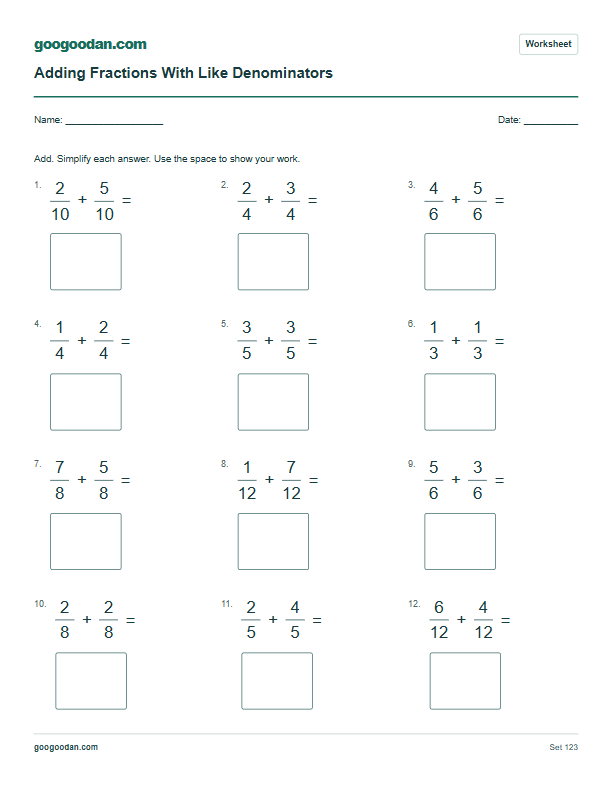 Calculation practice
Adding Fractions With Like Denominators
Add equal-sized parts; simplify sums that may be greater than one.
12 problems · Answer key included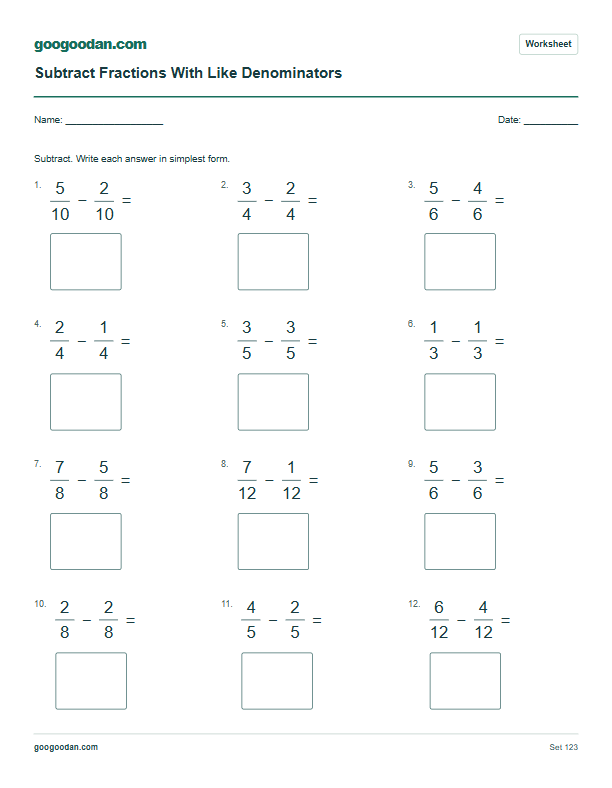 Calculation practice
Subtracting Fractions With Like Denominators
Take away equal-sized parts of the same whole and simplify the difference.
12 problems · Answer key included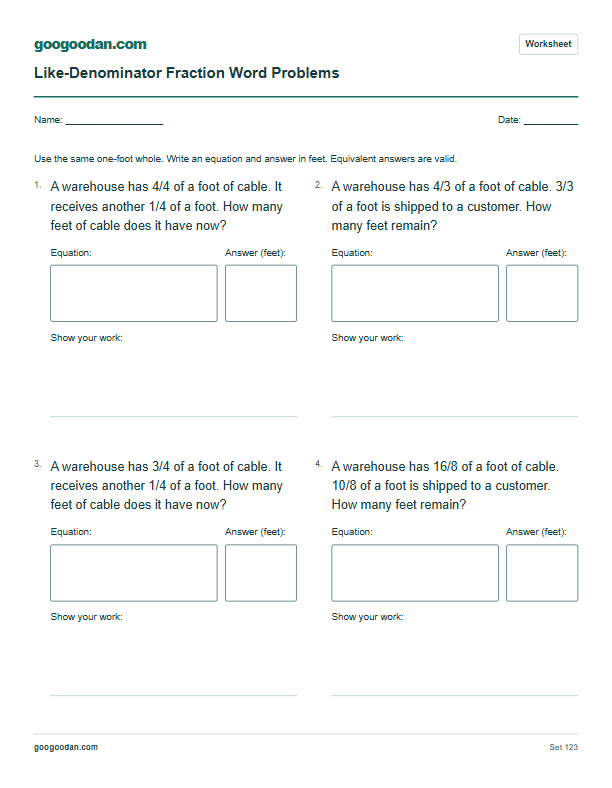 Word problems
Adding and Subtracting Fractions Word Problems With Like Denominators
Combine or remove fractional cable lengths measured using the same one-foot whole.
4 problems · Answer key included
More about fractions · Grade 5 worksheets
Grade 5 selected skill connection: 5.NF.A.1; 5.NF.A.2 (one-step cable-length stories with unlike written denominators). See the Common Core grade guidance. This worksheet does not cover every requirement in the standard.