
Adding and Subtracting Fractions Word Problems With Like Denominators
A fraction describes part of a chosen whole. In these cable-length stories, that whole is one foot. Join or remove equal-sized fractional parts, then describe the resulting length in feet.
Count parts of the same size
A warehouse has 3/8 of a foot of cable and receives another 7/8 of a foot. Ava writes 10/16 because she adds both the top and bottom numbers. Before correcting the arithmetic, ask what one eighth means: one of eight equal parts of a one-foot length.
3/8 + 7/8 = 10/8 = 5/4
Three eighth-foot parts and seven more eighth-foot parts make ten eighth-foot parts. Their size has not changed.
Each bar represents one foot. Ten shaded eighths cover one whole bar and two eighths of the next bar.
Why the denominator stays the same
The denominator names the size of each part relative to the whole. Adding another length made of eighths does not cut the existing parts into sixteenths. Only the count of eighths changes. The numerator therefore changes from three and seven to a total of ten, while the denominator remains eight.
This depends on the same whole. An eighth of a one-foot strip and an eighth of a two-foot strip would have different lengths. Here, every fraction is measured against one foot, so matching denominators describe equal-sized pieces.
A result can be more than one whole
Ten eighths is greater than eight eighths, so the answer is more than one foot. Eight eighths make one foot; the remaining two eighths make one quarter of a foot. Thus 10/8, 5/4, and the mixed number 1 1/4 describe the same length.
The answer key uses the simplified form supplied by the existing problem bank. A child who writes an equivalent fraction has not changed the length. Ask them to explain the equivalence with equal parts before treating a different notation as a wrong answer.
Subtract parts without changing their size
A second warehouse has 7/6 of a foot of cable and ships 5/6 of a foot. The question asks how much remains. Seven sixth-foot parts minus five sixth-foot parts leaves two sixth-foot parts.
7/6 − 5/6 = 2/6 = 1/3
Check: 1/3 = 2/6, and 2/6 + 5/6 = 7/6.
If the starting amount and the removed amount are equal, nothing remains. A zero answer is valid. If an addition makes exactly one foot, writing 1 is valid too. The fraction bars in the question do not require every final answer to remain a fraction.
Match the operation to the story first
Receiving more cable combines lengths; shipping cable removes a length from what was stored. Decide that relationship before working with the numerators. Keep the answer in feet because the story describes length, not area or a count of rolls.
Each printable contains four one-step stories with like denominators selected from 2, 3, 4, 5, 6, 8, 10, and 12. Given lengths can exceed one foot, but are at most two feet each; an addition result can be up to four feet. The set does not include unlike denominators or hundredths. Use the work area for a drawing or equivalent-fraction steps, and compare values rather than requiring one exact written form.
Try the same idea with a measuring cup
Leo is following a recipe. He has measured 2/4 of a cup of an ingredient and needs to add another 2/4 of a cup of that same ingredient. Before calculating, he notices that each amount is half a cup. Two halves should make one full cup.
A recipe uses 2/4 cup. Add 2/4 cup more. How much altogether?
2/4 + 2/4 = 4/4 = 1
The answer is one cup. The quarters keep the same size because both measurements refer to the same one-cup whole. If Leo writes 4/8, compare it with his prediction: 4/8 is only half a cup, the amount he had before adding anything. Adding a positive amount must increase the total.
This is a transfer example to read together, not an extra question in the printable cable set. The same fraction idea works for different units, but the answer unit must follow the story: cups for this recipe and feet for the cable worksheet. The mathematical model treats the two amounts of the same ingredient as additive measured quantities.
Make a practice set
Choose what to print. Selecting both shows the answer key on screen and prints the questions followed by the answers.
After the practice
Ask the child to name the whole and the fractional unit before checking one equation. If the relationship is correct but the answer looks different from the key, compare the two values using a bar model or equivalent fractions. Use the calculation-only sets for more practice with the same-sized parts.
 Calculation practice
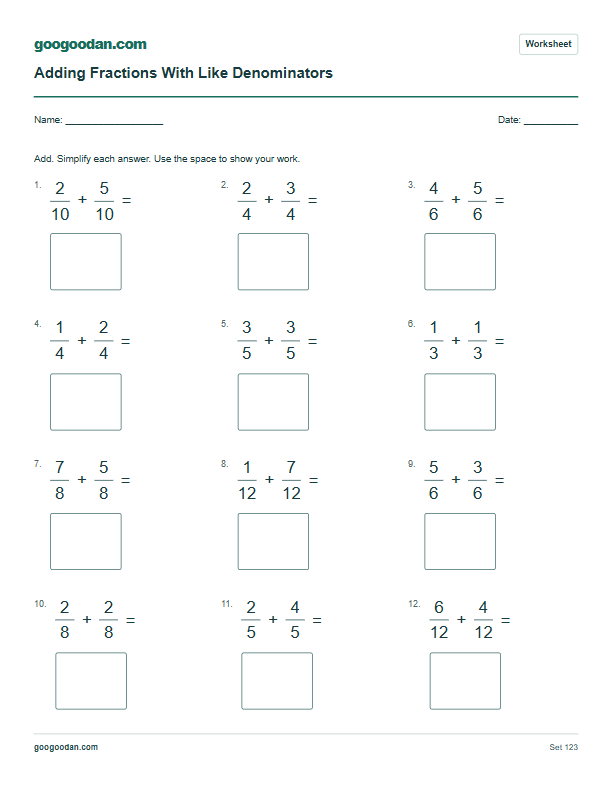
Adding Fractions With Like Denominators
Add equal-sized parts; simplify sums that may be greater than one.
12 problems · Answer key included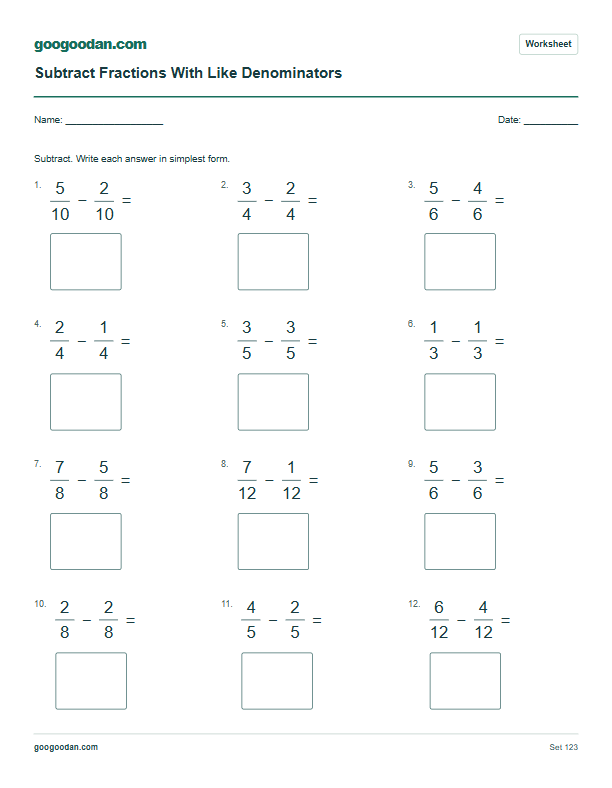 Calculation practice
Subtracting Fractions With Like Denominators
Take away equal-sized parts of the same whole and simplify the difference.
12 problems · Answer key included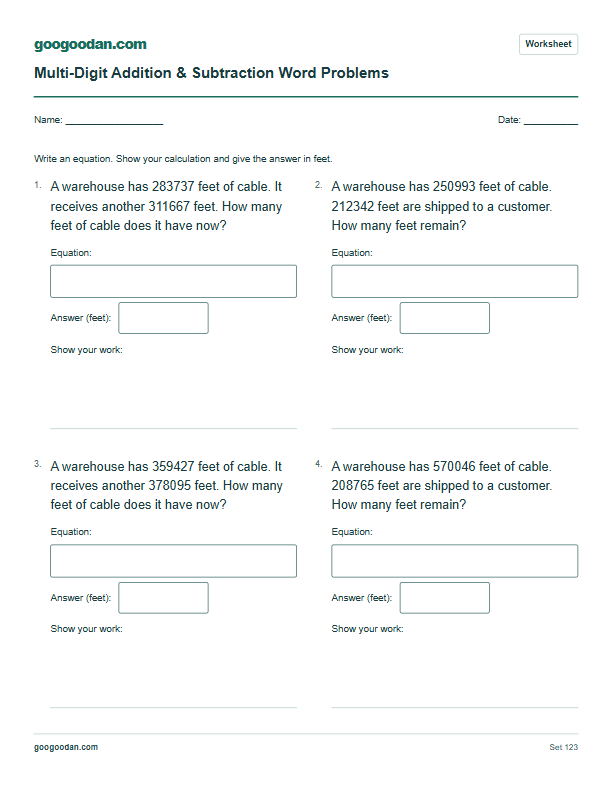 Word problems
Multi-Digit Addition and Subtraction Word Problems
Add and subtract cable lengths within 1,000,000 and label the answer in feet.
4 problems · Answer key included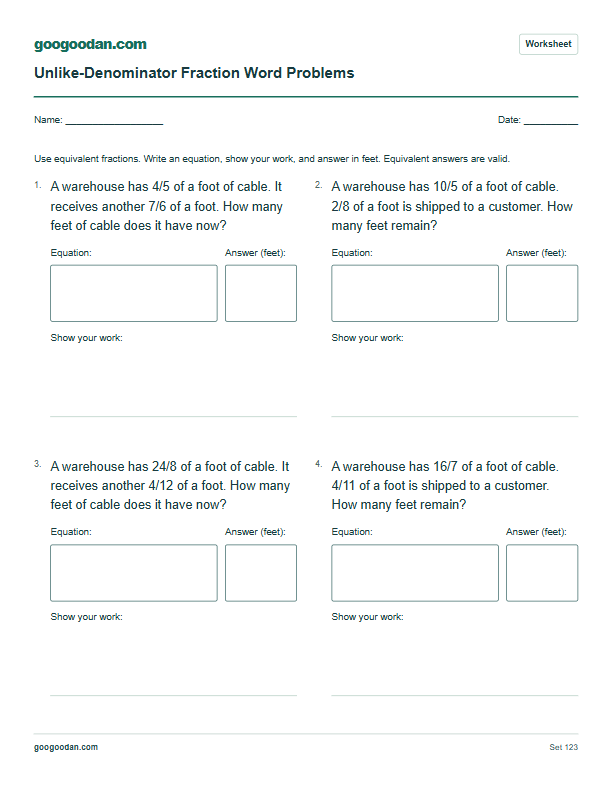 Word problems
Adding and Subtracting Fractions Word Problems With Unlike Denominators
Use equivalent fractions to combine or remove cable lengths measured against the same one-foot whole.
4 problems · Answer key included
More about fractions · Grade 4 worksheets
Grade 4 selected skill connection: 4.NF.B.3.d (like-denominator addition and subtraction in length contexts). See the Common Core grade guidance. This worksheet does not cover every requirement in the standard.