
Division Word Problems: Round Up the Remainder
A correct quotient is only the start. Help children decide whether a remaining student needs one more van, then check the fewest vehicles that can carry everyone.
Amir finds three full vans—but one student is still waiting
Nineteen students are traveling together. Each van has room for six students. Amir calculates 19 ÷ 6 = 3 R 1 and writes “3 vans.” His division is correct: three groups of six account for eighteen students. The remaining one is a student who still needs a seat, not an amount that can be ignored.
Ask, “Where will the nineteenth student sit?” One additional van can carry that student. Four vans are needed, even though the last van will not be full. The problem asks for enough whole vehicles, so the quotient alone is not always the final answer.
Three full vans carry 18 students. The remaining student needs a seat in a fourth van. There are 24 student places in all, with 5 unused.
Explain the quotient and the remainder in the story
In 19 ÷ 6 = 3 R 1, the 3 is the number of full groups of six, and R 1 means one student remains after filling those groups. Check the division with 6 × 3 + 1 = 19. The remainder is measured in students; it is not an extra fraction of a van that the group can order.
Since a remainder is smaller than the number of students one van can hold, one more van is enough for the students left over. Keep the division result in the equation box, then write the number of whole vans in the separate “Vans needed” box. This helps a child see why the number in the final answer may differ from the quotient.
Round up only when there is a remainder
For 18 students with six places per van, 18 ÷ 6 = 3 exactly. Three vans seat everyone, so a fourth is unnecessary. For 19 students, a remainder of one requires four vans. For 23 students, 23 ÷ 6 = 3 R 5 also requires four vans: the five remaining students fit together in the extra van.
This is not ordinary rounding to the nearest whole number. Nineteen divided by six is only a little more than three, but three vans still leave someone without a seat. Any positive remainder requires the next whole vehicle. A remainder of zero does not.
Check both enough seats and the fewest vans
Four vans with six student places each offer 4 × 6 = 24 places, enough for nineteen students. Now try one fewer: 3 × 6 = 18, which is not enough. Those two checks show that four is the smallest possible answer.
4 × 6 = 24 ≥ 19
Four vans have enough student places.
3 × 6 = 18 < 19
Three vans do not.
A child who answers five has provided enough seats but has not found the fewest vans. Ask whether one van could be removed while still seating every student. Keep removing unnecessary vans until one fewer would leave someone out.
Help with common interpretations
If Amir writes “3 R 1 vans,” ask what the remainder counts. It counts one student, while the question asks for a whole number of vans. If he writes “3 vans and 1 student,” he has described the grouping but has not finished deciding how to transport everyone.
If he always adds one, even for 18 ÷ 6, ask him to mark every student in the model. No one is left waiting, so there is no need for another van. If he adds the remainder to the quotient for 23 ÷ 6, he may get eight vans. The five remaining students share one additional six-place van; they do not each need their own.
A remainder does not always mean round up
Compare this transport story with a packing question. If you have 19 crayons and each complete box must hold 6, you can make 3 full boxes with 1 crayon left. If you need boxes to hold all 19 crayons and a partly filled box is allowed, you need 4 boxes. The numbers are the same; the question determines what the remainder means.
These worksheets consistently ask for vans needed to carry everyone. They do not ask for the number of full vans, the number of students left over, or an equal fractional share. Read that final question before deciding what to do with the remainder.
Use a drawing or a list of capacities
A child who is not ready to divide can list 6, 12, 18, 24 and stop at the first capacity that reaches nineteen. Four entries correspond to four vans. Another child can draw groups of six places and keep adding groups until every student has a place. Connect either strategy to the division equation after the child explains the model.
The stated capacity is the number of students each van can carry; it already refers to student places. This is an idealized arithmetic problem, not a real transport plan involving drivers, adult supervision, luggage, or vehicle selection. Use the given student capacity rather than subtracting another place for a driver.
Practice interpreting, not just dividing
Each printable set contains four different original student-and-van stories: one exact division and three with a nonzero remainder. Write the division result, decide the whole-van answer, and use the work area to show that every student fits. Encourage the child to check one fewer van as well as the chosen number.
The original questions use 2–9 student places per van and 5–89 students overall, with answers from 3 to 13 vans. Only compatible number pairs from the existing question bank are selected. This provides focused Grade 4 remainder interpretation using small numbers; it does not cover all multistep word problems or all four operations.
Make a practice set
Choose what to print. Selecting both shows the answer key on screen and prints the questions followed by the answers.
After the practice
Ask what the remainder counts. Check the total places in the chosen vans, then check one fewer van.
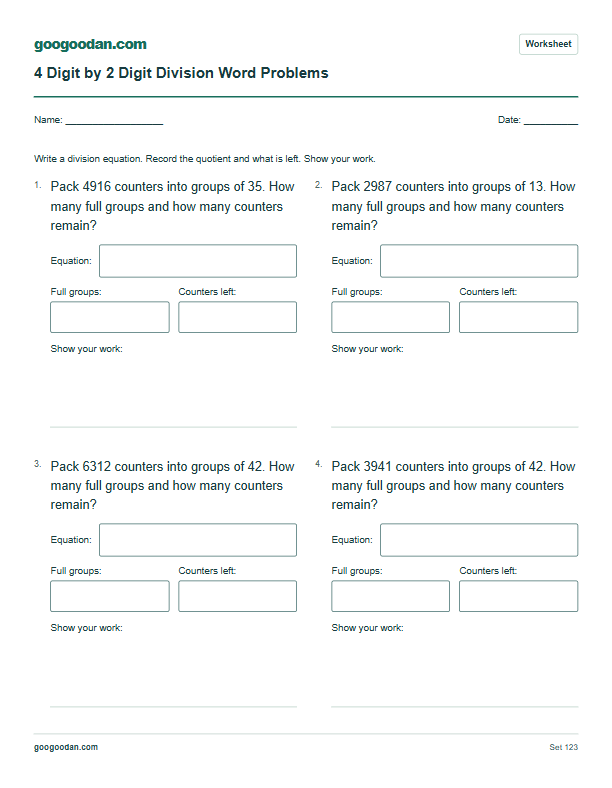 Word problems
4 Digit by 2 Digit Division Word Problems
Use estimates and partial quotients to find complete groups with two-digit divisors, then interpret any remainder. Choose a smaller exact-group activity before four-digit totals.
4 problems · Answer key included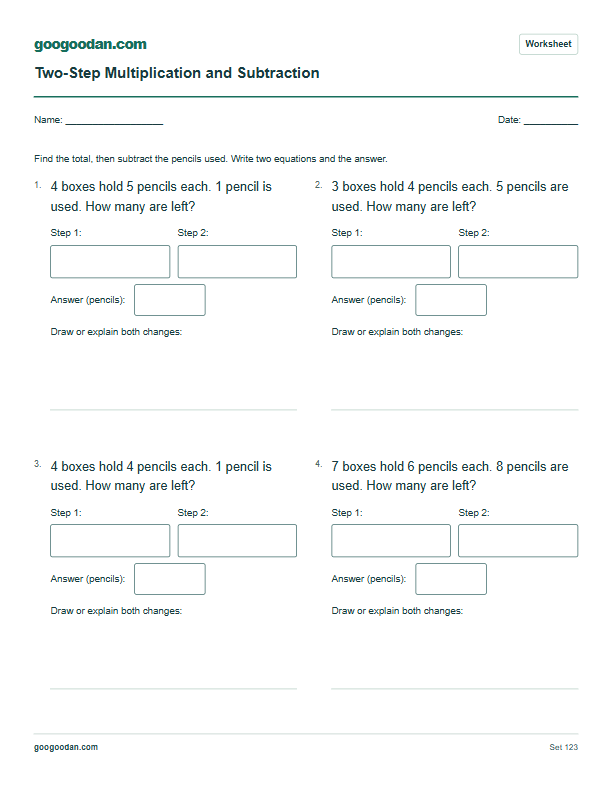 Word problems
Two-Step Multiplication and Subtraction Word Problems
Find the number of pencils in equal boxes, then subtract the pencils used. Explain both steps.
4 problems · Answer key included
More about division · Grade 4 worksheets
Grade 4 selected skill connection: Selected remainder-interpretation practice toward 4.OA.A.3: minimum whole-vehicle counts from one division; not full multistep or four-operation coverage. See the Common Core grade guidance. This worksheet does not cover every requirement in the standard.