
Two-Step Multiplication and Subtraction Word Problems
Find the total in equal groups, then subtract the amount used. Help a child explain the intermediate product and the number that remains.
Leo counts the boxes but stops too soon
Leo is setting up a drawing table. Three boxes hold 4 pencils each. His class uses 7 pencils. How many pencils are left? Leo writes 3 × 4 = 12 and says, “Twelve!” He has correctly found how many were available at the start. Now he needs to follow what happened to that collection.
Ask, “Does twelve describe before or after the class used some?” That question connects the arithmetic to the story. The first answer is useful information for the second step; it is not yet the answer to the final question.
Each dot stands for one pencil. Count 12 at first. Cross out seven across the collection, leaving five. The seven used pencils are not seven from each box.
Find the total in equal groups
The story gives two different quantities: 3 boxes and 4 pencils in each box. Adding 3 + 4 mixes a number of containers with a number of objects per container. Instead, draw three groups and put four marks in each. The repeated addition 4 + 4 + 4 = 12 has the same meaning as 3 × 4 = 12.
A child may know 3 × 4 immediately, count by fours, or combine two groups first and then add another four. Ask them to point to the group that each four represents. A multiplication fact is most useful here when the child understands what its factors and product count.
Subtract from the total, not from each box
3 × 4 = 12
There were 12 pencils altogether.
12 − 7 = 5
Five pencils remain after seven are used.
The second sentence says that 7 pencils are used in all. It does not say 7 from every box. Cross out seven marks anywhere across the complete drawing. The starting groups were equal, but the groups that remain do not have to be equal.
Sometimes a child writes 3 × (4 − 7). Ask what the parentheses would mean: taking seven pencils from each four-pencil box. That is a different situation and is not possible with these starting boxes. Retell the actual sequence: count all the pencils, then remove seven once.
Connect the two equations to an unknown
Let n stand for the number left. The whole story can be written as 3 × 4 − 7 = n, so n = 5. Multiplication comes before subtraction in this expression, matching the action of combining the equal groups first. The two step boxes on the worksheet make that intermediate total visible.
Avoid writing 3 × 4 = 12 − 7 = 5. An equals sign says the amounts on both sides are equal, but 12 is not equal to 5. Separate equations show the two true relationships without turning the equals sign into a symbol that means “next.”
When no pencils are left
Two boxes may hold 3 pencils each, and the class may use all 6. The correct reasoning is 2 × 3 = 6, then 6 − 6 = 0. Zero is a complete answer: no pencils remain. An empty final drawing helps distinguish zero from an unanswered question.
These problems never ask the class to use more pencils than were available. If a child obtains a negative number, check whether they subtracted from a single box, reversed the subtraction, or missed the multiplication step.
Check with the story and an inverse operation
For Leo’s answer of 5, put the 7 used pencils back: 5 + 7 = 12. Then check that 12 pencils can make 3 groups of 4. This verifies both parts of the story. Checking only the subtraction would miss an incorrect starting product.
The final answer must be at least zero and smaller than the starting total because a positive number of pencils is used. That is a useful first check, but many wrong answers also meet those bounds. Use the inverse check to confirm the exact value.
For a quick mental check, imagine 6 boxes of 5 pencils with 4 used. Six groups of five make 30, and removing four should leave a little less than 30. An answer of 26 is reasonable; 34 suggests addition was used for the second step. The child should still explain the exact calculation.
Make room for a different correct strategy
A child may draw all the groups and count what remains, or use repeated addition instead of a remembered multiplication fact. Accept those approaches when they account for every starting pencil and subtract the used amount once. The answer key shows one efficient pair of equations, not the only valid explanation.
Each printable set contains four problems of this specific pattern. There are 2–9 boxes with 2–9 pencils each; 1–8 pencils are used, never more than the total. Starting products range from 4 to 81, and final answers can be 0–80. This is selected Grade 3 two-step practice, not a complete assessment of all four operations or every word-problem structure. Read aloud if needed and let the child sketch before recording equations.
Make a practice set
Choose what to print. Selecting both shows the answer key on screen and prints the questions followed by the answers.
After the practice
Ask what each number counts. Put the used pencils back to check the final answer, then verify the original equal groups.
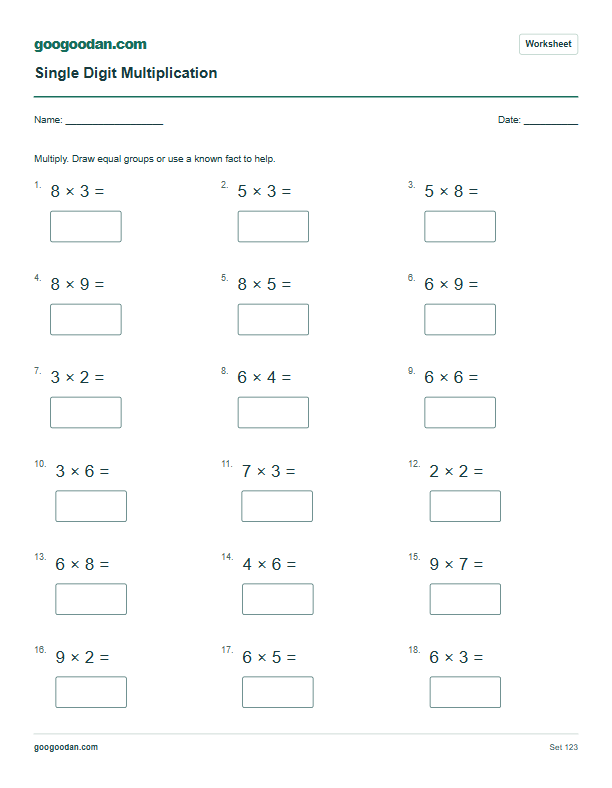 Calculation practice
Single Digit Multiplication Worksheets
Use equal groups and arrays to practise multiplication facts with factors from 2 to 9.
18 problems · Answer key included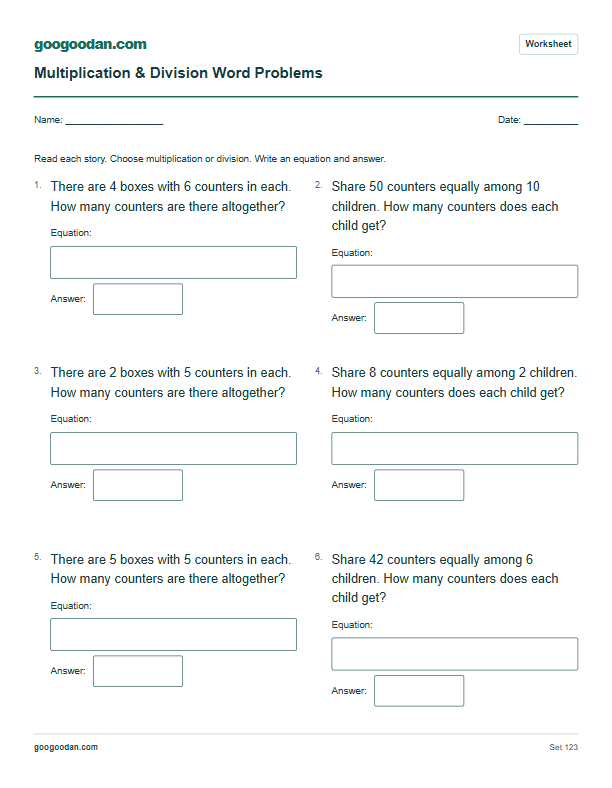 Word problems
3rd Grade Multiplication and Division Word Problems
Choose mixed facts, zero-and-one groups, or two- and three-digit group amounts. Explain what the answer counts.
6 mixed stories or 4 focused multiplication stories · Answer key included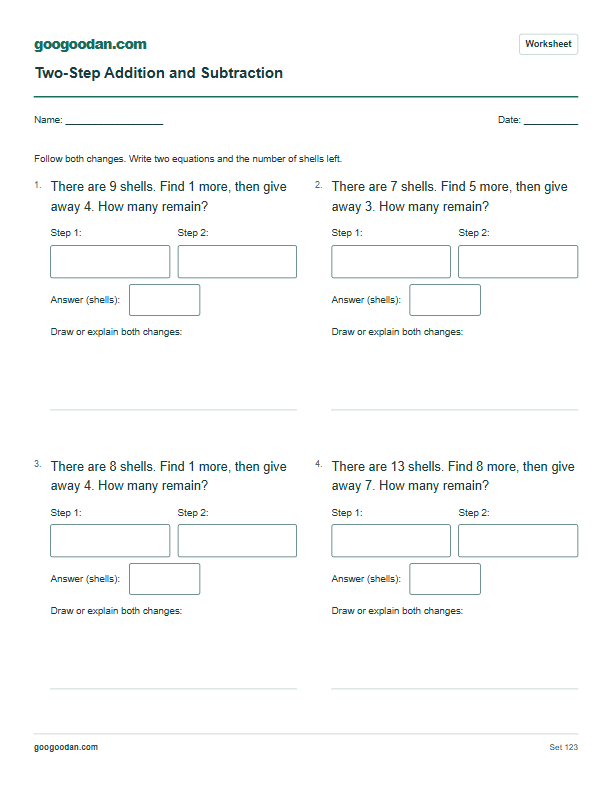 Word problems
Two-Step Addition and Subtraction Word Problems
Find a new total, then subtract what is given away. Follow both changes with small numbers.
4 problems · Answer key included
More about multiplication · Grade 3 worksheets
Grade 3 selected skill connection: Selected 3.OA.D.8 with supporting 3.OA.A.1: equal-group multiplication followed by subtraction, whole-number answers including zero. Not all four-operation situations. See the Common Core grade guidance. This worksheet does not cover every requirement in the standard.