
Two-Step Addition and Subtraction Word Problems
Help a child follow one collection through two changes: find more, then give some away. Use the intermediate total to finish the story.
Maya finds more shells, then shares some
Maya has 7 shells in her bucket. She finds 5 more and gives 3 shells to her brother. How many does she have left? She writes 7 + 5 = 12 and starts to put down her pencil. Her addition is correct, but the story has not ended: she still needs to account for the shells she gave away.
Ask, “When did Maya have 12 shells?” The answer is after finding more, before sharing. Naming that moment makes 12 an intermediate total rather than the final answer. Reread the last question together and point to the second change.
Each dot stands for one shell. The five added shells are a different color so you can follow the change. Three crossed-out shells have been given away.
Keep track of the same collection
Use counters or a quick drawing. Put down 7 objects, add 5, and count 12. Now remove 3 from that collection. There are 9 left. The two actions happen to one collection; the second action does not restart with the original 7.
A three-column record can help: at first, after finding more, and after giving some away. Write 7, 12, and 9 under those headings. The quantities 5 and 3 describe changes, while 7, 12, and 9 describe how many shells are present at particular moments. Mixing those roles is a common reason a child chooses the wrong equation.
Write two equations that fit the story
7 + 5 = 12
Twelve shells are in the bucket after Maya finds more.
12 − 3 = 9
Nine shells remain after she gives three away.
The result of the first equation becomes the starting quantity in the second. Children can write the equations separately in the two step boxes. They can also explain the relationship as 7 + 5 − 3 = 9, but do not write 7 + 5 = 12 − 3 = 9: that incorrectly says that 12 and 9 are equal.
Choose an operation from the action
Finding 5 more increases the collection, so add. Giving away 3 decreases it, so subtract. Ask the child to act out each sentence before naming the operation. Avoid teaching that a single word always determines the operation: a different story might ask how many were there before, and then the same action could require working backward.
These worksheets deliberately keep the final amount unknown. They give practice tracking two consecutive changes before moving to more complicated unknown positions. They do not cover every kind of two-step word problem.
Help with three common stopping points
If Maya answers 12, she has found the intermediate total. Ask what happens next rather than asking her to redo a correct addition. If she answers 15, she may have added all three numbers. Have her move three counters away and explain why that action makes the collection smaller.
If she writes 7 − 3 = 4, she has left out the five new shells. One valid alternative is to remove three of the original seven first and then add five: 7 − 3 = 4, followed by 4 + 5 = 9. Accept that rearranged strategy when she accounts for both changes and can explain it. The answer key shows the order of events, not the only acceptable way to think.
Check by undoing the changes
Start with the proposed answer of 9. Put back the 3 given away to get 12, then remove the 5 newly found shells to recover the original 7. This reverse check follows the meaning of the story as well as checking the arithmetic.
A quick estimate also helps: finding five and giving away three leaves two more than at the start, so 9 is reasonable. For a different problem, do not assume the final number must always be larger than the starting number. If the amount given away is larger than the amount found, the final collection is smaller.
Use small numbers to focus on the two steps
For example, 10 shells, 2 more found, and 6 given away lead to 10 + 2 = 12 and 12 − 6 = 6. When finding and giving involve the same number, the collection returns to its starting size: 8 + 4 = 12 and 12 − 4 = 8. Both stories still contain two changes.
Each printable set has four shell stories. Starting collections range from 4 to 18; additions range from 1 to 8 and amounts given away from 2 to 9. Intermediate totals can reach 26, while final answers range from 3 to 17. This is a small-number introduction within Grade 2 addition-and-subtraction problem solving, not a complete assessment of all problems within 100. An adult may read the story aloud so reading fluency does not hide the child’s mathematical understanding.
Make a practice set
Choose what to print. Selecting both shows the answer key on screen and prints the questions followed by the answers.
After the practice
Ask what the first total means and where it is used next. Accept a different correct strategy when the child accounts for both changes.
 Word problems
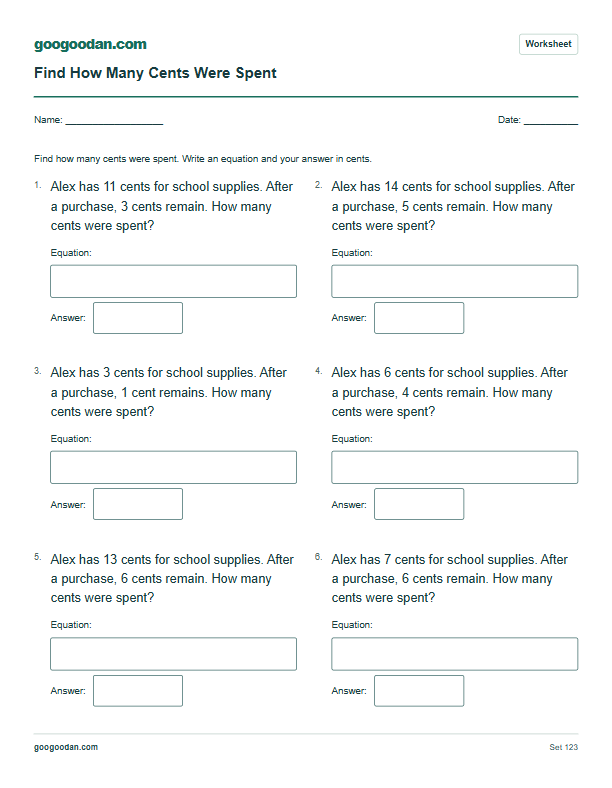
Find the Missing Change Word Problems
Use the starting amount and what remains to find how many cents were spent.
6 problems · Answer key included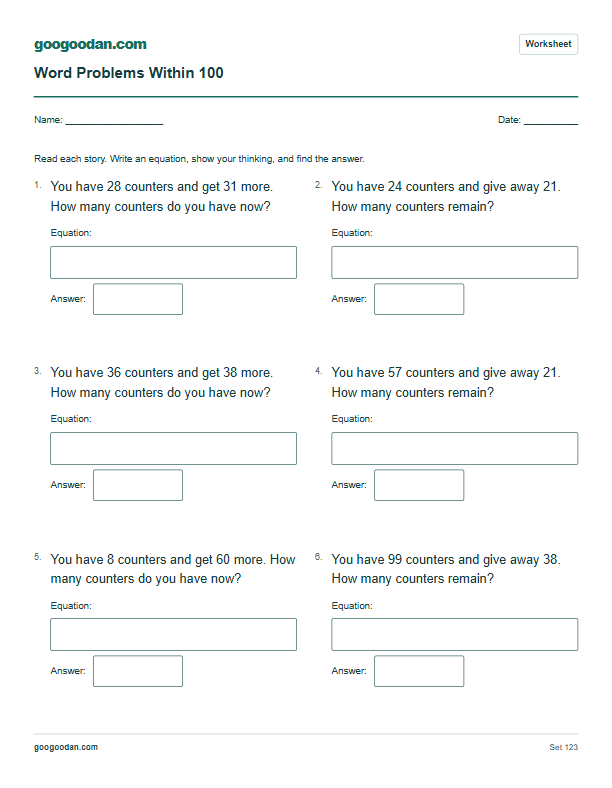 Word problems
Addition & Subtraction Word Problems Within 100
Choose an operation for a joining or taking-away story, then solve within 100.
6 problems · Answer key included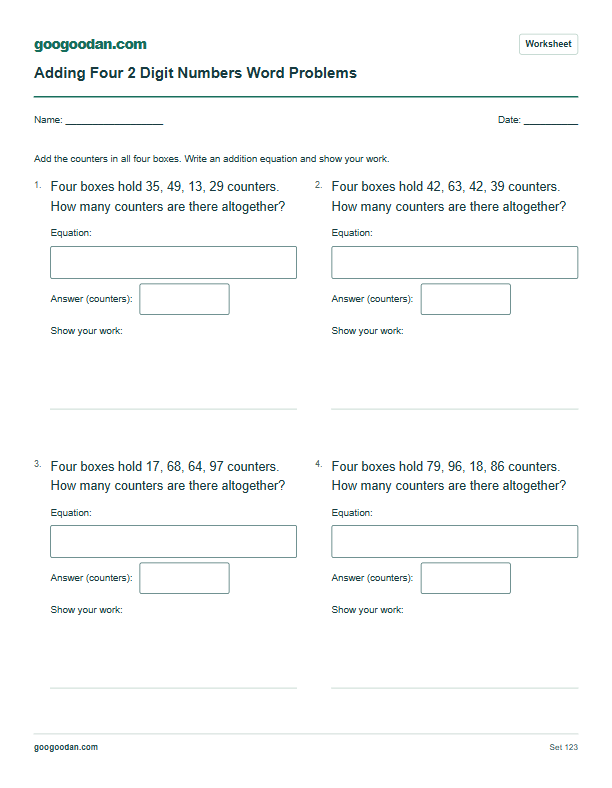 Word problems
Adding Four 2 Digit Numbers Word Problems
Combine four boxes of counters. Pair friendly sums or add tens and ones, keeping every box in the total.
4 problems · Answer key included
More about addition · Grade 2 worksheets
Grade 2 selected skill connection: Selected 2.OA.A.1: two-step adding-to then taking-from stories with the final amount unknown; small numbers, not all within-100 situations or unknown positions. See the Common Core grade guidance. This worksheet does not cover every requirement in the standard.