
Adding Four 2 Digit Numbers Word Problems
Keep track of four addends, choose helpful pairs, and use tens and ones to explain a total that may be greater than 100.
Four boxes, one total
Maya is putting counters away after a class game. Four boxes contain 23, 47, 36, and 14 counters. She adds the first two numbers and says there are 70 counters. That calculation is correct, but it answers only part of the question: two boxes still need to be counted.
Ask Maya to point to each box as she writes its number. The complete equation is 23 + 47 + 36 + 14 = ?. Each addend represents one box. The total must include all four boxes exactly once. A quick sketch of four labeled boxes can help her keep track without drawing every counter.
| Boxes | Pair of counts | Subtotal |
|---|---|---|
| 1 and 2 | 23 + 47 | 70 |
| 3 and 4 | 36 + 14 | 50 |
70 + 50 = 120 counters
The subtotals cover all four boxes. Do not add the original counts again after combining the subtotals.
Choose pairs that are easy to combine
In the example, 3 ones and 7 ones make a new ten. So do 6 ones and 4 ones. The two pairs give whole tens, which makes the last addition easier. The child can circle a pair, write its subtotal, and then circle the two remaining numbers.
Not every worksheet problem has such convenient pairs. For 35 + 49 + 13 + 29, Maya might combine 35 + 13 = 48 and 49 + 29 = 78, then add 48 + 78 = 126. Another valid route is 35 + 49 = 84, then 84 + 13 = 97, and finally 97 + 29 = 126. These methods change the order of the work, not the collection being counted.
Let the child choose a method they can explain. Reordering or regrouping addends is useful only when every original number is still used once. Reading back the four numbers is a better check than insisting that everyone draw the same circles.
Add tens and ones to explain the regrouping
Return to 23 + 47 + 36 + 14. There are 2 + 4 + 3 + 1 = 10 tens, worth 100 counters. There are 3 + 7 + 6 + 4 = 20 ones. Exchange those 20 ones for 2 more tens. Together, 12 tens have a value of 120.
This explains why adding several two-digit numbers can produce a three-digit answer. The answer is not limited to 99 just because each box contains a two-digit number. Base-ten blocks, bundled sticks, or a drawing of tens and ones can make that exchange visible.
A carry can represent more than one ten
If the child chooses vertical addition, line up the ones under the ones and the tens under the tens. Add all four ones digits before recording that column. Their sum can require exchanging two or three tens; the small number carried to the tens column is not always 1.
For 28 + 37 + 49 + 16, the ones add to 30. Record 0 ones and carry 3 tens. The original tens add to 10 tens; with the extra 3 tens, the answer is 130. Ask, "What does that small 3 stand for?" A clear response is "three tens," not simply "three." The worksheet leaves room for this written method or a more informal explanation.
Equal counts can belong to different boxes
A problem may include 42, 63, 42, and 39 counters. The two 42s are separate boxes, so both belong in the sum: 42 + 63 + 42 + 39 = 186. Crossing out one as a duplicate loses a whole box. Label a sketch Box 1 through Box 4 if repeated numbers make the tracking confusing.
Check the whole story before checking the answer key
Have the child name the four quantities, explain the grouping, and label the total as counters. Because all four counts are positive, the total must be greater than any single box count. That catches some errors, but it does not prove the answer is correct.
For a stronger check, use a different grouping or add the numbers in reverse order and compare totals. If two answers disagree, inspect the intermediate subtotals and the ones-to-tens exchange. These printable sets contain four box-total problems with two-digit counts; totals may exceed 100. They do not require multiplication, missing addends, or independent reading without adult help.
Make a practice set
Choose what to print. Selecting both shows the answer key on screen and prints the questions followed by the answers.
After the practice
Ask which box each number represents and how the child checked that every box was counted once. Compare a second grouping before using the answer key.
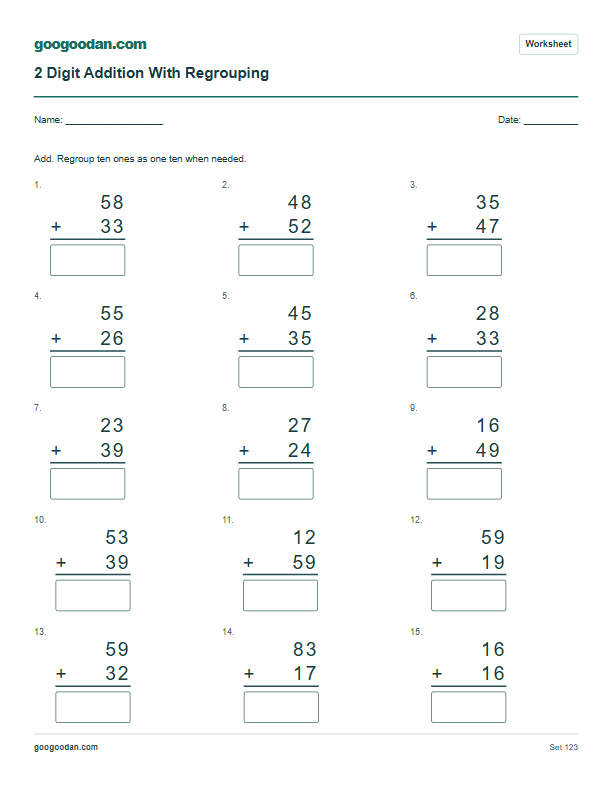 Calculation practice
2 Digit Addition With Regrouping
Exchange ten ones for a ten and keep the total within 100.
15 problems · Answer key included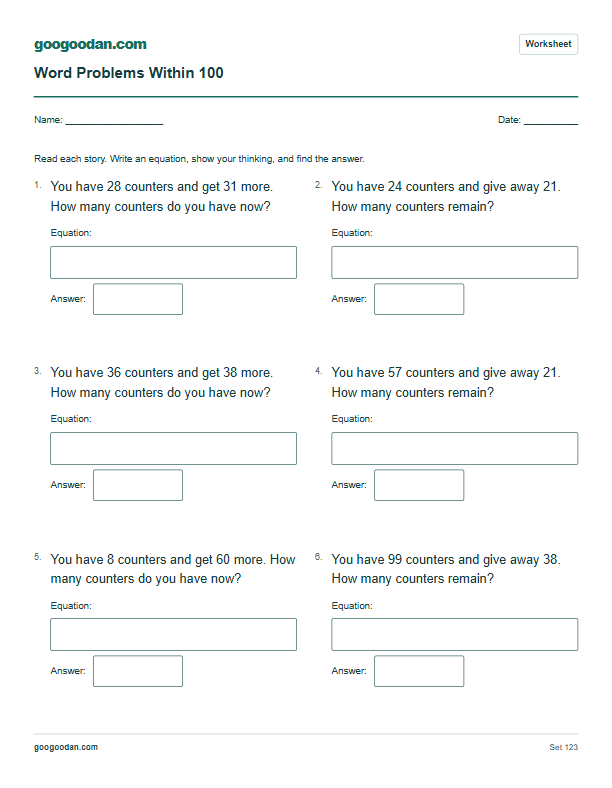 Word problems
Addition & Subtraction Word Problems Within 100
Choose an operation for a joining or taking-away story, then solve within 100.
6 problems · Answer key included
More about addition · Grade 2 worksheets
Grade 2 selected skill connection: 2.NBT.B.6; supporting 2.NBT.B.9 (four two-digit addends and explaining place-value strategies). See the Common Core grade guidance. This worksheet does not cover every requirement in the standard.