
2 Digit Addition Worksheets With Regrouping
Regrouping gives ten ones a new place without changing their value. Use a tens-and-ones example, then practise two-digit addition with a carry from the ones column. Every total is 100 or less.
Where does the extra ten come from?
Eli collects 36 game tokens and his sister brings 27 more. He combines the loose tokens first: 6 ones and 7 ones make 13 ones. He pauses because he cannot put the two digits of 13 into the one space for ones.
36: 3 tens and 6 ones.
27: 2 tens and 7 ones.
6 + 7 = 13 ones
13 ones = 1 ten + 3 ones
3 tens + 2 tens + 1 ten = 6 tens
36 + 27 = 63
Bundle ten of the loose tokens together. There are now three loose tokens and one new bundle of ten. Nothing has been added or taken away: thirteen ones and one ten plus three ones are two ways to show the same amount.
Connect the exchange to a carry mark
- Line up the two numbers so the ones are under the ones.
- Add the ones. Six plus seven makes thirteen.
- Write 3 in the ones position and mark the new ten above the tens column.
- Add all the tens: the original three, the original two, and the new one. Write 6 in the tens position.
The small 1 above the tens column means one ten, not one more single token. Saying “one new ten” makes the carry mark easier to understand than memorizing “write one up there.” A quick drawing of bundles and dots can show where that ten came from.
What if the total is exactly 100?
In 68 + 32, eight ones and two ones make a new ten with no ones left. Six tens, three tens, and the new ten make ten tens. Ten tens are one hundred, so the answer is 100. Both zero digits matter: there are no leftover tens or ones.
Choose practice that fits the next step
Every problem in this set requires exchanging ones for a ten. The operands have two digits and the totals do not exceed 100. If aligning place values is still difficult, try the linked set without regrouping first. Children may also use a number line or split a number into tens and ones; the written method is one way to record the same reasoning.
Make a practice set
Choose what to print. Selecting both shows the answer key on screen and prints the questions followed by the answers.
After the practice
Ask the child to point to the new ten in one completed problem and explain its value. Check a result by subtracting one addend from the total. The answer key shows final totals; it does not judge a particular mental or written strategy.
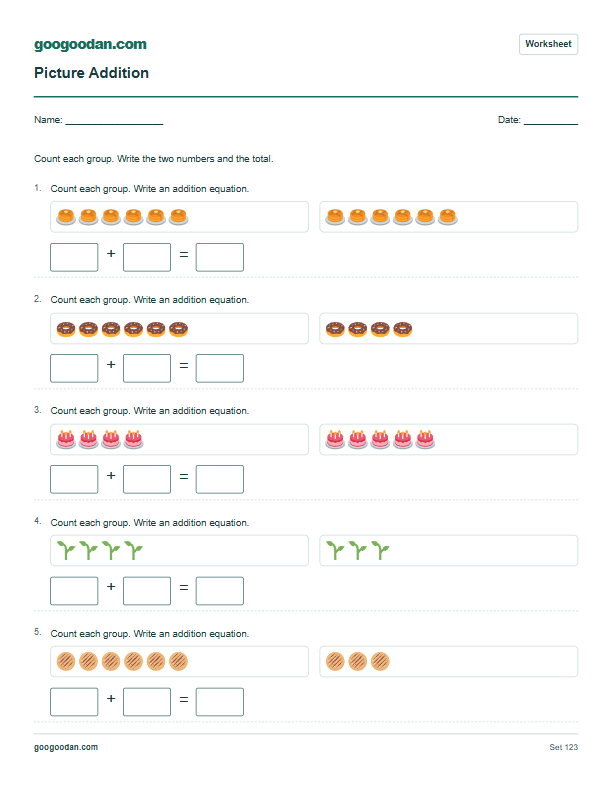 Picture activity
Picture Addition Worksheets
Count two groups of pictures and write the matching addition equation.
5 problems · Answer key included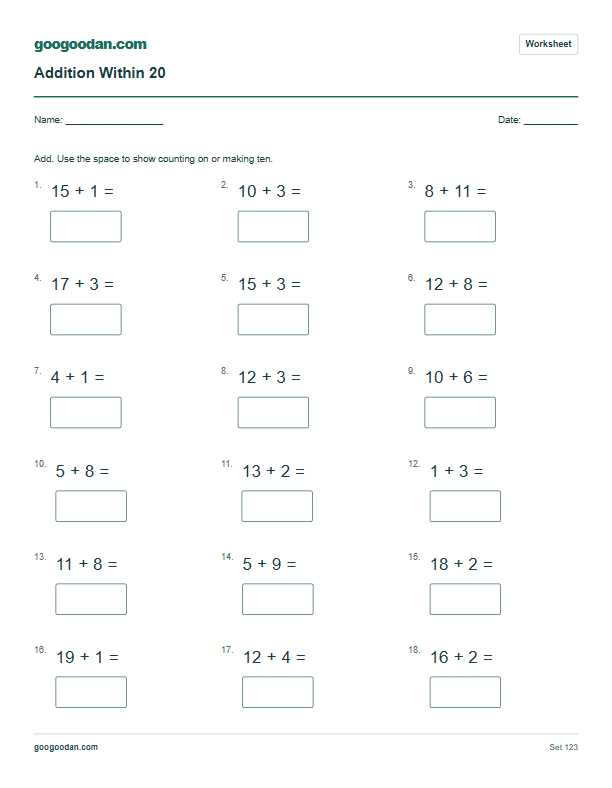 Calculation practice
Addition Within 20
Count on or make ten to add two numbers.
18 problems · Answer key included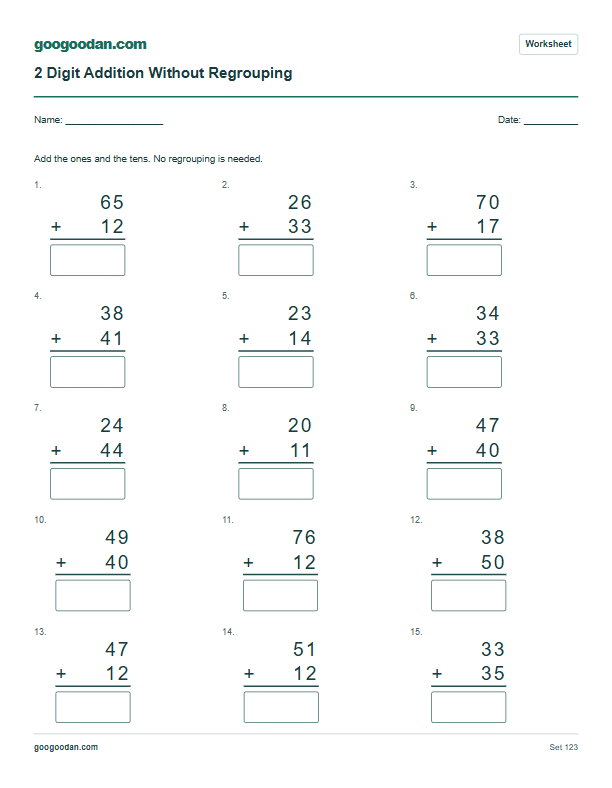 Calculation practice
2 Digit Addition Without Regrouping
Add tens to tens and ones to ones without exchanging ten ones.
15 problems · Answer key included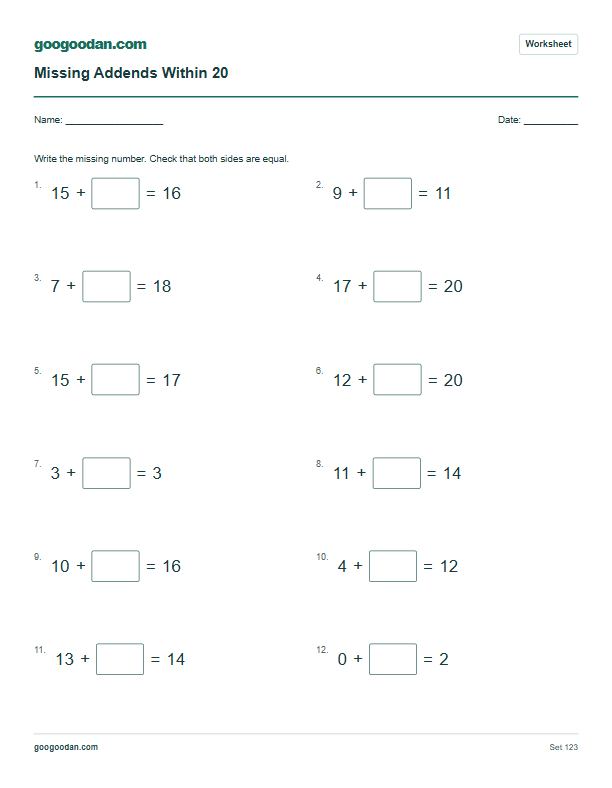 Missing-number practice
Missing Addend Worksheets Within 20
Find the missing part of an addition equation; use counting on or subtraction.
12 problems · Answer key included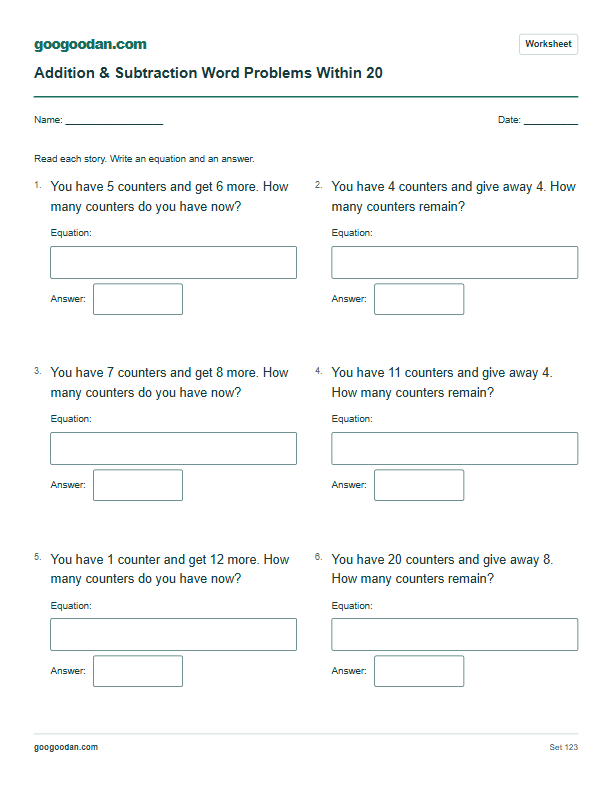 Word problems
Addition and Subtraction Word Problems Within 20
Read joining and taking-away stories, choose an equation, and answer in context.
6 problems · Answer key included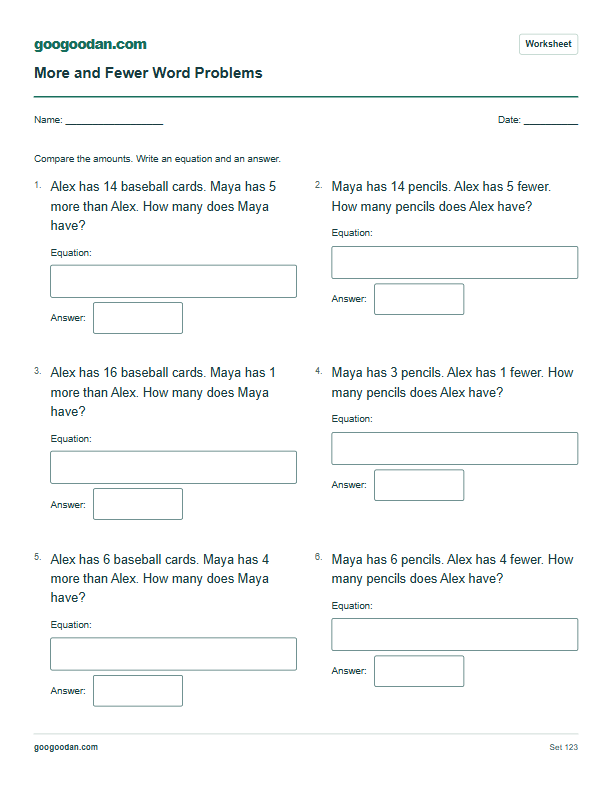 Word problems
More and Fewer Comparison Word Problems
Identify the known amount and compare two people’s collections.
6 problems · Answer key included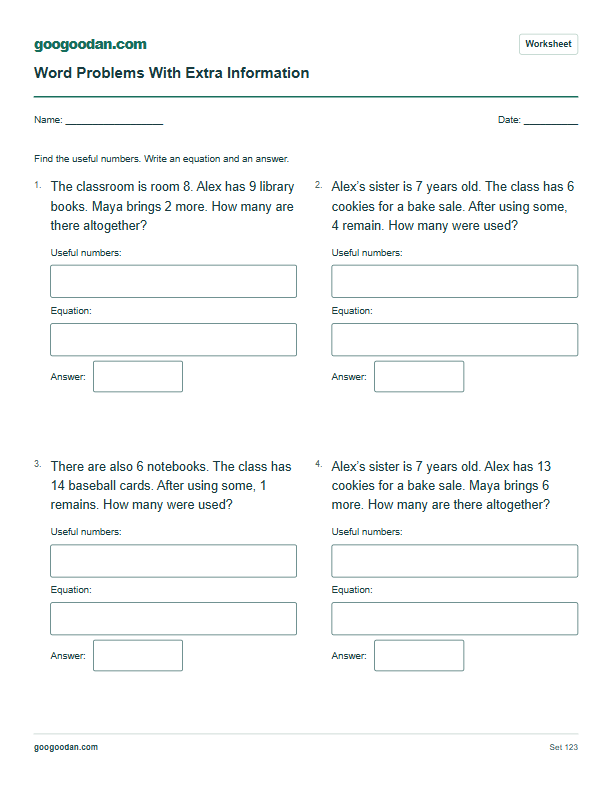 Word problems
Word Problems With Extra Information
Choose the useful quantities instead of calculating with every number.
4 problems · Answer key included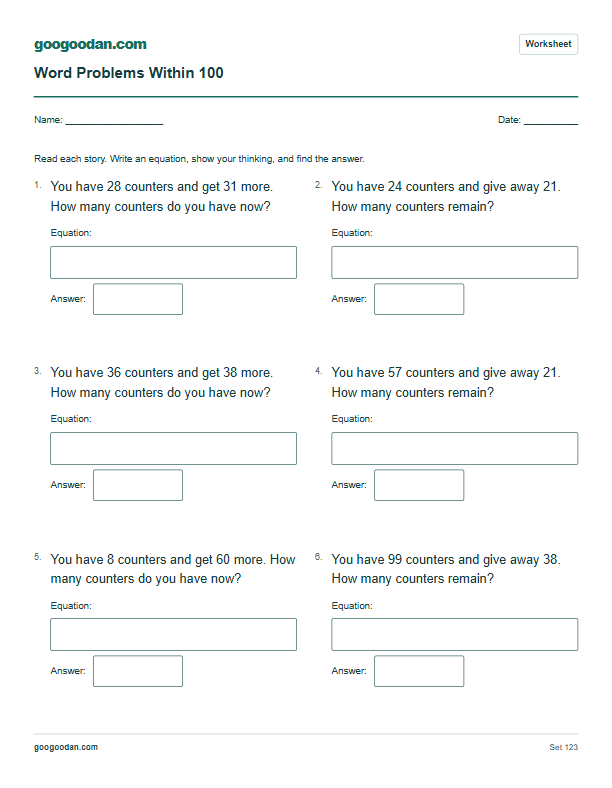 Word problems
Addition & Subtraction Word Problems Within 100
Choose an operation for a joining or taking-away story, then solve within 100.
6 problems · Answer key included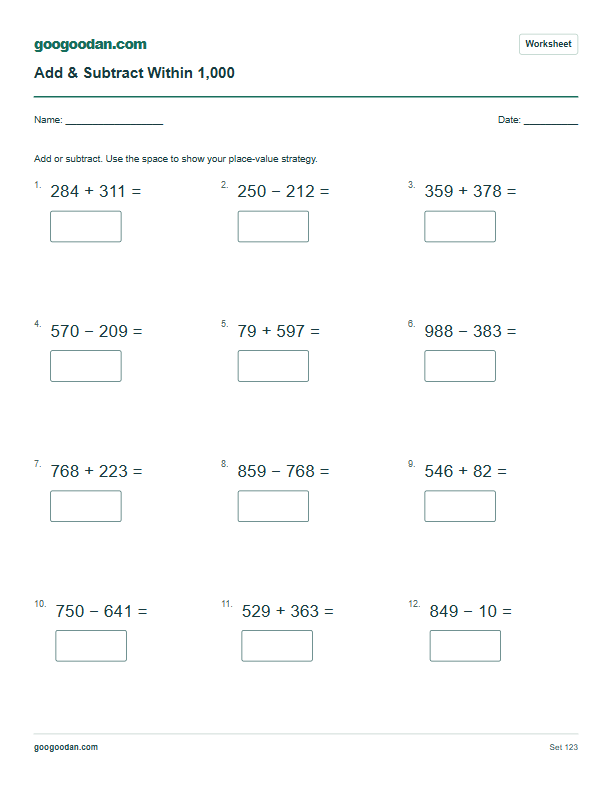 Calculation practice
Addition & Subtraction Within 1,000
Use hundreds, tens, and ones to add or subtract, with room to show your strategy.
12 problems · Answer key included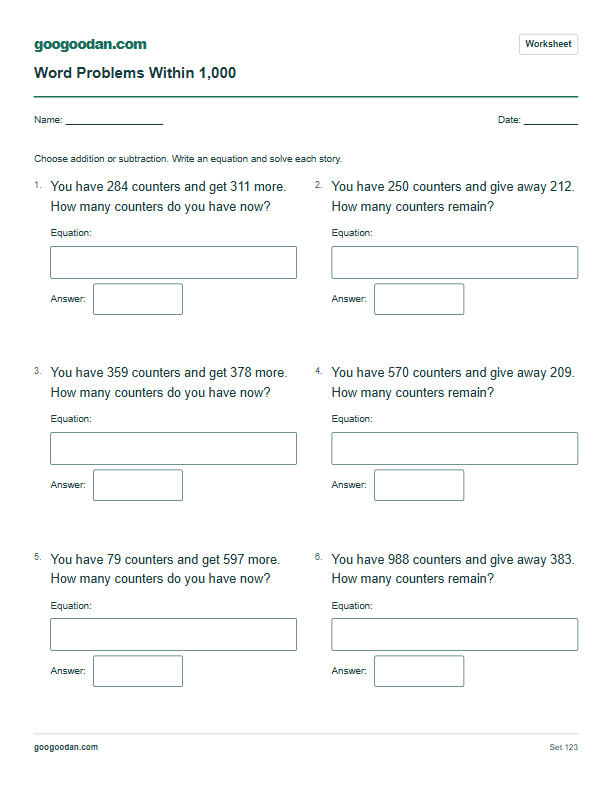 Word problems
Addition and Subtraction Word Problems Within 1,000
Explain a joining or taking-away situation and check the calculation with place value.
6 problems · Answer key included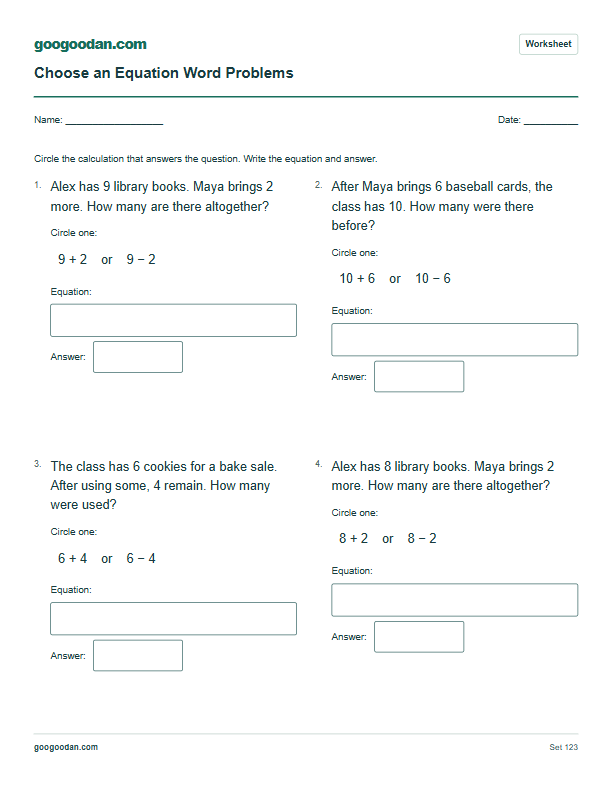 Word problems
Choose an Equation Word Problems
Decide whether addition or subtraction finds the missing quantity in the story.
4 problems · Answer key included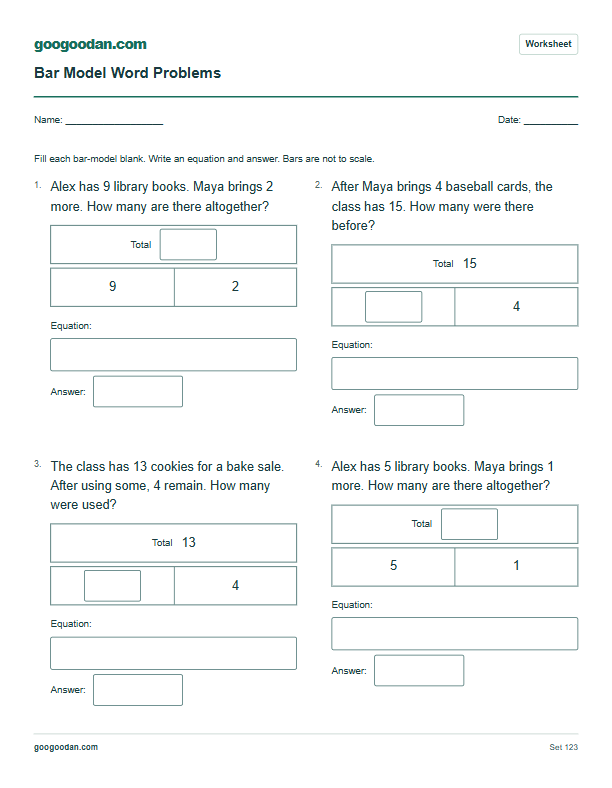 Word problems
Bar Model Word Problems
Use a whole-and-parts diagram to find the total, the starting amount, or the amount used.
4 problems · Answer key included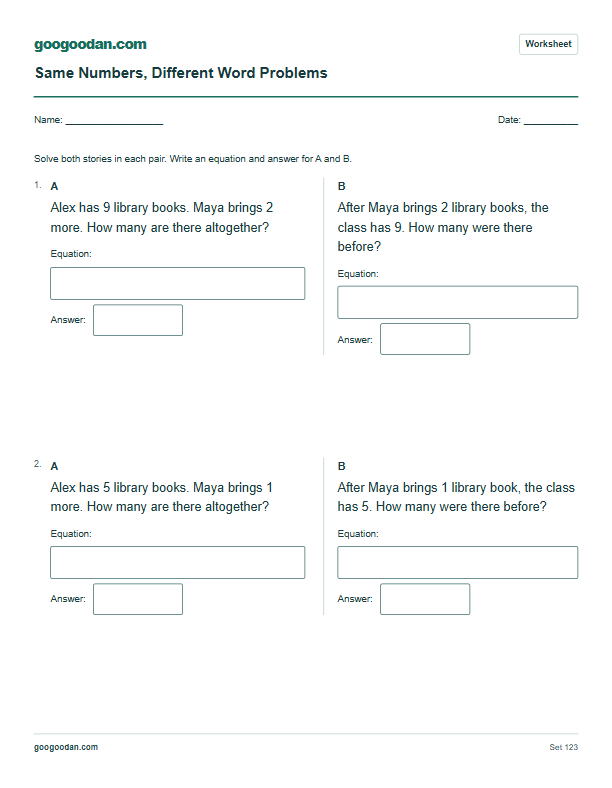 Word problems
Same Numbers, Different Questions Word Problems
Compare two stories with the same numbers: find the new total in one and the starting amount in the other.
2 pairs · 4 word problems · Answer key included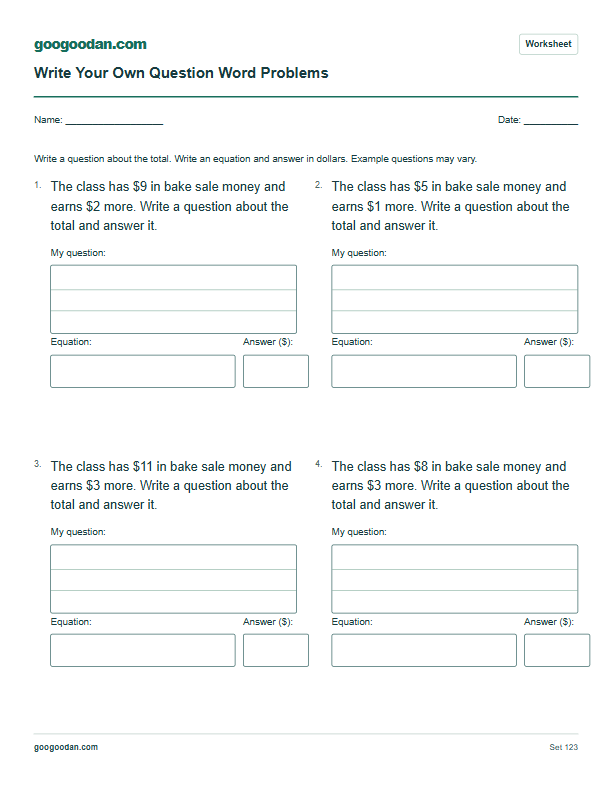 Word problems
Write Your Own Question Word Problems
Write a question about the total, then answer it with an addition equation using whole dollars.
4 problems · Answer key included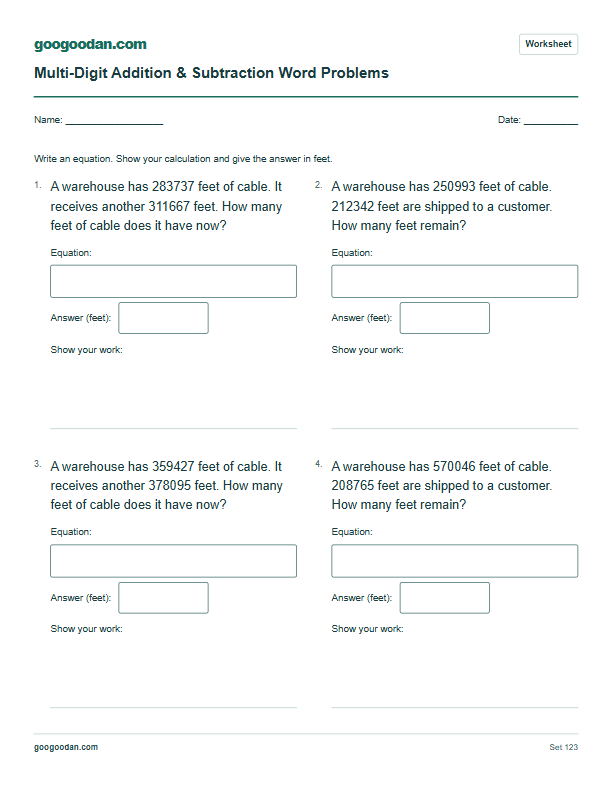 Word problems
Multi-Digit Addition and Subtraction Word Problems
Add and subtract cable lengths within 1,000,000 and label the answer in feet.
4 problems · Answer key included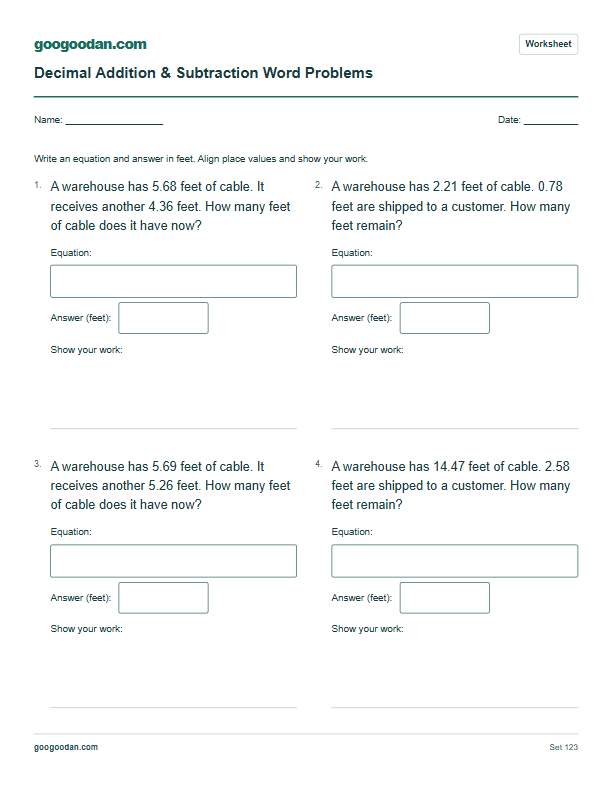 Word problems
Adding and Subtracting Decimals Word Problems
Combine cable lengths or find what remains, using place value through hundredths.
4 problems · Answer key included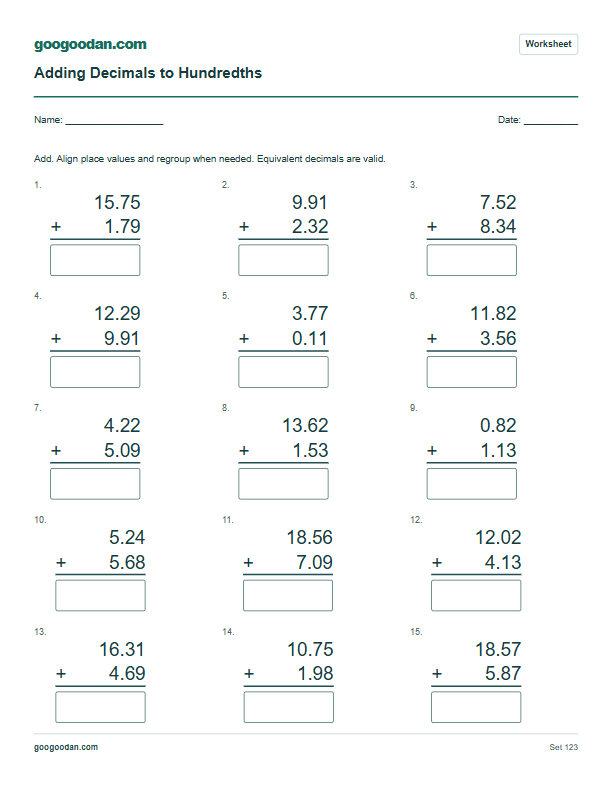 Calculation practice
Adding Decimals to Hundredths Worksheets
Align decimal points and exchange ten hundredths for one tenth.
15 problems · Answer key included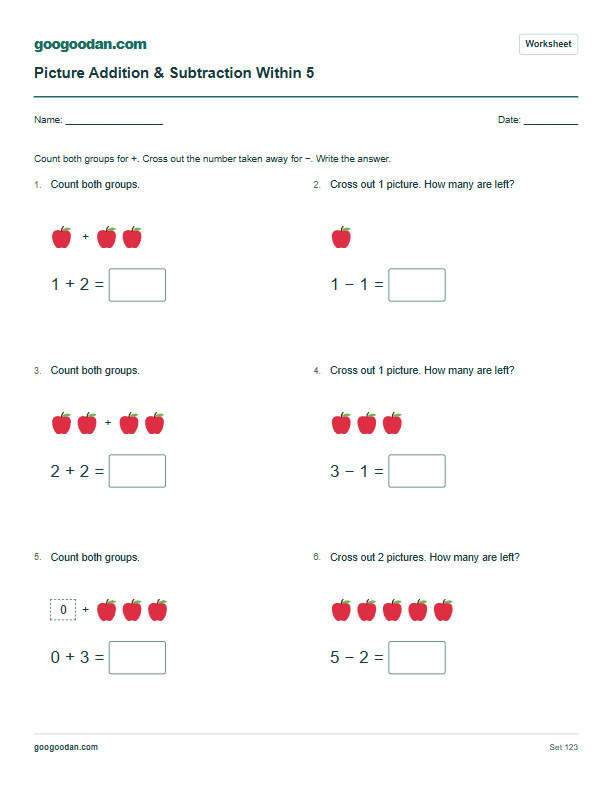 Picture activity
Kindergarten Addition and Subtraction Within 5
Count and combine pictures, or cross out the amount taken away.
6 problems · Answer key included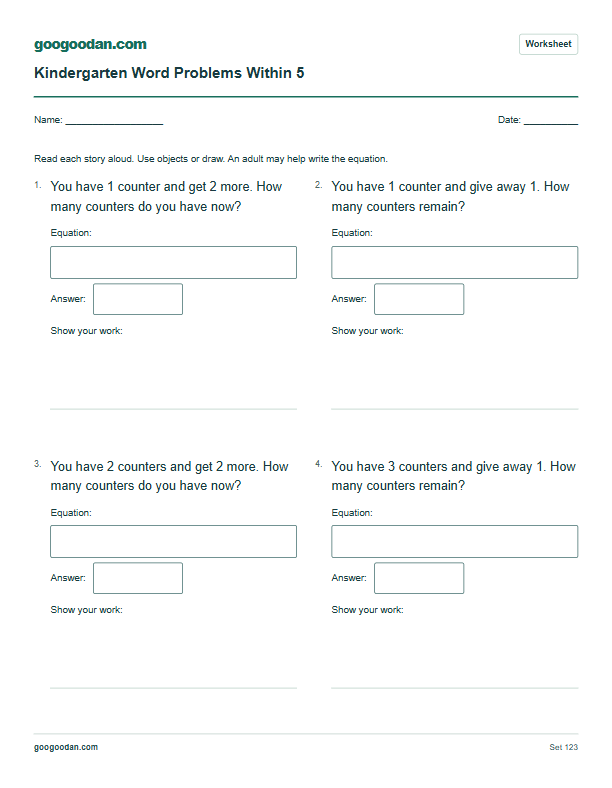 Word problems
Kindergarten Word Problems Within 5
Listen to a short story, act it out, and draw or write an answer within 5.
4 problems · Answer key included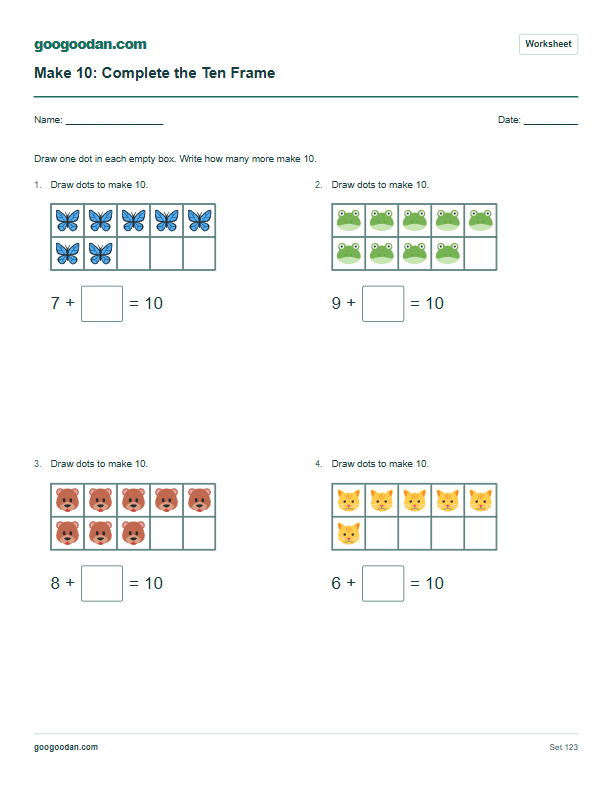 Draw and count activity
Making 10 with Ten Frames Worksheets
Draw a dot in each empty box, then write how many more make 10. Start with 5–9 pictures in a two-row frame.
4 problems · Answer key included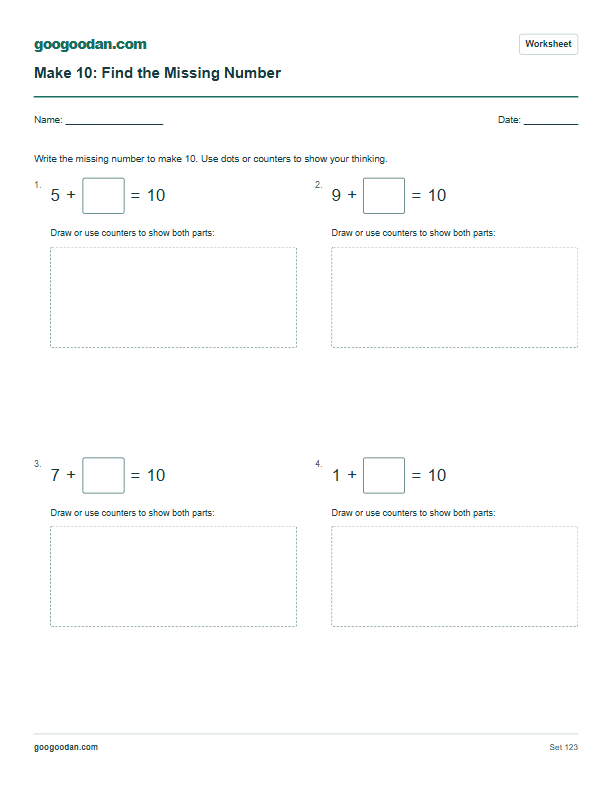 Missing number and drawing activity
Make 10 Missing Addend Worksheets
Find the missing part in an addition equation that totals 10. Use the drawing space or counters to explain your answer.
4 problems · Answer key included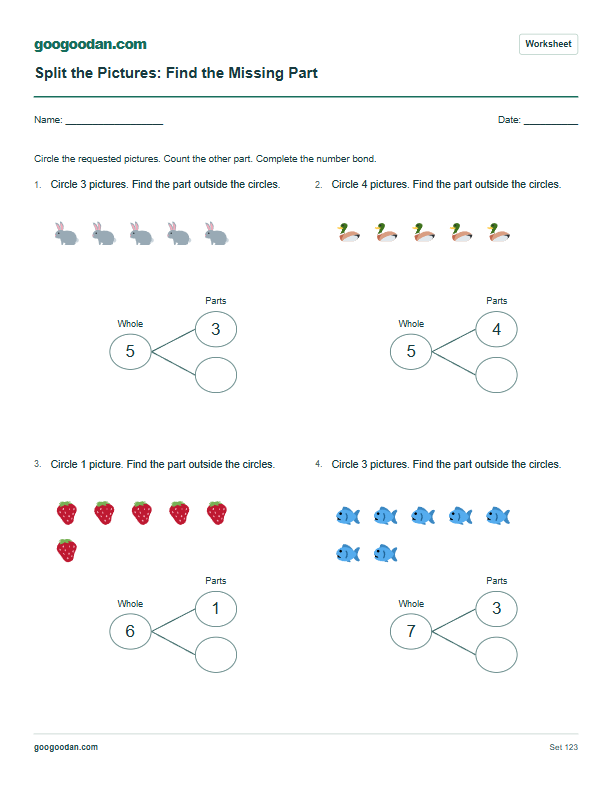 Circle and split picture groups
Missing Part Number Bonds Worksheets Within 9
Circle part of a group and complete the number bond. Choose two nonempty parts or one empty part (0). Empty-part practice also includes wholes of 1 or 10.
4 problems · Answer key included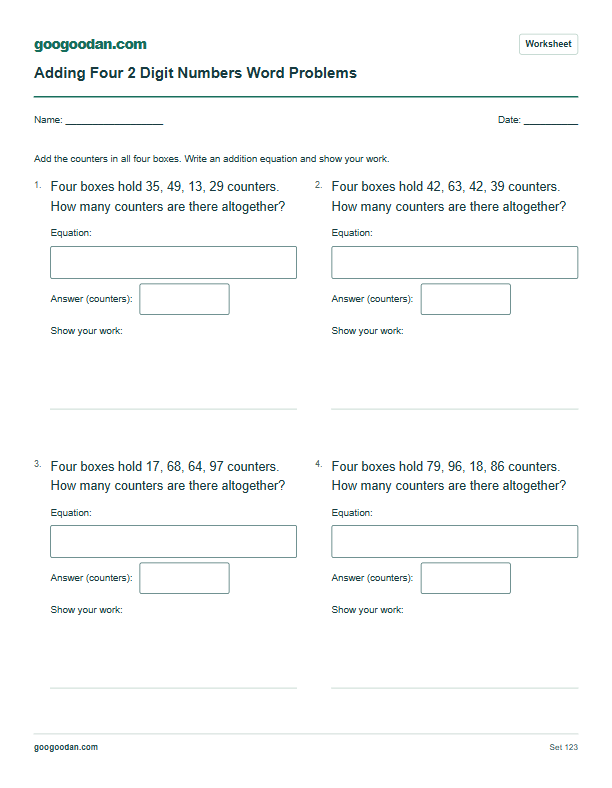 Word problems
Adding Four 2 Digit Numbers Word Problems
Combine four boxes of counters. Pair friendly sums or add tens and ones, keeping every box in the total.
4 problems · Answer key included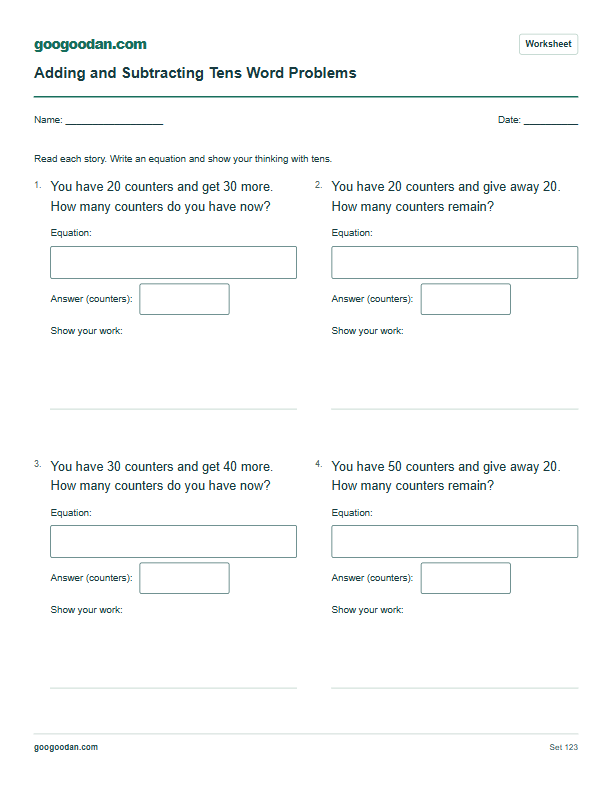 Word problems
Adding and Subtracting Tens Word Problems
Combine or remove whole tens of counters. Explain the place value, including stories where zero counters change or remain.
4 problems · Answer key included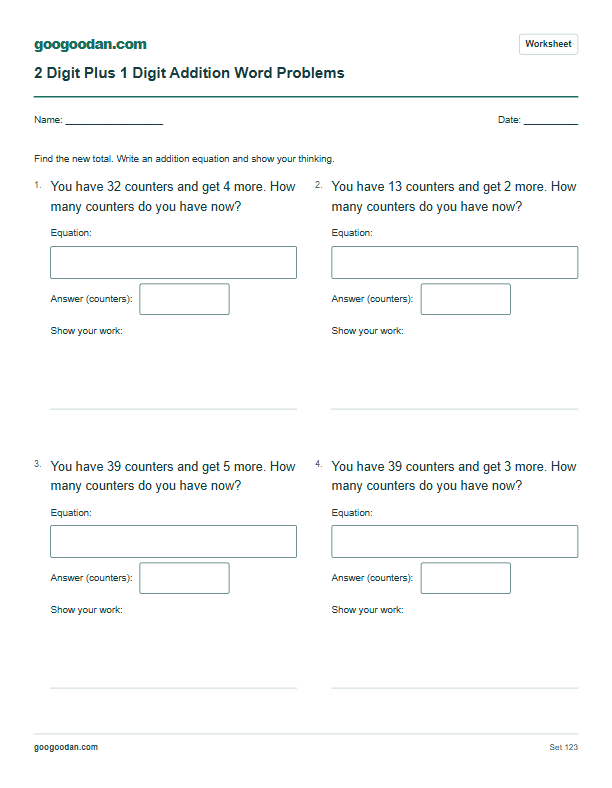 Word problems
2 Digit Plus 1 Digit Addition Word Problems
Add 0–9 more counters to a two-digit collection. Count on, add the ones, or make the next ten; sums stay below 100.
4 problems · Answer key included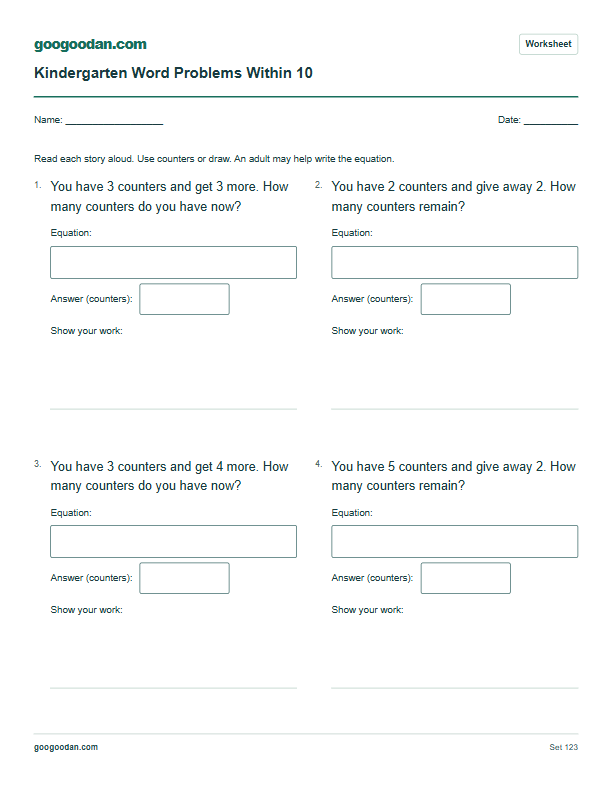 Word problems
Kindergarten Word Problems Within 10
Listen, move counters, and draw joining or taking-away stories with amounts up to 10.
4 problems · Answer key included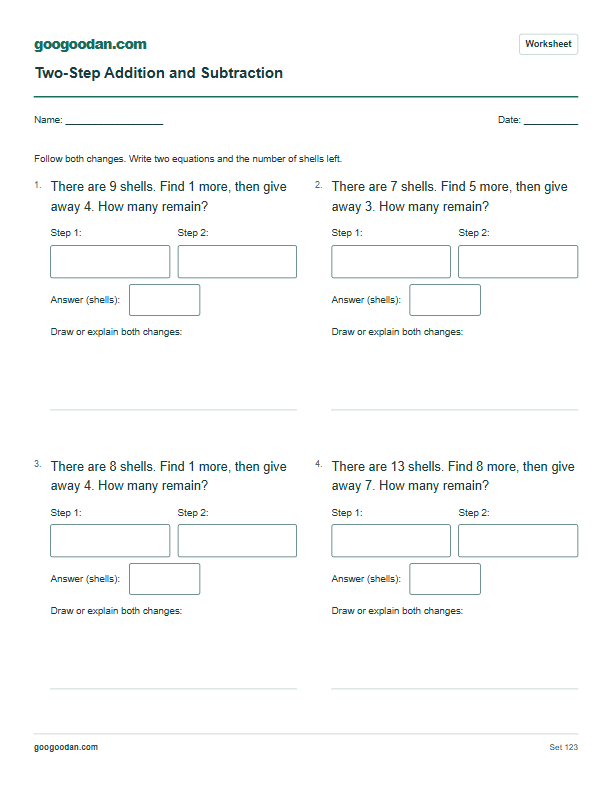 Word problems
Two-Step Addition and Subtraction Word Problems
Find a new total, then subtract what is given away. Follow both changes with small numbers.
4 problems · Answer key included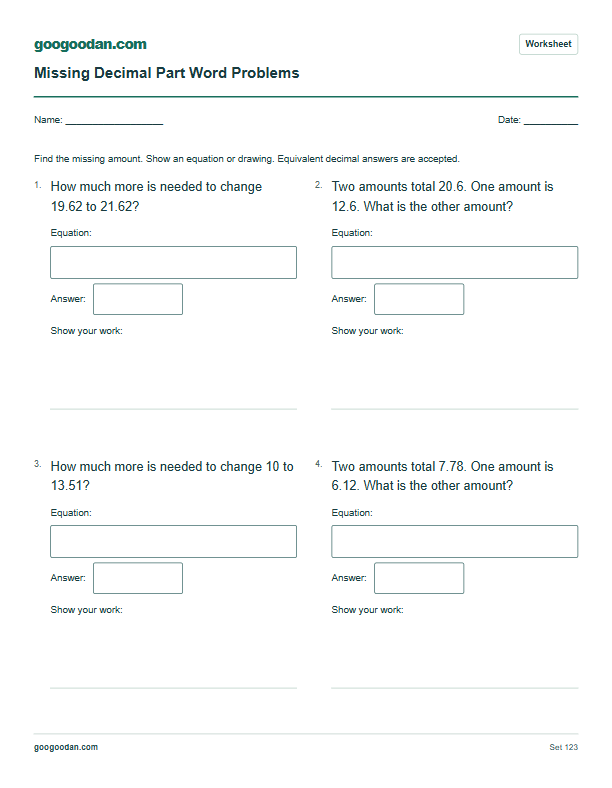 Word problems
Missing Decimal Part Word Problems
Find a missing decimal amount through hundredths. Align place values and check by adding the parts.
4 problems · Answer key included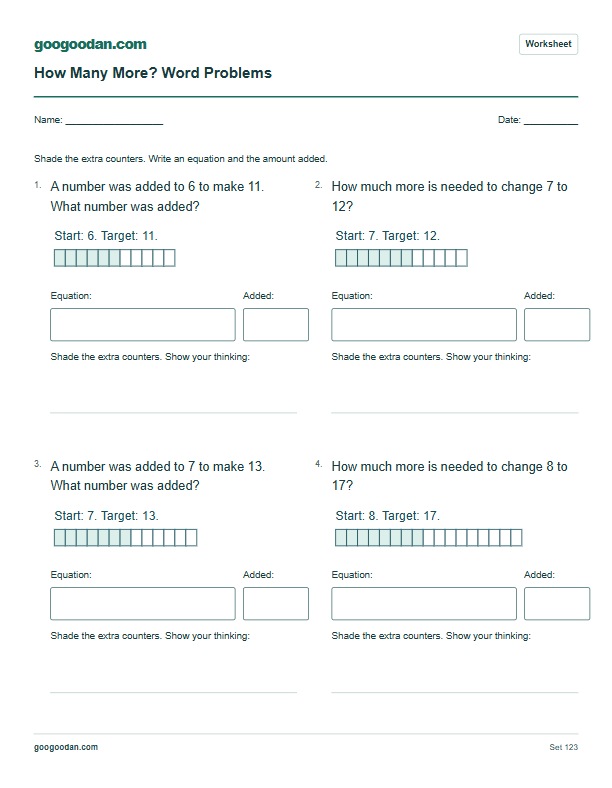 Word problems
How Many More? Word Problems Within 20
Find the amount to add to reach a target. Fill the empty spaces and check the missing part.
4 problems · Answer key included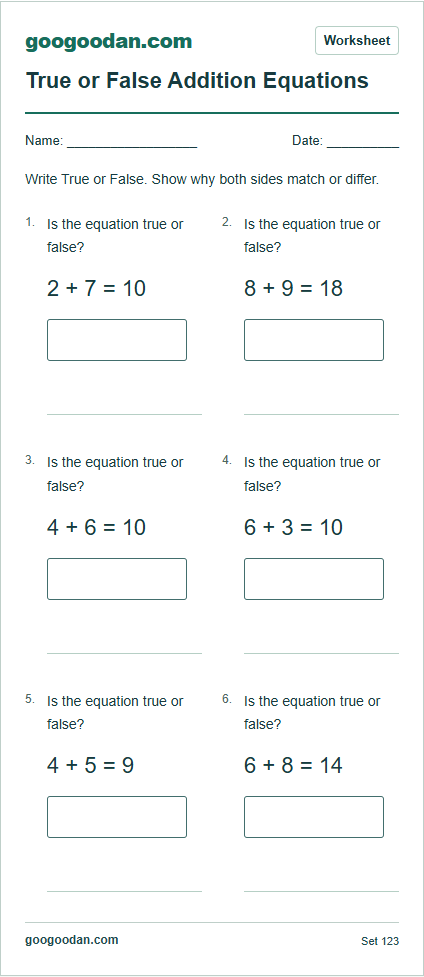 Calculation practice
True or False Addition Equations
Compare both sides of an addition equation and explain whether they match.
6 problems · Answer key included
More about addition · Grade 2 worksheets
Grade 2 selected skill connection: 2.NBT.B.5. See the Common Core grade guidance. This worksheet does not cover every requirement in the standard.