
Adding Decimals Worksheets Through Hundredths
Add hundredths to hundredths and tenths to tenths. Start with a place-value exchange, then practice 15 vertical addition problems with space for regrouping marks and answers.
Ten small parts can become one larger part
Noah adds 16.75 and 8.67. He lines up the decimal points, but when 5 plus 7 makes 12, he writes both digits after the other answer digits. He remembers adding columns with whole numbers; he has not yet connected that exchange to hundredths.
A hundredth is one of one hundred equal parts of a whole. Ten hundredths have the same value as one tenth. When a column totals more than nine hundredths, the extra group of ten belongs in the tenths column. The amount has not changed: it has been renamed using larger and smaller units.
| Value | Wholes | 0.1 | 0.01 |
|---|---|---|---|
| 16.75 | 16 | 7 | 5 |
| 8.67 | 8 | 6 | 7 |
The 0.1 column counts tenths; the 0.01 column counts hundredths.
16.75 + 8.67 = 25.42
- 5 hundredths + 7 hundredths = 12 hundredths. Write 2 hundredths and exchange 10 hundredths for 1 tenth.
- 7 tenths + 6 tenths + the new tenth = 14 tenths. Write 4 tenths and exchange 10 tenths for 1 whole.
- 16 wholes + 8 wholes + the new whole = 25 wholes.
What does a small regrouping mark mean?
A small 1 above the tenths column means one tenth, not one hundredth or one whole. A small 1 above the ones column means one whole. Ask the child to name the unit each time they make a mark. This connects the written method to place value instead of making it a rule to “carry a one” without knowing its size.
The printable leaves space above each calculation for those marks. Work from hundredths toward the whole-number columns, keeping the decimal point beneath the other decimal points. The two-digit whole part, when present, still has separate tens and ones positions.
Why line up the decimal points?
Alignment places equal-sized units in the same column. The 7 in 16.75 names tenths, while the 7 in 8.67 names hundredths. They must not be added directly as though they represented the same amount. You can draw a whole square, tenths strips, and hundredths pieces to show the difference.
An answer does not always need two written decimal places
Consider 3.24 + 2.16. The answer is 5.40, which can also be written 5.4. Four tenths and zero hundredths have the same value as four tenths. Removing a final zero after the decimal point preserves that value; removing the zero in 5.04 would not.
The answer key uses the original problem bank's compact decimal form. Accept 5.40 when the key shows 5.4, and accept 6.00 when the key shows 6. A difference in notation is not automatically a difference in value.
Estimate, then check exactly
For 16.75 + 8.67, the nearby whole numbers 17 and 9 give an estimate of 26. A result of 25.42 is reasonable; 2.542 or 254.2 would not be. Rounding can make the estimate a little larger or smaller than the exact result, so use it to check scale rather than demand equality.
These 15-problem sets use two decimal places in both addends. The first addend is positive and below 20; the second is positive and below 10. The hundredths digits are nonzero, but the total may end in zero or be a whole number. A set can include calculations with and without regrouping; it is not a regrouping-only drill. After one column-by-column explanation, let the child try a few problems independently before showing the answer key.
Make a practice set
Choose what to print. Selecting both shows the answer key on screen and prints the questions followed by the answers.
After the practice
Ask the child to explain one exchange and read one answer by place value. Check equivalent decimal forms before marking an answer incorrect. Move to the cable-length word problems when the child can explain both the decimal calculation and what the amounts mean.
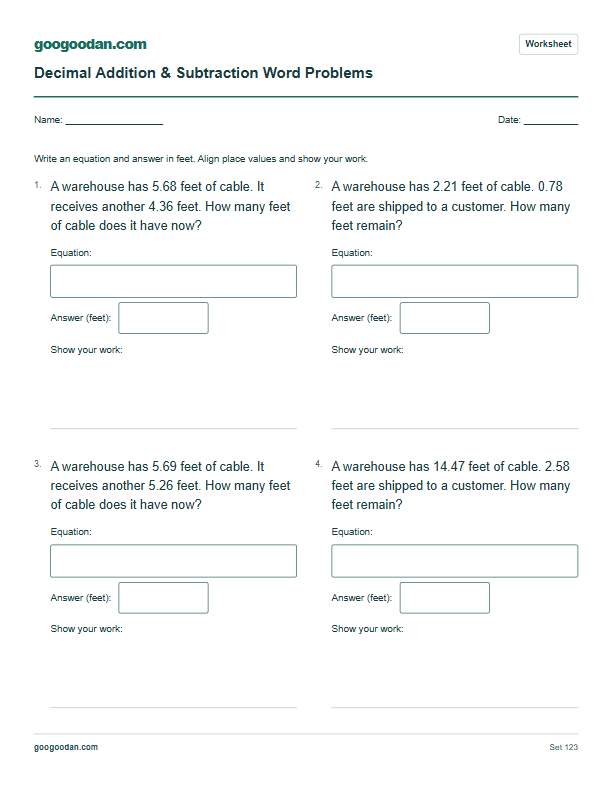 Word problems
Adding and Subtracting Decimals Word Problems
Combine cable lengths or find what remains, using place value through hundredths.
4 problems · Answer key included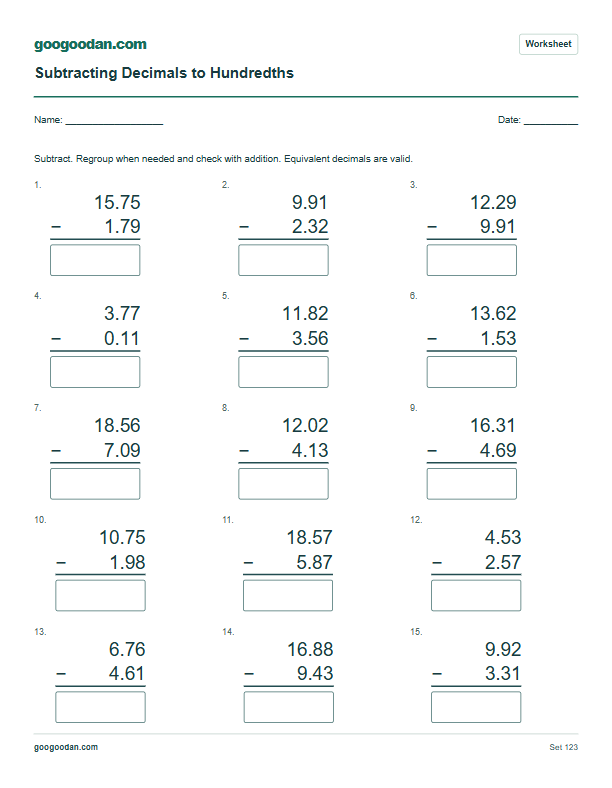 Calculation practice
Subtracting Decimals to Hundredths Worksheets
Align decimal points and rename tenths and hundredths before subtracting.
15 problems · Answer key included
More about addition · Grade 5 worksheets
Grade 5 selected skill connection: 5.NBT.B.7 (addition through hundredths using place-value strategies). See the Common Core grade guidance. This worksheet does not cover every requirement in the standard.