
Subtracting Decimals Worksheets Through Hundredths
Keep the starting number intact while renaming its units. Practice 15 vertical decimal subtraction problems, including guidance for regrouping and checking the difference with addition.
Subtract the lower amount from the starting amount
Ella works on 10.03 − 4.78. In the hundredths column she sees 3 and 8. She writes 5 because she knows 8 − 3 = 5. Then she continues taking the smaller digit from the larger digit in each column. Some digits may look plausible, but that method changes which amount is being subtracted.
The question asks for 10.03 minus 4.78. Keep that order. If there are not enough hundredths to remove eight of them, exchange a larger unit for smaller units. This is regrouping: the starting value stays the same, but its place-value description changes.
Rename 10.03 without changing its value
| Value | Wholes | 0.1 | 0.01 |
|---|---|---|---|
| 10.03 | 10 | 0 | 3 |
| 10.03 | 9 | 10 | 3 |
| 10.03 | 9 | 9 | 13 |
The 0.1 column counts tenths; the 0.01 column counts hundredths. Exchanging one whole gives ten tenths. Exchanging one of those tenths gives ten more hundredths.
10.03 − 4.78 = 5.25
- Remove 8 hundredths from 13 hundredths: 5 hundredths remain.
- Remove 7 tenths from the 9 tenths still available: 2 tenths remain.
- Remove 4 wholes from 9 wholes: 5 wholes remain.
Why the zero cannot be skipped
The zero in the tenths place says there are no ungrouped tenths available yet. It does not mean regrouping is impossible. A whole can be exchanged for ten tenths, and one tenth can then be exchanged for ten hundredths. After the second exchange, only nine tenths remain. Forgetting that second change makes the final difference too large.
When working in separate tens and ones columns, the same exchange can pass from one ten into ten ones before reaching tenths. A drawing or a place-value chart helps explain the sequence. The small written marks should record the new amounts, not erase the meaning of the original number.
Some problems do not need regrouping
In 7.86 − 2.34, six hundredths are enough to remove four, eight tenths are enough to remove three, and seven wholes are enough to remove two. The difference is 5.52. Do not add regrouping marks automatically just because the numbers contain decimals.
These sets include the cases produced by the existing bank, so a page may contain both kinds. Before subtracting, inspect the hundredths column, then the tenths column after any exchange. A change in one column can affect what remains available in the next.
Use addition to check the difference
A subtraction result tells what remains after removing the lower amount. Put that removed amount back: the sum should equal the starting number. For the worked example, 5.25 + 4.78 = 10.03. This checks the entire calculation, including decimal placement and any regrouping marks.
An estimate helps too. Ten minus about five is about five, so 5.25 is plausible. A result near fifty would need another look. Estimation can flag a large error, while the exact addition check confirms the value.
Read equivalent decimal answers fairly
For 8.73 − 3.23, the result is 5.50, also written 5.5. Zero hundredths add no extra amount. If both starting values are equal, the difference is zero; 0, 0.0, and 0.00 are equivalent. The answer key may omit final zeros, but the child's notation can still be correct.
Each worksheet contains 15 calculations. Both given numbers have two decimal places with nonzero hundredths digits. The first is positive and below 20, the second is positive and below 10, and the first is always at least as large as the second. Answers are never negative. Use the space above the numbers for exchanges, keep decimal points aligned, and explain one checked problem before starting another set.
Make a practice set
Choose what to print. Selecting both shows the answer key on screen and prints the questions followed by the answers.
After the practice
Choose one problem that required regrouping and ask the child to explain where the extra hundredths came from. Check it by adding the difference to the amount removed. Then use a decimal length story to connect the same subtraction to a quantity and its unit.
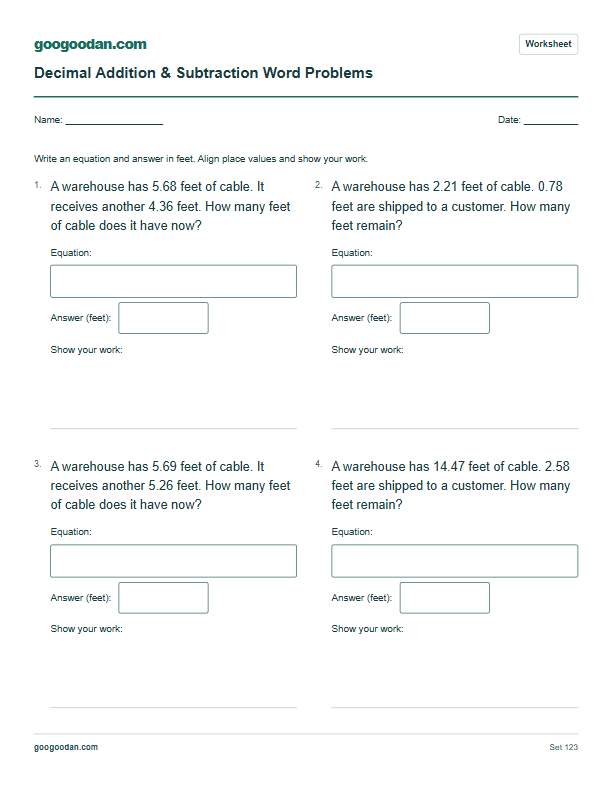 Word problems
Adding and Subtracting Decimals Word Problems
Combine cable lengths or find what remains, using place value through hundredths.
4 problems · Answer key included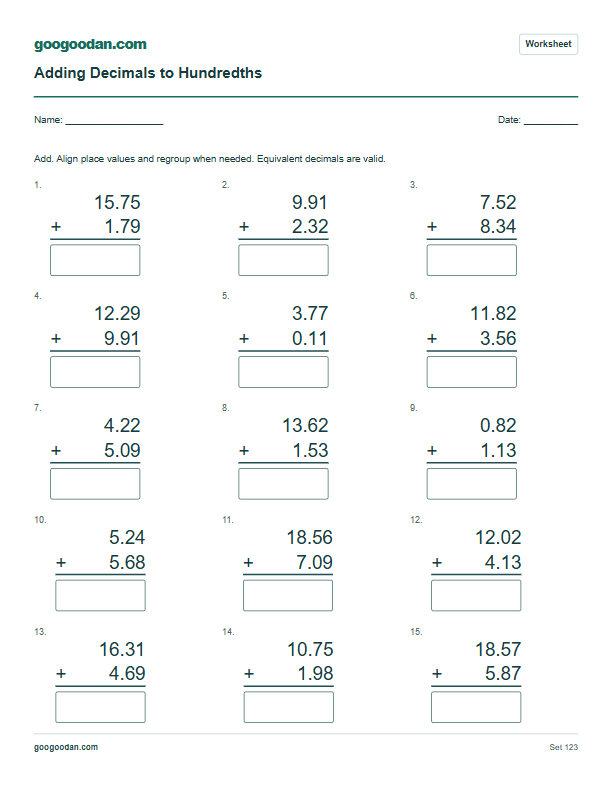 Calculation practice
Adding Decimals to Hundredths Worksheets
Align decimal points and exchange ten hundredths for one tenth.
15 problems · Answer key included
More about subtraction · Grade 5 worksheets
Grade 5 selected skill connection: 5.NBT.B.7 (subtraction through hundredths using place-value strategies). See the Common Core grade guidance. This worksheet does not cover every requirement in the standard.