
Ten Frame Worksheets: Making 10 for Kindergarten
Fill each empty box with one dot, then write how many more make 10. Each frame starts with 5–9 pictures and gives children room to draw.
How many more fill the ten frame?
Maya has seven pictures in a frame with ten boxes. When an adult asks how many more are needed, she says “ten.” She has named the size of the whole frame. The question asks for the empty part: what must be added to the pictures already there?
Point to the seven pictures first. They are already in the frame and do not need another dot. Touch each empty box once: one, two, three. Draw a dot in each of those three spaces.
Now every box is occupied. Seven pictures and three new dots make ten: 7 + 3 = 10. The number to write in the answer box is 3, not 10.
See five in each row
A ten frame has two rows of five boxes. One full row shows five without having to count every picture again. On these sheets the first row is full, and the second row may be empty or partly filled. For seven, the child can see five pictures on top and two more below.
The frame keeps the total visible. The filled boxes show the amount already present; the empty boxes show the amount still needed. Together they occupy exactly ten spaces. Use the row of five as support, but let the child count individual boxes when needed.
Draw only in the empty boxes
Ask the child to add one small dot to each empty box. A dot is enough; there is no need to copy the printed animal or object. Leave the original pictures visible. Count just the newly drawn dots, then write that number in the large blank.
Read the equation aloud: “Seven and three more make ten.” Point to the printed pictures for seven, the new dots for three, and the entire frame for ten. This connects the equation to the child's own marks rather than making it a separate symbol exercise.
Check the whole without changing the answer
After drawing, touch each occupied box and count the full group. There should be ten occupied boxes, with nothing drawn outside the frame. Then count only the new dots once more to check the missing addend. Checking ten altogether does not mean that ten belongs in the blank.
If two dots are squeezed into one box while another box is empty, move one dot to the empty space. Keep the one-box, one-item relationship clear. With counters, the child can physically move a piece; on paper, use a light pencil so a misplaced dot can be corrected.
Try counters before pencil work
Place small counters on the empty boxes first and ask how many were added. The child can say the answer, point to a matching numeral card, or ask an adult to record it. Difficulty drawing a dot or forming a numeral should not hide an understanding of the missing quantity.
Compare a frame showing five with one showing nine. The first needs five more; the second needs only one more. Ask what changed in the empty part when the filled part became larger. Return to the boxes to explain the relationship instead of expecting an instant memorized answer.
Use the matching answer key
Each page has four frames with different starting quantities. The original pictures stay in the same positions on the answer key, and red outlined dots show what was added. The missing number is also filled in red. A child's pencil dots can look different and still show the correct quantity.
These worksheets begin with five through nine pictures and ask for one through five more to make ten. They do not cover every possible partner of ten: frames starting with one through four are not included in this set. Choose New numbers for another selection, or print the worksheet and its matching key together.
Make a practice set
Choose what to print. Selecting both shows the answer key on screen and prints the questions followed by the answers.
After the practice
Count the dots you added, then check that all ten boxes are occupied. The blank records the added part, not the total of 10.
 Picture activity
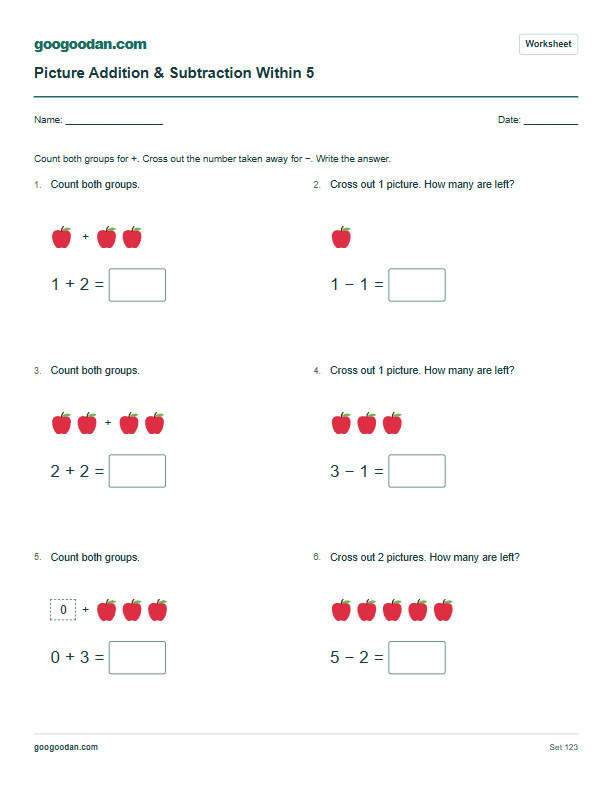
Kindergarten Addition and Subtraction Within 5
Count and combine pictures, or cross out the amount taken away.
6 problems · Answer key included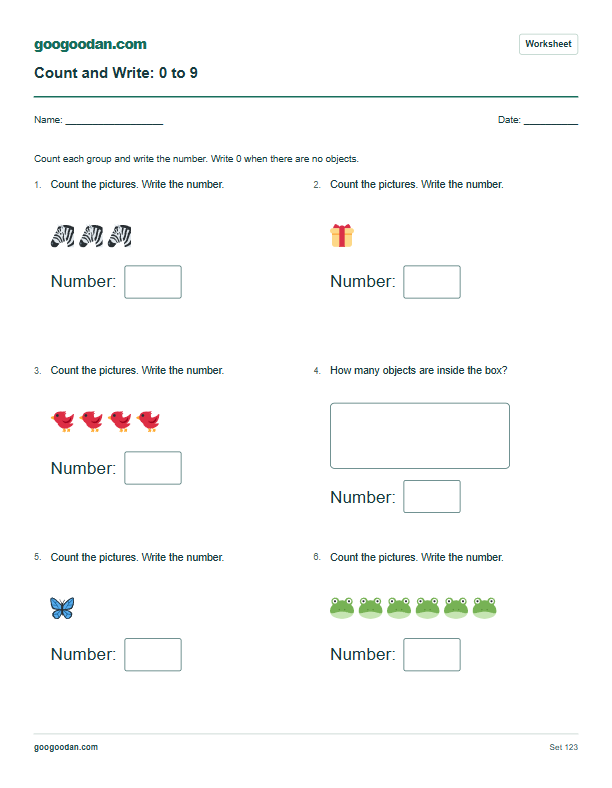 Picture activity
Count and Write Worksheets for Kindergarten
Count picture groups from 1 to 9 and write 0 for an empty group. Touch each object once and record the total.
6 problems · Answer key included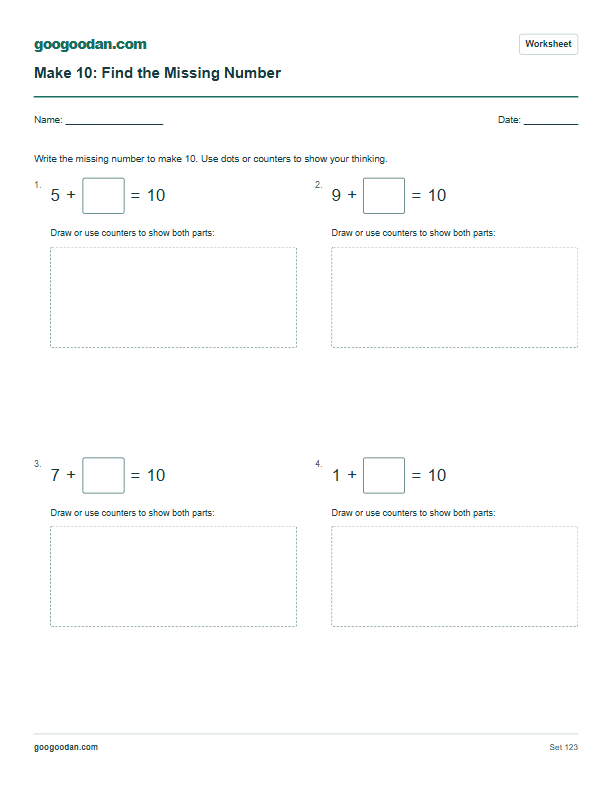 Missing number and drawing activity
Make 10 Missing Addend Worksheets
Find the missing part in an addition equation that totals 10. Use the drawing space or counters to explain your answer.
4 problems · Answer key included
More about addition · Kindergarten worksheets
Kindergarten selected skill connection: K.OA.A.4 supporting practice: find the partner that makes 10 for given quantities 5–9; quantities 1–4 are not included. See the Common Core grade guidance. This worksheet does not cover every requirement in the standard.