
Count and Write Worksheets for Kindergarten
Mia points to a row of six pictures. She says the number words in the right order but touches one picture twice. Her final answer is seven. Before asking her to memorize more number words, help her coordinate one spoken number with one object.
Count every object once
Mia points to a row of six pictures. She says the number words in the right order but touches one picture twice. Her final answer is seven. Before asking her to memorize more number words, help her coordinate one spoken number with one object.
Try it with six counters: move each counted counter to a new row while saying one number word. Stop when every counter has moved.
The last number spoken tells how many counters are in the whole group. It does not describe only the last counter.
Touch, say, and move on
Invite the child to point to a picture as they say its number. Move through the group in a steady direction. When the pictures wrap onto a second row, continue from where the first row ended. Starting the count again on each row loses the total.
For a child who points faster than they speak, count together slowly. Small counters placed on the pictures can mark which ones have already been counted. Remove the extra support when the child can keep track independently.
The total stays the same when the arrangement changes
Count four real objects, then spread them farther apart. Ask whether any objects were added or removed. Count again to confirm that the total is still four. A longer row can take up more space without containing more objects.
No objects is a quantity too
One question shows an empty counting box. Ask Mia to look inside it: “Are there any objects to touch and count?” There are none, so the matching numeral is 0. The border only marks the space to look in; it is not an object in the group.
Place three counters on a mat, then move all three off the mat. The mat has not disappeared, but there are zero counters on it. Put one counter back to compare zero with one. This makes the difference visible without asking the child to start counting an object that is not there.
Connect a quantity to its numeral
After counting, ask the child to choose or write the matching numeral. If they know there are six but cannot yet form a 6, offer numeral cards or write their spoken answer for them. Keep the counting goal separate from pencil control. Practice writing the numeral later in a larger space if needed.
Ask “How many altogether?” after the count. If the child starts counting again every time, gently repeat the final number with the whole group in view: “Six. There are six altogether.” Allow recounting as a check; it is not a failure.
Use the same page in more than one way
First, count aloud and write the number. Next, use real objects to build another group with the same quantity. Finally, cover the printed answer and ask the child to explain how they kept track. These variations deepen one activity instead of adding more questions before the idea is understood.
This worksheet has six questions: five picture groups containing one through nine objects, and one empty counting box for zero. The empty group may appear in a different position when you choose New numbers. The empty box has no objects or decorations inside; its border simply marks the counting area. Teen numbers and number-word matching are not included. The answer key records a numeral for every group, including 0 for the empty one.
Make a practice set
Choose what to print. Selecting both shows the answer key on screen and prints the questions followed by the answers.
After the practice
Invite the child to explain one choice with objects, pointing, or a drawing. Offer help recording the answer when needed. Choose another activity when the child is ready for a different way to use the same quantities.
 Picture activity
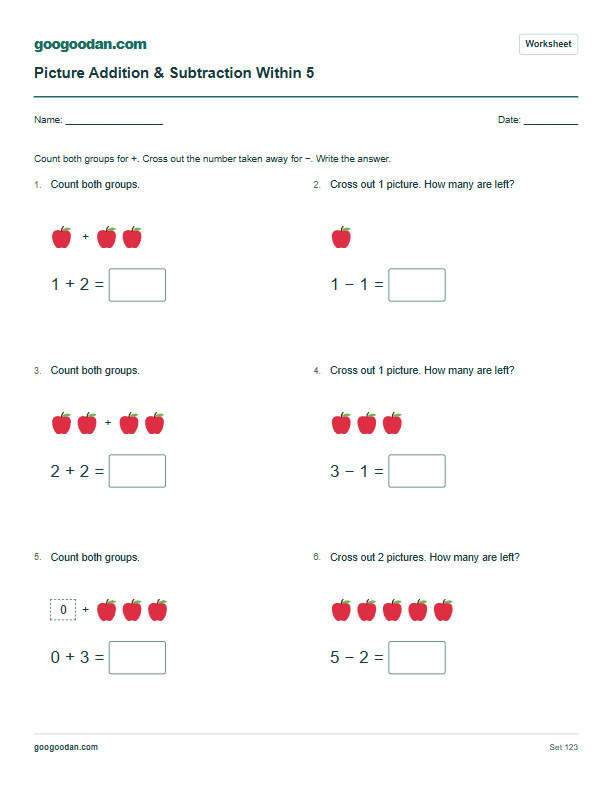
Kindergarten Addition and Subtraction Within 5
Count and combine pictures, or cross out the amount taken away.
6 problems · Answer key included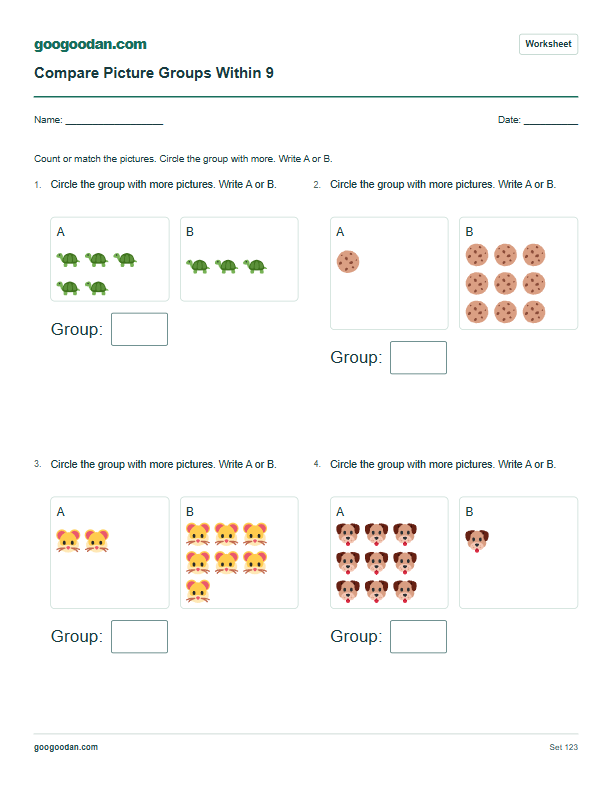 Picture activity
Compare Picture Groups Worksheets for Kindergarten
Match or count two groups and circle the group with more objects.
4 problems · Answer key included
More about numbers · Kindergarten worksheets
Kindergarten selected skill connection: Supporting K.CC.A.3 and K.CC.B.4: count and record groups of 0–9; 10–20 not included. See the Common Core grade guidance. This worksheet does not cover every requirement in the standard.