
Compare Picture Groups Worksheets for Kindergarten
Ben sees three counters spread across a wide row and six counters packed close together. He says the wide row has more. Instead of correcting him immediately, line the counters up in pairs so that each counter in one group has a partner in the other.
Compare how many, not how much space
Ben sees three counters spread across a wide row and six counters packed close together. He says the wide row has more. Instead of correcting him immediately, line the counters up in pairs so that each counter in one group has a partner in the other.
Group A: three counters.
Group B: six counters.
Make three pairs. All of Group A has partners, but three counters in Group B remain unmatched. Group B has more counters.
One-to-one matching makes the comparison visible
Matching works before a child is confident with written comparison symbols. Put the first object from each group together, then the next pair, and continue. The group with leftover objects has more. The group that runs out first has fewer.
On the worksheet, the groups are labeled A and B. Read those labels aloud, and let the child point or circle the group with more. Writing A or B in the answer box records the choice, but forming a letter is not the mathematical goal.
Check by counting both groups
Count the first group and remember its total. Count the second group and compare the two numbers. If the child loses the first total while counting the second, write the totals beside the groups or use numeral cards. That support reduces the memory demand without changing the comparison.
Keep the question clear
This sheet always asks for the group with more objects. It does not alternate between more and fewer without warning. After a correct choice, an adult can ask which group has fewer as a discussion question. Make clear that this is a new question rather than changing what the printed instruction meant.
Each pair has different totals, so there is one group with more. Some other activities include equal groups; this particular original bank does not. If both groups were equal, each object would have a partner and neither group would have more. Discuss that possibility using real counters without telling the child it occurs on this worksheet.
Let the child explain a method
A child might say “B has six and A has three,” or show unmatched counters. Both explain a comparison. Ask how they know instead of requiring one memorized sentence. Avoid rushing to greater-than and less-than symbols before the quantity relationship is clear.
There are four comparisons on each page. The pictured quantities are within nine: one group has one through four objects and the other has five through nine. The sides can change, so the larger group is not always on the same side. The answer key identifies A or B. Use a new set after the child can justify choices by matching or counting.
Make a practice set
Choose what to print. Selecting both shows the answer key on screen and prints the questions followed by the answers.
After the practice
Invite the child to explain one choice with objects, pointing, or a drawing. Offer help recording the answer when needed. Choose another activity when the child is ready for a different way to use the same quantities.
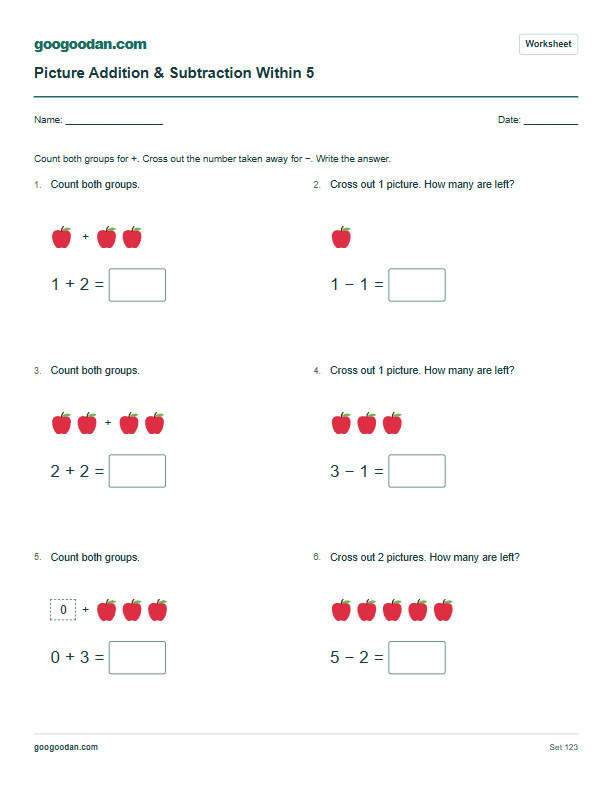 Picture activity
Kindergarten Addition and Subtraction Within 5
Count and combine pictures, or cross out the amount taken away.
6 problems · Answer key included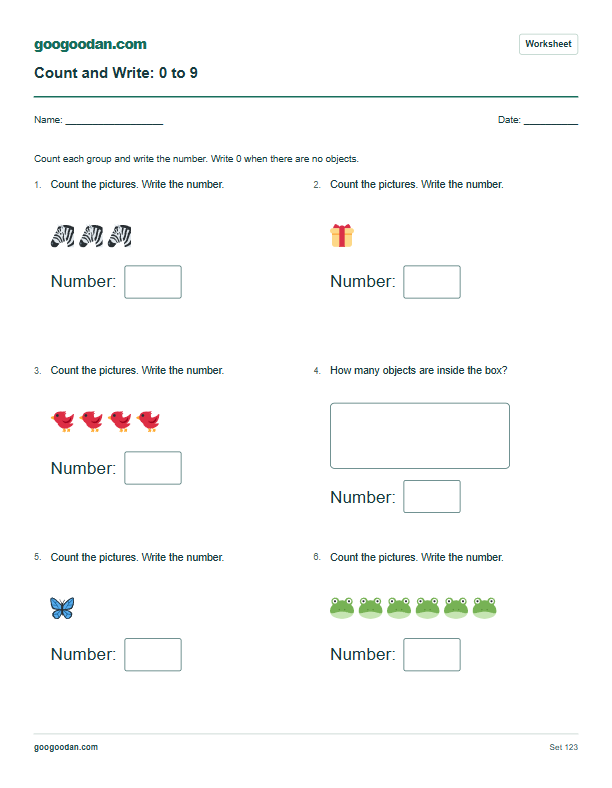 Picture activity
Count and Write Worksheets for Kindergarten
Count picture groups from 1 to 9 and write 0 for an empty group. Touch each object once and record the total.
6 problems · Answer key included
More about numbers · Kindergarten worksheets
Kindergarten selected skill connection: K.CC.C.6 (comparing pictured groups within 9). See the Common Core grade guidance. This worksheet does not cover every requirement in the standard.