
Kindergarten Addition and Subtraction Worksheets Within 5
Lily has two toy apples and gets one more. Instead of starting with a rule about the plus sign, let her move the two apples and the new apple into one group. She touches each apple once and counts three. The written equation records that action: 2 + 1 = 3.
Join and take away with pictures
Lily has two toy apples and gets one more. Instead of starting with a rule about the plus sign, let her move the two apples and the new apple into one group. She touches each apple once and counts three. The written equation records that action: 2 + 1 = 3.
2 + 1 = 3
Two objects, one more object, three objects altogether. The plus sign connects the groups; the equals sign says that both sides describe the same total.
One picture stands for one object
Each worksheet drawing has one picture for each object in the original problem. Point to the first group, then the second, and count every picture once. An adult can read the equation while the child acts it out. The goal is to connect the action, the picture, and the number, rather than test handwriting speed.
Taking away begins with the whole group
Now place five apples on the table and put two aside. Three remain. In a subtraction picture, all five apples are visible at first. The instruction asks the child to cross out two; it does not show a second group that should be counted again.
5 − 2 = 3
Start with five, remove two, and count only the three that remain. Put the two back to check that the starting group had five.
Nothing is a quantity too
A box marked 0 represents an empty group. Adding an empty group leaves the other group unchanged. Taking away zero leaves everything where it was. Taking away all the objects leaves zero, which should be written as an answer rather than mistaken for an unfinished question.
For 0 − 0, use an empty space on the table: there is nothing to remove and nothing left. No negative amounts appear on this worksheet. All given numbers and all answers stay between zero and five.
Let children explain before checking
Ask “What did you do to the group?” A child may show the correct total with fingers before writing its numeral. Record the number for them if fine-motor control is the obstacle. The answer key marks the removed pictures in subtraction and supplies the answer; children may cross out a different valid selection of the same number of objects.
Each page contains six mixed addition and subtraction activities. Read the action for each one, pause when the sign changes, and use real counters when a picture is not yet enough. A new set changes the quantities while keeping the same small range.
Make a practice set
Choose what to print. Selecting both shows the answer key on screen and prints the questions followed by the answers.
After the practice
Invite the child to explain one choice with objects, pointing, or a drawing. Offer help recording the answer when needed. Choose another activity when the child is ready for a different way to use the same quantities.
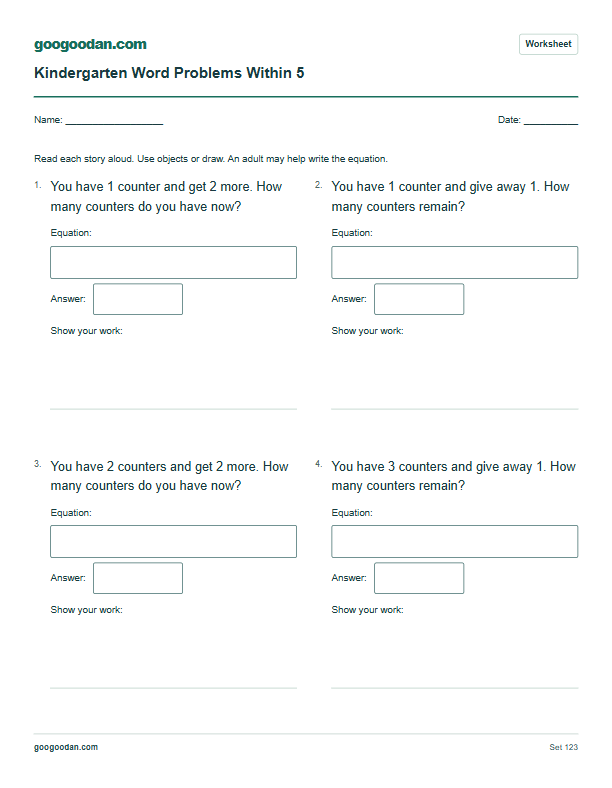 Word problems
Kindergarten Word Problems Within 5
Listen to a short story, act it out, and draw or write an answer within 5.
4 problems · Answer key included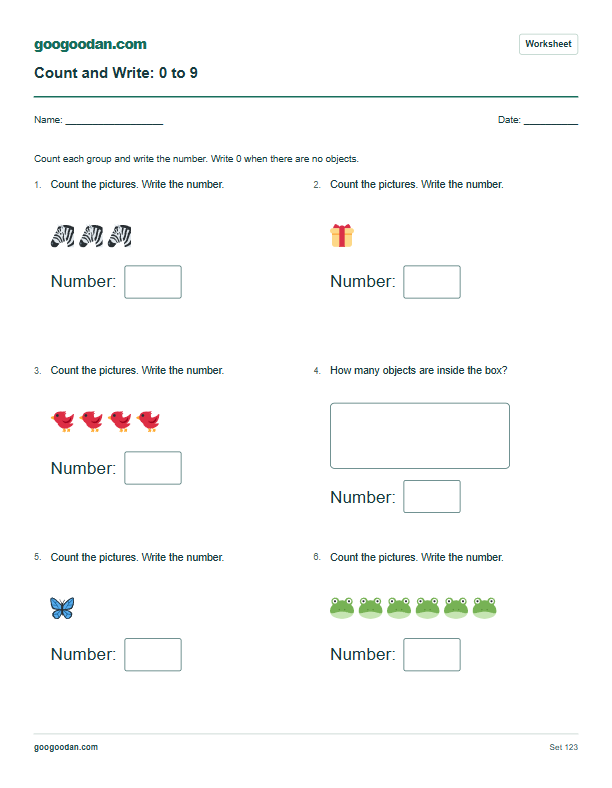 Picture activity
Count and Write Worksheets for Kindergarten
Count picture groups from 1 to 9 and write 0 for an empty group. Touch each object once and record the total.
6 problems · Answer key included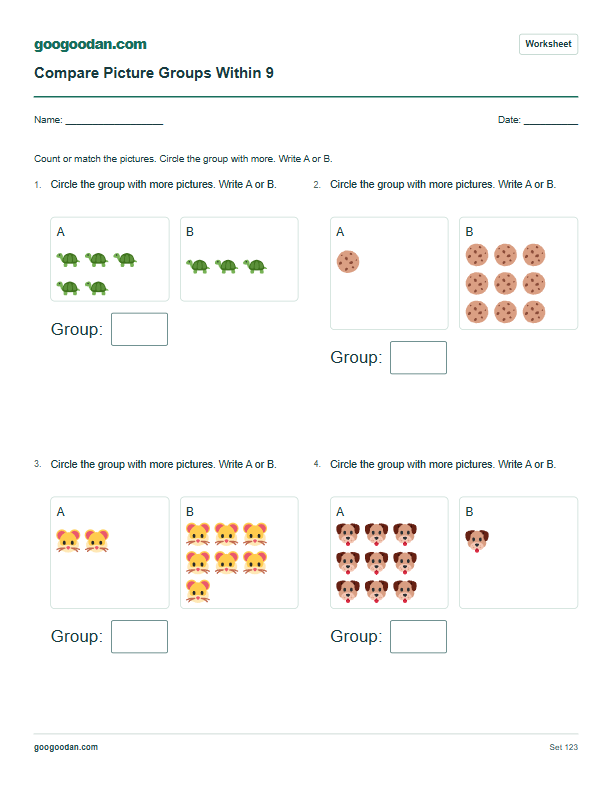 Picture activity
Compare Picture Groups Worksheets for Kindergarten
Match or count two groups and circle the group with more objects.
4 problems · Answer key included
More about addition · Kindergarten worksheets
Kindergarten selected skill connection: K.OA.A.1; K.OA.A.2; K.OA.A.5 (selected addition and subtraction within 5). See the Common Core grade guidance. This worksheet does not cover every requirement in the standard.