
Make 10 Missing Addend Worksheets for Kindergarten
Find the missing part that makes a total of 10. Begin with a written equation, then use counters or the open drawing space to show why your number works.
The blank is a part, not the total
Leo sees 8 + an empty box = 10. He writes 18 because he adds the two numbers he can see. Instead of asking him to try the same calculation again, place eight counters on the table and ask, “How many more do we need to have ten?”
Keep the eight counters together. Add one counter and say “nine.” Add one more and say “ten.” Two counters were added, so 8 + 2 = 10.
The 10 is already the total. The box asks for the missing part. To check, count all eight original counters and the two new counters together.
Read the equation before calculating
Say the sentence aloud: “Eight and how many more make ten?” Point to the given number, the blank, and the total in that order. The plus sign joins the two parts; the equals sign says that their combined amount is the same as ten.
A child may be used to putting every answer at the end of an equation. Here the answer belongs in the middle. Cover the printed 10 briefly, identify the two parts on the left, and uncover the total again. Do not move the blank or change the equation to make it look familiar.
Use the drawing space to show both parts
Draw the given number of small dots in the space below the equation. Add enough new dots to reach ten. Use a different color, or circle only the new dots, so that the two groups remain easy to distinguish. Write the number of new dots in the blank.
For 6 + a blank = 10, six dots are already there and four more are needed. Drawing ten dots without identifying which ones were added shows the whole, but does not yet explain the missing part. Ask the child to point to the four new dots.
Count on without counting the starting number again
If drawing every object is no longer necessary, begin with the given number and track each new count on a finger. Starting at seven, say “eight, nine, ten” while raising one, two, then three fingers. Three new counts mean that seven needs three more.
Start small or start near ten
Starting with two means adding eight more; starting with eight means adding two more. Show both situations with the same ten counters. The two parts switch roles, but their combined amount stays ten. A small starting group is not a sign that the missing part must also be small.
For 1 + a blank = 10, keep one counter apart and count the other nine. For 9 + a blank = 10, the one empty place is enough. Let the child use objects for the larger missing groups rather than requiring a long mental count before they are ready.
Check by joining the parts
Read the completed equation with the chosen answer. Count the original group and the added group together to see whether they make exactly ten. Too few means the added part is too small; more than ten means it is too large. Return to the drawing or counters to adjust the missing part.
As a connection, an adult can show ten counters and separate out the given amount. The counters left over are the same missing part. A child can use that action without having to memorize a subtraction rule first.
Choose pictures or an equation
Use Complete the Ten Frame when the child needs the empty spaces to show how much is missing. Choose this page when they are ready to start from a written equation and make their own representation. Both activities work with partners of ten, but the visual support is different.
An adult may read the equation aloud or record the number the child says. Drawing and handwriting are ways to communicate the idea, not extra tests that must be passed before a correct mathematical explanation is recognized.
Print a small set with room to explain
Each page has four different equations. The given addends and missing addends range from one through nine, and every total is ten. Choose New numbers to practice other partners: one sheet includes four different equations, not all nine pairs. The blank always comes after the plus sign; zero parts are not included.
The matching answer key fills the missing numeral in red and keeps the same equations in the same order. The drawing space stays open because there are many correct ways to show the two parts. Accept a clear drawing, counters, or a spoken explanation that agrees with the completed equation.
Read a matching story before showing the equation
Try this read-aloud prompt from the existing story bank: “You need 10 counters. You have 2. How many more do you need?” Place two counters in a ten frame and let the child fill the empty spaces. Eight new counters are needed, so 2 + 8 = 10. Ask the child to point only to the added counters when saying eight, then to all ten when checking the total.
This is the same missing-part relationship as the printed equations. The story changes the way you introduce the activity, not the answer rule. If the child says ten, they may be naming the target total; ask which counters were already there and which had to be added. An adult can record the equation after the child demonstrates it.
Make a practice set
Choose what to print. Selecting both shows the answer key on screen and prints the questions followed by the answers.
After the practice
Read each completed equation aloud. Count both parts to check that they make 10. The missing number tells how many were added.
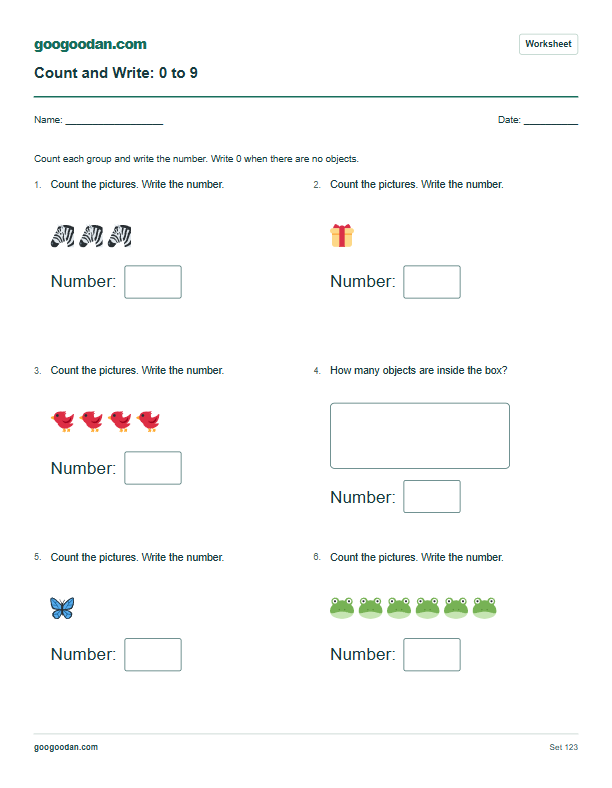 Picture activity
Count and Write Worksheets for Kindergarten
Count picture groups from 1 to 9 and write 0 for an empty group. Touch each object once and record the total.
6 problems · Answer key included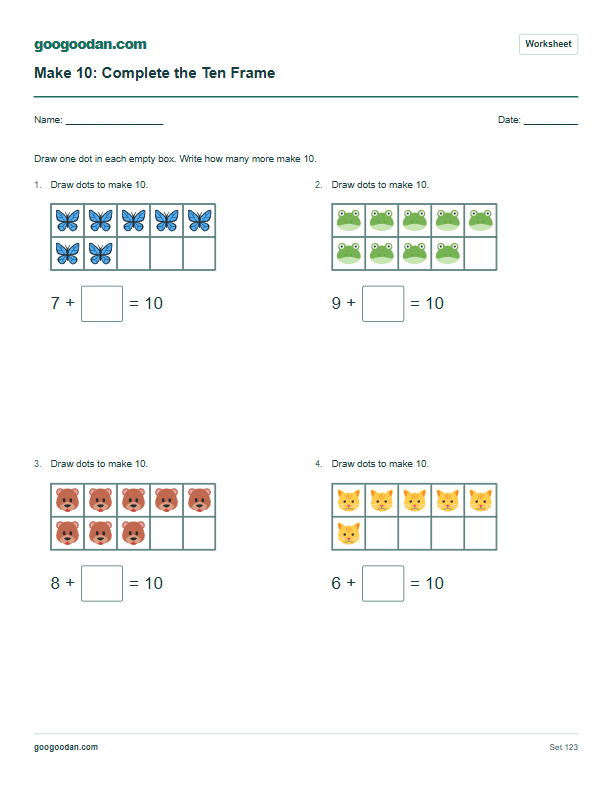 Draw and count activity
Making 10 with Ten Frames Worksheets
Draw a dot in each empty box, then write how many more make 10. Start with 5–9 pictures in a two-row frame.
4 problems · Answer key included
More about addition · Kindergarten worksheets
Kindergarten selected skill connection: K.OA.A.4 supporting practice: record the missing partner of 10 for any given addend 1–9, using drawings or counters to explain. See the Common Core grade guidance. This worksheet does not cover every requirement in the standard.