
Missing Addend Worksheets Within 20
A blank does not always mean the answer goes at the end. Find the part that makes both sides of the equation equal. These problems keep the missing number after the plus sign, with totals up to 20.
The total is already there. What is missing?
Maya wants to put 12 beads on a bracelet. She has already placed 8 beads on the string. Her question is not how many beads there will be altogether; she knows that. She wants to know how many more beads she needs.
Whole bracelet: 12 beads.
Beads already on the string: 8.
8 + ? = 12
12 − 8 = 4
8 + 4 = 12
The 8 and the missing number are the two parts. The 12 is the whole. The equal sign means the amount on the left must be the same as the amount on the right. It does not mean that every number in sight should be added together.
Count the steps, not the starting number
Begin at 8 and count on: 9, 10, 11, 12. Put up one finger for each new number. Four fingers show four steps, so four more beads are needed. Starting by putting up a finger for 8 would count a bead that Maya already has.
For a child who loses track, draw 12 small circles and shade the first 8. Count the unshaded circles. This makes the known part and the missing part visible inside the same whole.
Use subtraction to find a missing part
When the whole and one part are known, subtracting the known part from the whole finds what is left. That is why 12 − 8 answers the same question as 8 + ? = 12. Let the child use either method and explain what the number represents.
Can the missing number be zero?
Yes. In 6 + ? = 6, nothing more is needed, so the missing addend is 0. In 0 + ? = 9, the whole amount is missing, so the answer is 9. A blank is an unknown number; it does not automatically mean zero.
This worksheet practises a missing second addend. It does not move the blank to different positions or mix in subtraction equations. The answer key fills the same blank so the child can check each completed equation.
Read the same relationship in a word problem
When the child can fill the blank in an equation, try how many more word problems within 20. These questions give a start and a target in words. A counter strip helps the child identify the amount added before writing an equation.
Make a practice set
Choose what to print. Selecting both shows the answer key on screen and prints the questions followed by the answers.
After the practice
Choose one equation and ask the child to replace the blank with their number, then read both sides aloud. If it is incorrect, decide whether they found the total instead of the missing part or counted the starting number. Use counters for that example before trying another fresh set.
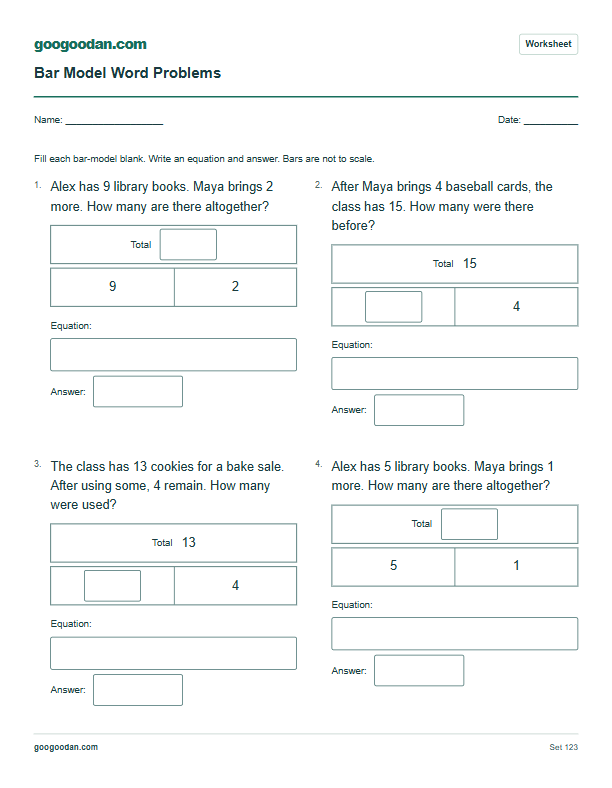 Word problems
Bar Model Word Problems
Use a whole-and-parts diagram to find the total, the starting amount, or the amount used.
4 problems · Answer key included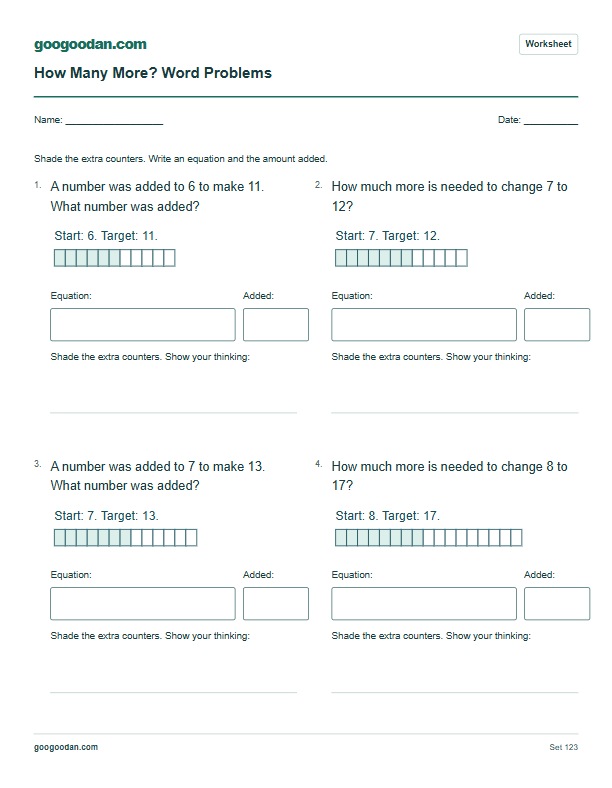 Word problems
How Many More? Word Problems Within 20
Find the amount to add to reach a target. Fill the empty spaces and check the missing part.
4 problems · Answer key included
More about addition · Grade 1 worksheets
Grade 1 selected skill connection: 1.OA.D.8 (missing second addend only). See the Common Core grade guidance. This worksheet does not cover every requirement in the standard.