
How Many More? Word Problems Within 20
Start with a known amount and reach a known target. Find the amount added using a counter strip, counting on, or a related subtraction equation.
We know the target. How much more is needed?
Imagine a counter strip with room for fourteen counters. Five spaces are already filled. A child points to fourteen and says, “That is the answer.” Fourteen is the target, but we already know it. The question is how many counters to add to the five that are there.
Keep the five starting counters in place. Fill each empty space with one new counter. Nine new counters complete the strip. The starting five and the added nine make fourteen: 5 + 9 = 14. The answer names only the added part, not the whole finished strip.
A blank can stand for the change
Before solving, write 5 + ? = 14. Read it as “five plus some amount makes fourteen.” The equal sign tells us that both sides describe the same total. It does not tell us to add five and fourteen. Fourteen already includes both the five we started with and the amount we need to find.
The same situation can be worded in two ways: “A number was added to five to make fourteen” or “How much more does five need to become fourteen?” Both give the starting amount and the result. Both ask for the amount added. The printable includes these two sentence patterns so the child can recognize the relationship even when the wording changes.
Find the missing part with subtraction
Separate the completed strip into the five spaces already filled and the nine extra spaces. Subtracting the known part from the whole leaves the missing part: 14 − 5 = 9. This subtraction finds an amount added; it does not mean someone took counters away in the story.
The answer key shows this subtraction equation. A correct completed addition equation, such as 5 + 9 = 14, is also a valid way to explain the answer. Ask the child what each number means before deciding whether their equation matches the situation.
Count on without counting the start twice
Try another question: how much more does eight need to become thirteen? Start with eight, then count nine, ten, eleven, twelve, thirteen. Raise one finger for each new number. Five fingers show five steps, so five more are needed.
A child may find it easier to reach ten first. Eight needs two to reach ten, and ten needs three to reach thirteen. The two jumps together add five: 2 + 3 = 5. Check by putting the start and change together: 8 + 5 = 13.
Keep the amount added separate from the final amount
Use three labels when discussing a question: start, added, and target. The start is already given. The target is already given. Only the added amount is missing. If the child adds the start to the target, put the target strip in front of them and ask whether the starting counters are already part of it.
This differs from a story that asks how much was spent or used. In a spending story, the amount decreases. Here it increases toward a target. Both may be solved by subtracting known amounts, but their answers describe different changes. It also differs from comparing two existing collections, where neither collection has to change.
Use the picture, then explain without it
Each set contains four questions with positive additions and targets within twenty. In each strip, the filled spaces show the start and the empty spaces show room left before reaching the target. Shade the extra spaces, write an equation, and record the amount added. The answer key colors those extra spaces separately.
After a correct answer, cover the picture and ask the child to explain it with counting on or a related subtraction. Return to the picture when the explanation becomes uncertain. For shorter equation-only practice, use the missing addend worksheet. To work with a whole and two labeled parts, use the bar model word problems.
Make a practice set
Choose what to print. Selecting both shows the answer key on screen and prints the questions followed by the answers.
After the practice
Cover the answer and have the child name the start, the added amount, and the target. Check that start plus added equals target. Accept a correct addition or subtraction equation that describes the same relationship.
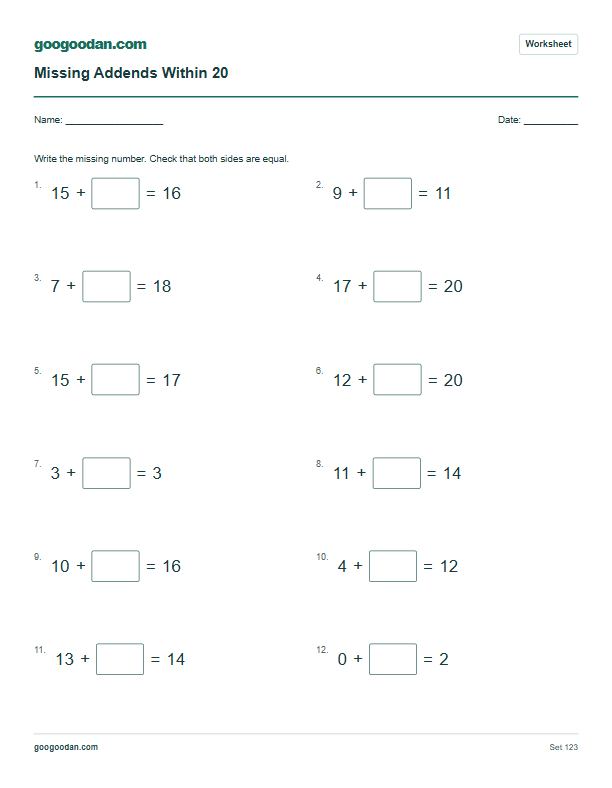 Missing-number practice
Missing Addend Worksheets Within 20
Find the missing part of an addition equation; use counting on or subtraction.
12 problems · Answer key included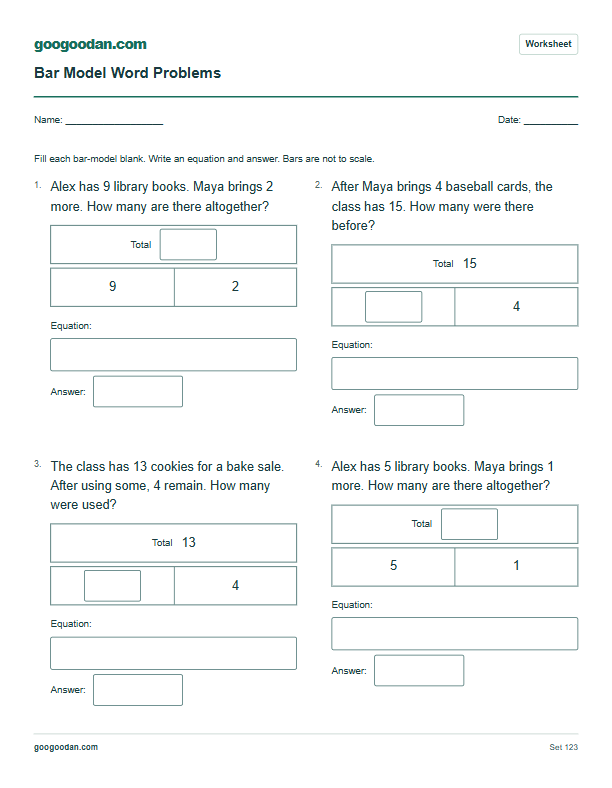 Word problems
Bar Model Word Problems
Use a whole-and-parts diagram to find the total, the starting amount, or the amount used.
4 problems · Answer key included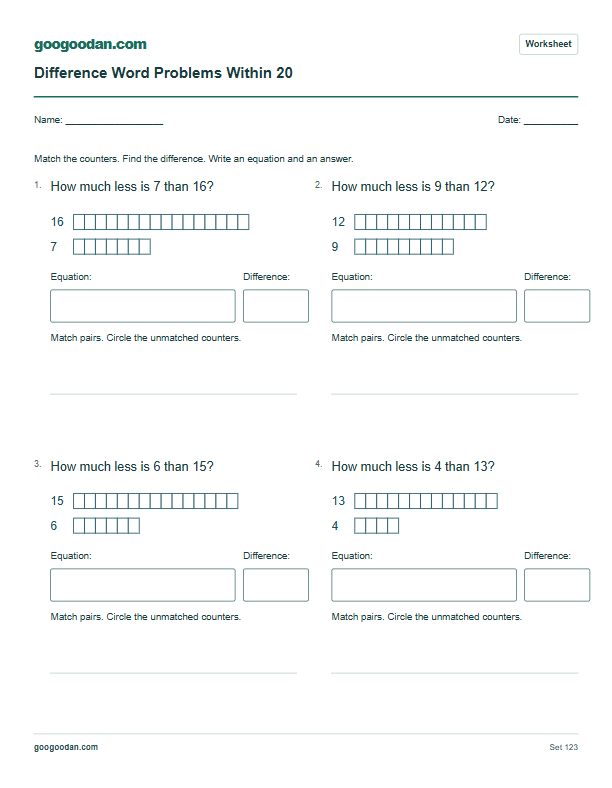 Word problems
Difference Word Problems Within 20
Match two rows of counters to find how much less one amount is than another.
4 problems · Answer key included
More about addition · Grade 1 worksheets
Grade 1 selected skill connection: 1.OA.A.1 (selected add-to, change-unknown situations). See the Common Core grade guidance. This worksheet does not cover every requirement in the standard.