
Bar Model Word Problems: Find the Whole or Missing Part
A bar model organizes the quantities in a story. The top bar names the whole, and the two lower parts fit together to make it. Find which quantity is missing, fill its box, and connect the diagram to an equation.
A diagram should explain the relationship
Maya has 9 library books and receives 5 more. She begins drawing fourteen tiny books, then loses count. A bar model lets her keep the relationship visible without drawing every object. Nine and five are the two parts; the new total is the whole.
9 + 5 = 14
The whole is fourteen because both parts belong to it.
Move the unknown, and the calculation changes
Now the class has 14 books after receiving 5. We know the whole and the new books, but not the starting collection. Put fourteen in the whole bar, five in one part, and a question mark in the other.
14 − 5 = 9
Nine books were there before the new books arrived.
Both diagrams describe a whole made of two parts. The position of the blank shows which quantity needs to be found. The bars in these worksheets organize numbers; they are not rulers. Do not measure the printed lengths to calculate an answer.
Use a part-whole model for an amount taken away
If there were 17 cookies and 6 remain after some were used, the starting seventeen is the whole. The used amount and the remaining six are the parts. Subtract the known remaining part from the whole: 17 − 6 = 11. Then check that 11 + 6 rebuilds seventeen.
Read the model back into the story
Ask the child to name each region before writing the equation. In a receiving story, a part might mean the books there before. In a taking-away story, that same position might represent cookies used. The shape alone does not supply the object or the event; the sentence does.
These four questions include an unknown total, an unknown starting amount, and an unknown amount used, with numbers within twenty. They use part-whole bars, not comparison bars or multiplication models. The answer key fills the same blank and shows one suitable equation.
Make a practice set
Choose what to print. Selecting both shows the answer key on screen and prints the questions followed by the answers.
After the practice
Cover the equation and ask the child to explain what the whole and each part mean. Then cover the model and read the completed equation in the story. Agreement between the two is more useful than simply copying a diagram.
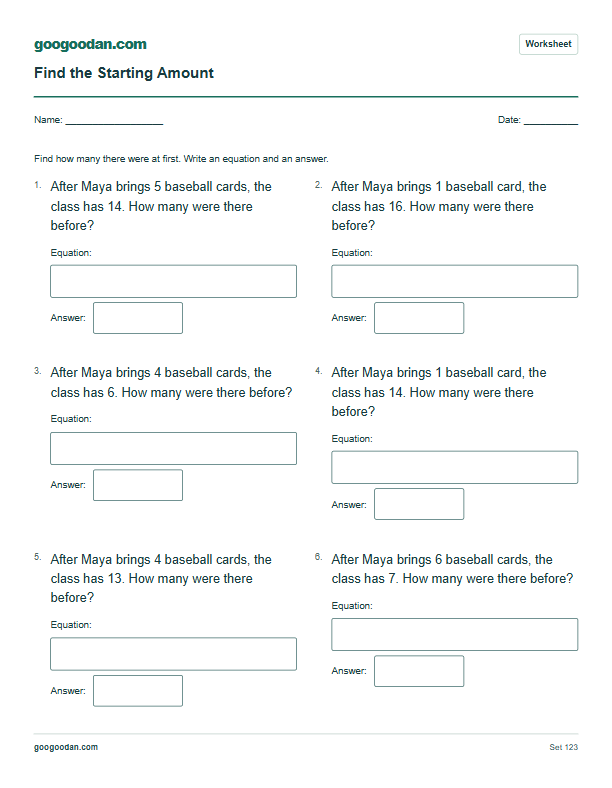 Word problems
Find the Starting Amount Word Problems
Work backward from a final total to find how many there were before.
6 problems · Answer key included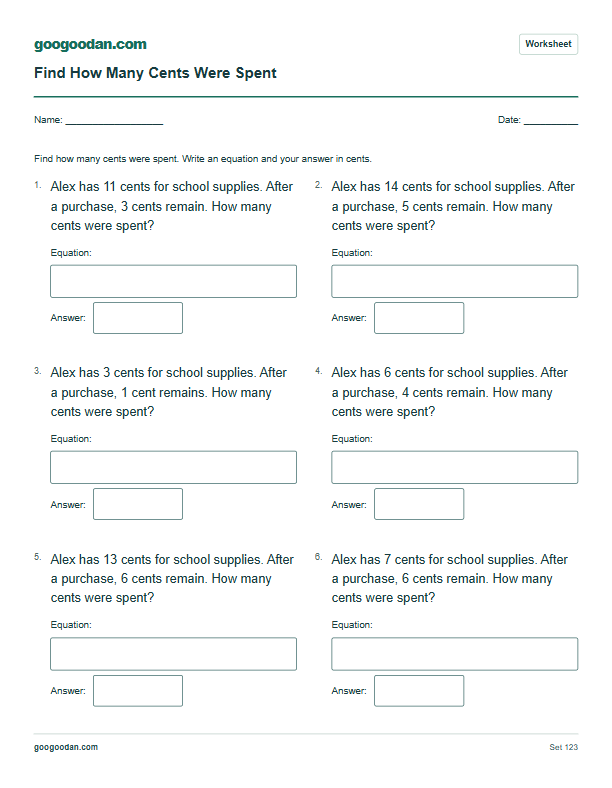 Word problems
Find the Missing Change Word Problems
Use the starting amount and what remains to find how many cents were spent.
6 problems · Answer key included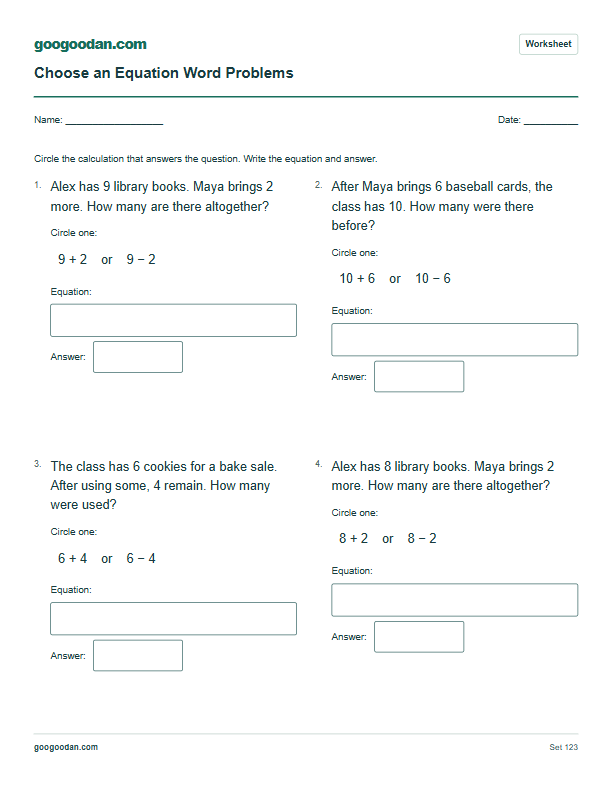 Word problems
Choose an Equation Word Problems
Decide whether addition or subtraction finds the missing quantity in the story.
4 problems · Answer key included
More about addition · Grade 1 worksheets
Grade 1 selected skill connection: 1.OA.A.1 (selected joining and taking-away relationships). See the Common Core grade guidance. This worksheet does not cover every requirement in the standard.