
Find the Starting Amount Word Problems
Sometimes a story tells you the ending, but asks about the beginning. Use the final total and the amount received to find how many there were before. These six stories use small quantities within 20.
“More” does not always mean add the printed numbers
Ella brings 4 library books to her classroom. After she adds them to the shelf, the class has 13 books. Sam sees the words “brings more” and writes 13 + 4. His calculation would be correct for a different question: receiving four more books after already having thirteen. Here, thirteen is the ending total.
Before: an unknown number of books.
Change: 4 books arrive.
After: 13 books.
? + 4 = 13
13 − 4 = 9
There were 9 books on the shelf before Ella arrived.
The four new books are already included in thirteen. Adding them again would count them twice. To find the starting collection, remove the new books from the final collection.
Build the ending first
- Put out thirteen counters to represent the books on the shelf now.
- Move four counters aside to show the books that just arrived.
- Count the nine remaining counters. They represent the books that were there before.
- Bring the four counters back. Nine and four return to thirteen.
This check connects subtraction to the story. A child can also count on from four to thirteen to find the missing part, or use the addition fact 9 + 4 = 13. The method can vary while the meaning stays the same.
Read the time words carefully
Words such as “after,” “before,” and “at first” tell where a quantity belongs. Ask the child to retell the events in order, even when the sentence begins with the ending. A short before/change/after sketch is often enough to make the missing amount clear.
These worksheets focus on receiving an amount and finding the unknown starting collection. They do not mix in stories about losing items or ask for every possible unknown position. The generated quantities stay below twenty, so reading the relationship can receive most of the attention.
Accept an equation that fits
The answer key shows a subtraction equation. An equivalent completed addition equation, such as 9 + 4 = 13, also explains the correct starting amount. Check what the child says the nine represents before requiring a particular written form.
Make a practice set
Choose what to print. Selecting both shows the answer key on screen and prints the questions followed by the answers.
After the practice
Choose one story and read it forward using the child’s answer as the starting amount. Does adding the new amount produce the final total? If it does, the quantities fit. If not, return to the before/change/after sketch.
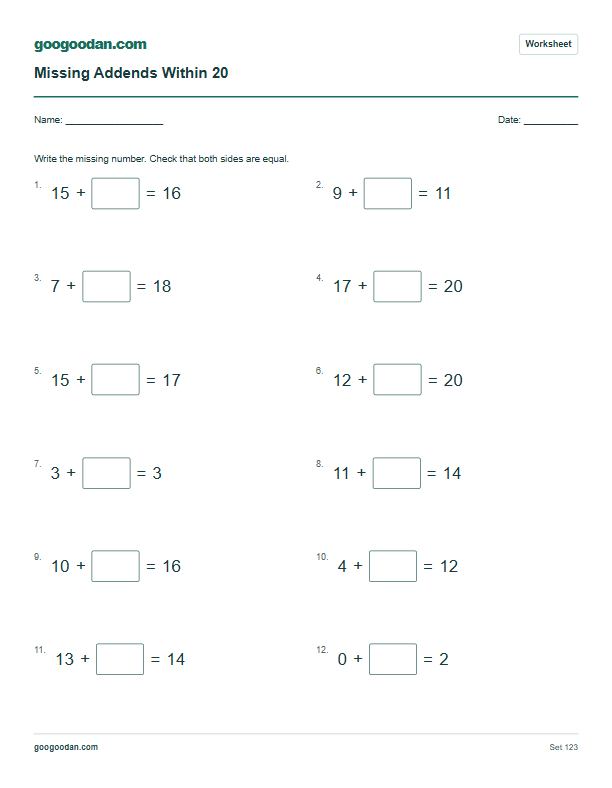 Missing-number practice
Missing Addend Worksheets Within 20
Find the missing part of an addition equation; use counting on or subtraction.
12 problems · Answer key included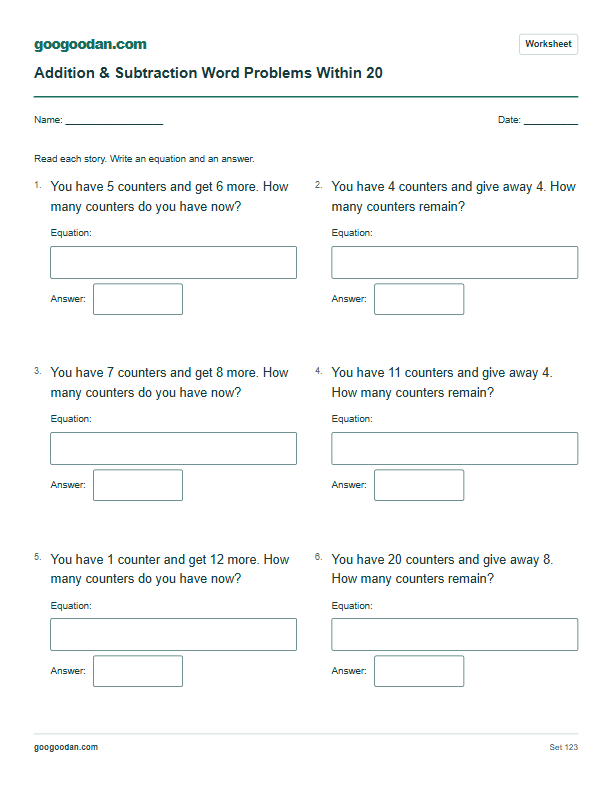 Word problems
Addition and Subtraction Word Problems Within 20
Read joining and taking-away stories, choose an equation, and answer in context.
6 problems · Answer key included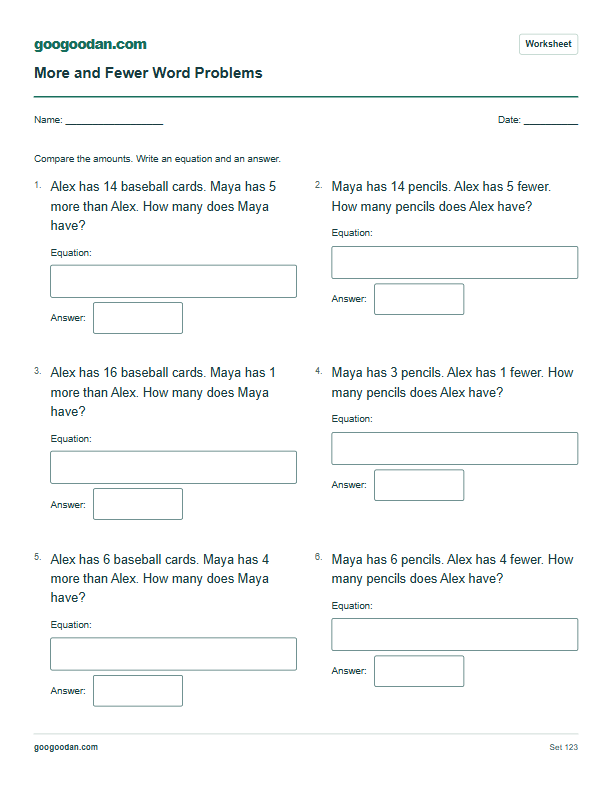 Word problems
More and Fewer Comparison Word Problems
Identify the known amount and compare two people’s collections.
6 problems · Answer key included
More about subtraction · Grade 1 worksheets
Grade 1 selected skill connection: 1.OA.A.1 (selected story structures). See the Common Core grade guidance. This worksheet does not cover every requirement in the standard.