
More and Fewer Comparison Word Problems
A comparison names one amount and describes another amount in relation to it. Find who has the known collection, what the difference means, and whose amount is being asked for.
More than whom? Fewer than whom?
Alex has 8 baseball cards. Maya has 3 more cards than Alex. Ben reads the story and points to the 3: “Maya has three.” He has found the difference, but the question asks for Maya’s whole collection.
Alex: 8 cards.
Maya: as many as Alex, plus 3 extra.
8 + 3 = 11
Maya has 11 cards. The extra 3 are only the part beyond Alex’s collection.
Use two rows of counters. Put eight counters in Alex’s row. Match eight in Maya’s row, then add three to the end. The matched parts show the amount both collections share; the unmatched part shows how much more Maya has.
Now compare with fewer
Maya has 12 pencils. Alex has 4 fewer pencils than Maya. Start with twelve to represent the known collection. Alex’s collection must be shorter by four, so 12 − 4 = 8. Alex has eight pencils, not four.
Ask the child to finish the sentence “Alex has as many as Maya, except for four.” This keeps the difference separate from the total being found. It also makes the comparison meaningful without relying only on the word “fewer.”
Keep track of the person the question names
- Find the person whose amount is given.
- Say who has more or fewer than that person.
- Identify the size of the difference.
- Find the other person’s amount and label the answer.
The same pair of collections can be described in opposite ways: Maya has three more than Alex, and Alex has three fewer than Maya. Do not assume one word always determines an operation in every comparison story; first identify which amount is missing.
What changes when both amounts are given?
Compare these two questions. “One collection has 9, and another has 5 more. How many are in the larger collection?” gives the difference and asks for a total: 9 + 5 = 14. “How much less is 9 than 14?” gives both totals and asks for the difference: 14 − 9 = 5.
Match one counter from the shorter row with one from the longer row. Nine pairs match. The five counters that have no partner show the difference. Neither collection changes during the comparison; the subtraction finds the part that the two rows do not share.
Ask the child to say what the answer counts. In the first question, fourteen names the whole larger collection. In the second, five names only the unmatched part. Saying “more means add” cannot decide between these questions: first find out whether a total or the difference is missing.
Check the difference by rebuilding the larger amount: 9 + 5 = 14. The same difference can be described in either direction: 14 is 5 more than 9, and 9 is 5 less than 14.
This is a discussion example. The six printed questions below still give the difference and ask for a person's amount. To practice finding a missing difference, use the difference word problems within 20.
What this set practises
Each question gives a reference amount and a difference, then asks for the compared person’s total. The set includes both larger and smaller collections, with numbers within twenty. Finding the difference between two given totals or finding an unknown reference amount are separate skills.
Check an answer against the story as well as the arithmetic. A correct sum for the wrong person has not yet answered the question.
Make a practice set
Choose what to print. Selecting both shows the answer key on screen and prints the questions followed by the answers.
After the practice
Have the child name the person and object in the answer. Then check the difference between the two collections. If the difference is right and the larger collection belongs to the right person, the comparison is consistent.
 Word problems
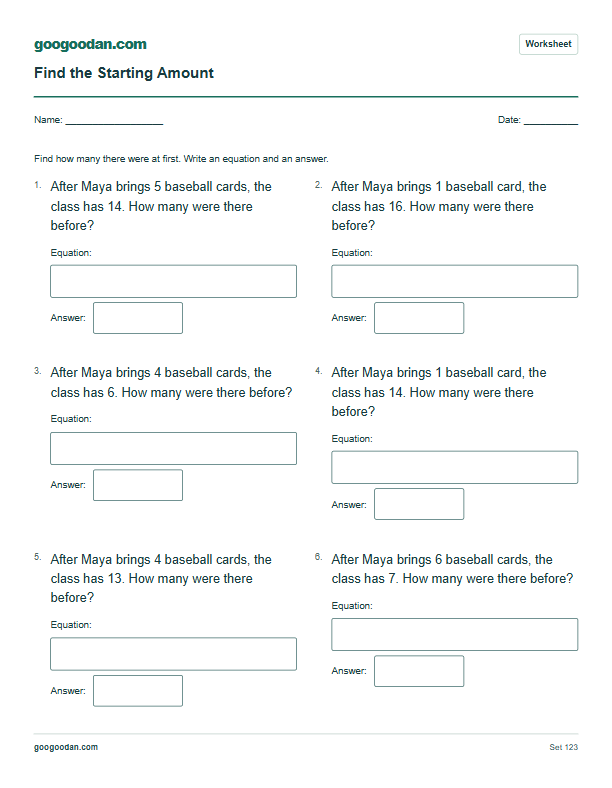
Find the Starting Amount Word Problems
Work backward from a final total to find how many there were before.
6 problems · Answer key included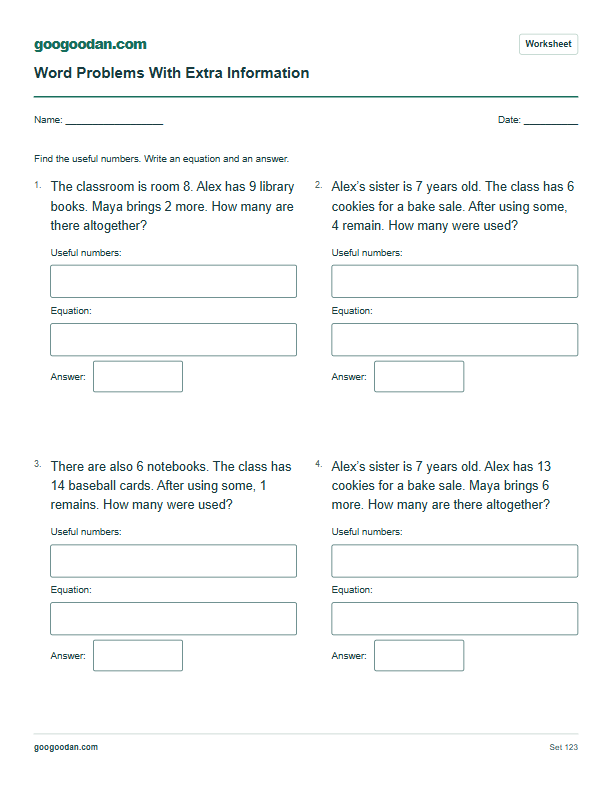 Word problems
Word Problems With Extra Information
Choose the useful quantities instead of calculating with every number.
4 problems · Answer key included
More about addition · Grade 1 worksheets
Grade 1 selected skill connection: 1.OA.A.1 (selected story structures). See the Common Core grade guidance. This worksheet does not cover every requirement in the standard.