
Word Problems With Extra Information
Not every number in a story belongs in the calculation. Read the question first, identify the quantities it asks about, and leave out details such as a room number or someone’s age.
A number can be true without being useful
Room 8 has 7 library books. Maya brings 5 more books. How many books are there now? Theo adds 8 + 7 + 5 because he thinks every number must be used. But the 8 labels the classroom; it does not count books.
Question: How many books are there now?
Useful quantities: 7 books already there and 5 books received.
Extra detail: room 8.
7 + 5 = 12
There are 12 books. The room number is not part of that total.
Connect each number to what it describes
Ask the child to say the words after or around each number: “room eight,” “seven books,” and “five more books.” Two numbers describe the collection of books. The other number is a name for a place. It can help someone find the classroom, but it does not help count the books.
In another story, a child’s sister might be seven years old. Her age is not part of a total of cards. A number of notebooks may also be irrelevant when the question asks only about books. Relevance depends on the question, not on whether a number looks small or large.
Choosing the numbers is only the first step
Some questions ask for a new total, while others ask how many there were before or how many were used. After selecting the useful quantities, decide how they are related. Knowing which two numbers matter does not automatically mean they should be added.
- Read the final question.
- Name the object or amount being asked about.
- Choose the quantities that explain that amount.
- Write an equation, solve it, and check the answer against the situation.
Give reading room
This sheet has four questions rather than a full page of short calculations. Each includes space to record the useful numbers, an equation, and an answer. Children can also mark the unneeded detail in the story.
The quantities used in the calculations stay within twenty. The extra information changes among room labels, other objects, and ages. The answer key identifies the useful numbers and gives a matching equation; it does not require the child to use the same order when listing the two quantities.
Make a practice set
Choose what to print. Selecting both shows the answer key on screen and prints the questions followed by the answers.
After the practice
Ask the child why one detail was left out. A useful explanation names what the question asks for and what the extra number describes. Check number selection separately from calculation so you can see whether the difficulty is reading the situation or computing.
 Word problems
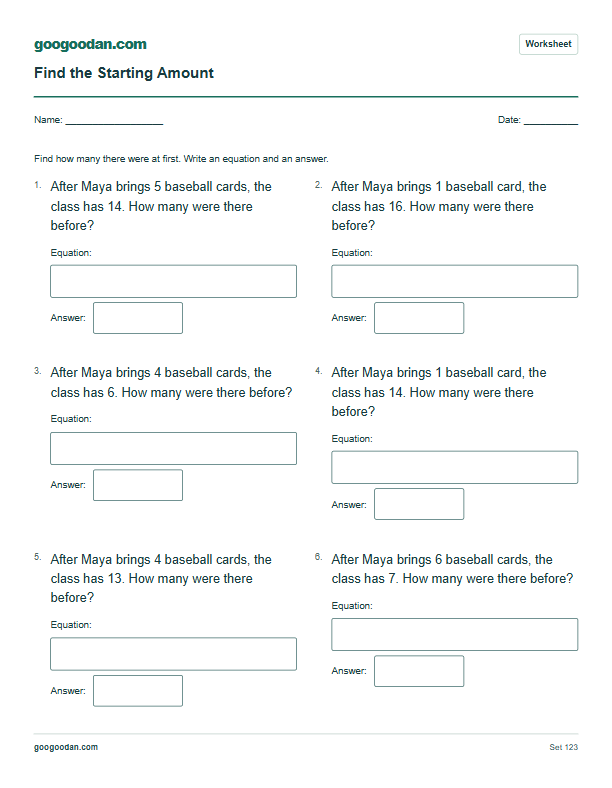
Find the Starting Amount Word Problems
Work backward from a final total to find how many there were before.
6 problems · Answer key included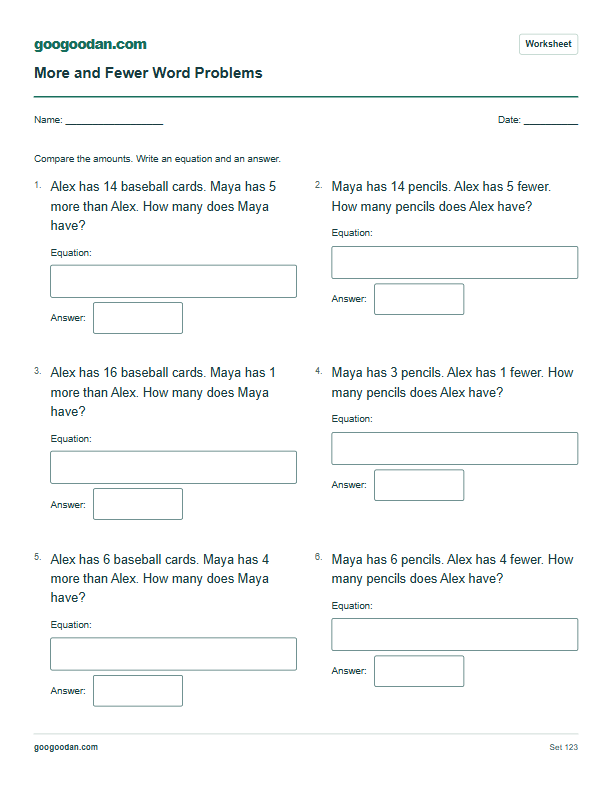 Word problems
More and Fewer Comparison Word Problems
Identify the known amount and compare two people’s collections.
6 problems · Answer key included
More about addition · Grade 1 worksheets
Grade 1 selected skill connection: 1.OA.A.1 (selected story structures). See the Common Core grade guidance. This worksheet does not cover every requirement in the standard.