
Addition and Subtraction Word Problems Within 20
A story tells what changes; an equation records that change. Practice finding a new total after counters are added or taken away. Each printable set has six stories with numbers and results within 20.
Tell what happened before choosing a sign
Grace puts 8 counters on her desk. A friend gives her 5 more. She knows both numbers matter, but she is not sure whether to add or subtract. Before writing a sign, she acts out the story: start with eight, then bring five more into the same group.
At the start: 8 counters.
What changes: 5 counters are added.
What we need: the number of counters now.
8 + 5 = 13
Grace has 13 counters now.
Now change the action. Grace starts with 8 counters and gives 5 away. Move five counters out of the group. Only three remain, so this story is represented by 8 − 5 = 3. The numbers are the same as before, but the action and the answer are different.
A short reading routine
- Say what is being counted.
- Find the starting amount.
- Describe whether something joins the group or leaves it.
- Say what the question asks you to find.
- Write an equation and finish with an answer about the counters.
Do not rush to circle numbers before understanding the situation. A quick sketch of dots can show which amount is present first and which amount changes. The equation should describe that sketch.
Move from counting every counter to making ten
Grace can solve 8 + 5 without counting all thirteen counters from one. Eight needs two more to make ten. Split the five new counters into two and three: use two to complete ten, then add the remaining three. Splitting five changes how the counters are grouped, not how many she receives.
8 original + 2 new = 10
The 5 new counters are 2 + 3.
8 + 5 = 8 + 2 + 3 = 10 + 3 = 13
If the child answers 15 after making ten, ask which counters have already been moved. Adding all five again counts the two moved counters twice. Point to the two used to fill the ten and the three left over.
Choose a strategy that fits the numbers
A known double: for 6 + 7, start with 6 + 6 = 12 and add one more. This works because seven is one more than six. It is not a reason to change every addition problem into a double.
A related addition fact: for 13 − 5, ask “Five and what make thirteen?” Since 5 + 8 = 13, the remaining amount is eight. Another way is to remove three to reach ten, then remove the other two: 13 − 3 − 2 = 8. Both account for the five taken away.
Count on for a small change: for 14 + 2, say fifteen, sixteen. The starting number fourteen is already present; it is not the first added counter. Making ten is not necessary for every problem.
Use the same stories for Grades 1 and 2
Grade 1: act out the joining or taking-away event and match it to an equation. Counters and drawings are welcome. Separate understanding the story from carrying out the calculation.
Grade 2: after identifying the operation, ask the child to explain a mental strategy or use a known fact. Return to objects when needed, then connect that model to a shorter calculation. An adult can read the story aloud; slow reading should not be mistaken for weak number facts. These six random stories support practice, but do not test every fact or prove that all one-digit addition facts have been memorized.
What if a story includes zero?
Receiving zero counters means the original amount stays the same. Giving away all the counters leaves zero. Use the actual objects to show that zero is a possible quantity, not a missing instruction.
Support reading without supplying the operation
If decoding the sentence takes all the child's attention, an adult can read it aloud once. Then let the child retell the event and decide what to do. Asking “What happens to the group?” gives more useful information than telling them to add whenever they see a familiar word.
This first set uses short joining and taking-away stories with the result unknown. Finding an unknown starting amount or comparing two people's amounts requires other story structures; those are not mixed into this set.
Make a practice set
Choose what to print. Selecting both shows the answer key on screen and prints the questions followed by the answers.
After the practice
Check the equation as well as the answer. Ask the child what each number represents and whether the final amount fits the action. If the equation matches the story but the arithmetic is wrong, practice that fact separately before returning to another story.
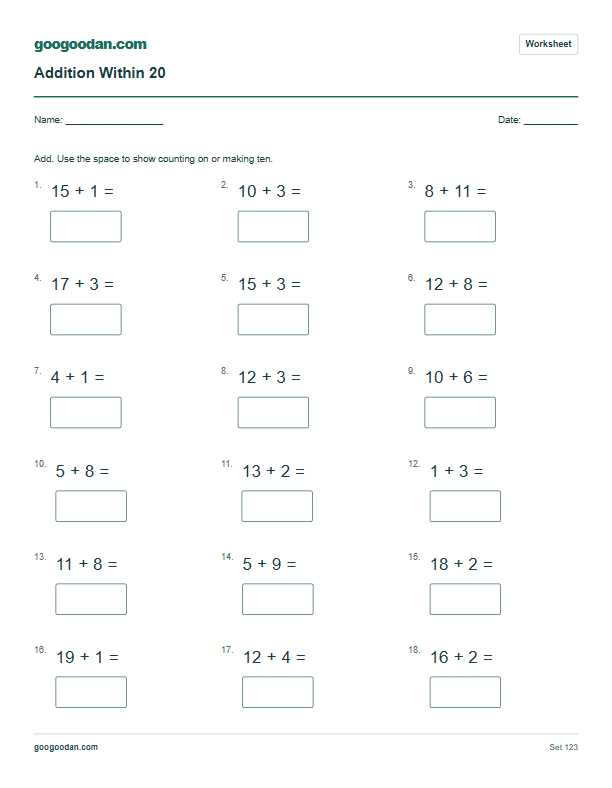 Calculation practice
Addition Within 20
Count on or make ten to add two numbers.
18 problems · Answer key included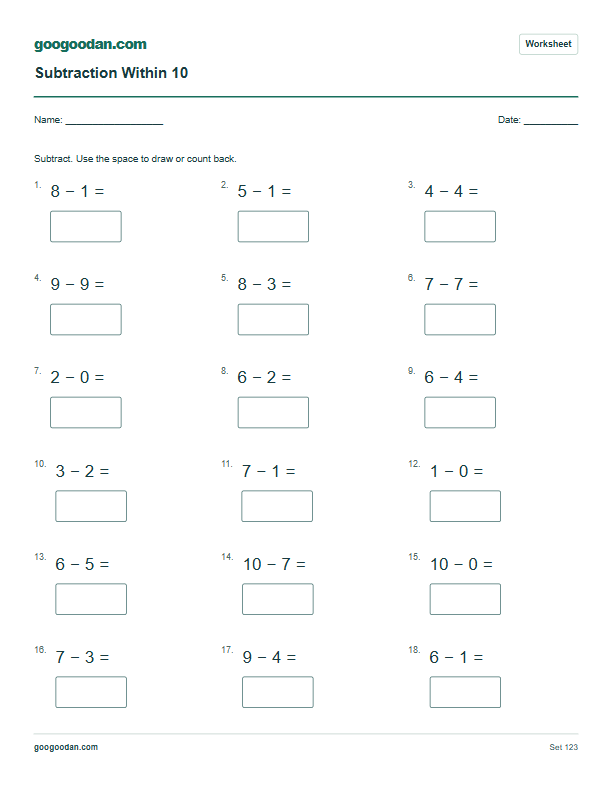 Calculation practice
Subtraction Within 10
Take away or count back, including subtracting zero and subtracting a number from itself.
18 problems · Answer key included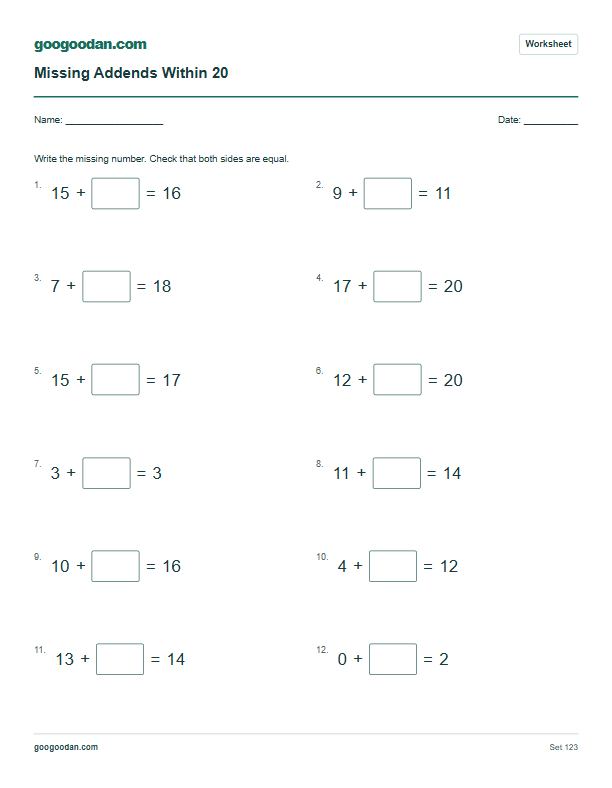 Missing-number practice
Missing Addend Worksheets Within 20
Find the missing part of an addition equation; use counting on or subtraction.
12 problems · Answer key included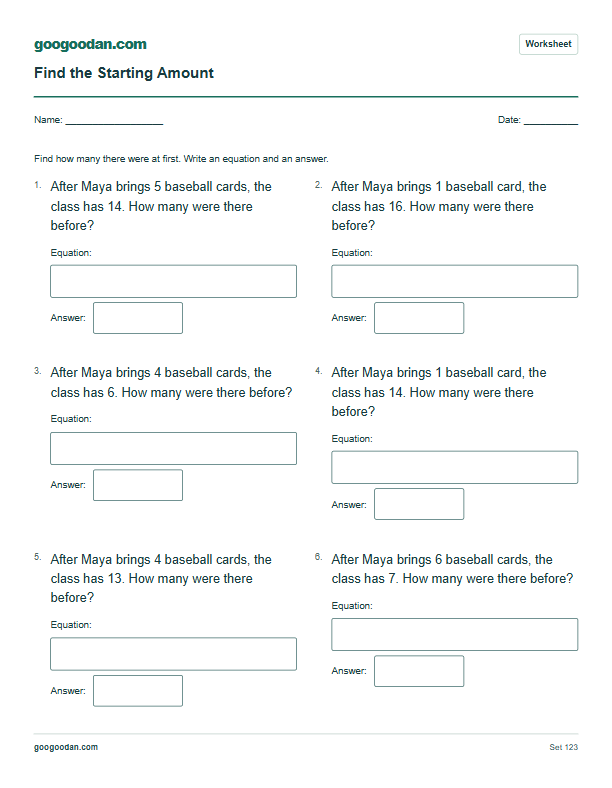 Word problems
Find the Starting Amount Word Problems
Work backward from a final total to find how many there were before.
6 problems · Answer key included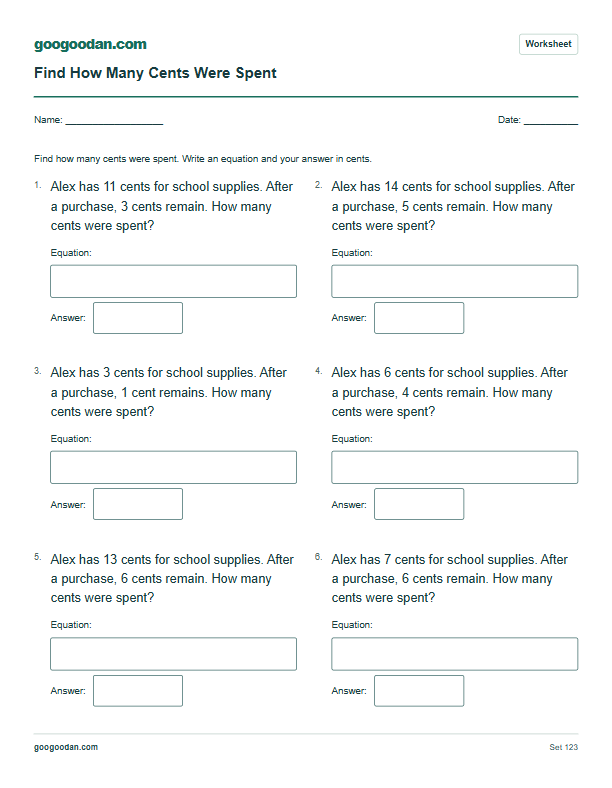 Word problems
Find the Missing Change Word Problems
Use the starting amount and what remains to find how many cents were spent.
6 problems · Answer key included
More about addition · Grade 1 worksheets · Grade 2 worksheets
Grade 1 selected skill connection: 1.OA.A.1 (result-unknown joining and taking-away stories). See the Common Core grade guidance. This worksheet does not cover every requirement in the standard.
Grade 2 selected skill connection: Supporting 2.OA.B.2: explain mental addition and subtraction strategies within 20 through one-step stories; not a full fact-recall assessment. See the Common Core grade guidance. This worksheet does not cover every requirement in the standard.