
Choose an Equation Word Problems: Addition or Subtraction
The same two numbers can tell different stories. Read what is known and what is missing, choose the calculation that answers the question, and then solve it. These four questions mix totals, starting amounts, and amounts used.
The numbers do not choose the operation
Alex has 12 books. Maya brings 4 more. If the question asks how many books there are now, the two collections join: 12 + 4 = 16. But imagine a different story: after Maya brings 4 books, there are 12 altogether. Now the question asks how many there were before.
Story A: 12 at first, then 4 arrive. Find the total.
12 + 4 = 16
Story B: 4 arrive, making 12 altogether. Find the starting amount.
12 − 4 = 8
Both stories use twelve, four, and the action of bringing more books. The difference is the unknown quantity. Choosing an operation from a single word such as “more” can miss that difference.
Sort the information before choosing
- Say what each printed number represents.
- Point to the quantity the question asks you to find.
- Decide whether the whole is missing or one part is missing.
- Choose a calculation, complete the equation, and read the answer in the story.
When the whole is unknown, addition combines the two known parts. When the whole and one part are known, subtraction finds the other part. A child can show this with a small drawing or counters before selecting from the two printed choices.
What if the story says some were used?
The class begins with 15 cookies. After using some, 6 remain. The missing amount is what was used, so 15 − 6 = 9. Check by putting nine used cookies and six remaining cookies back into one collection of fifteen.
An addition check can still explain a subtraction answer
For the starting-amount story, 8 + 4 = 12 is a useful completed equation that proves the answer. Among the two printed calculations, 12 − 4 directly finds the missing eight. Explain that distinction rather than telling a child that all addition thinking is wrong.
This page contains four questions within twenty, with room to circle a choice and write an equation. It does not introduce multiplication, division, or every comparison structure. The answer key marks the direct calculation and supplies the completed equation.
Make a practice set
Choose what to print. Selecting both shows the answer key on screen and prints the questions followed by the answers.
After the practice
Ask the child to explain one choice using the meanings of the quantities. If the answer is right but the explanation is only “because it says more,” try the matching starting-amount story and compare the two situations.
 Word problems
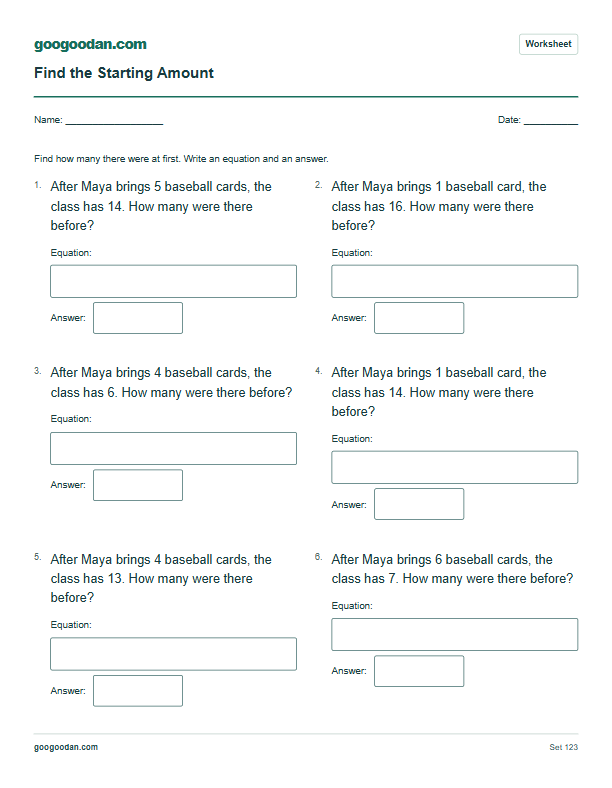
Find the Starting Amount Word Problems
Work backward from a final total to find how many there were before.
6 problems · Answer key included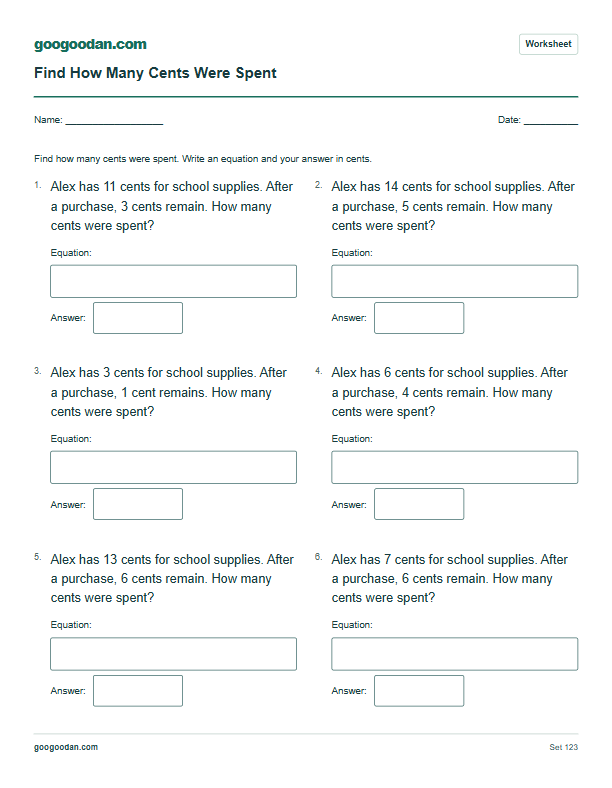 Word problems
Find the Missing Change Word Problems
Use the starting amount and what remains to find how many cents were spent.
6 problems · Answer key included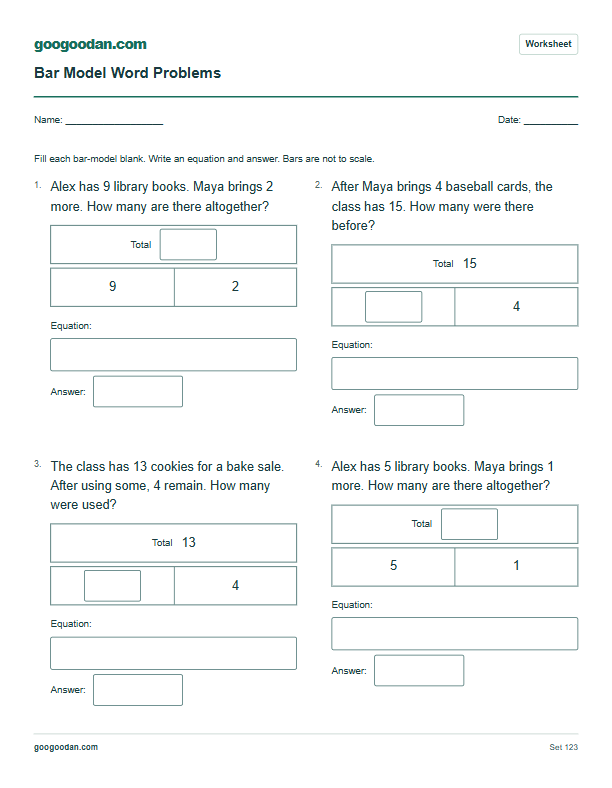 Word problems
Bar Model Word Problems
Use a whole-and-parts diagram to find the total, the starting amount, or the amount used.
4 problems · Answer key included
More about addition · Grade 1 worksheets
Grade 1 selected skill connection: 1.OA.A.1 (selected joining and taking-away relationships). See the Common Core grade guidance. This worksheet does not cover every requirement in the standard.