
Difference Word Problems Within 20
Both amounts are known. Match equal-size counters, find the unmatched part, and explain the difference using subtraction and an addition check.
Find the part that does not have a partner
Place fourteen counters in one row and nine in another. Ask, “How much less is nine than fourteen?” A child might answer “nine” because it is the smaller number. Nine tells us the size of one collection, but the question asks how far apart the two amounts are. We need the difference.
Match the first counter in the short row with the first counter in the long row. Keep matching one to one. Nine pairs use all the counters in the shorter row. Five counters in the longer row have no partners. Those five are the difference: 14 − 9 = 5.
Subtraction can compare amounts without taking anything away
Both collections stay on the table. Nobody loses a counter. Here, subtraction separates the larger collection into the part that matches the smaller collection and the part that is left unmatched. The matching part is nine; the extra part is five. Together those two parts make fourteen.
Have the child complete both sentences: “Fourteen is five more than nine” and “Nine is five less than fourteen.” The same five counters explain both statements. Changing the direction of the comparison changes the words, but it does not change the size of the gap.
Use addition to check the difference
Think, “Nine plus what makes fourteen?” Count on from nine: ten, eleven, twelve, thirteen, fourteen. There are five jumps. Nine is the starting number, so it is not the first jump. This is a useful check if a child gets six by counting the starting number as well.
Write 9 + 5 = 14 next to the subtraction equation. The addition rebuilds the larger amount using the smaller amount and the difference. If the two parts do not make fourteen, return to the paired counters and check for a skipped or twice-counted counter.
Try the same idea with a different pair
Now compare four and thirteen. Before calculating, ask which row should be shorter. Build four matching pairs, then count only the counters in the long row that do not have partners.
There are nine unmatched counters, so 13 − 4 = 9. Four is nine less than thirteen. Check with 4 + 9 = 13. The answer is not four, because four names the smaller amount; it is not thirteen, because thirteen names the larger amount.
Decide what is missing before choosing an operation
“There are nine counters in one row and fourteen in another” gives both amounts. Their difference is missing. In contrast, “One row has nine counters and the other has five more” gives one amount and the difference. That second question asks for the larger total, so it uses 9 + 5. Knowing what each number describes is more useful than memorizing “more means add” or “less means subtract.”
How to use this printable set
Each of the four questions gives two whole-number amounts within twenty and asks how much less the smaller is. The equal-size boxes are counters to match, not answer boxes. Draw a short line between each pair, then circle the unmatched counters. Write a subtraction equation and the difference in the labeled spaces. The answer key marks the unmatched counters in the longer row.
Once the child can explain the matching, cover the picture and solve another question by counting on. Keep the drawing available as a check. Accuracy and a clear explanation matter more than speed. For questions where the difference is already given, use the more and fewer comparison word problems.
Compare larger amounts
When the child can explain what the unmatched counters mean, try difference word problems within 100. Aligned bars replace long rows of individual counters, while the relationship stays the same: smaller amount plus difference equals larger amount.
What if the amounts match, or one group is empty?
After comparing different amounts, try two counters in each row. Pair the counters one to one. Every counter has a partner, so there are no unmatched counters: 2 − 2 = 0. Zero describes the difference; it does not mean that both collections are empty.
If the child answers 2, ask whether that number counts a collection or the gap between the collections. Check by adding the difference back: 2 + 0 = 2.
Compare two counters with an empty row
Now compare a row of two counters with an empty row. Nothing can be paired, so both counters are unmatched: 2 − 0 = 2. The empty row has zero counters; it is not a missing answer. Check with 0 + 2 = 2.
These are short follow-up discussions using real counters. They do not change the printable questions below or guarantee an equal or empty pair in each generated set.
Make a practice set
Choose what to print. Selecting both shows the answer key on screen and prints the questions followed by the answers.
After the practice
Ask what the difference counts. Have the child add it to the smaller amount to check the larger amount, then describe the comparison in both directions.
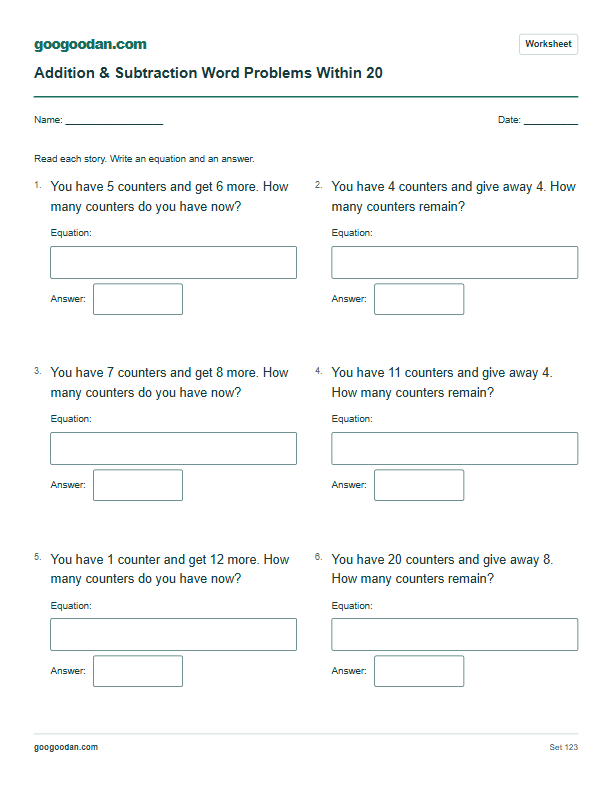 Word problems
Addition and Subtraction Word Problems Within 20
Read joining and taking-away stories, choose an equation, and answer in context.
6 problems · Answer key included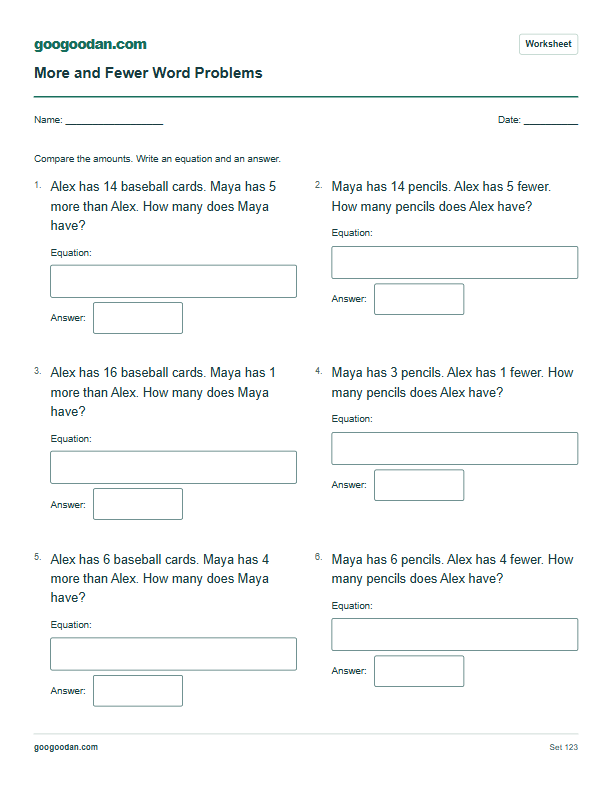 Word problems
More and Fewer Comparison Word Problems
Identify the known amount and compare two people’s collections.
6 problems · Answer key included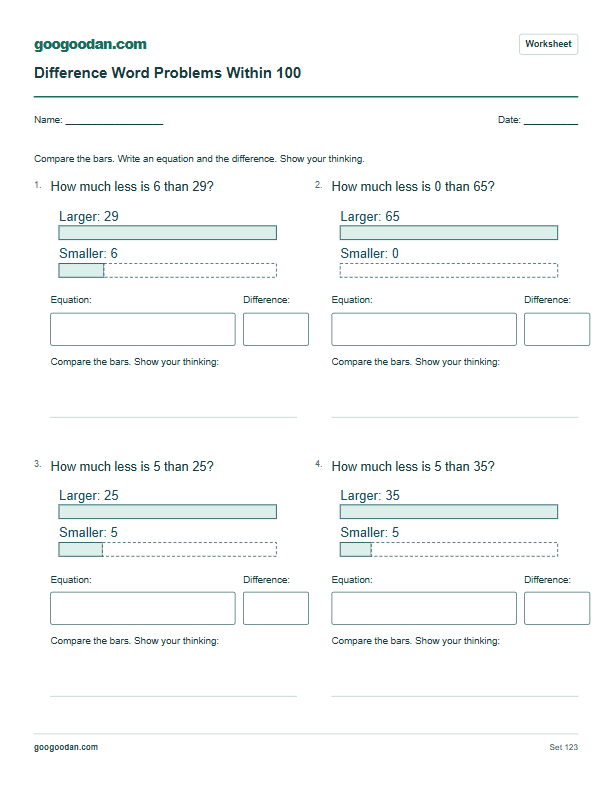 Word problems
Difference Word Problems — Within 100 or 1,000
Compare aligned bars and find the difference. Choose the default range within 100 or compare three-digit amounts within 1,000.
4 problems · Answer key included
More about subtraction · Grade 1 worksheets
Grade 1 selected skill connection: 1.OA.A.1 (selected difference-unknown comparisons). See the Common Core grade guidance. This worksheet does not cover every requirement in the standard.