
Difference Word Problems — Within 100 or 1,000
Compare two amounts to find how much more or less one is than the other. Choose the default range within 100, or extend to two three-digit amounts within 1,000. For Grade 3, choose Crossing 100 to compare a two-digit amount with a total above 100.
Two amounts are known. Find how far apart they are.
Imagine two collections with 56 counters in one and 2 in the other. A child says, “There are 58 altogether.” That correctly finds their combined total, but our question is different: how much less is 2 than 56? We want the difference between the collections, not the total in both.
Start both bars in the same place
The upper bar represents 56 and the lower bar represents 2. Both use the same scale and start on the left. The short lower bar matches the first part of the upper bar. The remaining length represents 54. A bar is a model of an amount, so the thin bar labeled 2 still represents two counters, not one counter.
Nothing has been taken away from either collection. Subtraction is useful because it measures the part of the larger amount that does not match the smaller amount. Say the relationship aloud: 2 plus the difference equals 56. Then write 56 − 2 = 54 and check 2 + 54 = 56.
Use the model to choose a calculation
For 56 − 2, think of 56 as five tens and six ones. Remove two ones in the calculation to leave five tens and four ones. That gives 54. Another approach is to count from 2 to 6, then from 6 to 56: the jumps are 4 and 50, totaling 54. Both methods find the same gap.
The numbers you land on while counting up are positions, not the amounts added. A jump ending at 6 does not mean you added 6. Ask the child to name each jump size and add those sizes. In a different question, crossing a ten may make counting up or regrouping useful; do not simply subtract the smaller digit from the larger digit in every column.
What if the smaller amount is zero?
The smaller collection is empty, so its bar has zero length. It is still labeled 0: an empty collection is not a missing answer. No part of the bar for 46 is matched, so the difference is all 46. The check 0 + 46 = 46 explains why subtracting zero leaves the larger amount unchanged.
Same numbers, different question
“How much less is 2 than 56?” and “How much more is 56 than 2?” both ask for 54. But “What number is 2 more than 56?” gives the difference and asks for a new amount, 58. The word more alone does not tell us which operation to use. First decide which quantity the question asks us to find.
If the child writes 56 as the answer, ask which label already tells us 56 and point to the unmatched section. If they write 58, ask whether they have combined both collections instead of compared them. Let them explain the picture before correcting the arithmetic.
What the default Within 100 activity includes
Each default Within 100 sheet has four short number comparison questions, aligned bars, and room for an equation and working. The larger amount is greater than 20 and at most 100. These selected questions compare a small amount with a larger two-digit amount; they do not cover every possible pair within 100. Equal amounts are not included. Zero may be the smaller amount.
The two bars in each question share a scale, but different questions may use different scales. Read the labels rather than using a ruler to compare bars across questions. The answer key highlights the unmatched length and gives the original subtraction equation. A correct addition equation that checks the same difference is also useful evidence of understanding.
For smaller numbers and one-to-one matching, start with difference word problems within 20. For a whole split into parts or an amount needed to reach a target, choose missing part word problems within 100. These are different relationships, even when subtraction appears in both.
Compare two three-digit amounts
Choose difference practice within 1,000 when the child can explain a comparison and is ready to calculate with hundreds, tens, and ones. Both amounts are already known. We are finding how far apart they are, rather than finding a combined total or a missing collection inside a stated total.
Match from the same starting point
Compare 530 and 322. The upper bar represents 530 and the lower bar represents 322. Start both at the same point and use the same scale. The lower bar matches part of the upper bar. The section left unmatched shows the difference.
The difference is 530 − 322 = 208. Nothing needs to be taken away from either original collection for subtraction to be useful. It measures the gap between their amounts. Adding 530 and 322 would give 852, the combined amount, which answers a different question.
Regroup without changing the value
In 530, there are five hundreds, three tens, and zero ones. To subtract two ones, exchange one ten for ten ones. Now there are five hundreds, two tens, and ten ones; the total is still 530. Subtract three hundreds, two tens, and two ones. Two hundreds, zero tens, and eight ones remain: 208.
Do not subtract the smaller digit from the larger digit independently in every column. The place values belong to whole numbers. Keeping the ten that was exchanged in the tens column would count its value twice. Ask the child to explain where the ten ones came from.
Count the gap as an alternative
Start at 322, add 8 to reach 330, add 170 to reach 500, then add 30 to reach 530. The jumps total 8 + 170 + 30 = 208. A different set of stopping points is also fine if the increases add to the same gap. The landing numbers are positions, not amounts to add together.
Check 322 + 208 = 530. This check connects the smaller amount, the difference, and the larger amount. If the child gives 530 as the difference, point to the part of that bar already matched by 322 and ask whether it belongs in the unmatched section.
A second comparison uses the same relationship
Now compare 744 and 321. Again, neither amount is missing. The unknown is the distance between them.
This time no regrouping is needed: seven hundreds minus three hundreds leaves four hundreds, four tens minus two tens leaves two tens, and four ones minus one one leaves three ones. The difference is 423. Check 321 + 423 = 744. The calculation changed, but the meaning of the unmatched section did not.
“How much less is 321 than 744?” and “How much more is 744 than 321?” both ask for 423. Reading the question in both directions helps separate comparison from a rule such as “more always means add.” The question determines what the answer represents.
What the larger-number option includes
Each set contains four distinct comparisons. Both given amounts are at least 100 and no greater than 1,000, and the larger amount is strictly greater than the smaller. Equal amounts and zero amounts are not included. The selected source does not cover every possible pair or guarantee a particular mix of regrouping and no-regrouping questions.
Bars share a scale within each question. Read the number labels rather than comparing lengths between different questions. Write the difference, an equation, and enough working to show how you found the gap. For a known whole with a missing part or a start-to-target increase, use missing amounts within 1,000 instead.
Compare amounts on opposite sides of 100
How much less is 42 than 116? Both amounts are known. The missing number is their difference, not a new total. Match the first 42 of the larger amount with the smaller amount; the unmatched part is what we need.
Count up in two steps: 42 + 58 = 100, then 100 + 16 = 116. The complete gap is 58 + 16 = 74. Therefore 116 − 42 = 74. Check by adding: 42 + 74 = 116.
If the child answers 58, ask which number that first jump reaches. If the child answers 16, ask how much of the gap comes before 100. The difference includes both parts. Adding 42 and 116 would count both collections together, which answers a different question.
The Crossing 100 (Grade 3) activity provides four different comparisons: the smaller amount is two digits, the larger amount is 101–198, and the difference is two digits. The default Within 100 activity remains available for Grade 2. Use the printed bars to compare the amounts, then show a subtraction calculation or count up through 100.
Make a practice set
Choose what to print. Selecting both shows the answer key on screen and prints the questions followed by the answers.
After the practice
Ask the child to name both amounts and explain what the difference measures. Check that the smaller amount plus the difference equals the larger amount.
 Word problems
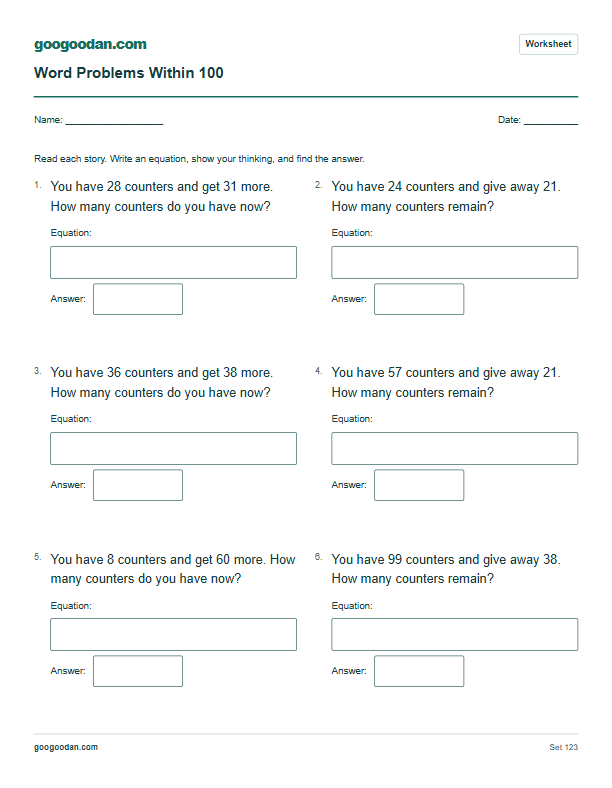
Addition & Subtraction Word Problems Within 100
Choose an operation for a joining or taking-away story, then solve within 100.
6 problems · Answer key included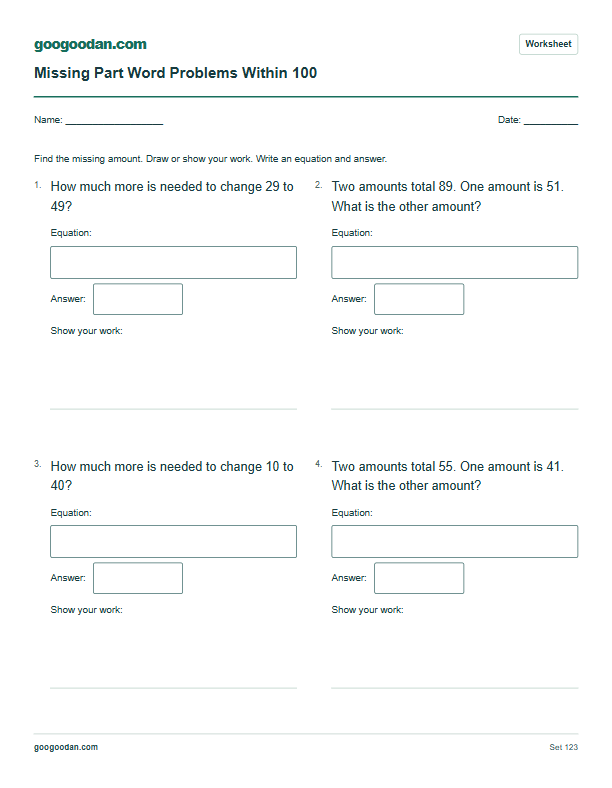 Word problems
Missing Part Word Problems — Within 100 or 1,000
Find a missing part or an amount needed to reach a target. Choose practice within 100 or extend to 1,000.
4 problems · Answer key included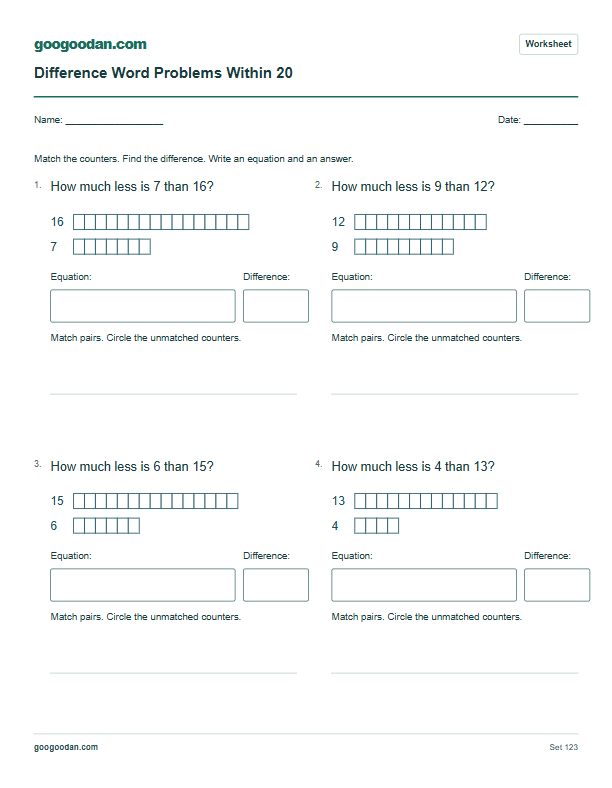 Word problems
Difference Word Problems Within 20
Match two rows of counters to find how much less one amount is than another.
4 problems · Answer key included
More about subtraction · Grade 2 worksheets · Grade 3 worksheets
Grade 2 selected skill connection: Within 100 default activity: 2.OA.A.1 (selected one-step difference-unknown comparisons); 2.NBT.B.5 (addition/subtraction relationship). See the Common Core grade guidance. This worksheet does not cover every requirement in the standard.
Grade 3 selected skill connection: Supporting 3.NBT.A.2 through the within-1000 option: use place value and the addition/subtraction relationship to compare two known amounts; not a full fluency assessment. See the Common Core grade guidance. This worksheet does not cover every requirement in the standard.