
Missing Part Word Problems — Within 100 or 1,000
Find the missing part of a known whole, or how much more is needed to reach a target. Begin within 100, or choose the Within 1,000 option for three-digit practice. For Grade 3 practice with a two-digit start and a total above 100, choose Crossing 100.
The total is already known
Maya reads, “Two amounts total 58. One amount is 23. What is the other amount?” She adds 58 and 23 because she sees the word total. Ask her which number describes the whole. Fifty-eight already includes both parts, so adding the known part again counts it twice.
Whole: 58
23 + □ = 58
Find the missing part: 58 − 23 = 35.
Check the whole: 23 + 35 = 58.
Read each number by its role
Point to the entire bar when saying fifty-eight, and to the first part when saying twenty-three. The question mark stands for the remaining part. The colors separate the two parts; they are not extra amounts. In this example the bar lengths match the amounts, but the written labels are what tell you the exact values.
If Maya answers 81, ask whether a part of this whole could be larger than 58. That check does not replace calculating, but it helps her notice that she answered a different question. Then cover the known section and point to the space that still needs a number.
Find how much more is needed
Maya tries another number story: “How much more is needed to change 27 to 70?” Twenty-seven is the starting amount, and seventy is the target. She sketches a number line and chooses a friendly stopping point: thirty. First add 3 to reach 30, then add 40 to reach 70.
The numbers below the line name positions. The labels above it name how much was added. If Maya adds the landing numbers, 30 + 70 = 100, ask her to trace each jump and say its size. Thirty is where the first jump ends; it does not mean thirty was added. The same check rules out 70 as the answer: seventy is the target, not the increase.
Both 70 − 27 = 43 and 27 + 43 = 70 explain the missing amount. Maya could also count up by several smaller jumps; their total must still be 43. The line shows only the part from 27 to 70, so its left end is not zero. Using two jumps is a calculation strategy for this one missing amount, not a story asking for two separate answers.
Subtract with place value when it helps
For 58 − 23, subtract two tens and then three ones: 58 − 20 = 38, and 38 − 3 = 35. A different question may cross a ten, so do not always subtract the smaller digit from the larger digit in each column. Use counting up, base-ten drawings, or regrouping to keep the value of the whole consistent.
Zero can be the missing amount
If the total is 42 and the known part is also 42, the other part is zero. Zero is a valid quantity. Ask the child to explain what is already accounted for instead of assuming every blank must contain a positive number.
Compare two amounts: a discussion extension
How much less is 59 than 80?
Maya sees both numbers and suggests 59 + 80 = 139. That would combine the amounts. This question asks for the difference: the extra length of the longer bar when both bars start together. Nothing in the question says that 59 objects were taken away.
80 − 59 = 21
Check: 59 + 21 = 80. The difference is 21; 80 is the larger amount, not the answer to “how much less?”
Count up to make the difference visible: 59 to 60 is 1, then 60 to 80 is 20. Add the jumps, 1 + 20 = 21. Maya can point to the short step and the two tens, then explain why 139 does not describe the space between the amounts.
One subtraction can describe different relationships
A missing-part question treats 80 as a whole made of 59 and an unknown part. A comparison question treats 80 and 59 as two amounts placed side by side. The calculation is the same, but the answer means an unknown part in one case and a difference in the other. Ask the child to name that meaning before calculating.
The comparison could also be stated as “How much more is 80 than 59?” It still asks for 21. The word “more” does not automatically mean add: first decide whether the unknown is an amount or the difference.
This comparison is a discussion example only. For a separate printable with two known amounts and an unknown difference, use difference word problems within 100. The four printed questions below still ask for a missing part or an amount needed to reach a target. For printed practice finding an unknown difference with smaller numbers, use difference word problems within 20. If the difference is given and the other amount is unknown, choose more and fewer word problems instead.
What the default Within 100 activity includes
Each default Within 100 sheet has four short number stories: two ask how much more is needed and two ask for the other part of a total. The known whole is between 20 and 100, and the given part is at least 10. The missing part is a nonnegative whole number. The set does not systematically cover every possible number combination. At most one question per set has an answer of zero.
These prompts describe number relationships rather than long real-world scenes. There is room to draw or show work before writing an equation and answer. The answer key shows a subtraction equation; a correct addition equation that finds and checks the same missing part is also useful evidence of understanding.
Read a question aloud if needed. The new challenge is identifying the missing amount with larger numbers, not reading speed or a timed test. This set does not include unknown starting amounts after a take-away event, two-step stories, or every situation in the grade standard.
Extend the same relationship to 1,000
When the child can name the whole and the missing part, choose practice within 1,000. The question is still about a missing amount. The extra challenge is keeping hundreds, tens, and ones organized while calculating. Use the default Within 100 activity if the relationship itself is still unclear.
A whole can contain a larger missing part
Two amounts total 811. One amount is 227. What is the other amount? The entire bar represents 811. Its known section represents 227, so the unfilled section is whatever must join 227 to make 811. Adding 811 and 227 would count the known part twice.
Find 811 − 227. One way is to trade a ten for ten ones: eight hundreds, zero tens, and eleven ones. Then trade a hundred for ten tens: seven hundreds, ten tens, and eleven ones. The value remains 811; only its grouping changes. Subtract seven ones, two tens, and two hundreds to leave five hundreds, eight tens, and four ones: 584.
Check 227 + 584 = 811. A part should fit inside this positive whole, so 584 being less than 811 is a useful reasonableness check. It is not enough on its own; the addition check confirms the exact amount.
Count up to a target instead
How much more is needed to change 278 to 707? The starting amount is 278 and the target is 707. The missing number is the increase, not the target itself.
Choose friendly stopping points: add 22 to reach 300, add 400 to reach 700, then add 7 to reach 707. The increase is 22 + 400 + 7 = 429. The numbers 300 and 700 are places you land, not jump sizes to add together. Ask the child to name each jump and then combine the jumps.
The subtraction equation 707 − 278 = 429 and the check 278 + 429 = 707 describe the same relationship. Counting up can be easier here than immediately writing a regrouping algorithm. Let the child compare methods and explain why their quantities still fit the story.
What the larger-number option includes
Each sheet has two known-whole/missing-part questions and two start-to-target questions. The known whole or target is greater than 100 and no more than 1,000. The known part or starting amount is at least 100. All answers are nonnegative whole numbers; at most one question has a zero answer. The selected source does not provide every possible number pair.
The bar segments use the same scale within each question, but different questions may use different scales. Read the labels rather than measuring across problems. The second section is the missing amount even when it is much longer or shorter than the known section. This option does not ask for a difference between two separate collections, an unknown starting amount after a take-away event, or two-step stories.
Cross 100 to find a missing amount
A number was added to 61 to make 113. What number was added? First identify what is missing: the amount added, not the final total. The original equation is 61 + □ = 113.
Break the change at 100. From 61 to 100 is 39. From 100 to 113 is another 13. Combine both changes: 39 + 13 = 52. Check the whole journey: 61 + 52 = 113, so 113 − 61 = 52.
If the child answers 39, ask which number that move reaches. If the child answers 13, ask how the starting 61 first became 100. Addition and subtraction give two ways to check the same missing amount.
Crossing 100 (Grade 3) has four original questions with a two-digit starting amount, a total from 101 to 198, and a two-digit missing amount. The basic Within 100 activity stays available for Grade 2. This option practices one selected relationship; it does not mix in comparisons between two separate collections.
Make a practice set
Choose what to print. Selecting both shows the answer key on screen and prints the questions followed by the answers.
After the practice
Ask the child to label the whole and the known part in one question. Check by adding the two parts back together. Use smaller-number stories if identifying the relationship is still difficult.
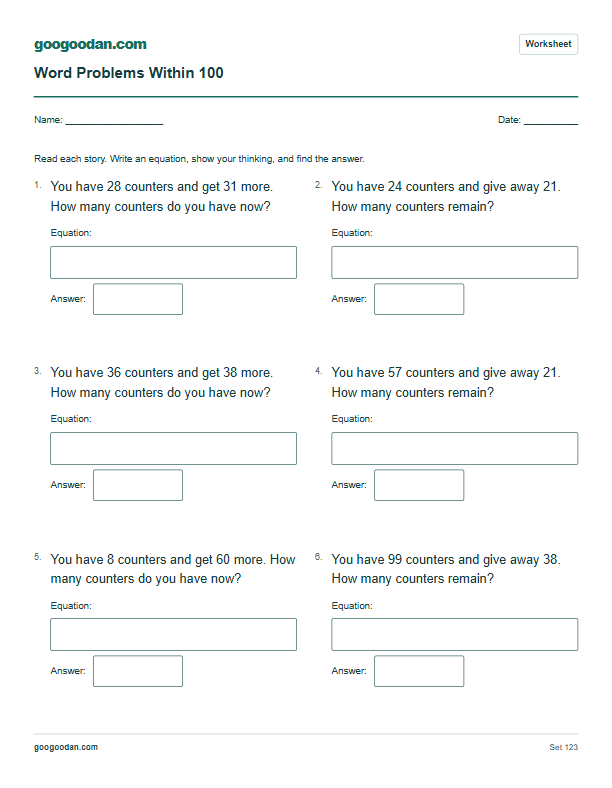 Word problems
Addition & Subtraction Word Problems Within 100
Choose an operation for a joining or taking-away story, then solve within 100.
6 problems · Answer key included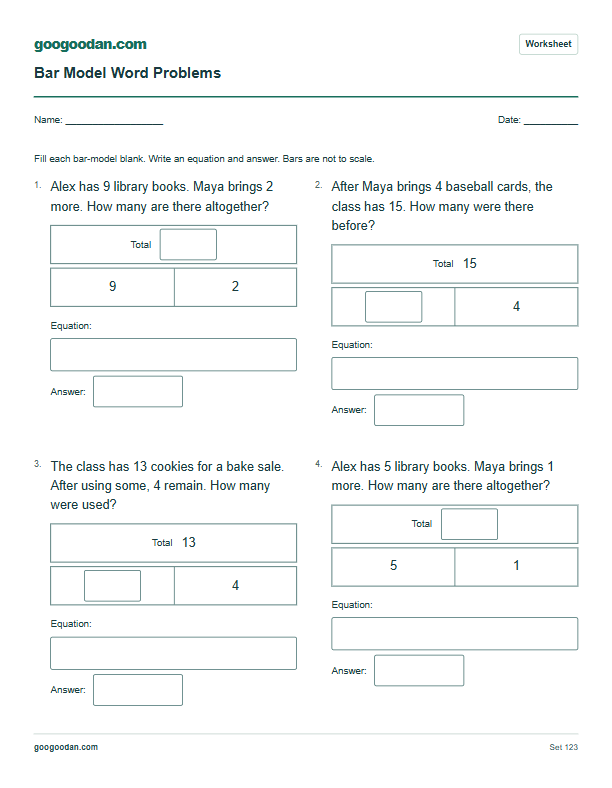 Word problems
Bar Model Word Problems
Use a whole-and-parts diagram to find the total, the starting amount, or the amount used.
4 problems · Answer key included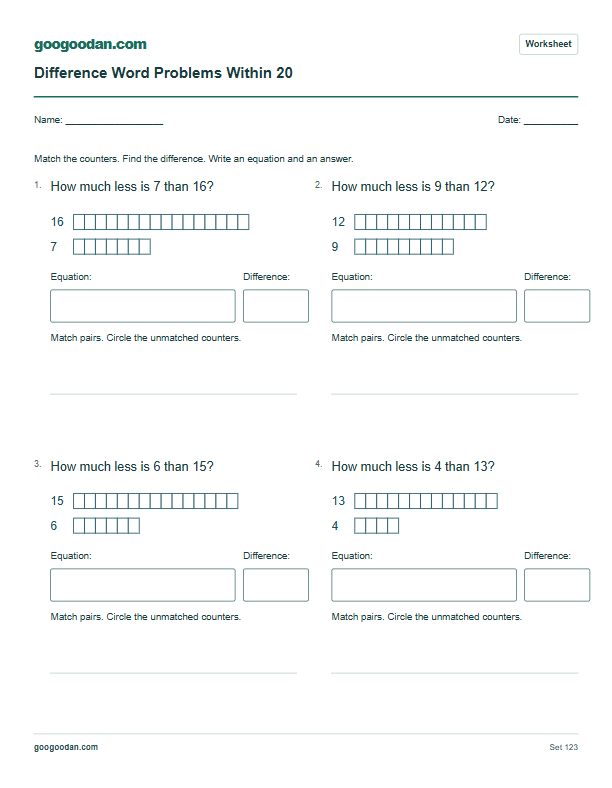 Word problems
Difference Word Problems Within 20
Match two rows of counters to find how much less one amount is than another.
4 problems · Answer key included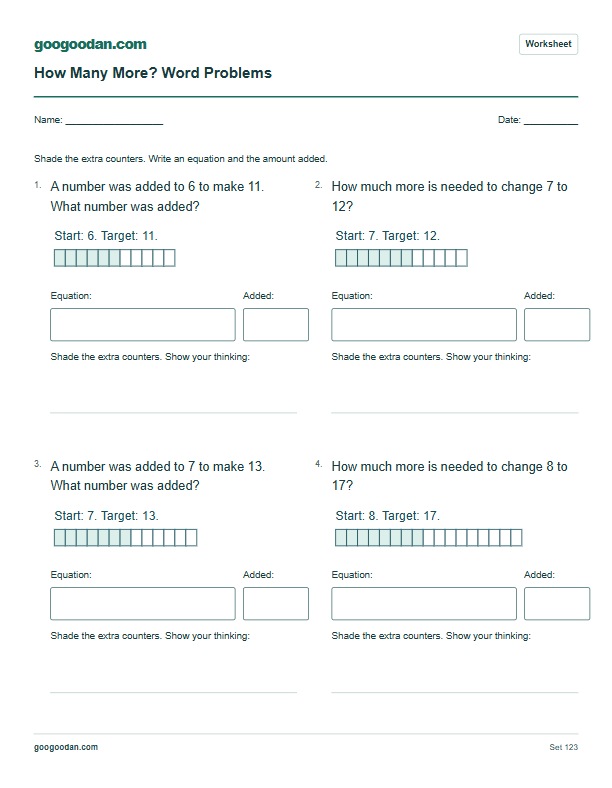 Word problems
How Many More? Word Problems Within 20
Find the amount to add to reach a target. Fill the empty spaces and check the missing part.
4 problems · Answer key included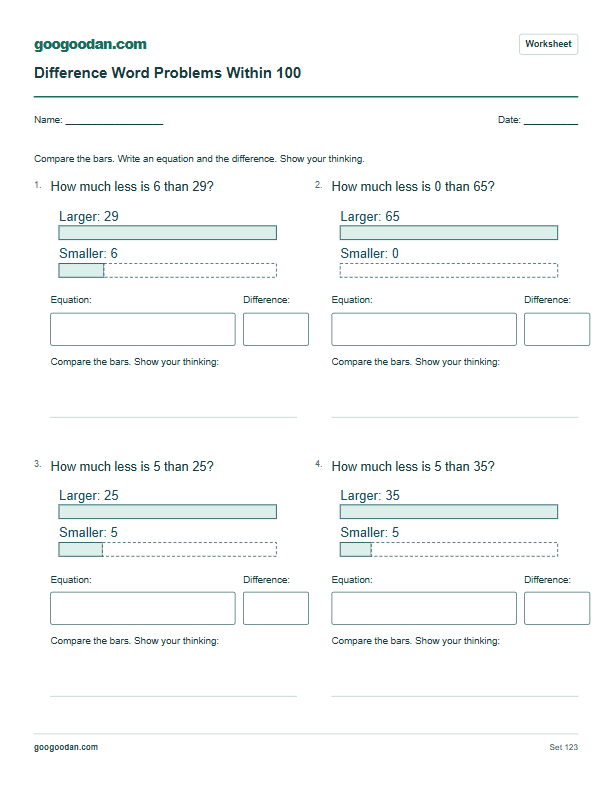 Word problems
Difference Word Problems — Within 100 or 1,000
Compare aligned bars and find the difference. Choose the default range within 100 or compare three-digit amounts within 1,000.
4 problems · Answer key included
More about subtraction · Grade 2 worksheets · Grade 3 worksheets
Grade 2 selected skill connection: Within 100 default activity: 2.OA.A.1 (selected one-step missing-amount relationships); 2.NBT.B.5 (addition/subtraction relationship). See the Common Core grade guidance. This worksheet does not cover every requirement in the standard.
Grade 3 selected skill connection: Supporting 3.NBT.A.2 through the within-1000 activity: use place value and the addition/subtraction relationship to find missing amounts; not a complete fluency assessment. See the Common Core grade guidance. This worksheet does not cover every requirement in the standard.