
2 Digit Plus 1 Digit Addition Word Problems
Add a few ones to a two-digit collection. Use a drawing, count on, or make the next ten while keeping track of every added counter.
Make a new ten without losing the extra ones
Mia has 28 counters for a class activity and receives 5 more. She knows that 28 is close to 30, so she adds 2 and announces that the answer is 30. She has reached a useful stopping point, but she has not used all five new counters yet.
Ask Mia to separate the five new counters into a group of two and a group of three. Two complete the next ten; three remain to be added. Her thinking becomes 28 + 2 = 30, followed by 30 + 3 = 33. This uses every new counter exactly once.
28 + 5 = 28 + 2 + 3 = 30 + 3 = 33
Use 2 of the 5 new counters to complete a ten. The other 3 stay as ones. The total amount stays the same when the counters are regrouped.
Start with tens and ones
The 2 in 28 represents two tens, or 20 counters. The 8 represents eight single counters. Receiving 5 more adds five ones, not five tens. Keep the original two tens while combining the eight ones with the five new ones.
There are now 13 ones. Exchange 10 of them for one more ten and leave 3 ones. Together with the original two tens, the collection is three tens and three ones: 33. Drawing long marks for tens and small dots for ones is enough; the child does not need to draw every counter individually.
Some problems do not need a new ten
For 42 counters and 6 more, combine 2 ones and 6 ones to make 8 ones. There are still 4 tens, so 42 + 6 = 48. No exchange is needed because the ones total is less than ten.
Compare that with 46 + 7. Six ones plus seven ones make thirteen ones, so the tens count increases by one and three ones remain. The answer is 53. Ask what changed in the ones collection before asking the child to write a small carry digit. A carry of 1 here means one ten.
Count on when that method is clearer
Counting on can be a sensible choice when only a few counters are added. For 58 + 3, begin after 58 and count 59, 60, 61. There are three counting steps, so the total is 61.
A common mistake is saying 58, 59, 60 and stopping. That includes the starting collection as if it were the first added counter. Touch one new counter for each new number spoken, or draw three jumps on a number line. The first jump lands on 59, not 58.
Counting on and making the next ten describe the same addition. For 58 + 3, adding 2 to reach 60 and then 1 more also gives 61. Encourage the child to explain a method they understand rather than requiring the same written procedure for every problem.
Do not move the added ones into the tens column
If Mia writes the numbers vertically, the single-digit addend belongs under the ones digit. In 34 + 5, the 5 goes under the 4. Writing it under the 3 treats five counters like fifty counters and would lead to 84.
Label two columns "Tens" and "Ones" when alignment is uncertain. Then link the written columns back to a drawing. The reason for the alignment is the value of the counters, not simply keeping the page neat.
Adding zero leaves the collection unchanged
Some original problems add 0. If Mia has 70 counters and receives 0 more, she still has 70. No new ones appear and no new ten is formed. Have the child record 70 + 0 = 70 rather than skipping the question as unfinished.
Also notice a total that lands exactly on a ten. For 36 + 4, all ten ones are exchanged for a ten and there are zero ones left. Write 40, keeping the zero in the ones place. An answer of 4 would count tens without expressing the full number of counters.
Check how much the collection grew
After solving 28 + 5 = 33, compare 28 and 33. Removing the five added counters should return the original collection. The difference between the total and the starting number must equal the number received. Since the added amount is never negative, the answer cannot be smaller than the start.
These four-problem sets use starting amounts from 10 to 90 and additions from 0 to 9. They include both regrouping and no-regrouping examples across sets, with totals from 10 to 99. They do not include a total of 100, two two-digit addends, or subtraction. Read the short stories aloud when reading would distract from the place-value reasoning.
Make a practice set
Choose what to print. Selecting both shows the answer key on screen and prints the questions followed by the answers.
After the practice
Ask whether the ones made a new ten. Check that the total increased by exactly the number of counters received, including cases where the increase is zero.
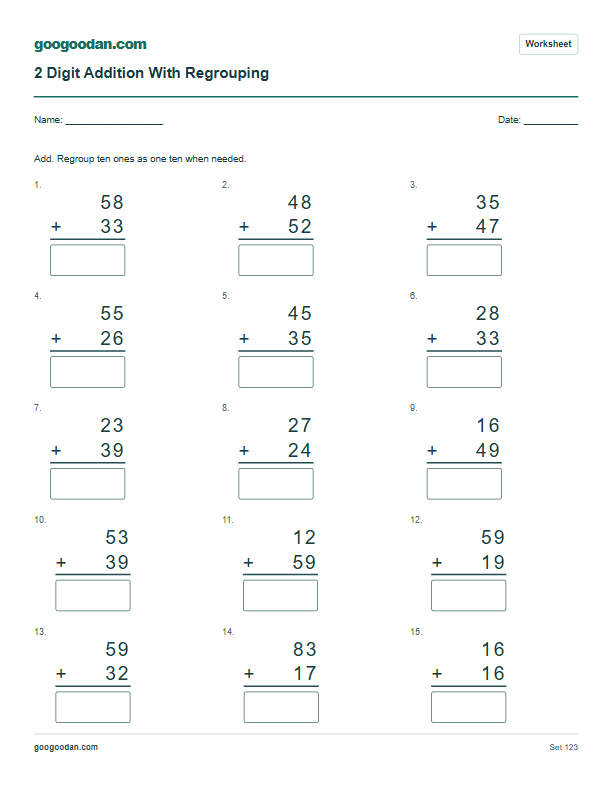 Calculation practice
2 Digit Addition With Regrouping
Exchange ten ones for a ten and keep the total within 100.
15 problems · Answer key included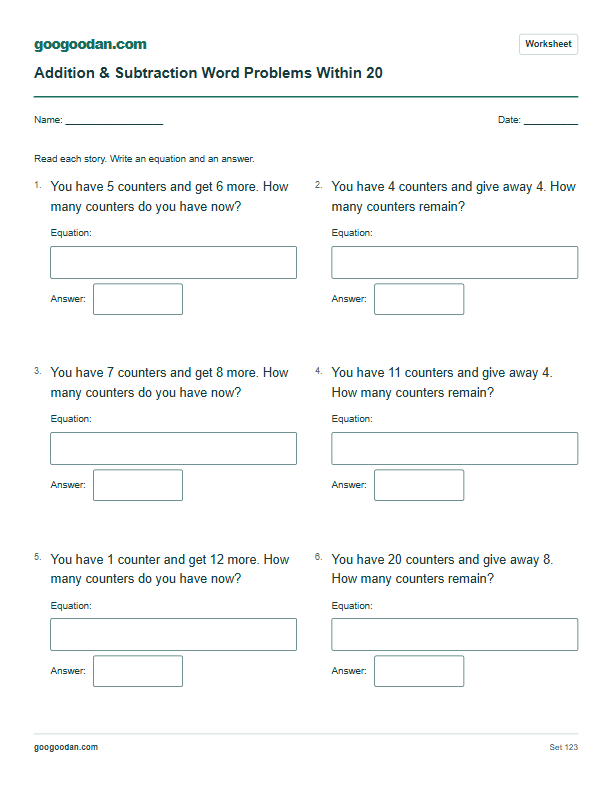 Word problems
Addition and Subtraction Word Problems Within 20
Read joining and taking-away stories, choose an equation, and answer in context.
6 problems · Answer key included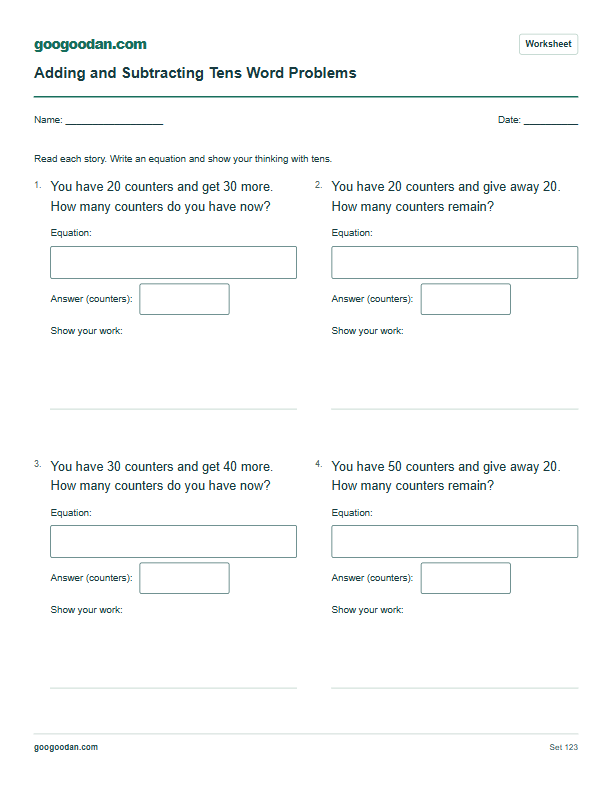 Word problems
Adding and Subtracting Tens Word Problems
Combine or remove whole tens of counters. Explain the place value, including stories where zero counters change or remain.
4 problems · Answer key included
More about addition · Grade 1 worksheets
Grade 1 selected skill connection: Selected 1.NBT.C.4: add a one-digit number to a two-digit number, including composing a ten; starts 10–90 and addends 0–9. See the Common Core grade guidance. This worksheet does not cover every requirement in the standard.