
Adding and Subtracting Tens Word Problems
Read a short counter story, choose addition or subtraction, and explain the answer in tens and ones. Practice whole tens from 0 through 90.
Take away tens, not single counters
Ava has 50 counters for a classroom game. She gives away 20. She draws five long marks, one for each group of ten, then hesitates: does she need to cross out twenty marks? Ask her what one mark means. Each stands for ten counters, so taking away twenty means removing two marks.
There are three tens left. Ava can say "five tens minus two tens is three tens," then connect that explanation to the equation 50 − 20 = 30. The counters did not become a smaller kind of object. She used a larger counting unit to keep track of them efficiently.
5 tens − 2 tens = 3 tens
50 − 20 = 30 counters
Each complete rod stands for ten counters. Cross out two whole rods, not two small sections.
Build the meaning of one ten
Before working with the printed stories, count ten small objects and put them in a cup or circle them on paper. Make several identical groups. Three groups contain 30 objects, even though you can count the groups with the smaller numbers one, two, three.
When a child writes 3 as the answer to 50 − 20, their group calculation may be correct. Ask, "Three of what?" The response "three tens" is the bridge to 30 counters. Keep the word tens next to the smaller calculation until the child can explain the change of unit without a reminder.
Combine tens in addition stories
Now Ava starts with 30 counters and gets 20 more. She combines three tens with two tens. Five tens represent 50 counters, so 30 + 20 = 50. The story describes a collection growing; the equation records the two quantities being combined.
If Ava writes 30 + 2 = 32, compare what she drew with what the story says. Two individual counters and two groups of ten are different amounts. A drawing of three rods plus two more rods makes the second quantity visible. It is not necessary to draw fifty separate circles every time.
In these problems the ones column stays at zero because every quantity is made from complete tens. Adding or subtracting the number of tens keeps the value of those tens. This is a place-value explanation, not a rule that a zero can always be ignored.
Choose the operation from the action
Read the sentence aloud if the child is still learning to read. Ask what Ava had at the beginning and what happened next. Receiving more counters increases the collection, so the new amount is found by addition. Giving counters away reduces it, so subtraction finds what remains.
For 70 counters with 40 given away, draw seven rods and cross out four. Three rods remain, representing 30 counters. Write 70 − 40 = 30 beside the drawing. Starting at 40 and counting on by tens to 70 is another useful check: 50, 60, 70 is three jumps of ten, a difference of 30.
Zero is a quantity worth recording
Some original problems use zero. If Ava has 60 counters and gives away 0, her collection stays at 60. If she gives away all 60, she has 0 left. Those are different stories: in one, no rods are crossed out; in the other, every rod is crossed out.
A story can also start with no counters. Starting with 0 and receiving 40 leaves four tens, or 40 counters. Write the numeral 0 for an empty starting collection or an empty result. A blank answer space does not communicate the same thing as a completed answer of zero.
Check a subtraction by rebuilding the start
After 70 − 40 = 30, put the removed four tens back with the remaining three tens. Seven tens reconstruct the original 70. The related equation 30 + 40 = 70 checks both the number and the meaning of the answer.
Let the child explain with rods, quick marks, words, or an equation in the working space. These four-problem sheets use whole tens from 0 through 90. Sums stay at or below 90, and subtraction never gives a negative answer. They include zero as supporting practice; they do not cover all addition within 100, exchanging individual ones, or teen-number composition.
Make a practice set
Choose what to print. Selecting both shows the answer key on screen and prints the questions followed by the answers.
After the practice
Ask how many tens changed and how many counters that represents. For subtraction, put the removed tens back to check the starting quantity.
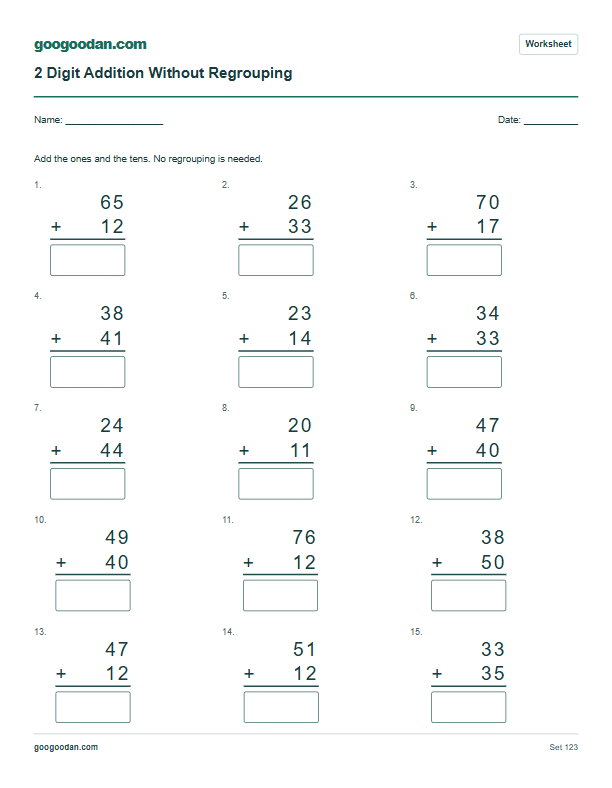 Calculation practice
2 Digit Addition Without Regrouping
Add tens to tens and ones to ones without exchanging ten ones.
15 problems · Answer key included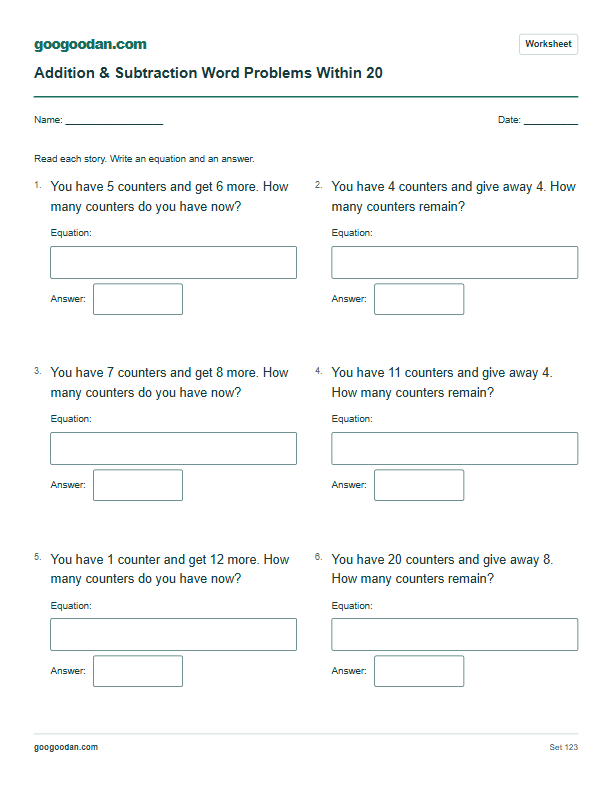 Word problems
Addition and Subtraction Word Problems Within 20
Read joining and taking-away stories, choose an equation, and answer in context.
6 problems · Answer key included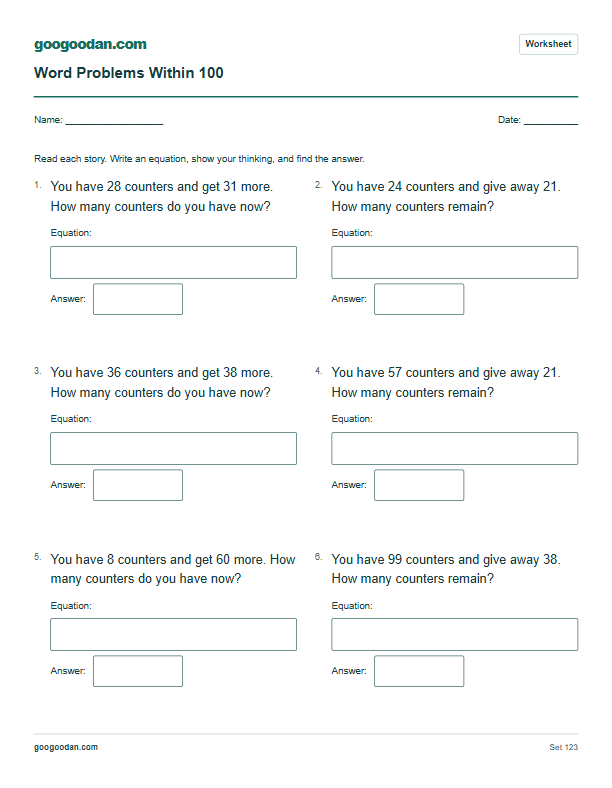 Word problems
Addition & Subtraction Word Problems Within 100
Choose an operation for a joining or taking-away story, then solve within 100.
6 problems · Answer key included
More about addition · Grade 1 worksheets
Grade 1 selected skill connection: 1.NBT.B.2.c; selected 1.NBT.C.4 and 1.NBT.C.6 (whole tens to 90; zero operands included as supporting practice). See the Common Core grade guidance. This worksheet does not cover every requirement in the standard.