
Write Your Own Question Word Problems
The story gives the numbers, but the child supplies the question. Ask about the total money after more is earned, then write an equation and an answer that match that question.
A story needs a question before it becomes a problem
The class has $8 from a bake sale and earns $5 more. Leo immediately writes 8 + 5 = 13. His calculation is correct. When asked what the thirteen means, he says, “The answer.” Writing the question helps him give that number a meaning: it is the money the class has now.
Already earned: $8.
New money: $5.
Example question: How much money does the class have now?
8 + 5 = 13
Answer: The class has $13 now.
Find what is known and what is still unknown
The starting amount is already in the story. So is the extra amount. The total after the extra money arrives is not stated. A useful question points to that missing quantity. Have the child label the two known amounts before asking what could be found from them.
In this set, the direction specifically asks for a question about the total. “How much more did the class earn?” is a sensible English question, but the story already supplies that amount. It does not match this task. Ask the child to change the question so both given amounts help answer it.
Connect the question, equation, and unit
Joining the original eight dollars and the five new dollars gives thirteen dollars. The first number and the second number describe different parts of the money collected; the answer describes the combined whole. The dollar unit stays the same throughout. These are whole-dollar amounts, so no coin values or decimal calculation is needed.
A child can draw eight marks for the first amount and five more for the new amount. Label each mark as one dollar, then count the combined group. Another child might make ten: eight plus two is ten, and the remaining three makes thirteen. Both methods answer the same total question.
Judge the math without requiring one exact sentence
“How much money is there altogether?” and “How many dollars does the class have now?” can both work. Accept a different sentence if it clearly asks for the combined amount. A short question is enough. For a child who is still learning to write, let them say the question first and help record it without changing their mathematical idea.
Check three things together: the question asks for the total, the equation combines the two given amounts, and the answer names dollars. If a child writes 5 + 8 = 13 instead, that equation is also valid because the same two parts are combined. A missing question mark is a writing issue; finding the wrong quantity is a math issue.
Use the answer key as an example
Each printable contains four joining situations with totals below twenty. The question area is left empty on the worksheet. The answer key shows one possible question, a matching equation, and the dollar total. Children do not have to reproduce that wording. Cover the example question until the child has had a chance to create their own.
Make a practice set
Choose what to print. Selecting both shows the answer key on screen and prints the questions followed by the answers.
After the practice
Ask the child to point to the two amounts in the story while reading their question. Then have them explain what the answer counts. Move to paired stories to see how changing a question can change the calculation.
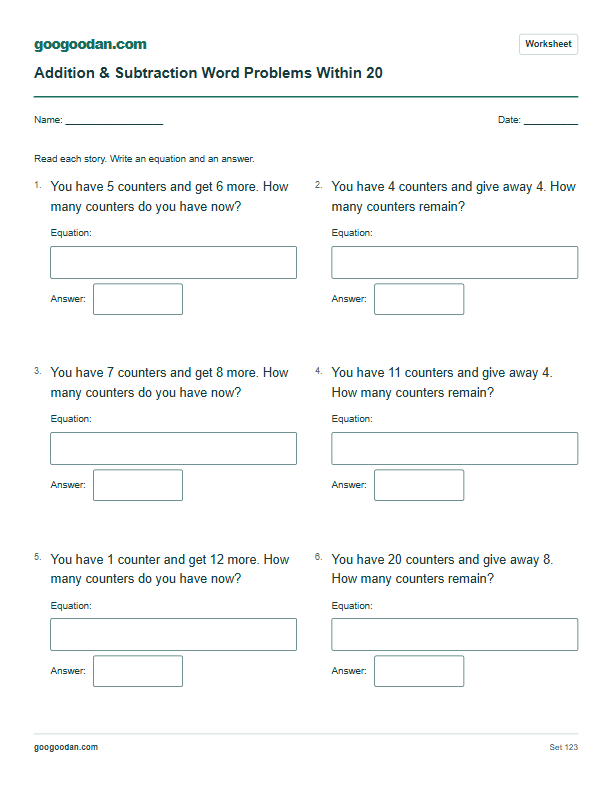 Word problems
Addition and Subtraction Word Problems Within 20
Read joining and taking-away stories, choose an equation, and answer in context.
6 problems · Answer key included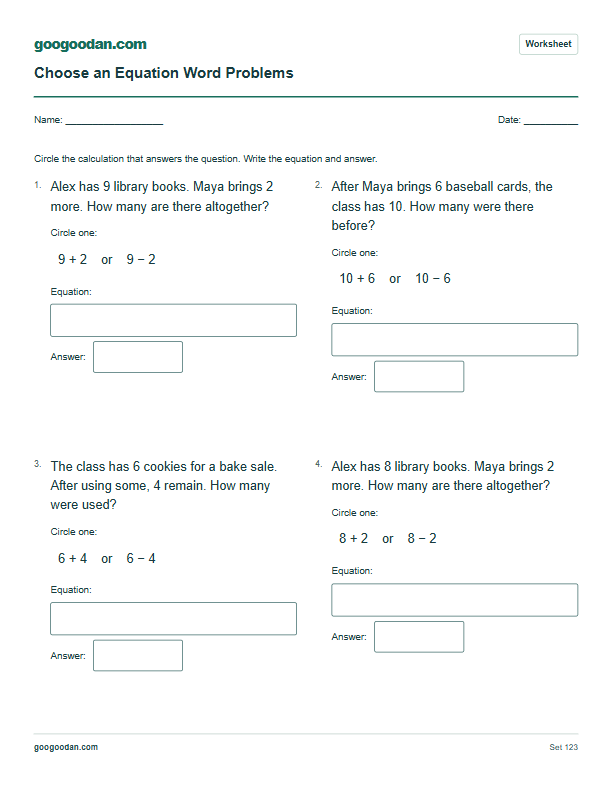 Word problems
Choose an Equation Word Problems
Decide whether addition or subtraction finds the missing quantity in the story.
4 problems · Answer key included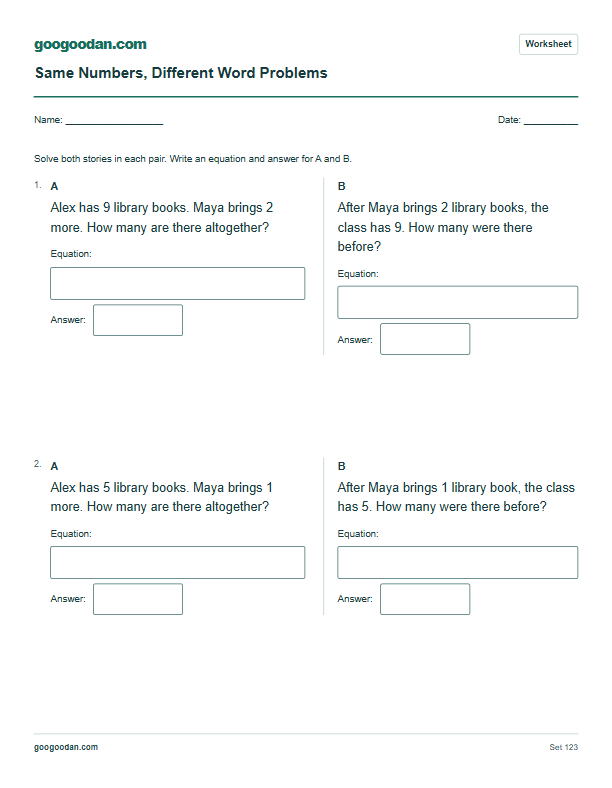 Word problems
Same Numbers, Different Questions Word Problems
Compare two stories with the same numbers: find the new total in one and the starting amount in the other.
2 pairs · 4 word problems · Answer key included
More about addition · Grade 1 worksheets
Grade 1 selected skill connection: 1.OA.A.1 (supporting question writing for joining stories). See the Common Core grade guidance. This worksheet does not cover every requirement in the standard.