
Same Numbers, Different Questions Word Problems
The numbers stay the same, but what they mean changes. In each pair, one story asks for a new total and the other asks for a starting amount. Compare both before choosing the operations.
Why can twelve and four have two correct answers?
Noah sees 12 and 4 in two stories. He solves the first, writes sixteen, and copies the same answer into the second. The arithmetic in the first answer is correct. What he missed is that twelve names a different quantity in the second situation.
Story A: Alex has 12 books. Maya brings 4 more. How many books are there altogether?
12 + 4 = 16
Story B: After Maya brings 4 books, the class has 12. How many books were there before?
12 − 4 = 8
Label the twelve before calculating
In Story A, twelve is the starting collection. The four new books join it, and the final total is unknown. In Story B, twelve is the final collection. It already includes the four new books, so the starting collection is the missing part.
Ask the child to complete two sentences: “In A, twelve means ___.” and “In B, twelve means ___.” If the child can distinguish the starting amount from the final total, the operation choice becomes easier to explain.
Use a before, change, after record
For A, write “before 12, change +4, after ?.” For B, write “before ?, change +4, after 12.” Both events describe receiving books. The difference is which position holds the unknown. Addition finds the ending in A; subtraction works backward from the ending in B.
Counters can make the contrast visible. For A, start with twelve and add four. For B, start with the final twelve and move four aside. The eight still on the table represent the books there before Maya arrived.
Check both answers in the original stories
Sixteen fits A because twelve existing books and four new books make sixteen. Eight fits B because eight existing books and four new books make the stated total of twelve. These checks use addition in both cases, even though the direct calculations used different operations.
A child may write 8 + 4 = 12 to justify B. That is a valid completed equation. The answer key uses 12 − 4 = 8 to show how the missing starting amount can be found directly. Focus on the meaning of the eight, not on requiring one form of working.
Compare one pair at a time
The worksheet has two pairs, giving four short stories within twenty. Each story has its own equation space and answer box. Solve a pair and discuss the different unknowns before moving to the next. These are two separate one-step stories, not a two-step word problem.
Make a practice set
Choose what to print. Selecting both shows the answer key on screen and prints the questions followed by the answers.
After the practice
Choose a pair and have the child name the starting amount, change, and final total in both stories. If both equations fit those labels, move on. If the same answer was copied twice, reconstruct the two situations with counters.
 Word problems
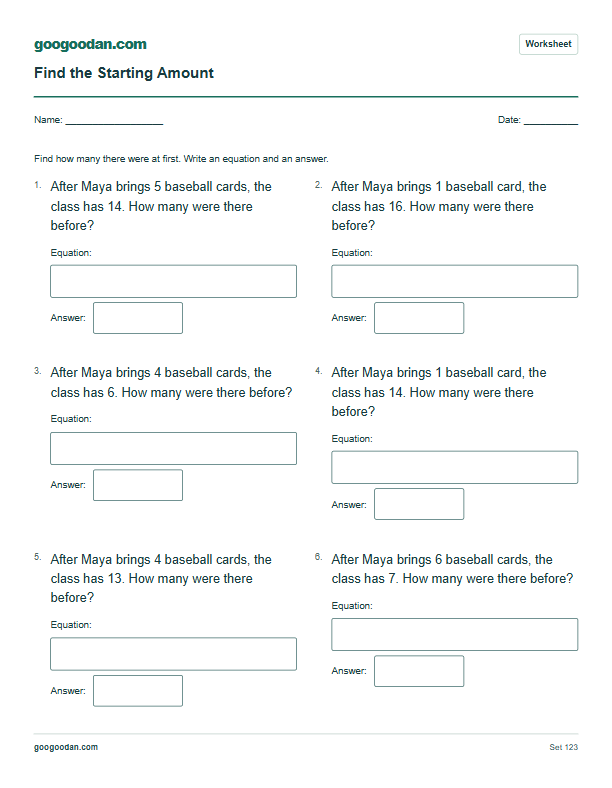
Find the Starting Amount Word Problems
Work backward from a final total to find how many there were before.
6 problems · Answer key included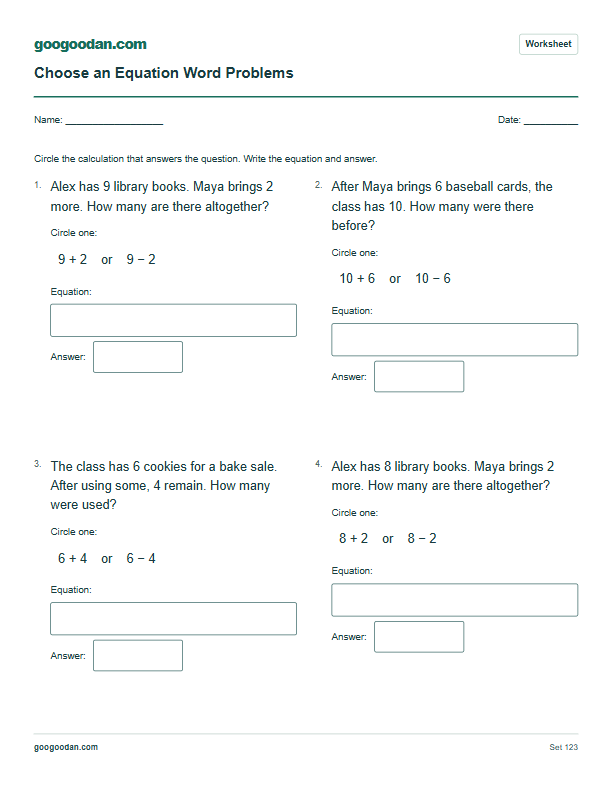 Word problems
Choose an Equation Word Problems
Decide whether addition or subtraction finds the missing quantity in the story.
4 problems · Answer key included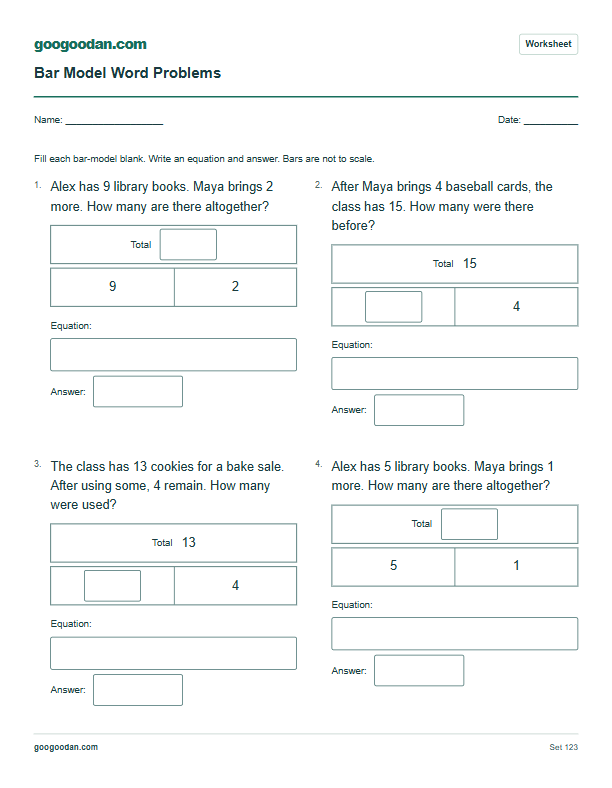 Word problems
Bar Model Word Problems
Use a whole-and-parts diagram to find the total, the starting amount, or the amount used.
4 problems · Answer key included
More about addition · Grade 1 worksheets
Grade 1 selected skill connection: 1.OA.A.1 (paired result-unknown and start-unknown stories). See the Common Core grade guidance. This worksheet does not cover every requirement in the standard.