
Missing Decimal Part Word Problems
Find a missing decimal amount or the increase needed to reach a target. Identify the unknown first, then align place values and check the parts.
The total already includes the known part
Maya reads, “Two amounts total 6.11. One amount is 1.97. What is the other amount?” She starts adding the two printed numbers. Pause before she calculates: 6.11 is already the combined amount. Adding 1.97 again would count the known part twice. The question asks for the part that is not yet named.
The two sections make the total. Write the relationship first: 1.97 + □ = 6.11. To find the box, subtract the known part from the total.
6.11 − 1.97 = 4.14
Line up units, not the last written digit
Each amount uses the same unit whole. A tenth is one of ten equal parts of that unit; a hundredth is one of a hundred. Put ones under ones, tenths under tenths, and hundredths under hundredths. The decimal points line up because the place values match.
Some given amounts have fewer decimal places. Writing 4 as 4.00 or 0.1 as 0.10 preserves the value and makes the columns visible. It does not turn a tenth into a whole number. For example, if two amounts total 4 and one is 0.1, the other is 3.9: 4.00 − 0.10 = 3.90.
Exchange units when there are not enough hundredths
Maya notices that 6.11 has only one hundredth, while 1.97 asks her to remove seven. She cannot take the smaller digit from the larger digit in each column: that would reverse which amount is being removed. Instead, she renames the top amount without changing its value.
- Start with 6 ones, 1 tenth, and 1 hundredth.
- Exchange 1 one for 10 tenths. The amount is now 5 ones, 11 tenths, and 1 hundredth.
- Exchange 1 tenth for 10 hundredths. There are now 5 ones, 10 tenths, and 11 hundredths. They still total 6.11.
- Subtract matching units: 11 − 7 = 4 hundredths, 10 − 9 = 1 tenth, and 5 − 1 = 4 ones. The missing amount is 4.14.
A child may exchange units in a different valid order. The important check is that each renamed amount still equals 6.11. Ask what a small regrouping mark represents rather than asking the child only to memorize where to write it.
Check the part by rebuilding the whole
Maya adds her answer to the known part: 1.97 + 4.14 = 6.11. Seven hundredths plus four hundredths make eleven hundredths, and the carried tenth helps reconstruct the original amount. This checks both the arithmetic and which quantity the question asked for.
An estimate gives a second check. The known part is close to 2, and the total is a little above 6, so the missing part should be a little above 4. A result such as 41.4 is larger than the whole total and cannot be its missing nonnegative part.
“How much more” asks for the gap
A second form asks how much more is needed to change one amount to another. For example, “How much more is needed to change 19.62 to 21.62?” asks for the increase, not the final target. Write 19.62 + □ = 21.62. The answer is 2, because adding 2 reaches the target.
The word “more” does not automatically mean adding the two given numbers. Identify what is already known and what the box represents. Counting up from the known amount is also a valid method when the child can explain the increments and their sum.
Equivalent decimal answers are correct
An answer of 3.9 has the same value as 3.90. A whole-number answer such as 2 can also be written as 2.00. The answer key omits unnecessary ending zeros, so compare values rather than marking an equivalent form wrong. When the starting amount already equals the target, the increase is zero.
Do not round these answers to make them match the key. Each selected problem can be solved exactly through hundredths. A rounded estimate is useful for checking reasonableness, but the final answer should account for the complete amount.
What this printable includes
Each set has four short number word problems: two missing-part questions and two questions about the amount needed to reach a target. The total or target is between 1 and 30 inclusive. The given part is positive and no greater than the total, and at least one given amount is not a whole number. All values are exact through hundredths. At most one answer in a set is zero.
These are short quantity relationships, not long money or measurement stories; no feet, dollars, or other unit is attached. The page focuses on addition and subtraction relationships. It does not include thousandths, decimal multiplication or division, or every part of the grade standard. The worked bar belongs to this guide; the printable gives blank space for equations and place-value work.
Before using fresh numbers, ask the child to explain the unknown, one place-value exchange, and the addition check. A correct equation can show that the relationship is understood even if an arithmetic slip still needs attention.
Make a practice set
Choose what to print. Selecting both shows the answer key on screen and prints the questions followed by the answers.
After the practice
Ask what the box represents and why the units line up. Check the missing amount by adding it to the known part.
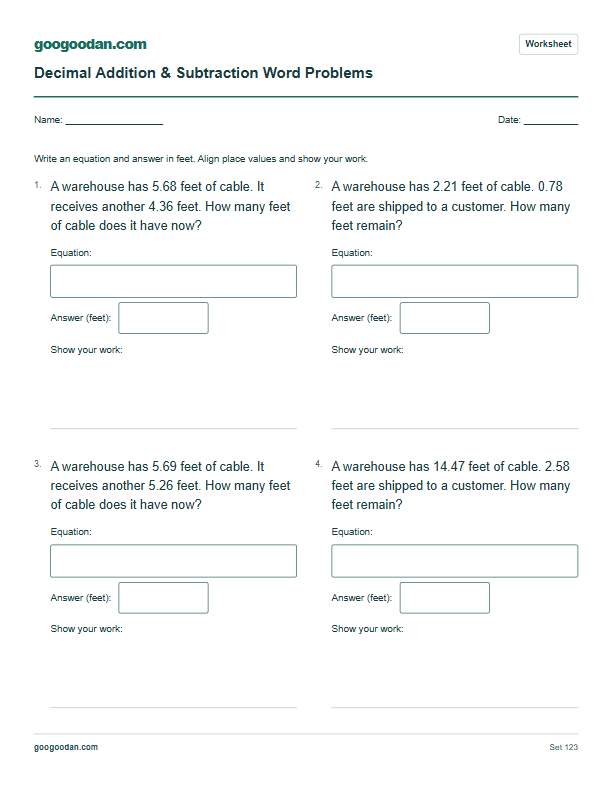 Word problems
Adding and Subtracting Decimals Word Problems
Combine cable lengths or find what remains, using place value through hundredths.
4 problems · Answer key included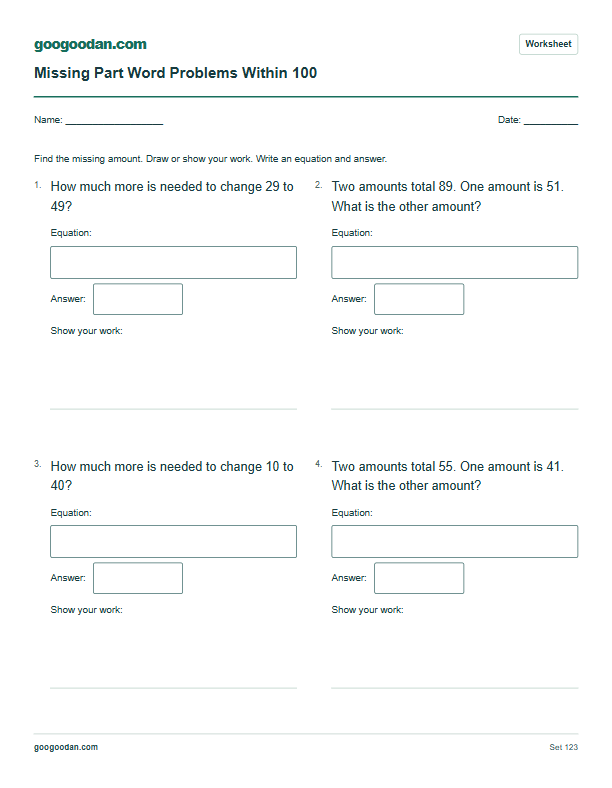 Word problems
Missing Part Word Problems — Within 100 or 1,000
Find a missing part or an amount needed to reach a target. Choose practice within 100 or extend to 1,000.
4 problems · Answer key included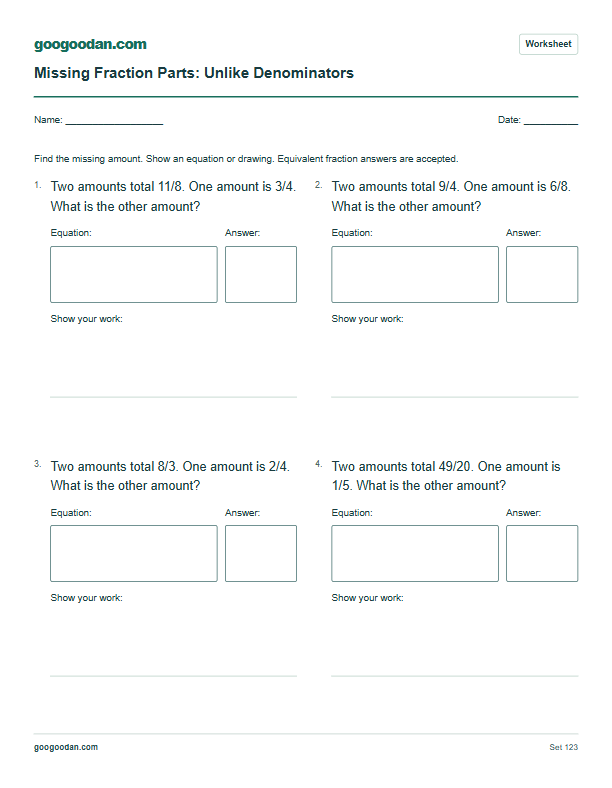 Word problems
Missing Fraction Part Word Problems With Unlike Denominators
Use a common denominator to find the missing part, then add the parts to check the total.
4 problems · Answer key included
More about addition · Grade 5 worksheets
Grade 5 selected skill connection: 5.NBT.B.7 (selected addition/subtraction relationships through hundredths; total or target from 1 to 30). See the Common Core grade guidance. This worksheet does not cover every requirement in the standard.