
Missing Fraction Part Word Problems With Unlike Denominators
Find the other part of a known total. Rename unlike fractions as equal-sized pieces, subtract, and check by adding the parts.
Find the missing part, not a new total
Maya reads, “Two amounts total 5/4. One amount is 7/12. What is the other amount?” She knows the parts must add to 5/4, but the fourths and twelfths look different. Before calculating, she writes 7/12 + □ = 5/4. The box stands for the unknown part. Adding the two given amounts would count the known part again.
Make the pieces the same size
A fourth and a twelfth are different-sized pieces of the same unit whole. Split each fourth into three equal pieces: one fourth becomes three twelfths. The amount has not changed; only the way it is counted has changed. Five fourths therefore becomes fifteen twelfths: 5/4 = (5 × 3)/(4 × 3) = 15/12.
Count the cells. The first twelve make one unit whole; three more extend the total to 15/12. Seven cells represent the known part, and eight represent the missing part.
5/4 − 7/12 = 15/12 − 7/12 = 8/12 = 2/3
Why the denominator stays twelve
Now Maya removes seven twelfths from fifteen twelfths. Eight twelfths remain. The pieces are still twelfths, so only the count of pieces changes. Subtracting the denominators would change the size of a piece and would no longer describe this model.
Ask her to point to one twelfth before and after the subtraction. Each cell has the same width. The whole total is more than one unit, but that does not make the entire fifteen-cell strip a new unit whole. Both original amounts must refer to the same unit for this subtraction to make sense.
Choose a common denominator without changing either amount
The least common multiple of 4 and 12 is 12, so twelfths work for both amounts. It is not necessary to multiply the two denominators together every time. Another common denominator can also work, but it usually creates more pieces to count. When renaming a fraction, multiply its numerator and denominator by the same number; changing only the denominator changes the value.
The generated problems use different displayed denominators from 2 through 24, with a least common denominator no larger than 24. Sometimes one denominator is already a multiple of the other, as in this example. Other pairs require renaming both fractions.
Simplify and then rebuild the total
Maya groups the eight remaining twelfths into two groups of four. Four twelfths make one third, so eight twelfths make two thirds. Dividing both 8 and 12 by 4 gives 8/12 = 2/3. Both answers name the same missing amount.
Her check goes back to the original relationship: 7/12 + 2/3 = 7/12 + 8/12 = 15/12 = 5/4. Matching the original total confirms both the calculation and the role of the unknown. A quick estimate helps too: the known amount is a little more than a half, and the total is one and a quarter. A missing part of two thirds is reasonable; a result larger than the total is not.
Handle mixed numbers and equivalent answers
A given amount can be a mixed number or an improper fraction. For example, 1 1/4 and 5/4 both name five fourths. Count the four fourths in the whole-number part and then add the extra fourth before finding a common denominator.
The answer key keeps the original example answer, which may not be in simplest form. For example, 1 5/10, 1 1/2, and 3/2 are equivalent. Accept an equivalent value with a correct explanation rather than requiring the child to copy the key's exact form. Zero is possible when differently written given amounts are equal; no amount is left to find.
What this printable practices
Each set has four short missing-part number word problems. The total is between 1 and 3 inclusive, and the known part is positive and no greater than the total. Every pair of given amounts has different displayed fraction denominators. Answers are nonnegative, with at most one zero in a set.
This page focuses on using equivalent fractions to find the other part of a known total. It does not include every fraction combination, every kind of word problem, or the full grade standard. The worked strip is part of this guide; each printable problem has blank space for the child's own equation or drawing. These are short number relationships rather than long real-world stories.
Have the child label the total and known part, rename the fractions, find the missing amount, and add the two parts to check. If the answer is wrong, first look for a changed unit whole or a fraction renamed on only one side of the fraction bar.
Make a practice set
Choose what to print. Selecting both shows the answer key on screen and prints the questions followed by the answers.
After the practice
Ask the child why the renamed fraction is equal to the original. Add the known and missing parts to check the stated total.
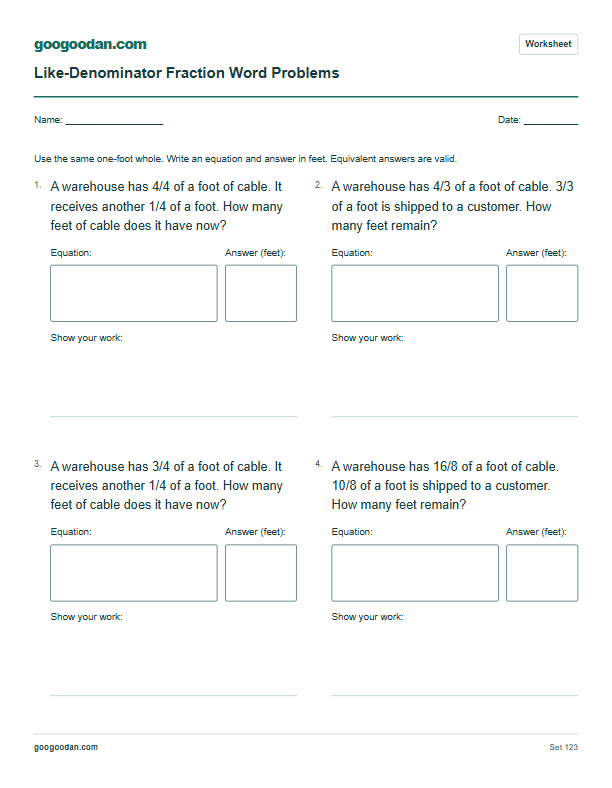 Word problems
Adding and Subtracting Fractions Word Problems With Like Denominators
Combine or remove fractional cable lengths measured using the same one-foot whole.
4 problems · Answer key included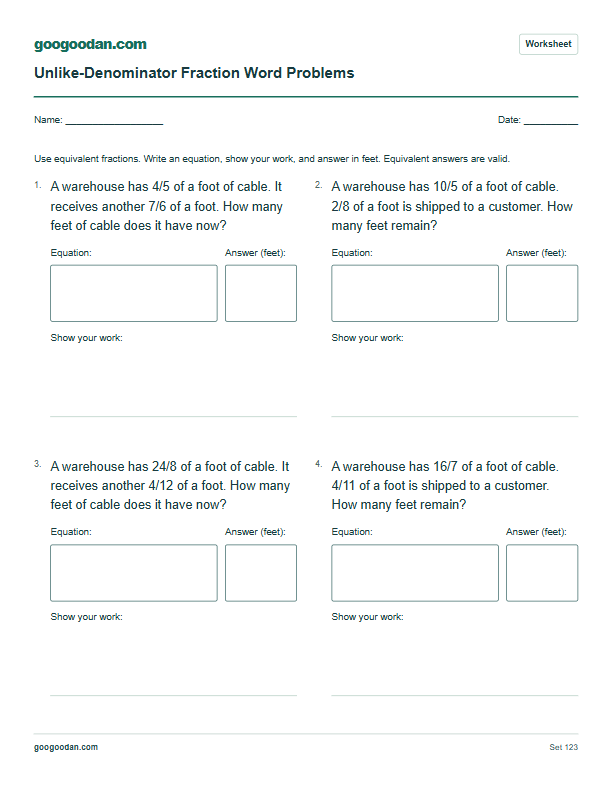 Word problems
Adding and Subtracting Fractions Word Problems With Unlike Denominators
Use equivalent fractions to combine or remove cable lengths measured against the same one-foot whole.
4 problems · Answer key included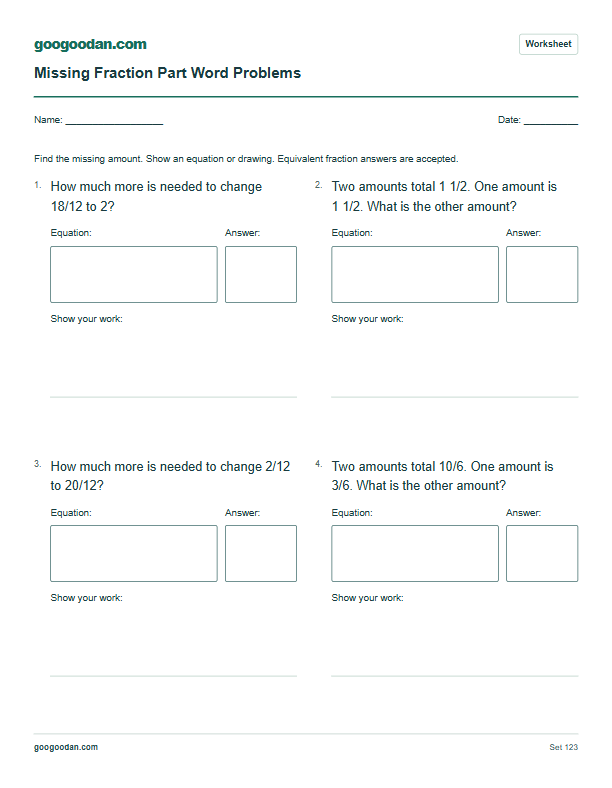 Word problems
Missing Fraction Part Word Problems
Find a missing fraction amount, including mixed numbers, and check by adding the parts.
4 problems · Answer key included
More about fractions · Grade 5 worksheets
Grade 5 selected skill connection: 5.NF.A.1–2 (selected unlike-denominator part-whole relationships; total from 1 to 3; common denominator at most 24). See the Common Core grade guidance. This worksheet does not cover every requirement in the standard.