
Missing Fraction Part Word Problems
The total is known and one part is missing. Keep the same unit whole as you find the other fraction amount or the increase needed to reach the target.
The total includes the part you already know
Maya reads, “Two amounts total 2. One amount is 3/2. What is the other amount?” She adds them and gets 3 1/2. Ask her to point to the total: two already includes the known amount. The question asks for the part still missing, not a new combined total.
3/2 + □ = 2
Two unit wholes make four halves: 2 = 4/2. Three halves are known, leaving one half.
2 − 3/2 = 4/2 − 3/2 = 1/2
Check: 3/2 + 1/2 = 4/2 = 2.
Keep the unit whole the same
Each outlined pair of halves represents one unit whole. Both unit wholes have the same size. The total amount is two units; that does not turn the entire two-unit strip into a new single unit. If Maya changes what “one whole” means halfway through, the fractions no longer refer to the same-sized pieces.
The denominator names the size of a piece. Counting how many halves remain changes the numerator, not the denominator. Subtracting both top and bottom numbers would not describe removing equal-sized pieces.
Mixed numbers and improper fractions can name the same amount
The known amount 3/2 is also 1 1/2: one whole and another half. Both describe the same three halves in the diagram. A mixed number keeps the whole-number part beside the fraction, not inside its numerator. Rewrite a mixed number using equal fractional pieces when that makes the subtraction clearer.
For example, to go from 1 1/6 to 1 2/6, the two whole-number parts match. Only one sixth is still needed. Check by adding: 1 1/6 + 1/6 = 1 2/6. A different problem may require regrouping a whole into fractional pieces.
Read the unknown before choosing a calculation
“How much more is needed to change 3/2 to 2?” asks for the increase, not the target of two. The equation 3/2 + □ = 2 shows the missing amount. Subtracting the known part from the target finds the same half. The word “more” does not automatically mean adding the two numbers that are printed.
Before calculating, ask whether the answer can be larger than the total. Adding 2 and 3/2 gives a value above two, so it cannot be the other nonnegative part of this total.
Accept equivalent answers and zero
The answer key preserves the original example answer, which may not be in simplest form. For instance, 6/12 and 1/2 are equivalent. A correct mixed-number answer can also match an improper fraction. Compare values and the relationship, rather than requiring an exact copy of the key.
If the total and known part are both 1 1/2, the missing amount is zero. The known amount already accounts for everything. Zero is a valid answer and needs no fraction bar.
What this printable includes
Each page contains four short number word problems: two missing-part questions and two questions about an amount needed. The total or target is between 1 and 2, inclusive. The given part is positive and no larger than that total. Fraction inputs use matching displayed denominators selected from 2, 3, 4, 5, 6, 8, 10, and 12; whole-number inputs can appear too. Given quantities may be mixed numbers or improper fractions, and at most one answer in a set is zero.
These are number relationships, not long real-world stories. They do not cover every fraction combination, unlike-denominator calculations, hundredths, or the entire grade standard. The worked diagram belongs to this guide; the printable leaves room to draw or show a method for each problem.
Write the missing amount and an equation, then add the parts to rebuild the total. An addition equation with a blank or a correct equivalent-fraction method can show understanding even when the key uses subtraction.
Make a practice set
Choose what to print. Selecting both shows the answer key on screen and prints the questions followed by the answers.
After the practice
Ask what each whole represents. Have the child explain the missing part, then check that both parts add to the stated total.
 Word problems
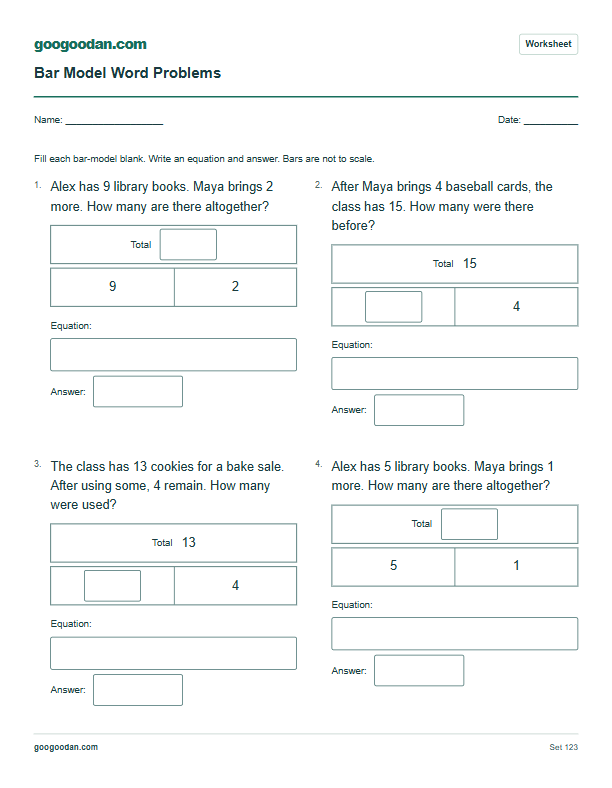
Bar Model Word Problems
Use a whole-and-parts diagram to find the total, the starting amount, or the amount used.
4 problems · Answer key included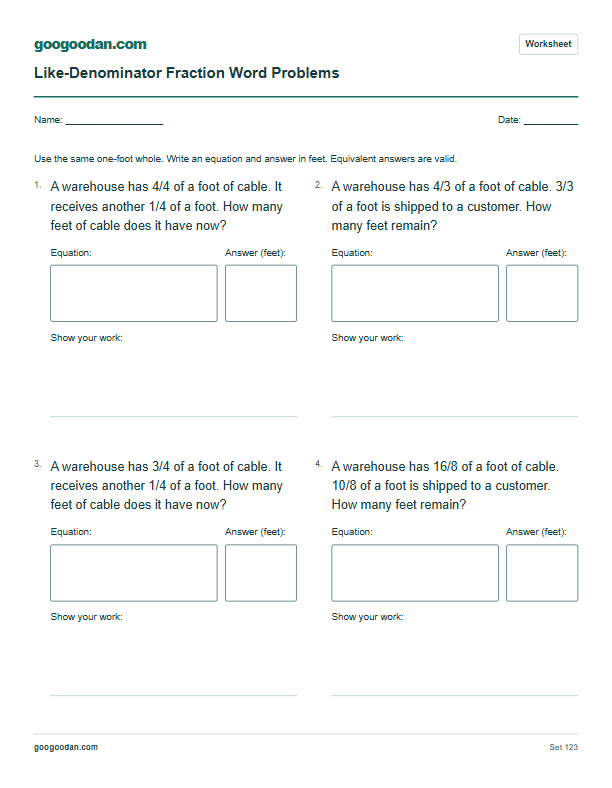 Word problems
Adding and Subtracting Fractions Word Problems With Like Denominators
Combine or remove fractional cable lengths measured using the same one-foot whole.
4 problems · Answer key included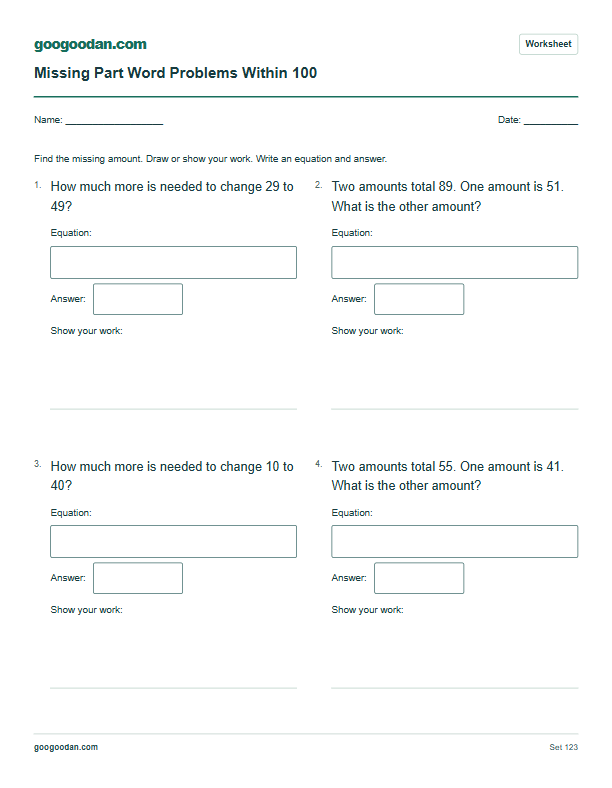 Word problems
Missing Part Word Problems — Within 100 or 1,000
Find a missing part or an amount needed to reach a target. Choose practice within 100 or extend to 1,000.
4 problems · Answer key included
More about fractions · Grade 4 worksheets
Grade 4 selected skill connection: 4.NF.B.3.a–c (selected part-whole and mixed-number relationships; whole/target from 1 to 2). See the Common Core grade guidance. This worksheet does not cover every requirement in the standard.